





 EN
5.6.7 - Monitoring Women's Graduation Outcomes: Graduation Data Gender Breakdown
1. Institutional Approach to Monitoring Women's Graduation Outcomes
Bahçeşehir University (BAU) places a strong emphasis on advancing gender equality through evidence-based institutional practices, systematic data collection, and continuous monitoring of student outcomes. A central component of this approach is the analysis of gender-disaggregated graduation data, which enables the University to monitor women's likelihood of graduating compared with men's, identify potential gender disparities in degree completion, and inform institutional measures aimed at addressing these differences.
BAU has been systematically monitoring gender-disaggregated graduation outcomes for many years, using comparative tables, heatmaps, and faculty-based trend analyses to assess patterns in student achievement and gender representation over time.
This systematic approach enables BAU to examine both the absolute number and proportion of female and male graduates, assess changes in graduation patterns over time, and identify academic fields where gender differences persist or where progress has been achieved. By analysing graduation outcomes across successive years and academic disciplines, the University strengthens its capacity to recognise potential disparities and evaluate areas requiring further institutional attention.
Importantly, BAU's commitment extends beyond monitoring and data analysis to the provision of institutional support mechanisms aimed at promoting equitable educational outcomes. These include academic advising, structured mentoring programmes, and professional development opportunities, including initiatives designed to support female students in traditionally male-dominated fields. Such measures contribute to the University's broader efforts to address barriers to academic progression, strengthen student retention, and support successful degree completion.
Through the integration of continuous gender-disaggregated graduation monitoring and student support mechanisms, Bahçeşehir University seeks not only to identify differences in women's and men's educational outcomes but also to address potential gaps through targeted institutional action. This approach reflects BAU's commitment to ensuring that all students, regardless of gender, have equitable opportunities, resources, and support to complete their studies successfully.
2-Monitoring of Gender-Disaggregated Graduation Outcomes at Bahçeşehir University
Building on its established institutional monitoring practices, Bahçeşehir University (BAU) systematically examines graduation outcomes to assess differences between female and male graduates and monitor changes in gender representation over time. The following analysis presents a four-year overview of graduation data from 2022 to 2025, examining both the absolute number of female and male graduates and their respective proportions.
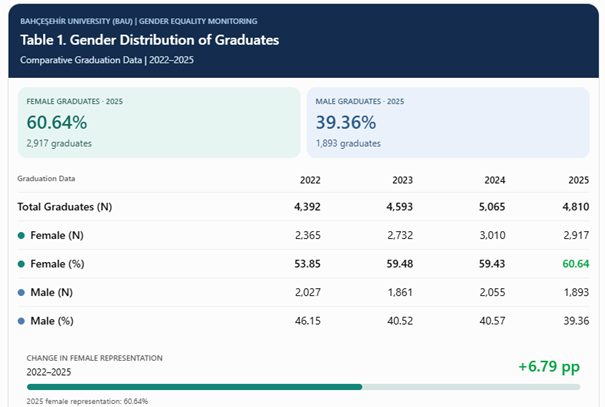
This section focuses on graduation outcomes across three major academic subject areas—STEM, Medicine, and Arts, Humanities and Social Sciences—while graduates from other academic fields are examined separately in Section 3.4 to provide a complete university-wide overview. The data demonstrate a positive overall trend in female graduate representation during the reporting period. In 2022, BAU recorded 4,392 graduates, comprising 2,365 women and 2,027 men, with women accounting for 53.85% of the total. In 2023, the total increased to 4,593 graduates, including 2,732 women and 1,861 men, with female representation reaching 59.48%. This represented a substantial increase of 5.63 percentage points in female representation within a single year.
In 2024, the reported total reached 5,065 graduates, comprising 3,010 women and 2,055 men, with women representing 59.43% of graduates. Although the female proportion remained relatively stable compared with 2023, the absolute number of female graduates continued to increase, reaching its highest level during the four-year period.
In 2025, the reported total was 4,810 graduates, comprising 2,917 women and 1,893 men, with female representation reaching 60.64%. Despite a reduction in the overall number of graduates compared with 2024, the proportion of female graduates increased by 1.21 percentage points, reaching its highest level during the reporting period.
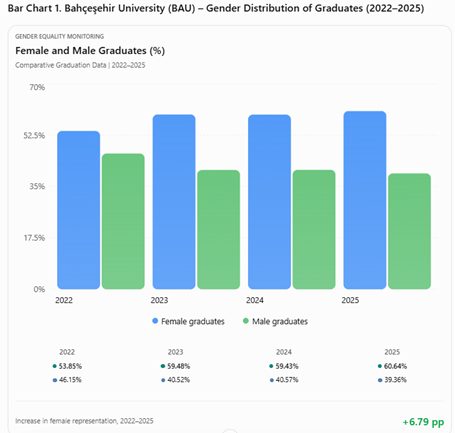
Across the four years, the number of female graduates increased from 2,365 to 2,917, representing an increase of 552 graduates, or approximately 23.3%. Consequently, the proportion of women among graduates increased by 6.79 percentage points, from 53.85% in 2022 to 60.64% in 2025.
These findings demonstrate a sustained female majority among graduates throughout the reporting period, accompanied by an overall increase in women's representation. The longitudinal analysis also highlights the importance of examining absolute graduation numbers alongside gender percentages, as changes in the total number of graduates can influence the interpretation of annual trends.
By systematically monitoring these indicators, BAU establishes an evidence base for identifying gender-related differences in graduation outcomes, assessing changes over time, and informing further institutional examination of potential disparities in degree completion.
The following image presents BAU's gender-disaggregated graduation data for 2022–2025, including the total number of graduates, female and male graduate numbers, their respective percentages, and the overall change in female representation during the four-year period. The data are provided in image format for visual reference
The accompanying Bar Chart 1, presented in image format below, provides a visual comparison of female and male graduate percentages between 2022 and 2025, highlighting the overall increase in female representation during the reporting period.
3. Gender-Disaggregated Graduation Outcomes by Academic Subject Area
Building on the overall graduation analysis, Bahçeşehir University (BAU) conducts a more detailed examination of gender-disaggregated graduation outcomes across different academic disciplines. This analysis focuses on three major academic subject areas: Science, Technology, Engineering and Mathematics (STEM); Medicine; and Arts, Humanities and Social Sciences.
Examining graduation outcomes by academic subject area enables BAU to identify differences that may not be apparent in aggregate institutional data. By monitoring the number and percentage of female graduates within each field over successive years, the University can assess changes in gender representation, identify areas where disparities persist, and inform targeted institutional measures to promote equitable educational outcomes.
3.1. Science, Technology, Engineering and Mathematics (STEM)
The analysis of STEM graduation outcomes demonstrates a substantial and consistent increase in female representation between 2022 and 2025. This development is particularly significant given the persistent gender imbalances traditionally associated with STEM disciplines.
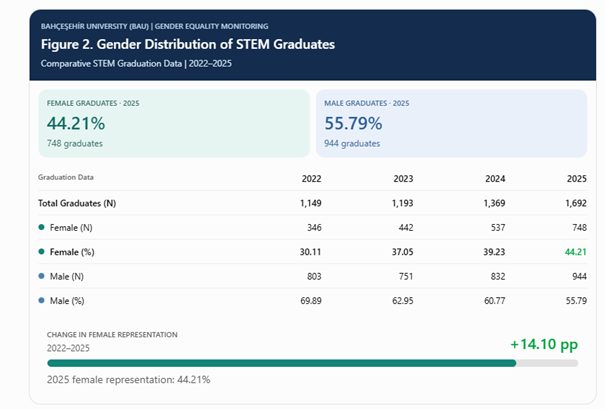
In 2022, BAU recorded 1,149 STEM graduates, comprising 346 women and 803 men, with women representing 30.11% of the total. In 2023, the total number of STEM graduates increased to 1,193, including 442 women and 751 men, while female representation rose to 37.05%. This marked an increase of 6.94 percentage points in a single year.
In 2024, the total number of STEM graduates reached 1,369, comprising 537 women and 832 men. Female representation continued to increase, reaching 39.23%. The upward trend accelerated in 2025, when BAU recorded 1,692 STEM graduates, including 748 women and 944 men, with female representation reaching 44.21%.
Across the four-year period, the number of female STEM graduates increased from 346 to 748, representing an increase of 402 graduates, or approximately 116.2%. During the same period, the total number of STEM graduates increased by approximately 47.3%. This indicates that the growth in female STEM graduates substantially outpaced the overall expansion in STEM graduation numbers.
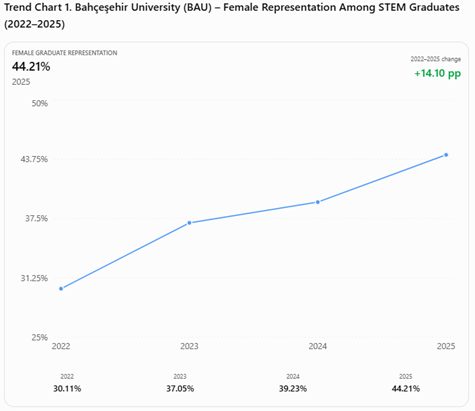
Most importantly, the proportion of female STEM graduates increased by 14.10 percentage points, from 30.11% in 2022 to 44.21% in 2025. The difference between female and male representation consequently narrowed from 39.78 percentage points in 2022 to 11.58 percentage points in 2025.
These findings highlight a significant improvement in gender representation among STEM graduates at BAU. Although women remained underrepresented relative to men in 2025, the consistent upward trend demonstrates substantial progress towards a more balanced gender distribution.
The results also underscore the importance of sustained institutional monitoring in academic fields where gender disparities remain more pronounced. By tracking changes in female STEM graduation outcomes, BAU can identify progress, recognise remaining differences, and inform academic advising, mentoring, and professional development initiatives aimed at supporting women's academic progression and successful degree completion.
The following image presents BAU's gender-disaggregated STEM graduation data for 2022–2025, including total graduate numbers, female and male graduate numbers, their respective percentages, and the four-year change in female representation. The data are provided in image format for visual reference,
The Trend Chart 1, presented in image format below, illustrates the annual increase in female representation among STEM graduates at Bahçeşehir University between 2022 and 2025,
3.2. Medicine
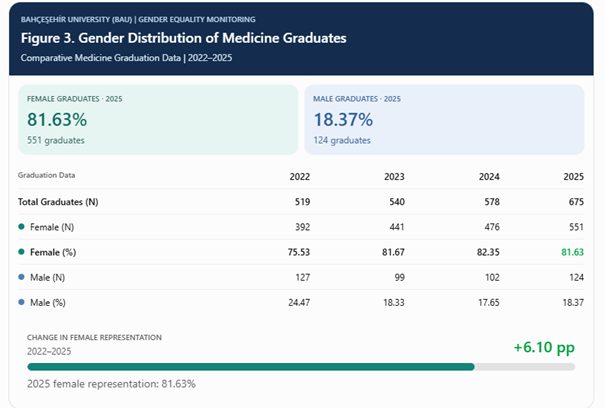
The analysis of Medicine graduation outcomes shows that female students have consistently represented a substantial majority of graduates throughout the reporting period. Between 2022 and 2025, both the number of female graduates and their overall representation increased.
In 2022, BAU recorded 519 Medicine graduates, comprising 392 women and 127 men, with female representation standing at 75.53%. In 2023, the total increased to 540 graduates, including 441 women and 99 men, while the proportion of female graduates rose to 81.67%.
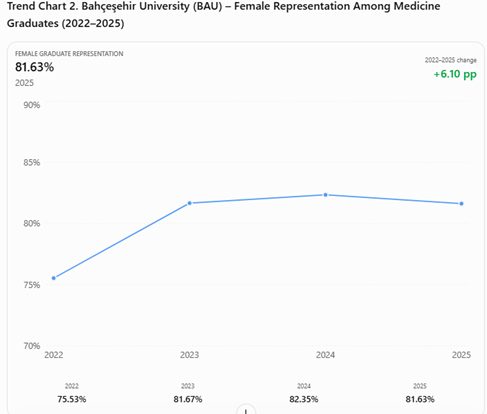
In 2024, the total number of Medicine graduates reached 578, comprising 476 women and 102 men, with female representation increasing to 82.35%. This was the highest female percentage recorded during the four-year period.
In 2025, BAU recorded 675 Medicine graduates, including 551 women and 124 men, with women accounting for 81.63% of the total. Although this percentage was slightly lower than in 2024, the absolute number of female graduates continued to increase, reaching its highest level during the reporting period.
Across the four years, the number of female Medicine graduates increased from 392 to 551, representing an increase of 159 graduates, or approximately 40.6%. Female representation also increased by 6.10 percentage points, from 75.53% in 2022 to 81.63% in 2025.
These findings indicate a sustained and substantial female majority among Medicine graduates, accompanied by continued growth in the absolute number of women completing their studies. The consistently high female representation highlights a different gender distribution pattern from that observed in STEM and reinforces the importance of examining graduation outcomes separately across academic disciplines.
The following image presents BAU's gender-disaggregated Medicine graduation data for 2022–2025, including total graduate numbers, female and male graduate numbers, their respective percentages, and changes in female representation. The data are provided in image format for visual reference.
The Trend Chart 2, presented in image format below, illustrates changes in female representation among Medicine graduates at Bahçeşehir University between 2022 and 2025,
3.3. Arts, Humanities and Social Sciences
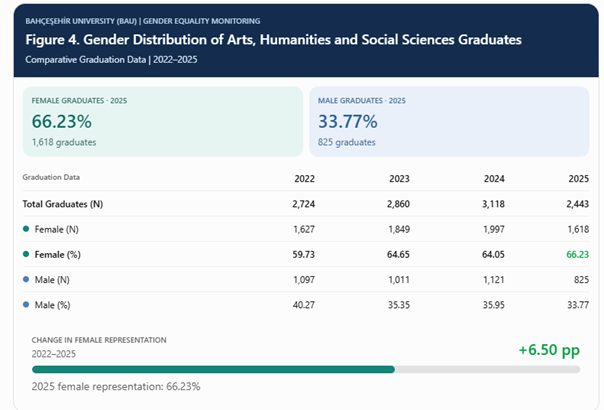
The analysis of graduation outcomes in Arts, Humanities and Social Sciences reveals a consistently high proportion of female graduates, with an overall increase in female representation between 2022 and 2025.
In 2022, BAU recorded 2,724 graduates in these disciplines, comprising 1,627 women and 1,097 men, with women representing 59.73% of the total. In 2023, the total increased to 2,860 graduates, including 1,849 women and 1,011 men, while female representation rose to 64.65%.
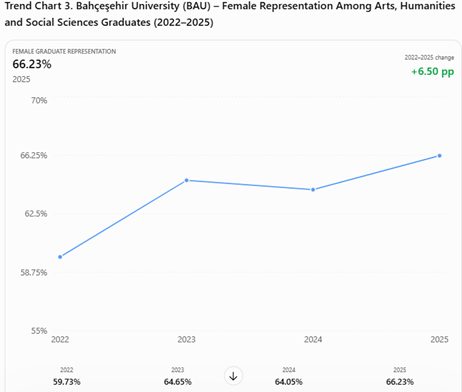
In 2024, the total number of graduates reached 3,118, comprising 1,997 women and 1,121 men, with female representation standing at 64.05%. Although the female proportion declined slightly compared with 2023, the number of female graduates reached its highest level during the reporting period.
In 2025, BAU recorded 2,443 graduates in Arts, Humanities and Social Sciences, including 1,618 women and 825 men, with female representation increasing to 66.23%. Despite a reduction in the total number of graduates compared with 2024, the proportion of women increased to its highest level during the four-year period.
Between 2022 and 2025, the proportion of female graduates increased by 6.50 percentage points, from 59.73% to 66.23%. The number of female graduates remained broadly comparable at the beginning and end of the reporting period, decreasing slightly from 1,627 in 2022 to 1,618 in 2025. This distinction demonstrates the importance of interpreting changes in female representation alongside fluctuations in overall graduate numbers.
These findings demonstrate a sustained female majority in Arts, Humanities and Social Sciences, with female representation increasing over the reporting period. The results also illustrate how changes in the total number of graduates can affect gender proportions, reinforcing the value of monitoring both absolute figures and percentages.
The following image presents BAU's gender-disaggregated graduation data for Arts, Humanities and Social Sciences from 2022 to 2025, including total graduate numbers, female and male graduate numbers, their respective percentages, and changes in female representation. The data are provided in image format for visual reference.
The Trend Chart 3, presented in image format below, illustrates changes in female representation among Arts, Humanities and Social Sciences graduates at Bahçeşehir University between 2022 and 2025,
3.4. Graduation Outcomes in Other Academic Fields
In addition to the three major academic subject areas examined above—STEM, Medicine, and Arts, Humanities and Social Sciences—Bahçeşehir University (BAU) monitors gender-disaggregated graduation outcomes across other academic fields to ensure comprehensive institutional coverage.
In 2022 and 2023, the graduates reported within the three major academic subject areas accounted for the University's total graduating population, with 4,392 and 4,593 graduates, respectively.
In 2024, an additional 153 graduates were recorded outside these three academic subject areas, comprising 83 women and 70 men, with women representing 54.25% of graduates in these additional fields.
In 2025, 91 graduates were recorded in other academic fields, including 56 women and 35 men, with female representation reaching 61.54%.
The inclusion of these additional academic fields ensures that BAU's gender-disaggregated graduation monitoring encompasses the University's complete graduating population. These figures are incorporated into the university-wide graduation totals, providing a comprehensive basis for monitoring gender representation and identifying potential disparities across all academic disciplines.
4. Institutional Measures Supporting Women's Graduation and Gender Equality
Bahçeşehir University (BAU) complements its systematic monitoring of gender-disaggregated graduation outcomes with institutional mechanisms designed to strengthen women's access to higher education, academic progression, and successful degree completion.
Through ApplyBAU scholarships and dedicated opportunities supporting female applicants, the University seeks to reduce financial and structural barriers to women's participation in higher education. These measures are complemented by academic advising, women's mentoring programmes, and professional development opportunities that support female students throughout their academic journeys.
Particular attention is given to increasing women's participation and success in STEM disciplines, where gender disparities remain more pronounced. Through scholarship support, mentoring, academic guidance, and opportunities that encourage women to pursue traditionally male-dominated fields, BAU seeks to strengthen female students' academic engagement and progression towards graduation.
Together, these measures demonstrate BAU's commitment to combining continuous monitoring of women's graduation outcomes with targeted institutional support aimed at addressing gender disparities and promoting equitable opportunities for degree completion.











