





 EN
16.3.3 - Participation in Government Research
Bahçeşehir University (BAU) actively engages in policy-focused research in collaboration with national and local government institutions, contributing academic expertise, empirical evidence, and research-based recommendations to address public policy challenges. Through these collaborations, the University supports government research activities, evidence-informed policymaking, and institutional decision-making across a range of social, economic, and environmental issues.
BAU's research partnerships with government bodies bring together academic researchers and public-sector institutions to investigate policy-relevant challenges, generate actionable knowledge, and develop recommendations that can inform public policies and institutional planning. These activities also facilitate the exchange of research findings, expertise, and best practices between universities and government institutions, strengthening the connection between academic research and public governance.
The following examples demonstrate Bahçeşehir University's contributions to government-related policy research, collaborative research initiatives, and the application of academic evidence to public-sector decision-making, supporting SDG 16 (Peace, Justice and Strong Institutions) and SDG 17 (Partnerships for the Goals).
1- Bahçeşehir University and Istanbul Metropolitan Municipality: Collaborative Policy Research on Labour Markets, Women's Employment and Inclusive Economic Development
The images below illustrate the cover page, team acknowledgements, and table of contents sections of this policy-focused research report jointly prepared by Bahçeşehir University and government bodies.
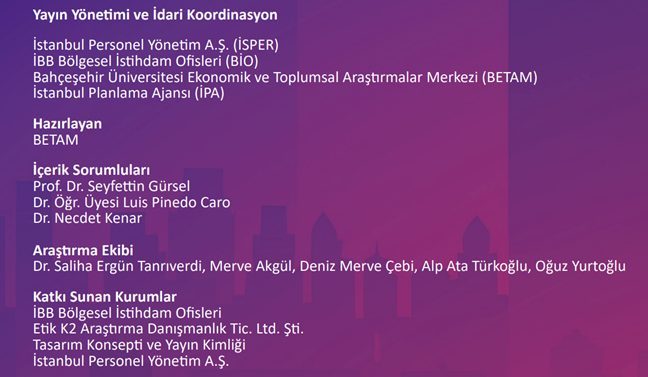
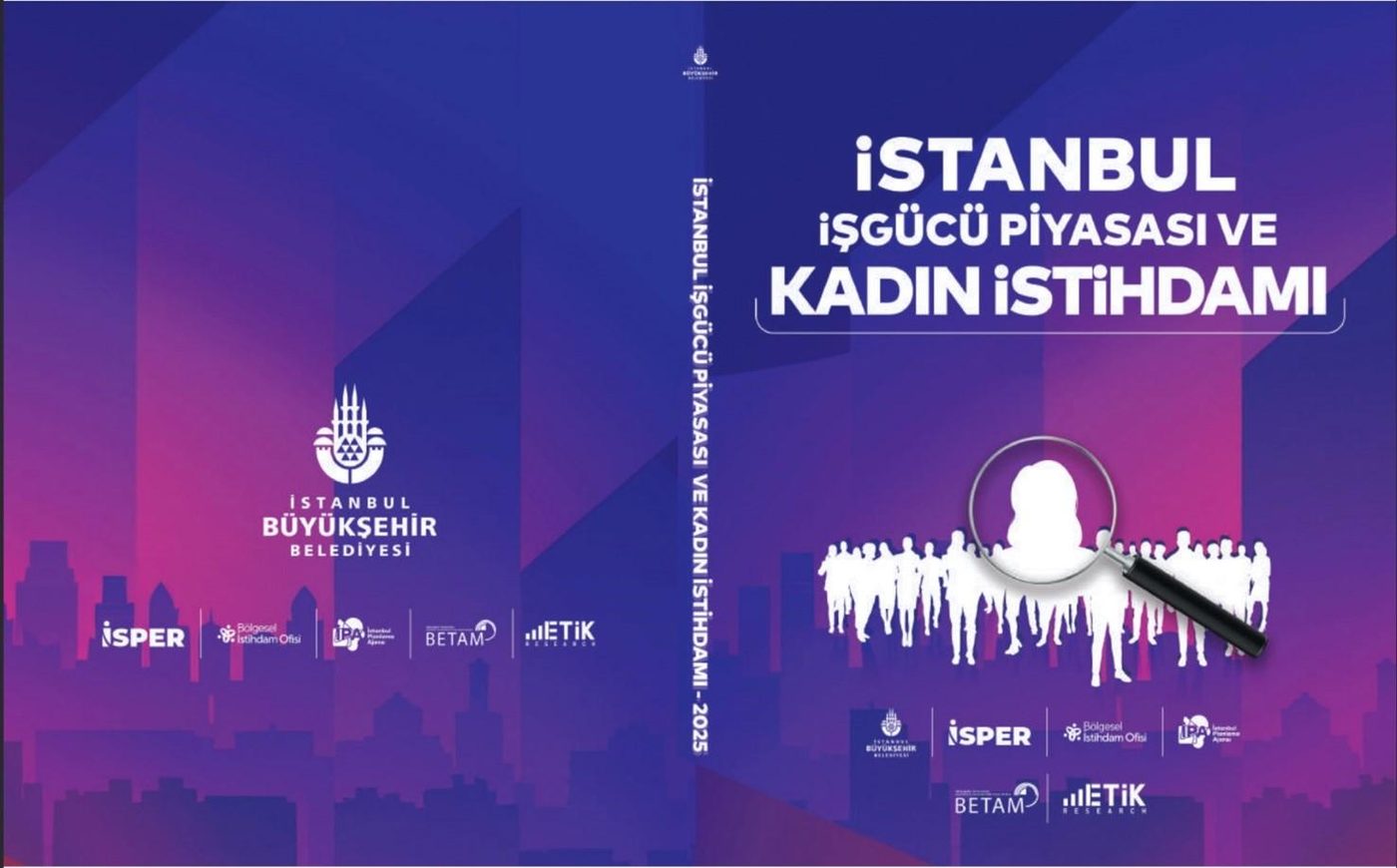
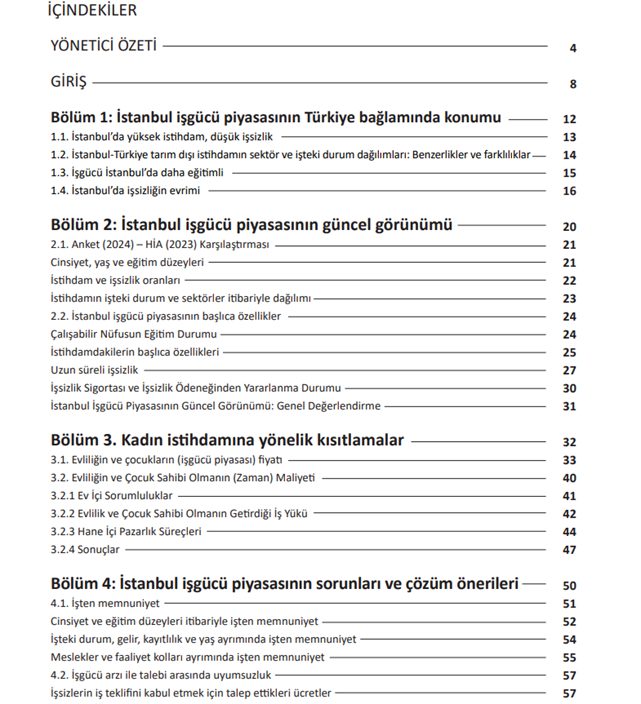
The images below illustrate the cover page, team acknowledgements, and table of contents sections of this policy-focused research report jointly prepared by Bahçeşehir University and government bodies.
During the 2024–2025 academic year, Bahçeşehir University (BAU) contributed to policy-focused research in collaboration with government institutions and local authorities, supporting evidence-based public decision-making and the development of effective public policies. Through its Center for Economic and Social Research (BETAM), the University brings academic expertise, empirical research, and policy analysis to institutional collaborations addressing socioeconomic challenges and public policy priorities.
A significant example is the Istanbul Labour Market and Women's Employment Research Report, developed through collaboration between Bahçeşehir University's Center for Economic and Social Research (BETAM), Istanbul Metropolitan Municipality (İBB), and İSPER, a municipal subsidiary. This collaboration brings together university researchers and public-sector stakeholders to examine labour market dynamics, identify structural employment challenges, and develop research-based recommendations relevant to metropolitan employment policies. The involvement of Istanbul Metropolitan Municipality and its affiliated institution establishes a direct connection between academic research and the policy research needs of local governments.
The research examines Istanbul's distinctive labour market conditions in comparison with Türkiye as a whole. Drawing on field survey data, statistical analysis, and in-depth interviews with company representatives, the study provides an empirical foundation for understanding employment trends, workforce participation, labour shortages, and socioeconomic inequalities. By combining academic research methods with the information needs of local government, the collaboration demonstrates how university–government partnerships can contribute to policy-relevant knowledge production.
A defining feature of the research is its focus on gender equality and women's participation in the labour market. The study examines structural barriers affecting women's employment, providing evidence relevant to the development of more inclusive labour and social policies.
The findings indicate that Istanbul accounts for approximately one-quarter of Türkiye's total employment, with an employment rate of 51.8%, compared with the national average of 44.4%. Women's employment in Istanbul reaches 34.8%, compared with 27% nationally, while female unemployment stands at 11.7%, below the national non-agricultural average of 15.1%. Despite these comparatively stronger indicators, the research identifies persistent challenges affecting women, individuals over 45, and people with lower educational attainment.
The study further examines the relationship between family responsibilities and women's participation in paid employment. Its findings indicate that employment rates decline by 11% following marriage and by an additional 7% after the birth of the first child, with particularly pronounced effects among women with lower levels of education. The report also highlights inequalities in unpaid domestic labour, documenting that women undertake approximately 75% of household responsibilities, compared with 25% undertaken by men, including in households where both partners are employed.
Additional findings concern skills mismatches, shortages of workers in certain occupations, informal employment, high employee turnover, and recruitment difficulties. The research also examines the relationship between Istanbul's cost of living, wage expectations, and labour market conditions, providing insights relevant to local economic and employment policy.
The collaboration extends beyond describing labour market conditions by translating empirical findings into policy-oriented recommendations for public institutions and local government. The study identifies potential measures to strengthen women's labour market participation, improve employment quality, and address structural barriers to inclusive economic development.
Recommendations include expanding access to childcare, encouraging formal employment opportunities for women, improving employment security, addressing skills mismatches, and strengthening cooperation between public institutions and employers. The research also considers geographically differentiated wage policies in relation to Istanbul's distinctive economic conditions and higher cost of living.
These recommendations provide an evidence base for public-sector consideration of employment, gender equality, social inclusion, and economic development policies. The direct involvement of Istanbul Metropolitan Municipality and İSPER connects BAU's academic research with the policy priorities and institutional responsibilities of local government. In this respect, the research represents a concrete example of university participation in government-related policy research, linking empirical analysis with the information required for local policy formulation and institutional planning.
On 6 March 2025, the findings of the Istanbul Labour Market and Women's Employment Research, conducted through the collaboration of Bahçeşehir University's Center for Economic and Social Research (BETAM), Istanbul Metropolitan Municipality (İBB), and İSPER, were publicly presented at a dedicated launch event. The event provided an opportunity to share the research findings with public authorities, policymakers, institutional stakeholders, and the media, extending the study's reach beyond academia. The presentation and subsequent discussions created a platform for examining the research's policy implications, particularly regarding women's labour market participation, gender inequalities, employment barriers, and inclusive economic development. By bringing empirical findings into dialogue with relevant stakeholders, the event helped translate academic research into policy-relevant knowledge that could inform public-sector decision-making, institutional priorities, and future employment and gender equality policies.
This university–government research collaboration supports SDG 16 through its contribution to evidence-informed public decision-making and policy-oriented research undertaken with local government institutions. By collaborating with Istanbul Metropolitan Municipality and its affiliated institution, BAU contributes to the development of knowledge that can inform public-sector analysis, policy formulation, and institutional planning.
The initiative also contributes to SDG 5 (Gender Equality) through research on women's employment and structural inequalities; SDG 8 (Decent Work and Economic Growth) through analysis of labour market challenges and sustainable employment; and SDG 11 (Sustainable Cities and Communities) through evidence relevant to inclusive metropolitan development.
Through its policy-focused research collaboration with Istanbul Metropolitan Municipality and İSPER, Bahçeşehir University demonstrates how academic research can directly support government institutions in identifying policy challenges, evaluating socioeconomic conditions, and developing evidence-based recommendations for more inclusive and effective public governance.
2- Bahçeşehir University–Malta Bilateral Research Cooperation: Government-Supported Policy Research on Sustainable Agriculture and Resource Management
The image below shows the promotional poster of the ‘AI-Based Sustainable Agriculture Research Collaboration Between Türkiye and Malta
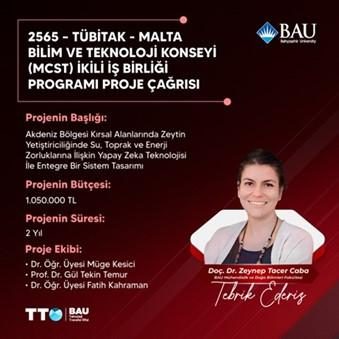
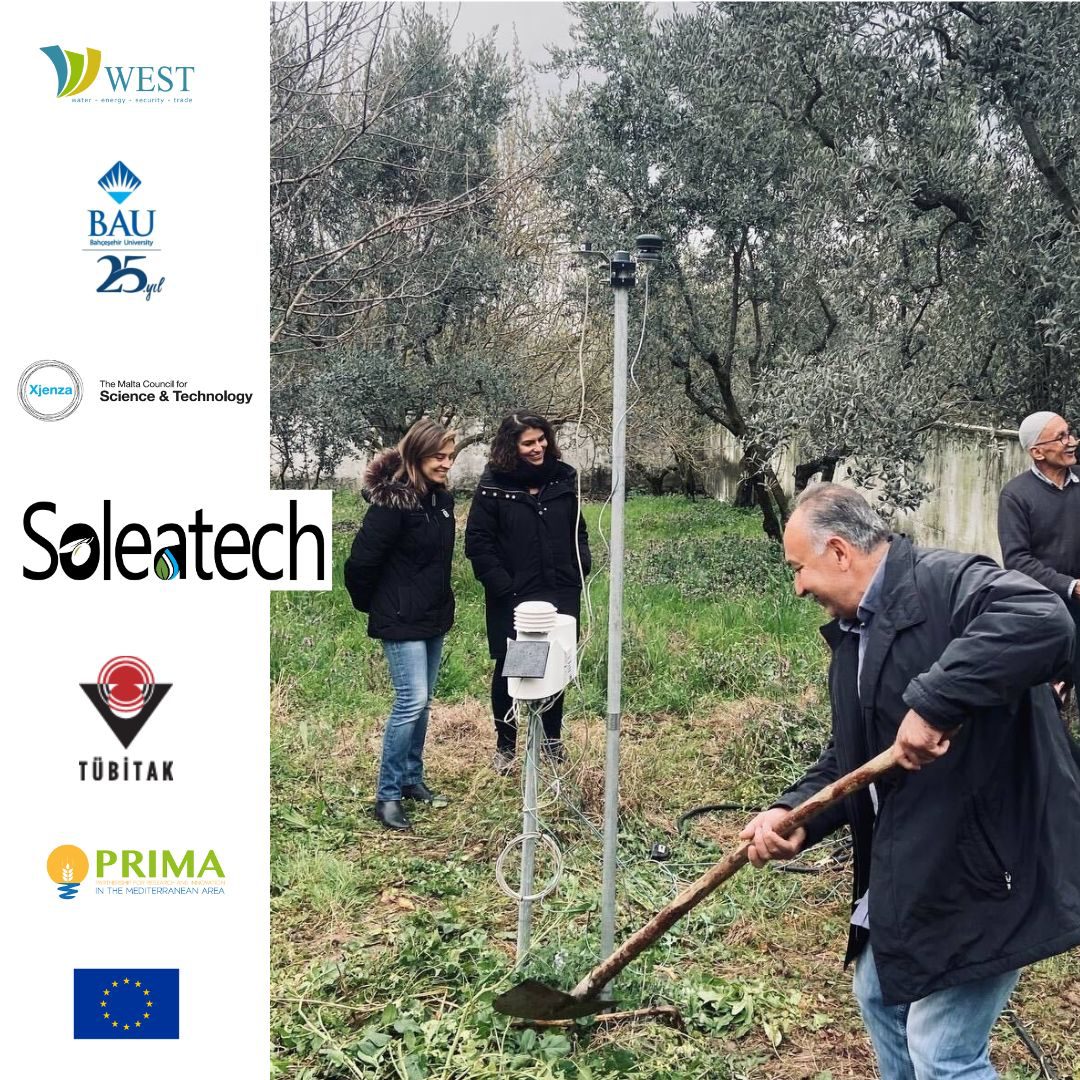
Bahçeşehir University (BAU) continued its participation in SOLEATECH, an international research and innovation initiative developed within the framework of bilateral scientific cooperation between Türkiye and Malta. The project demonstrates the University's engagement in policy-relevant research supported by governmental research and innovation bodies in both countries, addressing shared sustainability challenges while promoting the exchange of knowledge, technologies, and best practices.
The project, entitled “An Integrated System Design for Olive Growing Enabled by Artificial Intelligence Technology in Rural Areas of Mediterranean Regions Addressing Water, Soil and Energy Challenges,” is led by Assoc. Prof. Dr. Zeynep Tacer Caba of Bahçeşehir University and Barbara Bracone of WES Trade Ltd., Malta.
The research is supported through the bilateral cooperation programme jointly administered by two public research and innovation bodies: the Scientific and Technological Research Council of Türkiye (TÜBİTAK) and the Malta Council for Science and Technology (MCST). TÜBİTAK serves as Türkiye's national public research and innovation funding institution, while MCST is Malta's public body responsible for supporting research, technological development, and innovation. Their involvement places the project within an established government-backed bilateral research cooperation framework, connecting university-led scientific research with publicly supported research and innovation priorities in both countries.
Through its participation in this government-supported bilateral research framework, BAU contributes to research addressing policy priorities shared by Türkiye and Malta, particularly sustainable agriculture, water resource management, climate adaptation, and rural development. The project connects university-led scientific investigation with the research and innovation priorities of public institutions in both countries, generating evidence with potential applications in government policy development and institutional planning.
This institutional framework is particularly significant because the research addresses areas of direct relevance to public policy, including sustainable agriculture, water resource management, climate adaptation, rural development, and technological innovation. By supporting collaborative research in these fields, TÜBİTAK and MCST facilitate the development of scientific knowledge and technological solutions relevant to national and regional sustainability priorities.
The project focuses on developing an artificial intelligence-based integrated system for sustainable olive cultivation, combining environmental monitoring, predictive modelling, and data-driven approaches to improve the management of water, soil, and energy resources. Through the application of smart agricultural technologies, the research seeks to improve resource efficiency, support agricultural productivity, and address environmental challenges affecting rural Mediterranean communities.
A central dimension of the collaboration is the comparative evaluation, exchange, and application of best practices from Türkiye and Malta. By bringing together expertise, technological approaches, and practical experiences from both countries, the project supports mutual learning and the development of innovative solutions that may be adapted to similar agricultural and environmental conditions across the Mediterranean region.
The project places particular emphasis on identifying, comparing, adapting, and sharing sustainable agricultural best practices between Türkiye and Malta, with the aim of developing transferable approaches that can support SDG implementation in other Mediterranean rural communities. Through comparative research, data-driven modelling, and applied research activities, the initiative seeks to identify effective approaches to sustainable resource management and develop transferable practices and scalable solutions for agricultural communities facing similar environmental challenges.
This cross-border exchange of experience and expertise demonstrates how international research cooperation can contribute to the identification, development, and potential dissemination of SDG-related best practices, strengthening the capacity of participating institutions to address common sustainability challenges.
An important dimension of SOLEATECH is its policy-focused research contribution to sustainable agriculture, water resource governance, climate adaptation, and rural development. Beyond technological innovation, the project examines practical challenges that are directly relevant to public policy priorities in Türkiye and Malta, including agricultural resource efficiency, environmental sustainability, and the resilience of rural communities.
By combining comparative research, artificial intelligence-based modelling, and the evaluation of agricultural best practices across both countries, the initiative seeks to generate evidence that can inform public policy development, institutional planning, and government decision-making in areas such as sustainable water management, climate-responsive agricultural practices, and rural innovation. The research provides a basis for identifying approaches that may be adapted, scaled, or considered within broader agricultural and environmental policy frameworks.
The project's implementation within the TÜBİTAK–MCST bilateral cooperation framework connects these policy-relevant research activities with the publicly supported research and innovation priorities of Türkiye and Malta. This relationship illustrates how government-backed international research programmes can support the generation of scientific evidence relevant to shared policy challenges, while facilitating the exchange of knowledge and best practices between countries.
The involvement of TÜBİTAK and MCST as governmental research and innovation bodies establishes an institutional connection between BAU's academic research and the public research systems of Türkiye and Malta. Through this bilateral framework, the University contributes to internationally coordinated research addressing challenges relevant to government policy priorities, while supporting knowledge exchange between countries and the development of evidence that may inform public-sector decision-making.
The project is particularly relevant to SDG 17 (Partnerships for the Goals) through bilateral cooperation, international knowledge exchange, and the mutual evaluation and transfer of sustainable agricultural practices. Its emphasis on identifying, comparing, adapting, and sharing effective approaches across two countries supports international collaboration for the development and dissemination of SDG-related best practices.
The initiative also supports the broader objectives of SDG 16 (Peace, Justice and Strong Institutions) through the generation of policy-relevant research within a government-supported international cooperation framework, contributing scientific knowledge that may inform institutional planning and evidence-based public decision-making.
In addition, SOLEATECH contributes to SDG 2 (Zero Hunger) through agricultural innovation, SDG 6 (Clean Water and Sanitation) through improved water management, SDG 9 (Industry, Innovation and Infrastructure) through the application of artificial intelligence, SDG 12 (Responsible Consumption and Production) through resource efficiency, and SDG 13 (Climate Action) through climate-responsive agricultural approaches.
Through SOLEATECH, Bahçeşehir University demonstrates how international research partnerships supported by governmental research bodies can connect academic expertise with public research priorities, facilitate the exchange of SDG-related best practices, and generate policy-relevant evidence for sustainable development. The initiative illustrates the complementary roles of government-supported research cooperation, university expertise, and international knowledge sharing in addressing common environmental and socioeconomic challenges.
The image below portrays a highlight from the project as well as the partnering institutions:
3- Bahçeşehir University's Research Contributions to Evidence-Informed Government Policy Development
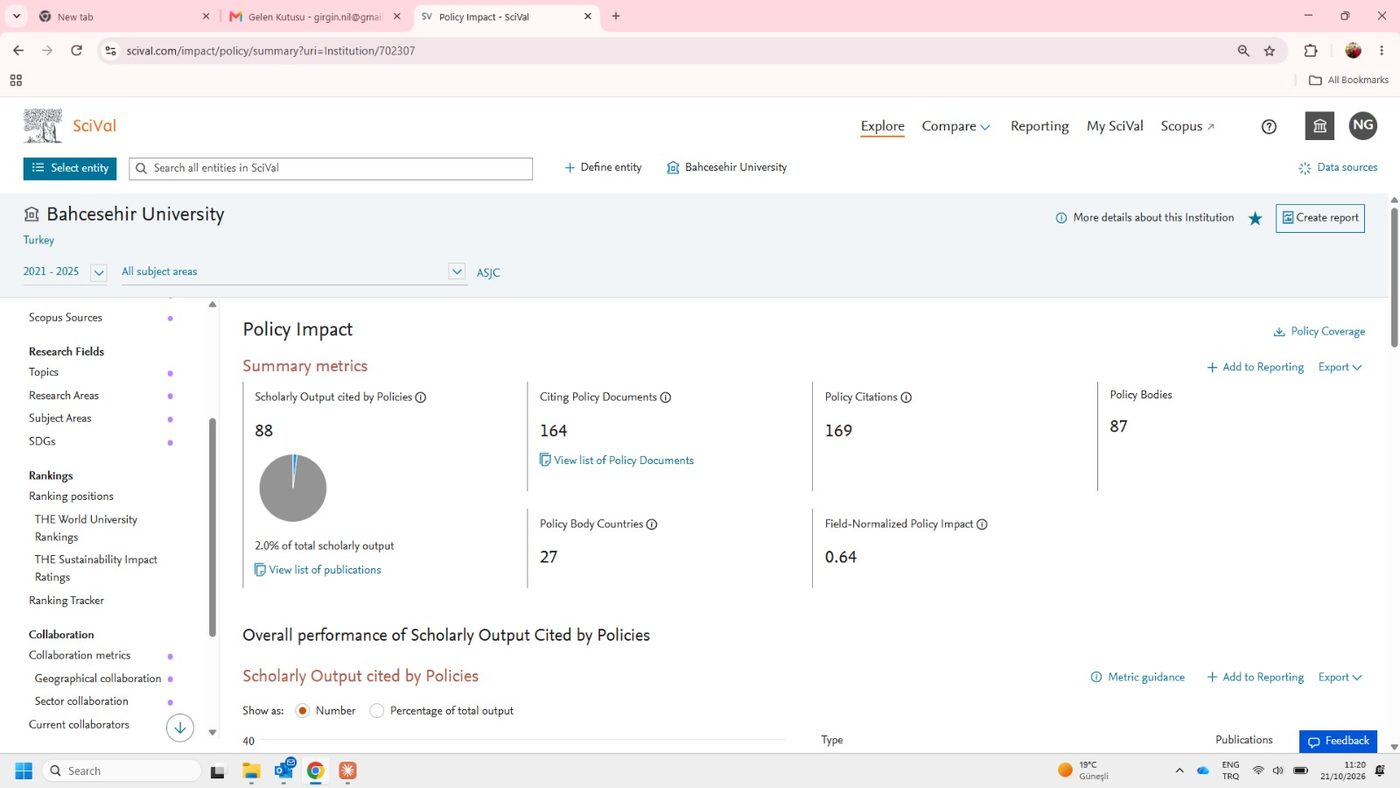
The screenshot below, taken from Bahçeşehir University's institutional profile on Elsevier's SciVal Policy Impact platform, presents the University's research contributions to policy-related documents. For the 2021–2025 publication period, it shows that 88 BAU scholarly publications were cited in 164 policy documents, generating 169 policy citations from 87 policy bodies across 27 countries.
Bahçeşehir University (BAU) contributes to evidence-informed policymaking by producing academic research that is referenced in policy documents issued by governmental institutions, intergovernmental organizations, and independent policy research bodies worldwide. This international research-to-policy reach demonstrates the relevance of the University's scholarly output beyond academia and its contribution to the knowledge base used in public policy analysis, institutional decision-making, and the development of responses to societal challenges.
Independent evidence of this contribution is provided by Elsevier's SciVal Policy Impact Analytics, drawing on data from the Overton policy document database. According to BAU's institutional profile, covering scholarly publications from 2021 to 2025, 88 BAU-affiliated academic publications have been cited in 164 policy documents, generating 169 policy citations from 87 policy bodies across 27 countries.
The policy documents referencing BAU research reflect a broad international and cross-sectoral institutional reach.
Governmental and Public Institutions
BAU-affiliated research has been referenced in documents issued by governmental and public institutions in different countries, including the Government of Japan, Government of Türkiye, French government ministries, and public institutions in the United Kingdom.
The dataset includes a document issued by the Government of Japan through its Ministry of Health, Labour and Welfare, as well as clinical guidance published by the United Kingdom's National Institute for Health and Care Excellence (NICE). These references illustrate the presence of BAU research within government-issued documentation and public-sector evidence resources.
Intergovernmental and International Organizations
BAU research is also referenced in documents published by major international organizations, including UNESCO, the World Bank, the Organisation for Economic Co-operation and Development (OECD), and institutions of the European Union.
The identified documents address areas such as higher education, artificial intelligence, digital transformation, climate change, human capital, and sustainable employment. Their inclusion demonstrates the international dissemination of BAU research within policy-oriented publications addressing development priorities relevant to the SDGs.
Independent Policy Research Institutions and Other Organizations
The SciVal dataset also identifies references to BAU research in documents produced by independent policy research institutions, think tanks, and other organizations contributing to public policy discussions.
This institutional diversity is particularly relevant to the University's commitment to supporting evidence-informed decision-making across sectors. It demonstrates that BAU's academic research is accessible and relevant not only to governmental institutions but also to organizations involved in policy research, analysis, and public dialogue.
Contribution to Sustainable Development and Evidence-Informed Governance
The policy documents referencing BAU research span several areas connected to sustainable development, including quality education, public health, technological innovation, climate action, social inclusion, and institutional development.
This research-to-policy reach supports the broader objectives of SDG 16 (Peace, Justice and Strong Institutions) by contributing scholarly evidence relevant to informed institutional and public decision-making, and SDG 17 (Partnerships for the Goals) by facilitating the international circulation and use of academic knowledge among governmental, intergovernmental, and policy-oriented institutions.
Together with BAU's direct policy engagement, institutional partnerships, and collaborative research initiatives, these independently documented references provide evidence of the University's contribution to connecting academic knowledge with policy-relevant challenges at national and international levels.
Together with BAU's direct research collaborations with government institutions, these independently documented policy citations provide complementary evidence of the University's contribution to government-related research and evidence-informed policymaking. They demonstrate how BAU's academic research informs policy-related knowledge across governmental, intergovernmental, and other policy-oriented institutions, extending the University's contribution to public policy development beyond its formal institutional research partnerships.











