





 EN
16.3.2 - Upskilling and Capacity-building to Policy- and Law-Makers
Bahçeşehir University (BAU) actively collaborates with local, regional, and national government bodies through educational programmes, professional development initiatives, expert consultation, and institutional partnerships. Drawing on its academic expertise and research capacity, the University supports the education, upskilling, and capacity building of policymakers, lawmakers, public officials, and professionals involved in public governance and decision-making.
BAU delivers outreach, education, and capacity-building initiatives addressing a broad range of policy-relevant areas, including law, economics, governance, migration, technology, climate change, diplomacy, and sustainable development. By connecting academic knowledge with practical learning, professional training, and opportunities for dialogue, these initiatives strengthen participants' understanding of complex public challenges and support the development of competencies relevant to policy formulation, legislative processes, institutional governance, and public-sector decision-making.
Through collaborations with ministries, municipalities, public institutions, professional organizations, and international partners, BAU facilitates knowledge exchange, specialized training, and continuing professional education. These activities contribute to strengthening institutional capacities and promoting informed, inclusive, and evidence-based approaches to governance, supporting SDG 16 (Peace, Justice and Strong Institutions) and SDG 17 (Partnerships for the Goals).
The following examples from the 2024–2025 academic year demonstrate Bahçeşehir University's contributions to outreach, education, professional upskilling, and capacity building for policymakers, lawmakers, and public-sector professionals through academic programmes, institutional cooperation, and specialized educational initiatives.
1. Bahçeşehir University’s Ministry of Justice-Authorized Mediation Training: Upskilling and Capacity Building for Legal and Public Sector Professionals
The official correspondence from the Ministry of Justice presented in the two images below documents Bahçeşehir University's authorization to provide mediation training. The first image confirms the University's existing authorization, while the second presents the Ministry's 2024 decision extending this authorization for an additional three years.
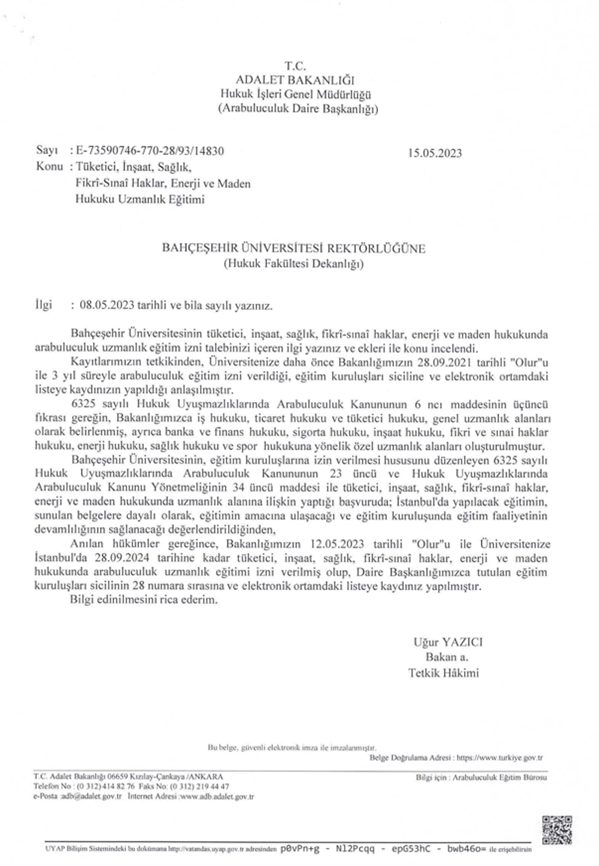
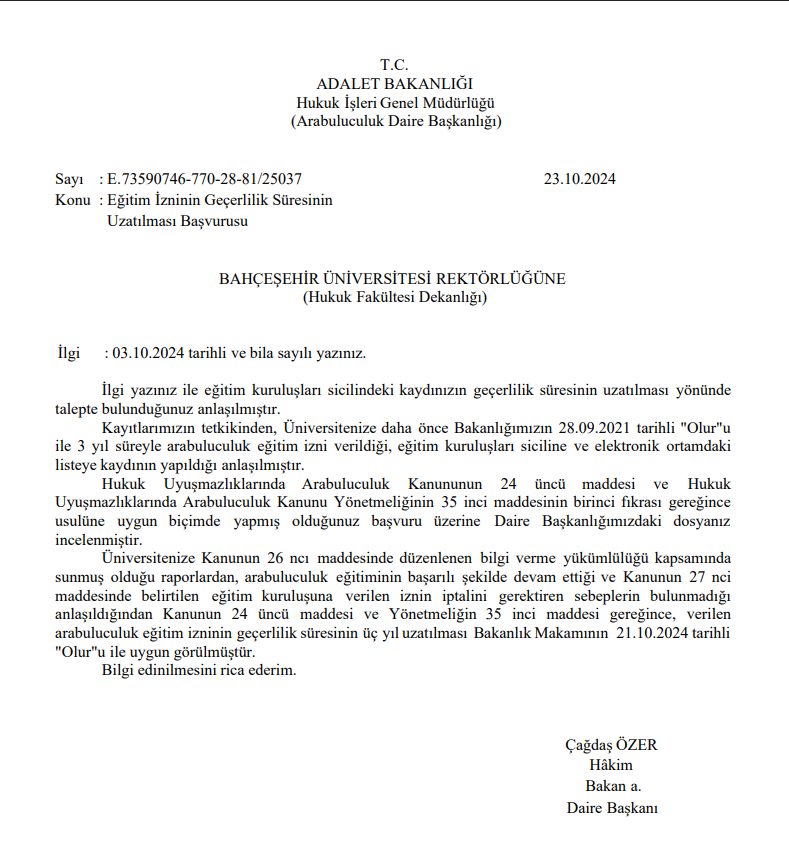
Bahçeşehir University (BAU) contributes to professional upskilling and capacity building in law, governance, and dispute resolution through mediation training programmes officially authorized by the Ministry of Justice of the Republic of Türkiye under the Law on Mediation in Civil Disputes.
These programmes provide specialized legal education and professional development opportunities for legal practitioners, public officials, and professionals working in fields relevant to legal and regulatory decision-making, including areas directly relevant to the work of policymakers and lawmakers. Covering areas such as energy, healthcare, and environmental law, the training strengthens competencies in mediation, negotiation, conflict management, and alternative dispute resolution, supporting more effective and accessible mechanisms for resolving disputes and strengthening professional capacities relevant to the application of legal and regulatory frameworks.
Initially authorized in 2021, BAU's authorization to provide mediation training was renewed by the Ministry of Justice in 2024 for an additional three years. Under this renewed authorization, BAU continued delivering mediation training programmes throughout 2025, demonstrating its sustained contribution to professional capacity building within Türkiye's legal and institutional framework.
Through these programmes, BAU supports the development of professional expertise relevant to the implementation of legal frameworks, effective dispute resolution, and institutional capacity, contributing to SDG 16 (Peace, Justice and Strong Institutions).
2. Bahcesehir University Diplomat School: Policy Education, Capacity Building and Neutral Dialogue on Global Challenges, Including Climate and Energy Diplomacy
The image below shows the official poster and content of BAU Diplomat School.
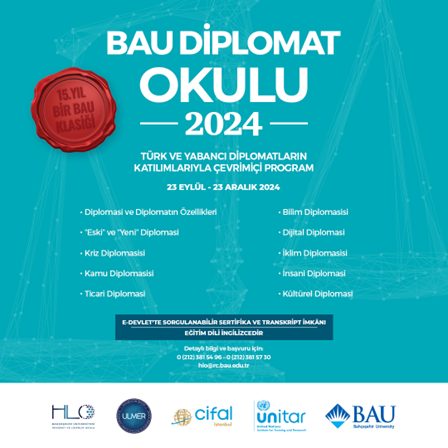
During the 2024–2025 academic year, Bahçeşehir University (BAU), through its International Leadership Practice and Research Center (ULMER) and the Government Leadership School, continued to deliver the BAU Diplomat School, a long-standing educational initiative designed to strengthen the knowledge, professional competencies, and policymaking capacities of policymakers, diplomats, public officials, senior administrators, and professionals engaged in international relations and public governance.
Celebrating its 15th year, the Diplomat School serves two complementary institutional purposes: providing structured education, professional upskilling, and capacity building in areas directly relevant to policymakers and lawmakers, while also offering a neutral, inclusive, and academically guided platform for dialogue among individuals representing different political perspectives, ideologies, institutional affiliations, and professional backgrounds.
Over the years, the programme has brought together ministers, ambassadors, members of parliament, senior bureaucrats, policy advisors, academics, and public-sector professionals. This diverse participation has enabled the exchange of knowledge and practical experience among individuals involved in public policy, legislation, diplomacy, and institutional decision-making, while encouraging constructive discussion across different political and professional perspectives.
For the 2024–2025 academic year, the Diplomat School delivered its 14-week online programme, with weekly sessions held on Mondays from 08:30 to 11:30. The structured curriculum provided sustained opportunities for professional learning, knowledge exchange, and the examination of contemporary diplomatic and governance challenges.
The updated curriculum covered climate and energy diplomacy, humanitarian and cultural diplomacy, the characteristics and responsibilities of diplomats, traditional and contemporary diplomacy, crisis diplomacy, public and commercial diplomacy, and science and digital diplomacy. Through these specialized modules, participants developed a deeper understanding of international policy frameworks, diplomatic negotiation, crisis management, climate governance, cross-border cooperation, and emerging technological challenges. The programme supported the development of analytical, diplomatic, and decision-making competencies relevant to policy formulation, legislative understanding, and effective public governance.
A defining feature of the BAU Diplomat School is its commitment to political neutrality and intellectual openness. The programme provides a non-partisan academic environment in which participants with differing, and sometimes conflicting, viewpoints can examine complex national and international issues. This approach is particularly important when addressing international conflicts, diplomatic crises, humanitarian challenges, climate and energy policy, and changing geopolitical relationships. By facilitating respectful disagreement and evidence-based discussion, the University creates opportunities for participants to engage with alternative interpretations and policy approaches without political or ideological exclusion.
The programme's educational and dialogue functions reinforce one another. Participants not only gain specialized knowledge and professional competencies but also develop the ability to critically assess complex policy challenges, consider different perspectives, and engage constructively with stakeholders from diverse institutional and political backgrounds. This combination of structured learning and open dialogue strengthens capacities relevant to policymaking, diplomatic engagement, public-sector leadership, and inclusive governance.
Through the BAU Diplomat School, the University contributes to two interconnected dimensions of effective governance: strengthening the professional capabilities of policymakers, public officials, and individuals involved in legislative and policy processes, and maintaining a neutral academic space where stakeholders with different perspectives can discuss challenging issues openly and constructively.
The initiative contributes primarily to SDG 16 (Peace, Justice and Strong Institutions) by advancing policymaker education, institutional capacity building, political dialogue, and inclusive governance. It also supports SDG 17 (Partnerships for the Goals) through diplomatic cooperation and cross-sector knowledge exchange, and SDG 4 (Quality Education) through structured professional education and lifelong learning.
3. BAU Politics & Society Seminar Series – “Bridging Justice and Gender: Analyzing Organizational Dynamics in Istanbul’s Local Governance through Studying Up and Scorecard Analysis”
The image below presents the official event poster for Bahçeşehir University's Politics & Society Seminar Series session entitled “Bridging Justice and Gender: Analyzing Organizational Dynamics in Istanbul’s Local Governance through Studying Up and Scorecard Analysis,” held during the 2024–2025 academic year.
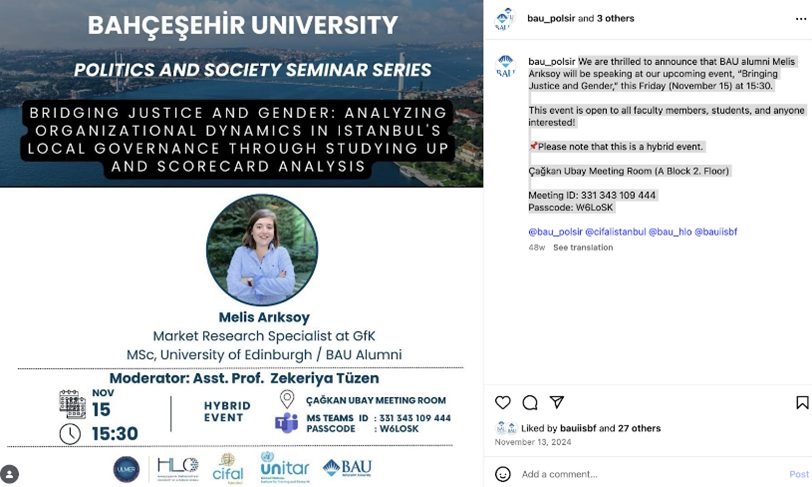
During the 2024–2025 academic year, Bahçeşehir University (BAU) hosted a session within its Politics & Society Seminar Series entitled “Bridging Justice and Gender: Analyzing Organizational Dynamics in Istanbul’s Local Governance through Studying Up and Scorecard Analysis.”
Presented by BAU alumna Melis Arıksoy, a research specialist, the seminar addressed the intersection of justice, gender equality, institutional accountability, and decision-making within Istanbul's local governance structures.
Drawing on her professional experience and research-based approaches, Arıksoy examined how organizational hierarchies, power relations, and institutional evaluation mechanisms can influence governance practices and the delivery of public services.
The session introduced Studying Up, an approach to examining institutions and positions of authority, alongside gender scorecard analysis as a framework for assessing institutional practices and identifying potential inequalities.
Particular attention was given to how gender-sensitive assessment tools and performance indicators can support municipalities in evaluating organizational practices, identifying disparities, strengthening institutional transparency, and incorporating equality considerations into public administration.
The seminar also explored the relevance of these approaches to gender-responsive planning, evidence-informed evaluation, and accountability in local government, providing practical conceptual frameworks applicable to municipal governance.
The session brought together representatives of local governments, policymakers, and BAU faculty members, creating an academic setting for knowledge exchange and discussion on gender equality and institutional governance.
Through its educational and analytical content, the seminar contributed to outreach and capacity-building for local policymakers and public-sector representatives, supporting their understanding of how research-based assessment approaches can inform more inclusive and accountable administrative practices.
As part of its Politics & Society Seminar Series, this initiative reflects BAU's engagement with public-sector stakeholders through educational activities that connect academic research with contemporary governance challenges.
The seminar's focus on gender equality, institutional accountability, and local government practices was aligned with SDG 5 (Gender Equality), SDG 16 (Peace, Justice and Strong Institutions), and SDG 11 (Sustainable Cities and Communities).
4. Bahçeşehir University's Sustainability Education and Capacity Building for Local Communities and Municipal Governance in Malatya
The image below represents CIFAL Istanbul team members meeting with the Malatya Municipality
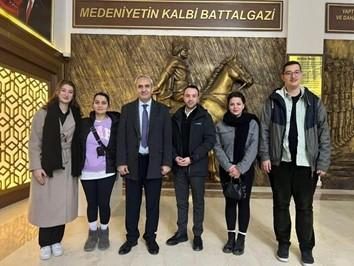
During the 2024–2025 academic year, Bahçeşehir University (BAU), through CIFAL Istanbul, a UNITAR-affiliated training centre hosted by the University, conducted sustainability education and capacity-building activities in Battalgazi, Malatya, a region significantly affected by the earthquakes of 6 February 2023.
The initiative combined direct sustainability training, knowledge dissemination, and engagement with local government authorities, contributing to the development of local capacities in environmental awareness, sustainable development, community resilience, and post-disaster recovery.
On 13 December 2024, the CIFAL Istanbul team delivered an educational seminar entitled “Heroes of Nature: Raising Awareness on Sustainability” in Battalgazi, Malatya.
The training introduced participants to the mission and values of the United Nations and provided education on the Sustainable Development Goals (SDGs), emphasizing how individuals, families, and communities can actively contribute to their achievement.
The programme covered clean water conservation, renewable energy, sustainable cities, climate action, environmental protection, and the preservation of natural ecosystems. Particular attention was given to waste reduction, responsible consumption, efficient resource use, and environmentally sustainable practices.
Through educational presentations and practical examples, participants gained knowledge of sustainability principles and their application in everyday life and community settings.
The training contributed to local capacity development by strengthening sustainability literacy, environmental awareness, and understanding of practical approaches to resource conservation and sustainable living.
In the context of post-earthquake recovery, the programme also reinforced the importance of integrating environmental responsibility and sustainability considerations into the long-term development of resilient communities.
By delivering this educational programme directly in Malatya, BAU and CIFAL Istanbul extended sustainability education beyond the University campus and supported knowledge development within a community facing significant recovery challenges.
Capacity Development and Knowledge Exchange with Malatya Metropolitan Municipality
On 15 December 2024, the BAU–CIFAL Istanbul delegation met with the Head of the Strategy Development Department at Malatya Metropolitan Municipality as part of its engagement with local public authorities.
The discussions focused on sustainable post-earthquake reconstruction, educational development, and the application of sustainability principles to local recovery priorities, particularly the reconstruction and improvement of schools.
Drawing on CIFAL Istanbul's educational expertise and its connection to UNITAR's global training network, the engagement facilitated knowledge exchange on sustainability-related approaches relevant to municipal planning and educational infrastructure.
The discussions addressed the importance of environmentally responsible reconstruction, quality learning environments, and educational initiatives that support long-term community development.
This exchange contributed to local institutional capacity development by sharing sustainability-related knowledge and educational perspectives relevant to municipal planning and recovery efforts.
The engagement also strengthened the connection between academic expertise and local government priorities, supporting the consideration of sustainability and education within the region's reconstruction and development agenda.
Capacity Development and Engagement with Battalgazi Municipality
Also on 15 December 2024, the CIFAL Istanbul team met with the Deputy Mayor of Battalgazi Municipality to address the district's recovery process, community needs, and the role of sustainability education in supporting resilient local development.
The engagement included knowledge exchange concerning community resilience, social service delivery, sustainable development, and the importance of educational initiatives in post-disaster recovery.
By sharing educational perspectives and sustainability-related knowledge with municipal leadership, BAU and CIFAL Istanbul contributed to the discussion of approaches relevant to local institutional learning and community-oriented development.
The engagement supported capacity development through the exchange of knowledge on sustainability, community needs, and the integration of educational approaches into local recovery efforts.
It also reinforced cooperation between the University and municipal authorities in addressing the interconnected challenges of sustainable recovery, social development, and community well-being.
Contribution to Policy- and Lawmakers Outreach, Education, and Capacity Building
The Malatya initiative represents BAU's commitment to delivering sustainability education and supporting local capacity development through engagement with communities and public-sector decision-makers.
The Heroes of Nature seminar provided direct education on sustainable development and environmental responsibility, strengthening participants' knowledge and awareness of sustainability-related challenges and solutions.
The subsequent engagements with Malatya Metropolitan Municipality and Battalgazi Municipality extended the initiative's knowledge-sharing dimension to local government officials, connecting sustainability education with municipal priorities concerning school reconstruction, community resilience, and public service development.
Through these activities, BAU and CIFAL Istanbul contributed to sustainability knowledge dissemination, local institutional learning, and capacity development relevant to public-sector planning and decision-making.
The initiative addressed themes directly relevant to policy- and lawmakers outreach and education, including climate action, sustainable cities, educational infrastructure, environmental responsibility, and disaster resilience.
By combining direct educational delivery with knowledge exchange involving municipal decision-makers, the University supported the application of sustainability-related knowledge within both community and local governance contexts.
The initiative contributed to SDG 4 (Quality Education), SDG 11 (Sustainable Cities and Communities), SDG 13 (Climate Action), and SDG 16 (Peace, Justice and Strong Institutions), reflecting BAU's commitment to strengthening education, sustainable recovery, institutional cooperation, and community resilience.
5. Bahçeşehir University’s Ministry of Justice-Authorized Legal and Administrative Capacity-Building Programme
The image below presents official correspondence issued by the Ministry of Justice of the Republic of Türkiye on 20 March 2025, confirming Bahçeşehir University's authorization to provide specialized legal and administrative capacity-building training for a three-year period.
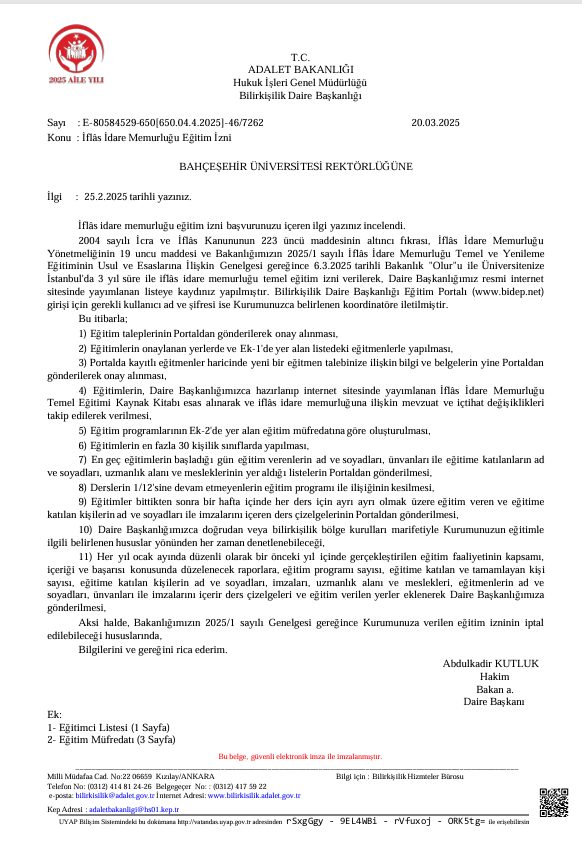
Bahçeşehir University (BAU) contributes to professional upskilling and institutional capacity building in law, economics, public administration, and financial governance through specialized education authorized by the Ministry of Justice of the Republic of Türkiye. The initiative reflects the University's commitment to extending its academic expertise beyond conventional degree programmes and strengthening knowledge and professional competencies in areas directly relevant to policy-makers, law-makers, legal professionals, and public-sector institutions.
In 2025, BAU received official authorization from the Ministry of Justice to deliver a specialized legal and administrative training programme for a three-year period. Granted on 6 March 2025 and formally communicated on 20 March 2025, the authorization places the programme within a nationally regulated framework, with Ministry-approved educational standards, curriculum requirements, and qualified academic instructors.
Throughout 2025, BAU maintained its institutional commitment to professional education and capacity building in fields relevant to policy-makers and law-makers, supported by its Ministry of Justice authorization and established academic expertise. This framework provides a basis for specialized training designed to strengthen legal, economic, and administrative competencies and support professional development within the justice and governance sectors.
The programme adopts an interdisciplinary approach to professional capacity building, integrating legal knowledge with economic and financial competencies. Its 36-hour curriculum includes 18 hours of legal education covering commercial law, judicial procedures, enforcement and insolvency law, and legal administration, alongside 18 hours addressing economics, public finance, financial management, accounting, and financial reporting.
Through this combination of disciplines, the training is designed to strengthen participants' understanding of legal procedures, economic principles, institutional responsibilities, and the financial dimensions of administrative decision-making. These areas of expertise are also relevant to the broader knowledge and capacity-building needs of policy-makers and law-makers, particularly in understanding the implementation of legal frameworks, the functioning of judicial institutions, and the economic implications of regulatory decisions.
An important feature of the initiative is its formal institutional connection with the Ministry of Justice. The Ministry establishes the regulatory framework, approves educational requirements and instructors, and defines procedures for monitoring, reporting, and quality assurance. This framework demonstrates BAU's recognized capacity to provide specialized professional education aligned with national legal and institutional standards.
The initiative contributes to SDG 16 (Peace, Justice and Strong Institutions) through legal education, professional capacity building, and the development of competencies supporting effective judicial and administrative processes. By providing an institutional framework for interdisciplinary education in law, economics, and public financial management, BAU also contributes expertise in fields relevant to informed policymaking, legislative understanding, and institutional governance.
6. Strengthening Education through Collaboration: Bahçeşehir University Partners with the Ministry of Education
The image below shows the cover page of the Ministry of Education partnership agreement
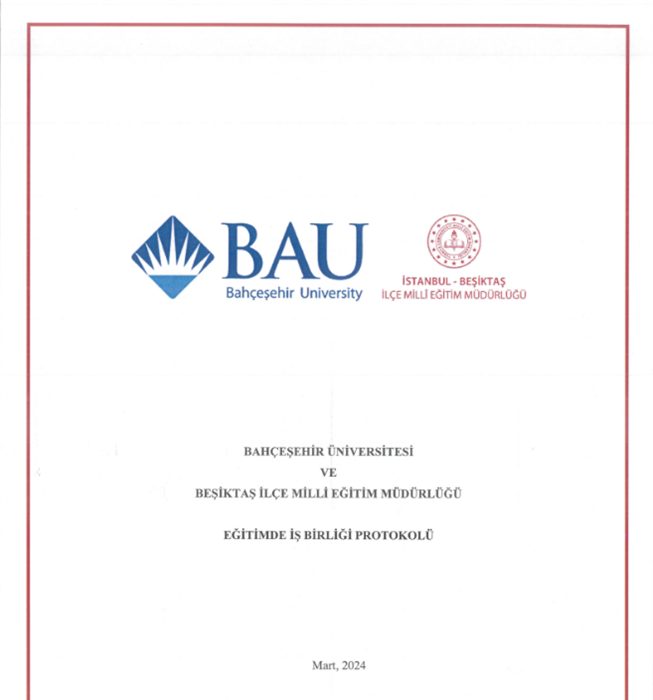
In the 2024-2025 academic year, Bahçeşehir University signed a cooperation protocol with the Beşiktaş District Directorate of National Education, which operates under the Ministry of National Education of the Republic of Türkiye. Under this protocol, BAU will serve as a “trainer of trainers,” providing educational programs and academic support for instructors affiliated with the Ministry, focusing on strengthening professional capacity, promoting innovation, and improving educational practices.
7. Bahçeşehir University and the Ministry of Industry and Technology Continue Strategic Partnership for Türkiye’s Technological Future
The images below show the cover page of the Ministry of Industry and Technology and BAU partnership agreement.
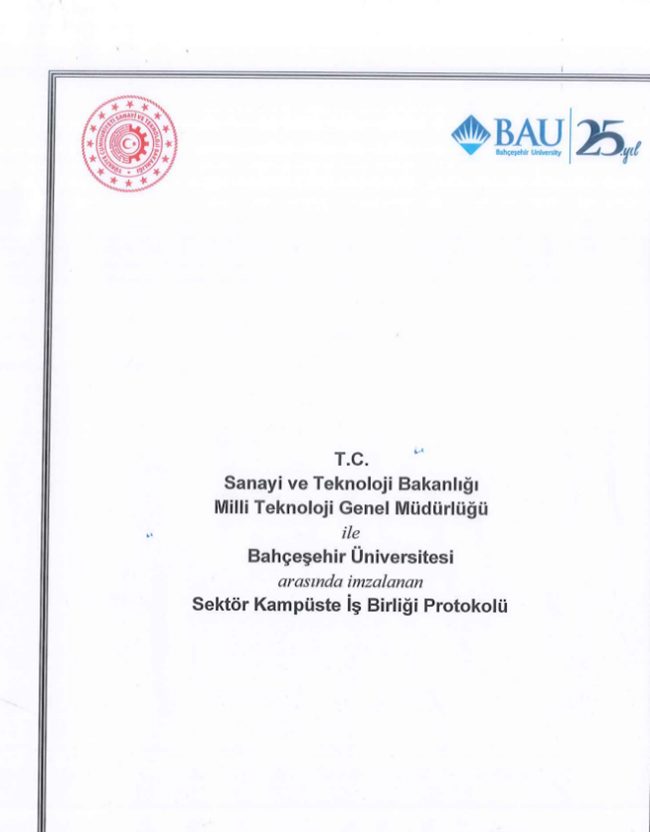
In 2023-2024 academic year, a cooperation protocol was signed between Bahçeşehir University and the Directorate General of National Technology of the Ministry of Industry and Technology of the Republic of Turkey to train and develop human resources. The protocol builds on and strengthens the ongoing collaboration between the two institutions, aiming to foster innovation, support national technology initiatives, and cultivate highly skilled professionals for Türkiye’s future. This cooperation continues actively.
The protocol remained in effect throughout the 2024–2025 academic year, sustaining the partnership between Bahçeşehir University and the Directorate General of National Technology. Through this continuing institutional framework, the two organisations maintained their shared commitment to human-capital development, technology-oriented education and the cultivation of skills relevant to Türkiye’s national innovation priorities. The continuation of the protocol enabled the partnership to preserve its long-term focus on connecting academic expertise with public-sector technology objectives and supporting a highly qualified workforce capable of contributing to Türkiye’s technological development and national innovation ecosystem.
8. Bahçeşehir University's 21st Green Dialogue Meeting: Climate Policy Education, Capacity Building and Cross-Sectoral Dialogue with Environmental NGOs for Sustainable Governance
The image below presents the official poster of the 21st Green Dialogue Meeting, held in 2025, highlighting the educational programme, expert speakers, and key topics addressed in climate legislation, just transition, and environmental governance.
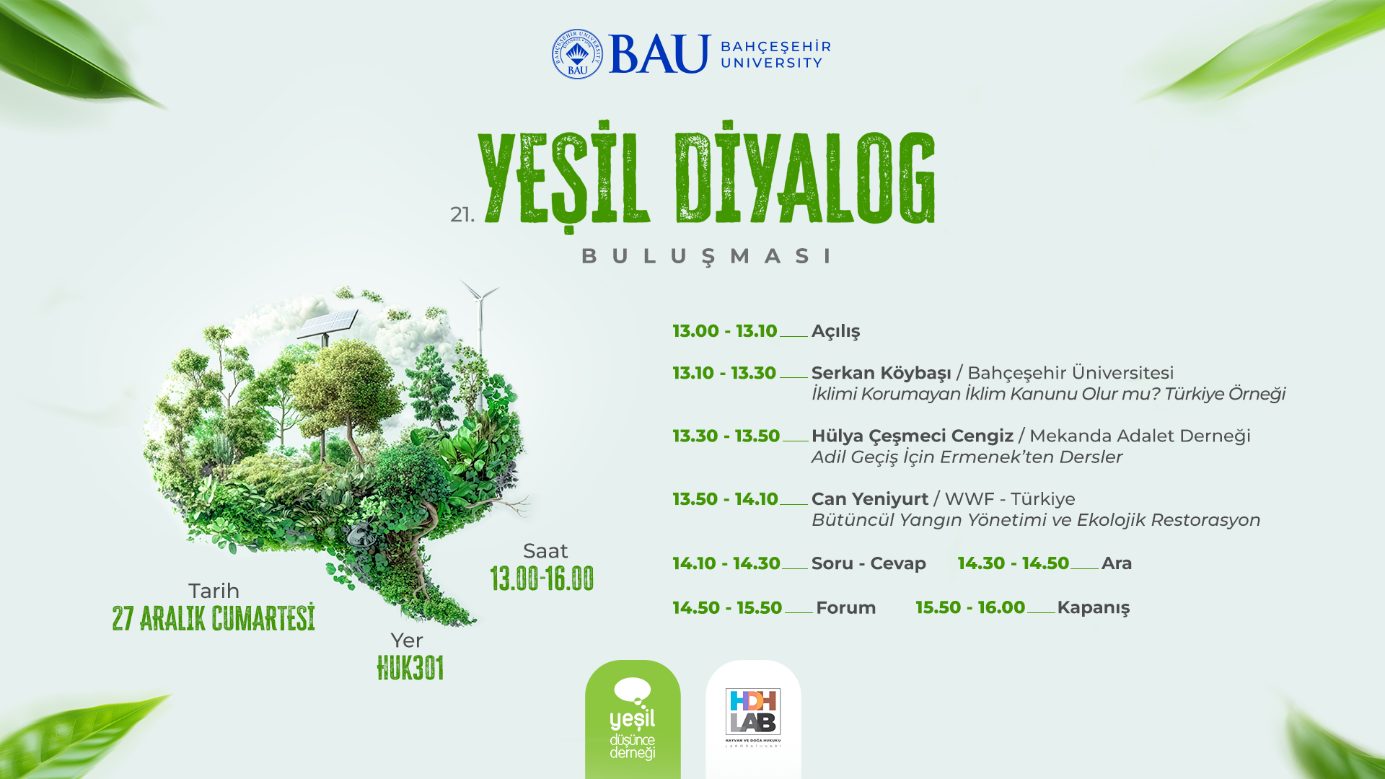
In 2025, Bahçeşehir University (BAU) hosted the 21st Green Dialogue Meeting (21. Yeşil Diyalog Buluşması), bringing together policymakers, lawmakers, public-sector representatives, local government officials, civil society organizations, and academic experts for an educational programme focused on climate legislation, environmental governance, and the green transition. The initiative also provided a platform for cross-sectoral dialogue among academia, public institutions, and environmental non-governmental organizations (NGOs) on shared sustainability challenges and the implementation of the Sustainable Development Goals (SDGs).
The education programme aimed to strengthen the knowledge and capacities of policymakers and public-sector decision-makers by providing expert-led education on the legal, institutional, and social dimensions of sustainable development. Through presentations and interactive discussions, participants engaged with policy-relevant approaches to climate regulation, institutional accountability, environmental protection, and sustainable public administration.
The programme featured Serkan Köybaşı from Bahçeşehir University, who examined the effectiveness of climate legislation and institutional accountability; Hülya Çeşme Cengiz from Mekanda Adalet Derneği (Centre for Spatial Justice), a non-governmental organization working on spatial justice and social equity, who discussed just transition and lessons from Ermenek; and Can Yeniyurt from WWF-Türkiye, an environmental non-governmental organization, who addressed integrated fire management and ecological restoration. Together, the presentations provided multidisciplinary perspectives on climate policy, social equity, and environmental governance. The participation of these NGOs connected academic and legal expertise with civil society perspectives on environmental protection, climate justice, and sustainable development.
The educational programme contributed directly to policy- and lawmakers' outreach, education, and capacity development, strengthening participants' understanding of climate-related legal frameworks, evidence-informed policymaking, socially inclusive transition strategies, and integrated environmental management.
The question-and-answer session and open forum enabled policymakers, public administrators, and other stakeholders to exchange perspectives, discuss implementation challenges, and consider how the knowledge presented could inform public policy development and institutional practices. These interactive exchanges also facilitated cross-sectoral dialogue on the relationship between climate legislation, environmental justice, ecological resilience, and institutional responsibilities, allowing academic, public-sector, and NGO perspectives to inform discussions of shared SDG-related challenges.
By bringing together public-sector decision-makers, academic experts, and civil society representatives, BAU facilitated knowledge transfer, professional learning, and capacity building, supporting more informed, transparent, and accountable approaches to climate governance. Through its engagement with Mekanda Adalet Derneği and WWF-Türkiye, BAU also strengthened dialogue between higher education and civil society, demonstrating the role of universities in connecting research-based knowledge, environmental advocacy, and public policy discussions.
The meeting's multi-stakeholder format supported collaborative approaches to sustainable development, bringing together perspectives from different sectors to address the interconnected legal, environmental, and social dimensions of the green transition. By providing a common platform for discussion, BAU contributed to cross-sectoral knowledge exchange on climate action, just transition, and environmental governance.
The initiative contributed to SDG 16 (Peace, Justice and Strong Institutions) through its emphasis on effective legislation, institutional accountability, and policy-related capacity building; SDG 13 (Climate Action) through climate policy education and dialogue; SDG 10 (Reduced Inequalities) through its focus on just transition; and SDG 15 (Life on Land) through ecological restoration and integrated fire management. It also supported SDG 17 (Partnerships for the Goals) through cross-sectoral dialogue and knowledge exchange among Bahçeşehir University, environmental NGOs, public-sector stakeholders, and academic experts, encouraging collaborative approaches to SDG-related challenges.
9. Legal Education and Capacity Building for Policymakers: Intellectual Property Rights, Copyright Law and Judicial Practice
The image below presents the official promotional poster for “Legal Education and Capacity Building for Policymakers: Intellectual Property Rights, Copyright Law and Judicial Practice,” held at Bahçeşehir University in 2025. The poster identifies the participating judge, legal practitioners, creative-sector representative and BAU academic, while also presenting the programme’s two-session schedule and venue.
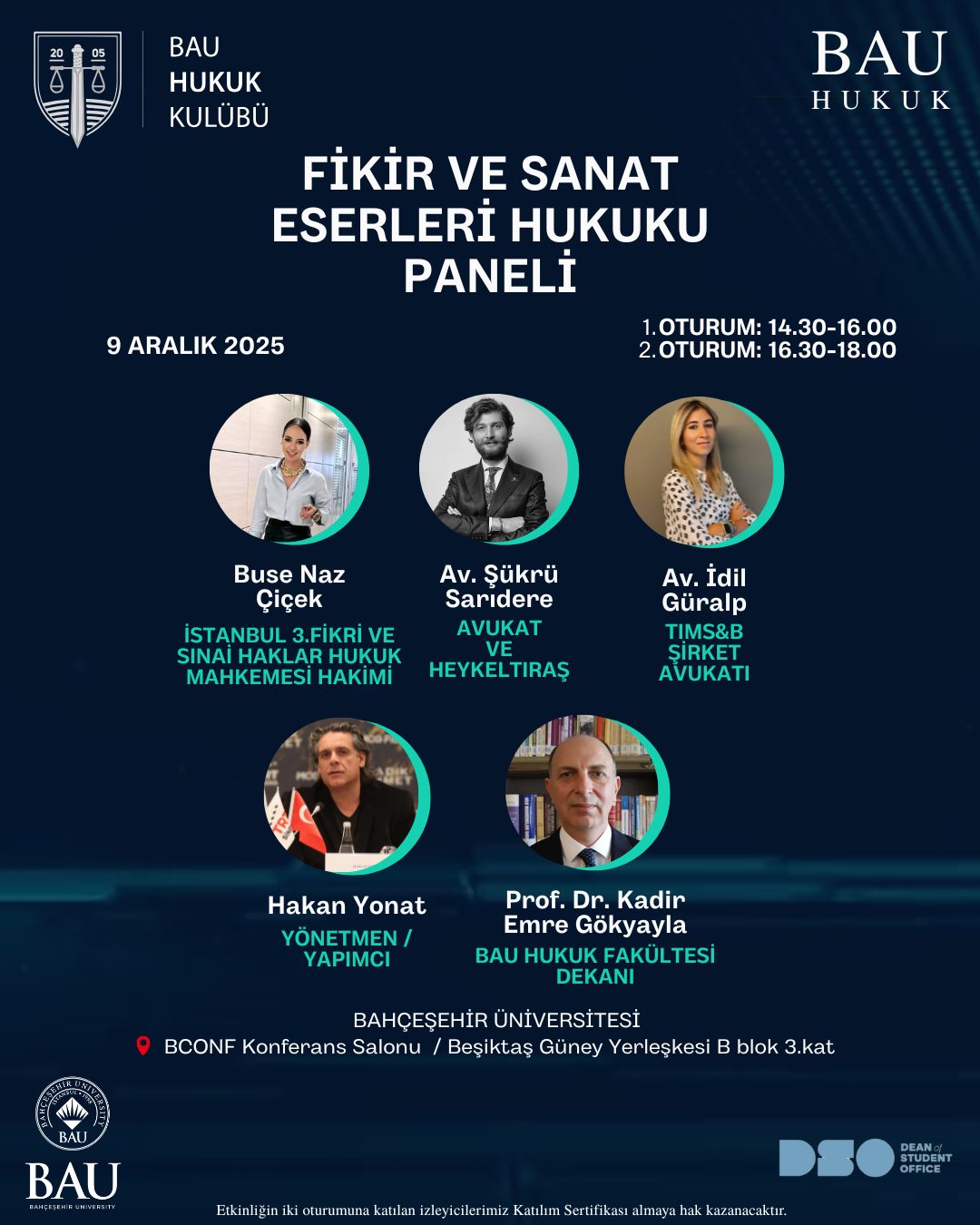
In 2025, Bahçeşehir University (BAU), through its Faculty of Law and BAU Law Club, organized an educational panel entitled “Fikir ve Sanat Eserleri Hukuku Paneli” (Panel on the Law of Intellectual and Artistic Works), bringing together policymakers, public-sector representatives, legal professionals, judicial experts, and members of the academic community for specialized legal education and capacity building.
The panel provided an opportunity for knowledge exchange on intellectual property legislation, copyright protection, judicial practice, and the implications of legal regulation for public policy and institutional decision-making.
The programme featured Buse Naz Çiçek, a judge at the Istanbul 3rd Intellectual and Industrial Property Rights Court; Attorney Şükrü Sarıdere, also a sculptor; Attorney İdil Güralp, a corporate lawyer and Dean of Bahçeşehir University Faculty of Law Prof. Dr. Kadir Emre Gökyayla. Their contributions connected judicial practice, legal interpretation, and the perspectives of creative industries, providing participants with a multidisciplinary understanding of intellectual property governance.
The educational sessions addressed copyright ownership, economic and moral rights, intellectual property protection, licensing, lawful use of creative works, and the balance between creators' rights and public access to knowledge and cultural resources. Discussions also considered the challenges of copyright enforcement in digital environments and the importance of effective legal frameworks in protecting innovation and creativity.
The participation of a serving intellectual property court judge as an expert speaker provided direct insight into the interpretation and application of copyright legislation within the judicial system. This practical judicial perspective strengthened the programme's educational contribution by connecting legal principles with their implementation and enforcement.
Through expert-led presentations and discussions, the panel contributed to the education, upskilling, and capacity development of policymakers, public-sector representatives, and legal professionals, strengthening their understanding of intellectual property regulation, judicial accountability, and the relationship between copyright law and the public interest.
By bringing together policymakers, judicial expertise, legal practitioners, and academic representatives, BAU facilitated knowledge transfer relevant to evidence-informed policymaking, effective legal implementation, and institutional capacity development.
The initiative contributed to SDG 16 (Peace, Justice and Strong Institutions) by supporting legal education, effective institutions, and informed approaches to intellectual property governance, while also advancing SDG 4 (Quality Education) through specialist education and professional capacity building.
10. The Future in Work 2: Legal Education and Capacity Building for Policymakers, Law Makers on Climate Change, Labour Law and Data Protection
The image below presents the official programme of “The Future in Work 2”, held in 2025, documenting the collaboration between Bahçeşehir University Faculty of Law and the Istanbul Bar Association, the participation of senior legal representatives and academic experts, and the specialized educational sessions on climate-related labour law and personal data protection.
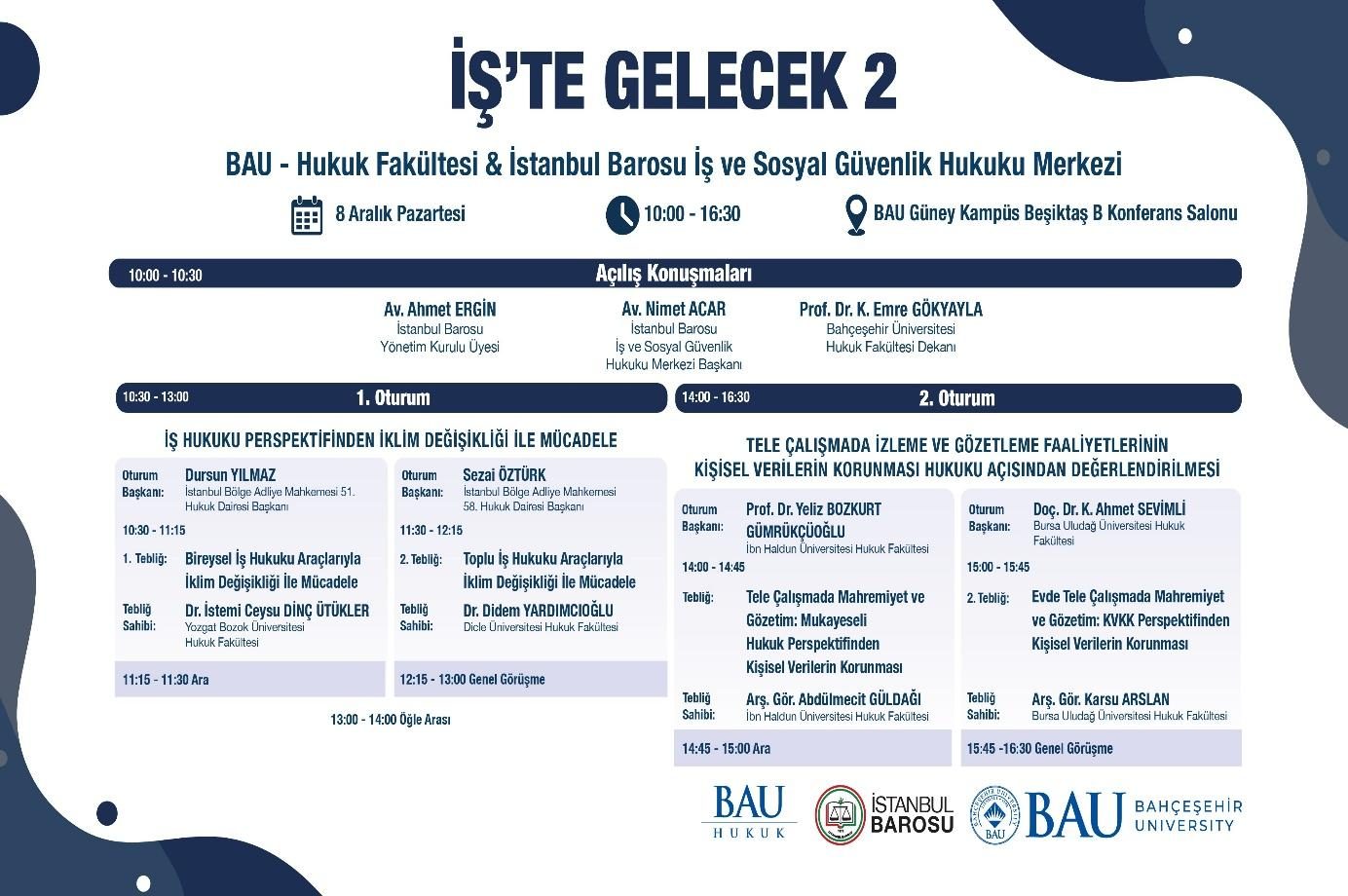
In 2025, Bahçeşehir University (BAU) Faculty of Law, in collaboration with the Istanbul Bar Association and its Labour and Social Security Law Centre, organized “İş'te Gelecek 2” (The Future in Work 2), a specialized legal education and capacity-building programme bringing together policymakers, law makers, legal professionals, representatives of professional legal institutions, and academic experts.
The event provided a platform for policy-oriented education, professional upskilling, and institutional knowledge exchange, focusing on emerging legal and regulatory challenges affecting employment, climate change, and personal data protection. By connecting academic expertise with professional legal practice, the programme supported the development of knowledge relevant to legislative frameworks, regulatory implementation, and public-sector decision-making.
The programme opened with contributions from Attorney Ahmet Ergin, a member of the Istanbul Bar Association Executive Board; Attorney Nimet Acar, President of the Istanbul Bar Association Labour and Social Security Law Centre; and Prof. Dr. K. Emre Gökyayla, Dean of BAU Faculty of Law. Their participation highlighted the collaboration between higher education and professional legal institutions in strengthening legal education and institutional capacity.
The first session, “Combating Climate Change from a Labour Law Perspective,” examined the role of individual and collective labour law instruments in addressing climate-related challenges. Expert presentations explored how employment legislation, workplace responsibilities, and collective legal mechanisms can contribute to climate action, providing participants with policy-relevant knowledge for adapting labour regulations to environmental challenges.
The second session, “Protection of Personal Data in Remote Work Monitoring and Surveillance Activities,” addressed the legal implications of employee monitoring, privacy rights, and personal data protection in remote working arrangements. Discussions examined the application of legal safeguards and regulatory principles to workplace surveillance, contributing to a deeper understanding of how employment practices can be aligned with data protection requirements.
Through these expert-led educational sessions, the programme contributed to the education, upskilling, and capacity development of policymakers, legal practitioners, and institutional decision-makers. It strengthened understanding of the intersection between labour legislation, climate governance, digital workplace regulation, and fundamental rights, supporting more informed approaches to policy development, legal interpretation, and regulatory enforcement.
The collaboration between BAU Faculty of Law and the Istanbul Bar Association reinforced the university's role in providing specialized legal education beyond the academic community and facilitating knowledge transfer between legal professionals, policymakers, and institutions involved in the development and application of legal frameworks.
The initiative contributed primarily to SDG 16 (Peace, Justice and Strong Institutions) through legal education, institutional cooperation, and capacity building in regulatory governance. It also supported SDG 8 (Decent Work and Economic Growth) through labour rights and employment regulation, SDG 13 (Climate Action) through climate-related legal education, and SDG 4 (Quality Education) through professional learning and upskilling.
11. Bahçeşehir University Constitutional Law Education and Capacity Building for Law Makers, Policymakers and Legal Professionals: The Role of Constitutional Courts in the Formation of Law
The image below presents the official programme of the international symposium held in 2025, documenting the institutional collaboration between Bahçeşehir University, the Constitutional Court of Türkiye, and the University of Greenwich, as well as the participation of a Constitutional Court member, legal scholars, and experts in constitutional adjudication.
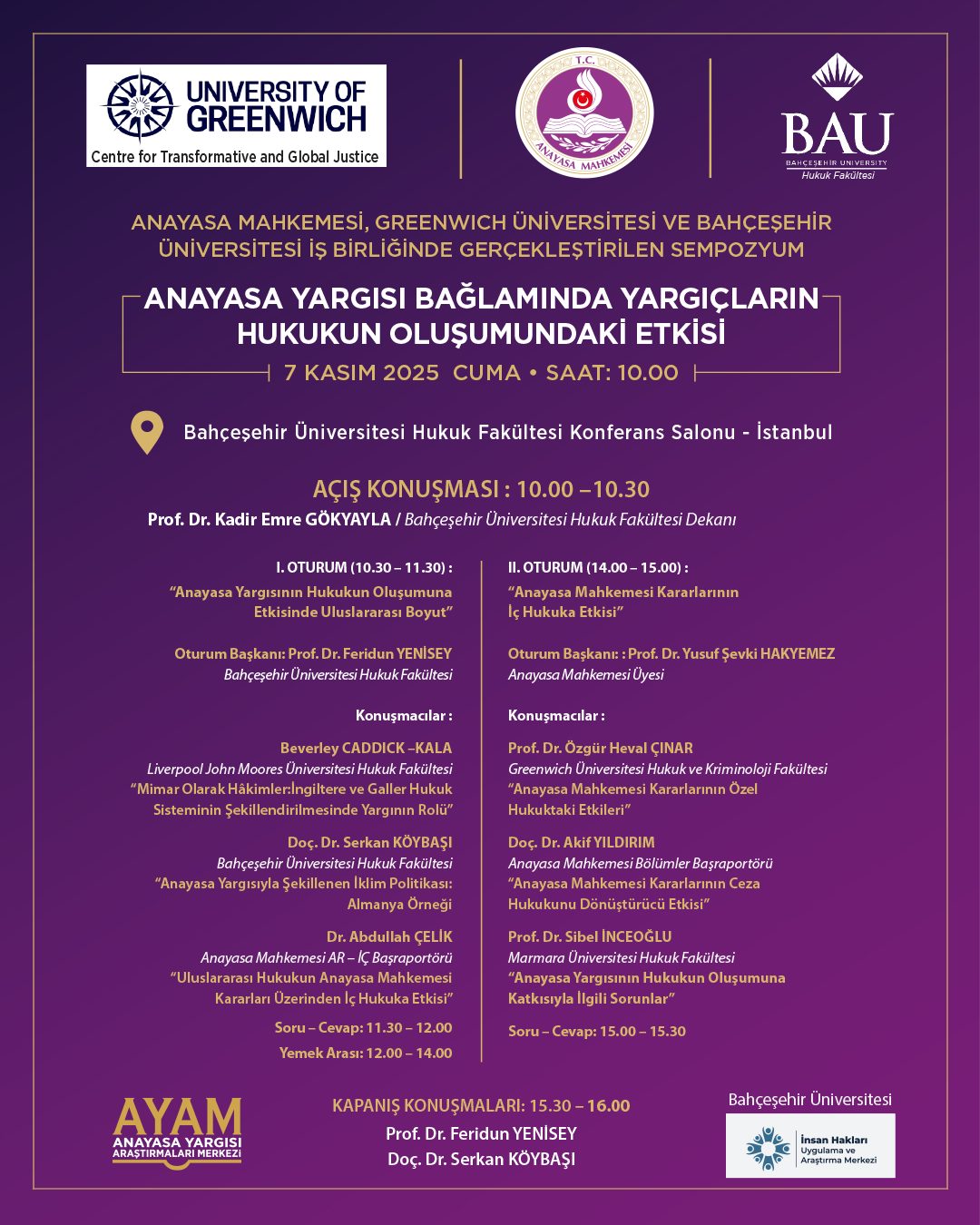
In 2025, Bahçeşehir University (BAU) Faculty of Law, in collaboration with the Constitutional Court of Türkiye and the University of Greenwich, organized an international symposium entitled “The Role of Judges in the Formation of Law in the Context of Constitutional Adjudication.” The event brought together policymakers, members of the judiciary, legal professionals, constitutional law scholars, and academic experts for advanced legal education, professional knowledge exchange, and capacity building in constitutional governance.
The symposium provided a specialized educational platform addressing the role of constitutional courts and judges in interpreting legislation, shaping legal principles, protecting fundamental rights, and contributing to the development of law. By connecting judicial experience with academic research and comparative legal perspectives, the programme supported policy-oriented education, legal upskilling, and institutional capacity development relevant to lawmakers, policymakers, and judicial decision-makers.
The programme opened with remarks by Prof. Dr. Kadir Emre Gökyayla, Dean of BAU Faculty of Law, and featured contributions from Prof. Dr. Yücel Şevki Hakyemez, a member of the Constitutional Court of Türkiye; Beverley Caddick-Kala from Liverpool John Moores University; Prof. Dr. Serkan Köybaşı and Dr. Abdullah Çelik from BAU; and Prof. Dr. Özgür H. Çınar, Dr. Akyıldırım, and Prof. Dr. Sibel İnceoğlu, who addressed different dimensions of constitutional adjudication, judicial interpretation, and the role of courts in legal development.
The educational sessions examined the influence of constitutional adjudication on the formation of law, the role of international legal principles, the impact of constitutional court judgments on legal interpretation, and the relationship between judicial decision-making and legislative frameworks. Particular attention was given to how constitutional courts contribute to the protection of fundamental rights, the development of legal standards, and the practical implementation of constitutional principles.
The direct involvement of a serving Constitutional Court member, alongside international scholars and legal experts, provided participants with valuable judicial and comparative perspectives. This strengthened the programme's contribution to the education, upskilling, and capacity building of policymakers, judicial professionals, and legal institutions, particularly in constitutional interpretation, judicial accountability, and the rule of law.
Through expert-led presentations and discussions, the symposium facilitated knowledge transfer between constitutional judicial institutions, academia, and legal practitioners, supporting more informed approaches to legal interpretation, legislative development, institutional decision-making, and rights-based governance.
The initiative contributed primarily to SDG 16 (Peace, Justice and Strong Institutions) through advanced legal education, judicial capacity development, and the promotion of constitutional governance and the rule of law. It also supported SDG 4 (Quality Education) through specialized professional learning and SDG 17 (Partnerships for the Goals) through cooperation among BAU, the Constitutional Court of Türkiye, and the University of Greenwich.
12. Bahçeşehir University's Consumer Law Symposium in Collaboration with Istanbul Arel University and the Confederation of Consumer Organizations (TÖK): Policy Education, Capacity Building and Cross-Sectoral Dialogue on Consumer Rights and Regulatory Governance
The image below presents the official programme of the 2nd Symposium on Current Issues in Consumer Law, held on 14 March 2025, documenting the collaboration among universities and consumer protection organizations, as well as the participation of public-sector representatives, legal professionals, and experts in consumer law and regulatory governance.
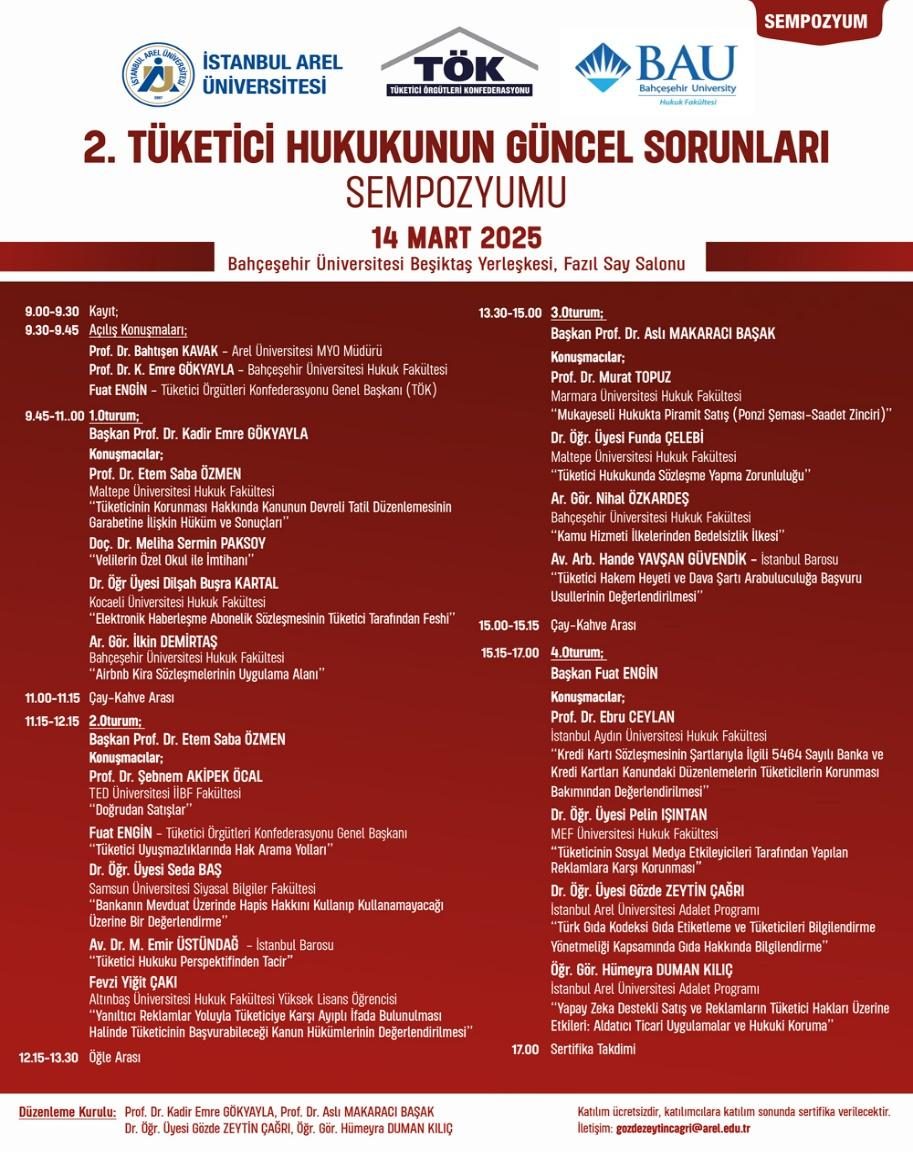
On 14 March 2025, Bahçeşehir University (BAU), in collaboration with Istanbul Arel University and the Confederation of Consumer Organizations (TÖK), a non-governmental organization (NGO) representing consumer rights organizations in Türkiye, organized the “2nd Symposium on Current Issues in Consumer Law”, bringing together policymakers, public-sector representatives, legal professionals, law makers, consumer rights organizations, regulatory stakeholders, and academic experts for specialized legal education and capacity building.
The symposium provided a platform for policy-oriented education, professional upskilling, and institutional knowledge exchange on consumer protection legislation, regulatory enforcement, and emerging challenges in consumer markets. By connecting academic expertise with public institutions, legal practitioners, and civil society organizations, the programme supported knowledge development relevant to consumer policy formulation, legal implementation, and institutional decision-making. It also facilitated cross-sectoral dialogue among academia, government institutions, professional organizations, and NGOs on shared challenges related to consumer rights, responsible market practices, and access to justice.
The programme featured contributions from representatives of the Ministry of Trade, the Istanbul Bar Association, the Consumer Confederation (TÖK), alongside legal scholars and practitioners from participating universities. Their involvement brought together regulatory, professional, and civil society perspectives, strengthening the exchange of practical knowledge on consumer rights and the effectiveness of consumer protection mechanisms.
The educational sessions examined consumer rights under Turkish legislation, unfair commercial practices, consumer dispute resolution, digital consumer protection, misleading advertising, product and service liability, and the responsibilities of regulatory and judicial institutions. Discussions addressed contemporary challenges in applying consumer protection rules and ensuring that legal safeguards remain effective as markets and commercial practices evolve.
Particular attention was given to the role of public authorities, consumer protection organizations, and legal institutions in enforcing consumer rights, improving regulatory oversight, and ensuring access to effective remedies. The participation of consumer advocacy organizations also introduced civil society perspectives on regulatory gaps and emerging consumer protection needs, contributing to policy-relevant dialogue and institutional learning.
Through expert-led presentations and discussions, the symposium contributed to the education, upskilling, and capacity development of policymakers, public-sector representatives, and legal professionals, strengthening their understanding of consumer protection legislation, regulatory responsibilities, and rights-based approaches to market governance.
By facilitating knowledge exchange among universities, public authorities, professional legal institutions, and consumer advocacy organizations, BAU supported evidence-informed policymaking, effective regulatory implementation, and institutional capacity building in consumer protection. The collaboration with TÖK as an NGO, alongside government representatives and academic institutions, further demonstrated BAU's role in facilitating cross-sectoral dialogue and multi-stakeholder cooperation on SDG-related legal, social, and regulatory challenges.
The initiative contributed primarily to SDG 16 (Peace, Justice and Strong Institutions) through legal education, access to justice, regulatory accountability, and stronger consumer protection institutions. It also supported SDG 12 (Responsible Consumption and Production) through fair and transparent market practices, SDG 4 (Quality Education) through specialized professional learning, and SDG 17 (Partnerships for the Goals) through cross-sectoral dialogue and cooperation among academic institutions, government authorities, professional legal bodies, and civil society organizations, including NGOs.
13. Strengthening Child Protection and Public-Sector Capacity: BAU's Contribution to Specialized Training for Ministry Personnel
The image below documents the practitioner training held in Ankara on 12–16 May 2025, demonstrating the specialized capacity-building programme delivered to 50 Ministry professionals with the academic contribution of BAU faculty member Prof. Dr. Özlem Karaırmak.
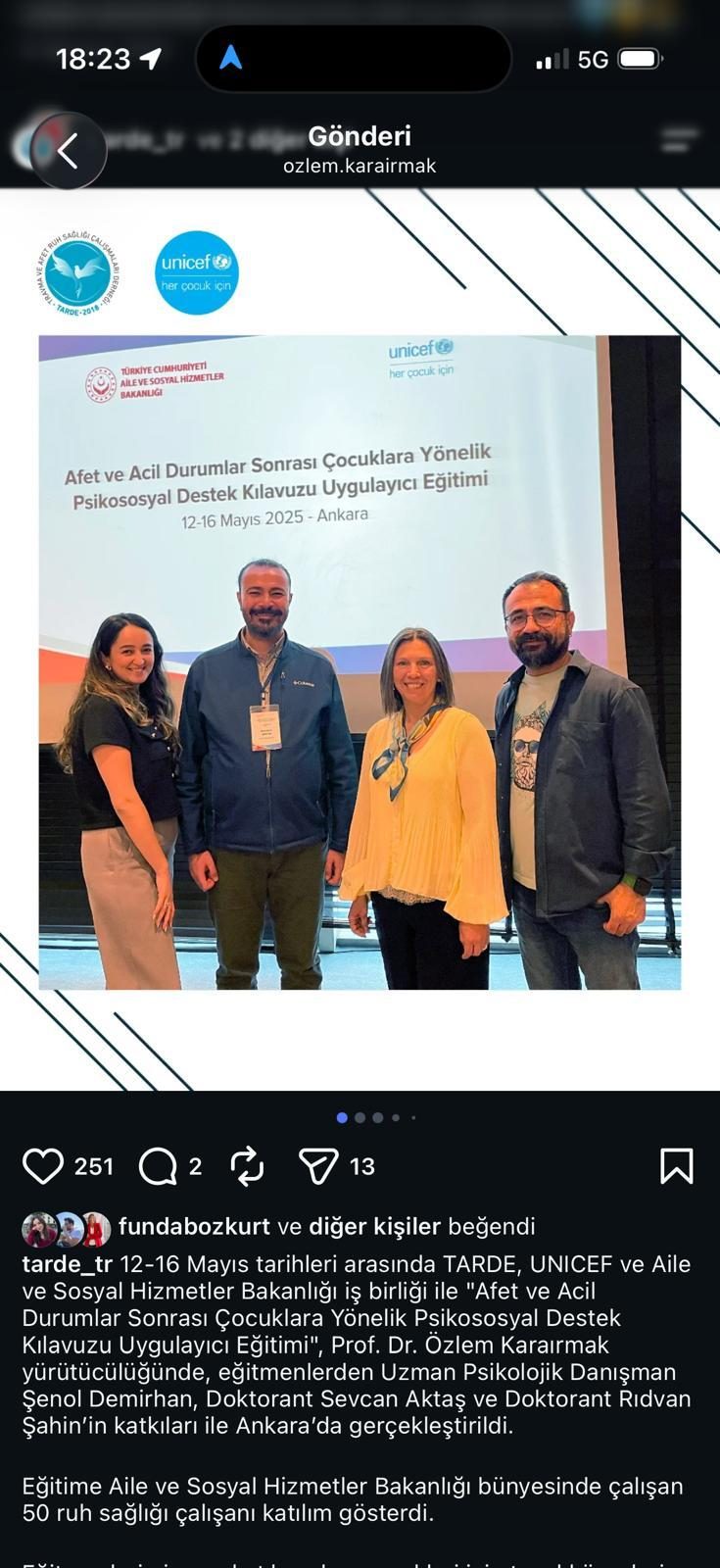
Between 12 and 16 May 2025, Bahçeşehir University (BAU) contributed to a five-day practitioner training programme entitled “Post-Disaster and Emergency Psychosocial Support Guide for Children”, held in Ankara through collaboration among the Trauma and Disaster Mental Health Studies Association (TARDE), UNICEF, and the Ministry of Family and Social Services of the Republic of Türkiye.
BAU's contribution was provided through Prof. Dr. Özlem Karaırmak, a faculty member of the University's Department of Guidance and Psychological Counseling, who led the training alongside expert trainers Şenol Demirhan, Sevcan Aktaş, and Rıdvan Şahin. The programme delivered specialized professional education to 50 mental professionals employed by the Ministry, directly supporting public-sector capacity development in child protection and disaster response.
The training focused on strengthening participants' knowledge and practical competencies in child-sensitive psychosocial support, post-disaster interventions, emergency response coordination, and the protection of children affected by crises. By connecting academic expertise with the operational responsibilities of Ministry personnel, the programme supported the translation of specialized knowledge into effective public service delivery.
Through Prof. Dr. Karaırmak's leadership, BAU directly contributed to the education, professional upskilling, and capacity building of public-sector practitioners responsible for implementing child protection and emergency response policies. This contribution strengthened institutional expertise and supported more coordinated, informed, and child-sensitive approaches to psychosocial interventions during disasters and emergencies.
The initiative contributed primarily to SDG 16 (Peace, Justice and Strong Institutions) by strengthening the professional capacities of government personnel and supporting effective, responsive child protection institutions. It also advanced SDG 3 (Good Health and Well-being) through psychosocial support, SDG 4 (Quality Education) through specialized professional training, and SDG 17 (Partnerships for the Goals) through cooperation among public institutions, civil society, UNICEF, and academic expertise.
14. BAU Rotary Peace Center – A Neutral Platform for Peacebuilding and Policy Development in the MENA Region
The image below shows a screenshot from the official Rotary International website indicating that Bahcesehir University hosts a Rotary Peace Center, serving as a neutral platform for peacebuilding and policy development in the MENA region.

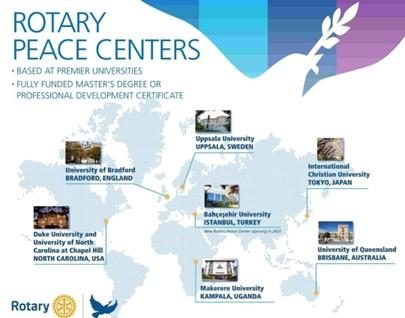
Bahçeşehir University (BAU) plays an active role in advancing peacebuilding, inclusive governance, international policy dialogue, and institutional capacity development through the BAU Otto and Fran Walter Rotary Peace Center, established at the University in partnership with Rotary International. The Centre's work is further supported by BAU's institutional partnership with the United Nations Institute for Training and Research (UNITAR) through CIFAL Istanbul. Serving the Middle East and North Africa (MENA) region, the Centre positions BAU as an international academic platform where policymakers, government representatives, civil society leaders, academics, international organizations, and peacebuilding professionals can engage in constructive dialogue on complex regional and global challenges.
The Centre reflects BAU's commitment to providing a safe, inclusive, and politically neutral environment for dialogue among individuals representing different countries, institutional backgrounds, political perspectives, and professional experiences. By encouraging open discussion, mutual understanding, and the exchange of diverse viewpoints, BAU facilitates engagement across political, cultural, and institutional boundaries, supporting collaborative approaches to conflict resolution, sustainable governance, and policy development.
Through its academic programmes, BAU combines capacity building, policy-oriented education, expert consultations, and practical field engagement. The Centre brings together Rotary Peace Fellows and professionals from across the MENA region, equipping participants with knowledge and practical skills in peacebuilding, conflict transformation, humanitarian diplomacy, migration, climate resilience, community development, and sustainable governance. Its academic coursework, workshops, seminars, and field-based projects strengthen participants' abilities to address complex challenges and contribute to informed institutional and policy responses.
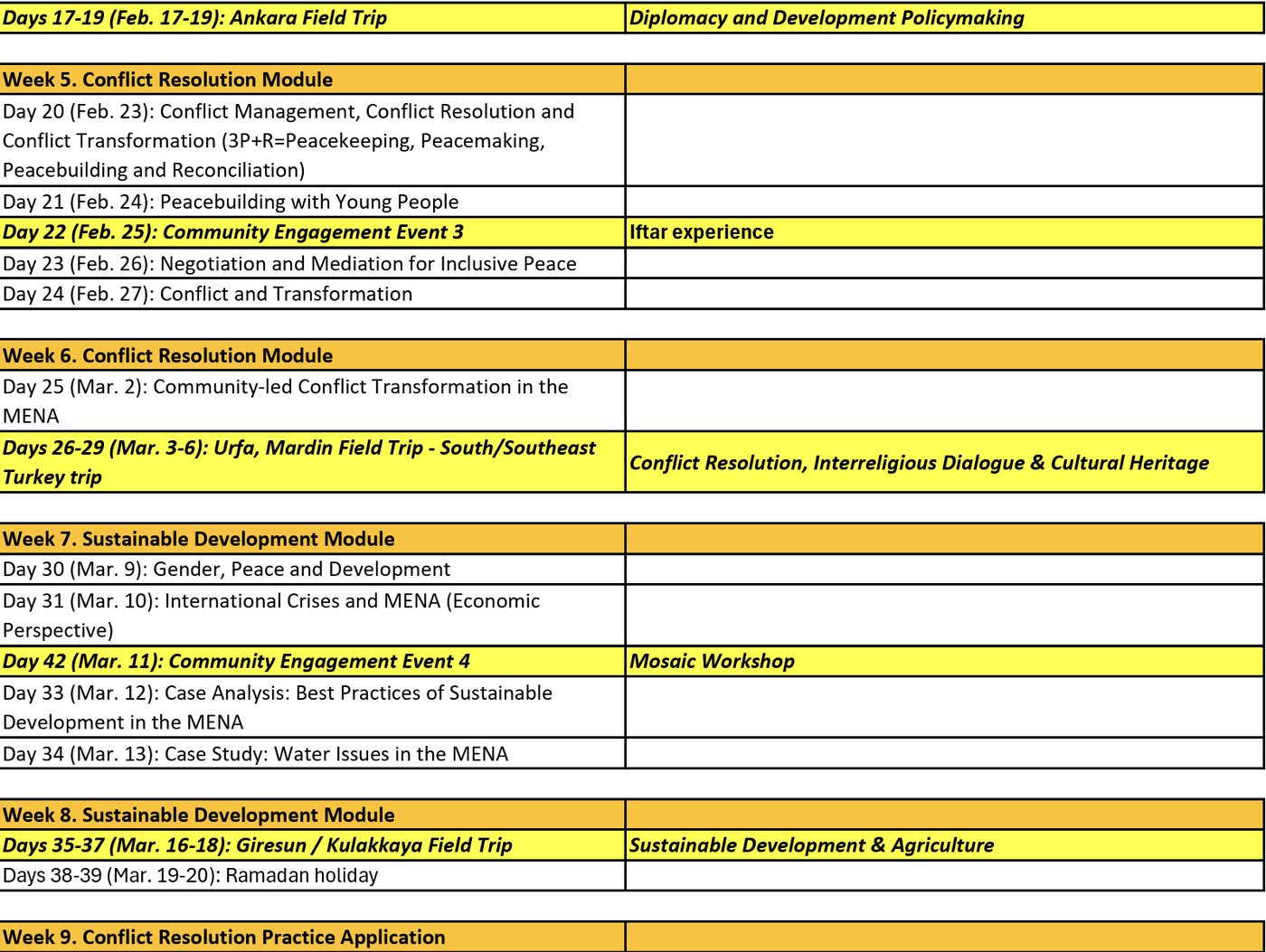
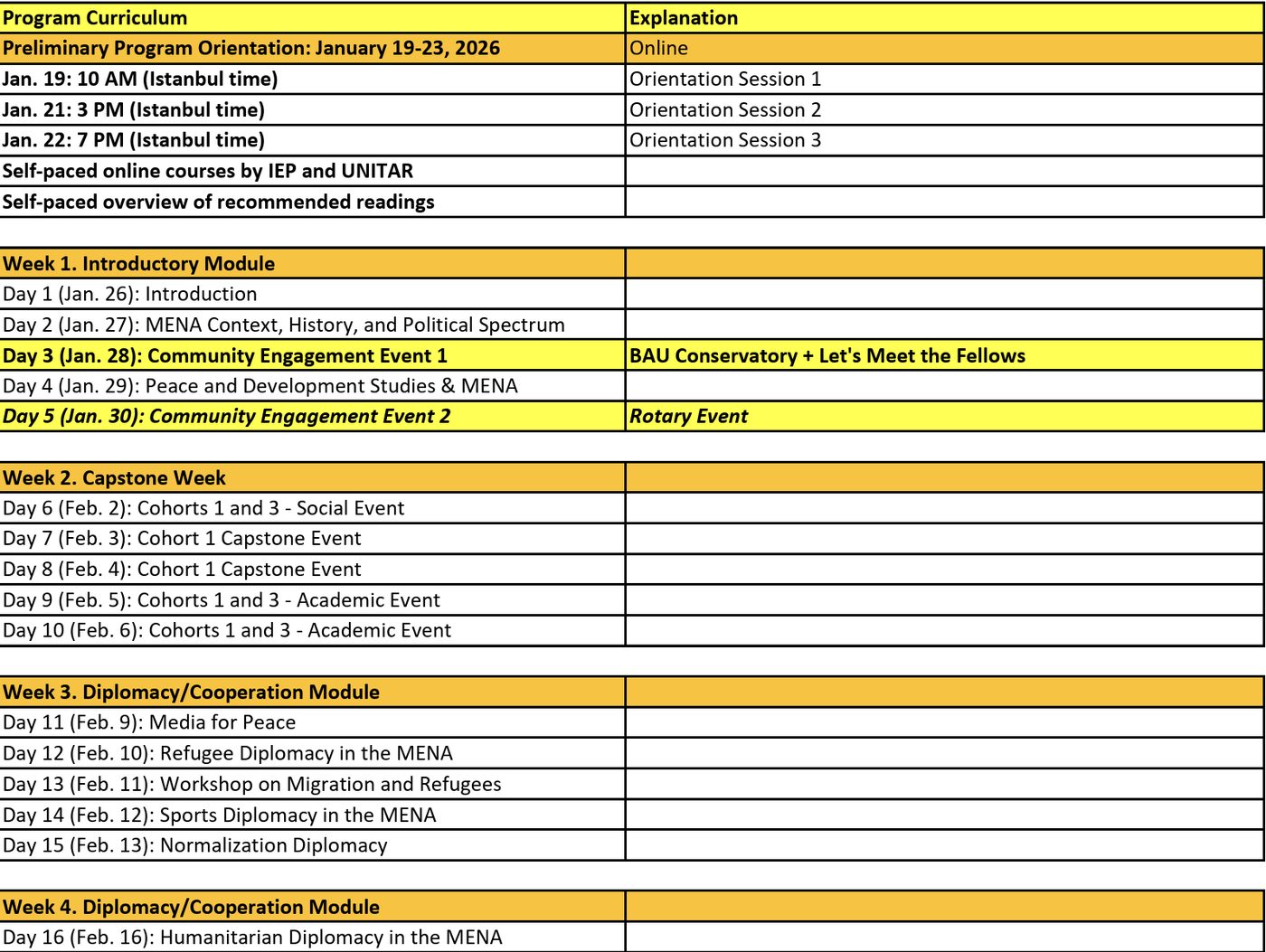
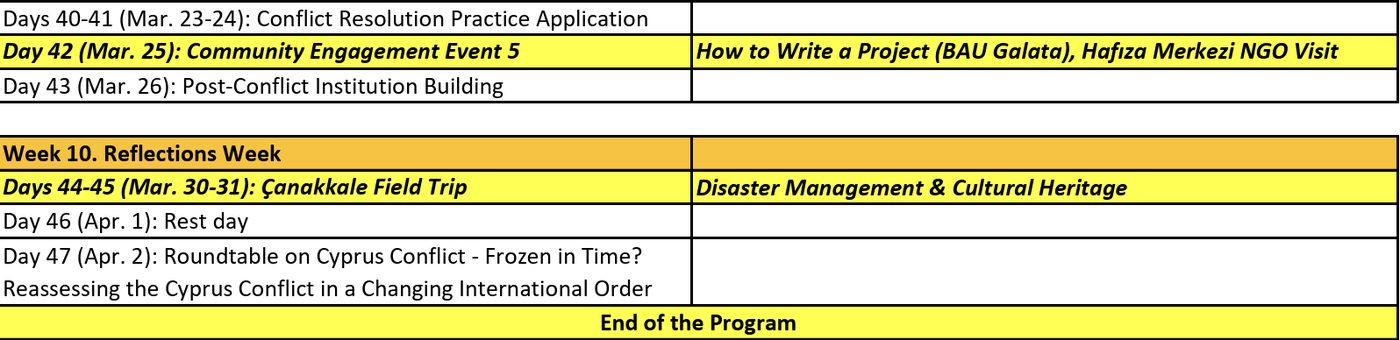
The Centre's ten-week certificate programme has brought together Rotary Peace Fellows from the Philippines, Egypt, Iraq, the United States, Italy, India, Canada, Brunei, Syria, and Indonesia, including professionals engaged in policy development, law-making, public administration, and institutional decision-making in their respective countries. Through a MENA-focused curriculum addressing displacement, refugee diplomacy, migration and refugees, humanitarian diplomacy, climate-related challenges, sustainable development, conflict resolution, and post-conflict institution building, BAU provides targeted capacity building for policymakers and legal professionals, strengthening their abilities in evidence-informed policy formulation, regulatory development, institutional governance, policy implementation, and cross-sectoral coordination. While studying these interconnected issues in Türkiye, the Fellows contribute comparative legal, political, and institutional perspectives from their own national contexts. This reciprocal exchange enables BAU to strengthen policy-oriented dialogue and institutional capacity within Türkiye while extending its impact internationally, as Fellows return to their countries equipped to adapt the knowledge, analytical tools, and governance approaches developed through the programme to their own laws, policies, public institutions, and communities.
A major milestone in 2025 was the Rotary Presidential Peace Conference, “Healing in a Divided World,” held in Istanbul on 20–22 February 2025. Organized under the leadership of Rotary International President Stephanie Urchick, with Bahcesehir University playing a prominent institutional and academic hosting role through the BAU Otto and Fran Walter Rotary Peace Center, the conference brought together more than 1,000 participants from over 80 countries, including international leaders, policymakers, peacebuilding practitioners, academic experts, NGO representatives, and stakeholders from diverse political and institutional backgrounds.
The conference provided an international platform for dialogue across differing perspectives, enabling participants to exchange experiences, examine shared challenges, and explore collaborative responses to issues affecting peace, governance, and sustainable development. Discussions addressed conflict prevention, social polarization, reconciliation, climate diplomacy, environmental challenges, and the role of institutions and communities in building sustainable peace.
BAU contributed directly to the conference's international academic and policy dialogue. BAU Rector Prof. Dr. Esra Hatipoğlu delivered a keynote address, while Prof. Dr. Esra Albayrakoğlu, Academic Director of the BAU Otto and Fran Walter Rotary Peace Center, contributed a session on Climate Diplomacy, connecting environmental challenges with international cooperation and peacebuilding strategies.
Beyond facilitating dialogue, the conference and the Centre's continuing activities support policy development and institutional capacity building by connecting academic research, policymaking perspectives, and practical experience. These exchanges create opportunities to identify emerging policy priorities, examine institutional and governance challenges, share evidence-informed approaches, and strengthen the capacity of participants to contribute to policy formulation and implementation within their respective organizations and communities.
The Centre also serves as a mechanism for international knowledge exchange and cross-sectoral cooperation, bringing together stakeholders who may hold different political positions or represent institutions with distinct priorities. Through this inclusive approach, BAU promotes constructive engagement, mutual learning, and collaborative problem-solving, reinforcing the importance of dialogue and institutional cooperation in addressing interconnected global challenges.
At the regional and global levels, BAU's participation in Rotary International's peacebuilding network, alongside its wider cooperation with UNITAR, strengthens its international engagement in sustainable development, peace education, and institutional capacity building. These partnerships support knowledge exchange among academic institutions, international organizations, governments, and NGOs and reinforce BAU's contribution to policy-oriented discussions on peace and sustainable governance.
Through the BAU Otto and Fran Walter Rotary Peace Center and its active participation in the 2025 Rotary Presidential Peace Conference, Bahçeşehir University contributes simultaneously to international policy dialogue, peacebuilding capacity development, inclusive stakeholder engagement, and evidence-informed approaches to sustainable governance. The initiative demonstrates BAU's role as a trusted academic convenor that connects individuals and institutions across different backgrounds, strengthens their capacity to address complex challenges, and supports cooperation on shared sustainable development priorities.
This engagement contributes directly to SDG 16 (Peace, Justice and Strong Institutions) through peacebuilding, inclusive dialogue, and institutional governance; SDG 17 (Partnerships for the Goals) through international cooperation and multi-stakeholder engagement; and SDG 4 (Quality Education) through professional education and capacity development. It also supports SDG 10 (Reduced Inequalities) through inclusive participation and dialogue across diverse backgrounds, and SDG 13 (Climate Action) through climate diplomacy and discussions connecting environmental challenges with peacebuilding and international cooperation.
The images below represents the official 10-week curriculum, including modules which focused on displacement, refugee diplomacy, migration and refugees, humanitarian diplomacy, climate-related challenges, sustainable development, conflict resolution, and post-conflict institution building
15. Bahçeşehir University Global Leadership Forum: Ongoing Policy Education, Capacity Building, Leadership Development and a Neutral Platform for International Dialogue Since 2021
The images below show highlight pictures of BAU Global Leadership Forum.
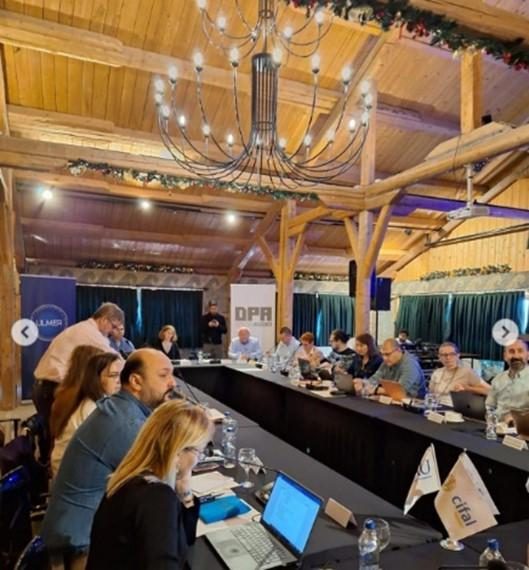
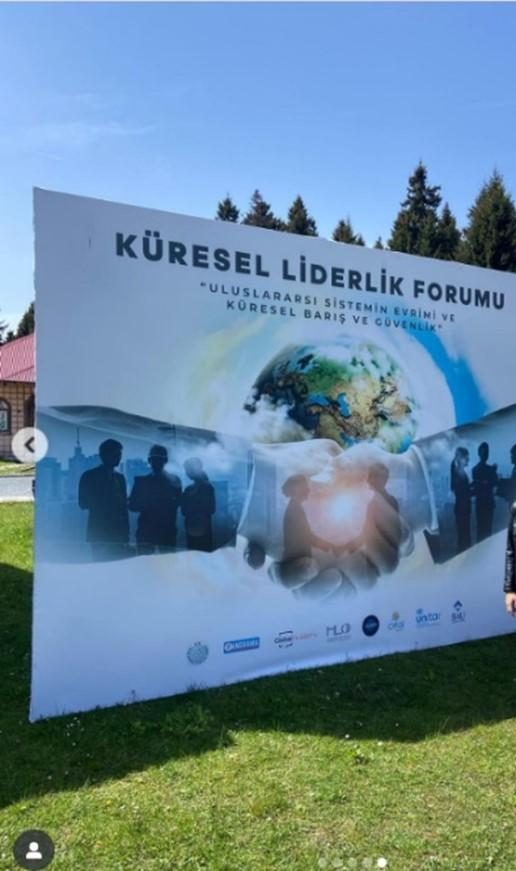
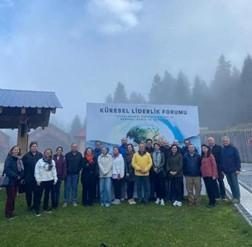
Since its establishment in 2021, Bahçeşehir University (BAU) has developed the Global Leadership Forum as an ongoing platform for policy-oriented education, leadership development, and inclusive dialogue on international affairs, governance, peace, and security. Led by BAU's International Leadership Practice and Research Center (ULMER) and Government and Leadership School (HLO), the initiative reflects the University's sustained commitment to connecting academic expertise with the professional development of policymakers, public officials, and individuals engaged in public affairs, while providing an academic environment for the exchange of diverse perspectives on international and political issues.
Organized in the 2024-2024 academic year, in cooperation with academic and institutional partners, including Global Akademi, and supported across its documented editions by organizations such as the Council on International Relations (UİK), Panorama Portal, and UNITAR-affiliated CIFAL Istanbul, the forum brings together policymakers, local government representatives, diplomats, academics, and experts from diverse professional, institutional, academic, and political backgrounds. By facilitating engagement among individuals representing different institutions, experiences, and perspectives, the forum creates opportunities for dialogue across professional and political viewpoints. This collaborative approach also supports SDG 17 (Partnerships for the Goals) through institutional cooperation, interdisciplinary knowledge exchange, and engagement across academic, public-sector, and international networks.
The Global Leadership Forum is structured around evolving themes that reflect emerging international developments and changing policy priorities. Its thematic agenda encompasses the transformation of the international system, the emergence of a new world order, shifting global power dynamics, regional peace and stability, and contemporary challenges to international security. Discussions also explore the changing balance between global and regional powers, the future of multilateral cooperation, geopolitical uncertainty, and the implications of these developments for international governance and public policy. By addressing different dimensions of global leadership and international relations, the forum provides an academic platform for examining complex policy challenges from multiple perspectives.
These thematic discussions are closely connected to SDG 16 (Peace, Justice and Strong Institutions), particularly through their focus on peace, international stability, governance, and the challenges facing public institutions. The forum encourages participants to examine different approaches to international cooperation, conflict resolution, and institutional responses to complex geopolitical developments, contributing to a deeper understanding of issues relevant to effective governance and policymaking.
A central objective of the forum is to strengthen the knowledge, analytical capabilities, and strategic competencies of policymakers, public officials, and policy practitioners. Through expert-led presentations, policy analysis, and interactive discussions, participants engage with issues concerning international governance, conflict resolution, institutional resilience, and global cooperation. The forum's educational approach connects academic knowledge with contemporary policy challenges, contributing to professional upskilling and capacity building in areas relevant to effective leadership and evidence-informed policymaking.
This educational dimension also contributes to SDG 4 (Quality Education) by extending university-based learning opportunities to professional audiences and supporting interdisciplinary knowledge exchange and continuing professional development.
A Neutral and Inclusive Platform for Dialogue Across Diverse Perspectives
Beyond its educational function, the Global Leadership Forum provides an academically guided, inclusive, and politically neutral environment for dialogue among stakeholders representing different perspectives, institutional interests, and professional backgrounds. Held during the 2024-2025 academic year, the forum creates opportunities for individuals with diverse political viewpoints, academic approaches, and institutional experiences to engage in constructive discussions on international affairs, governance, peace, and security.
An important characteristic of the forum is its emphasis on open academic exchange. Participants are encouraged to examine different interpretations of international developments, challenge assumptions, exchange arguments, and engage respectfully with perspectives that may differ from their own. This approach is particularly relevant when discussing sensitive and contested issues such as geopolitical tensions, regional conflicts, international security, and global governance.
By bringing together individuals from different professional, institutional, and political backgrounds, BAU provides an academic setting in which diverse and potentially contrasting viewpoints can be expressed, examined, and discussed through constructive dialogue. The forum's emphasis on respectful disagreement, critical reflection, and mutual understanding supports meaningful engagement across differences while maintaining an educational and academically grounded approach.
This dialogue-oriented dimension strengthens the forum's relevance to SDG 16 (Peace, Justice and Strong Institutions) by encouraging peaceful engagement, mutual understanding, and informed discussion on international and governance-related challenges. It also reinforces SDG 17 (Partnerships for the Goals) by facilitating communication, cooperation, and knowledge exchange among stakeholders from different institutional and professional backgrounds.
The combination of policy-oriented education and dialogue across political, institutional, and professional perspectives supports leadership development while strengthening connections between academia, public institutions, and international organizations. Through this ongoing initiative, BAU promotes knowledge exchange, institutional cooperation, and informed approaches to complex governance challenges.
Overall, the Global Leadership Forum contributes to three interconnected Sustainable Development Goals: SDG 16 (Peace, Justice and Strong Institutions), through policy education, professional capacity building, peaceful dialogue, and governance-related discussions; SDG 17 (Partnerships for the Goals), through institutional cooperation and knowledge exchange across diverse stakeholders; and SDG 4 (Quality Education), through interdisciplinary learning and professional development. Together, these dimensions reflect BAU's broader commitment to supporting informed leadership, international understanding, and constructive academic dialogue on contemporary global challenges.
16. BAU Politics School: A Safe and Neutral Platform for Cross-Political Dialogue and Capacity Building
The images below highlight selected promotional posters and programme announcements from BAU Politics School, illustrating the range of topics addressed and the School's ongoing commitment to political dialogue, policy-oriented education, and leadership development within a neutral academic environment.
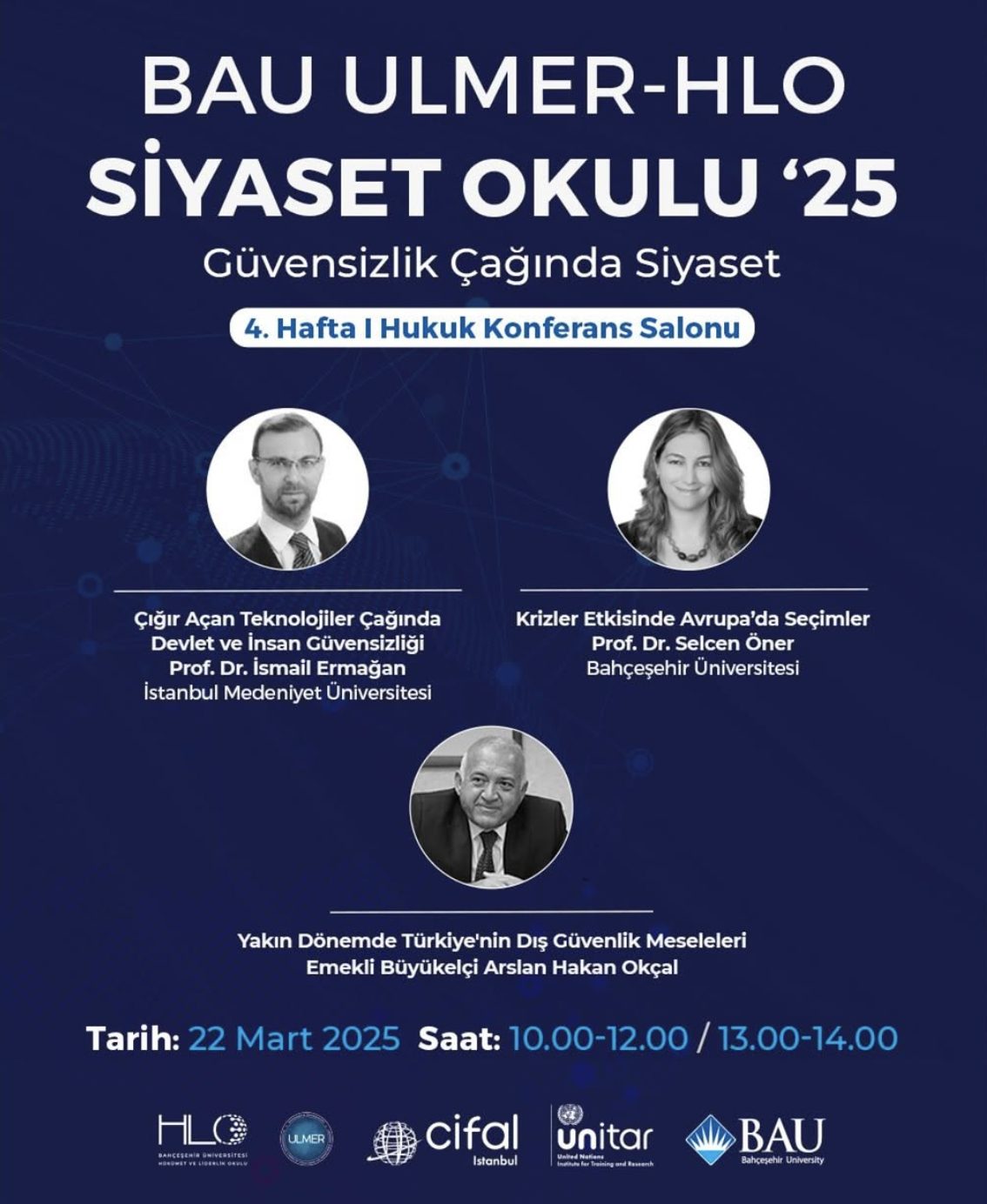
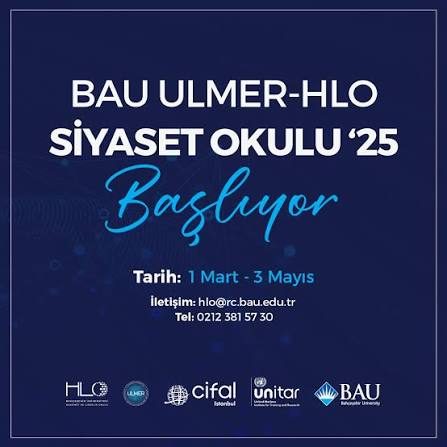
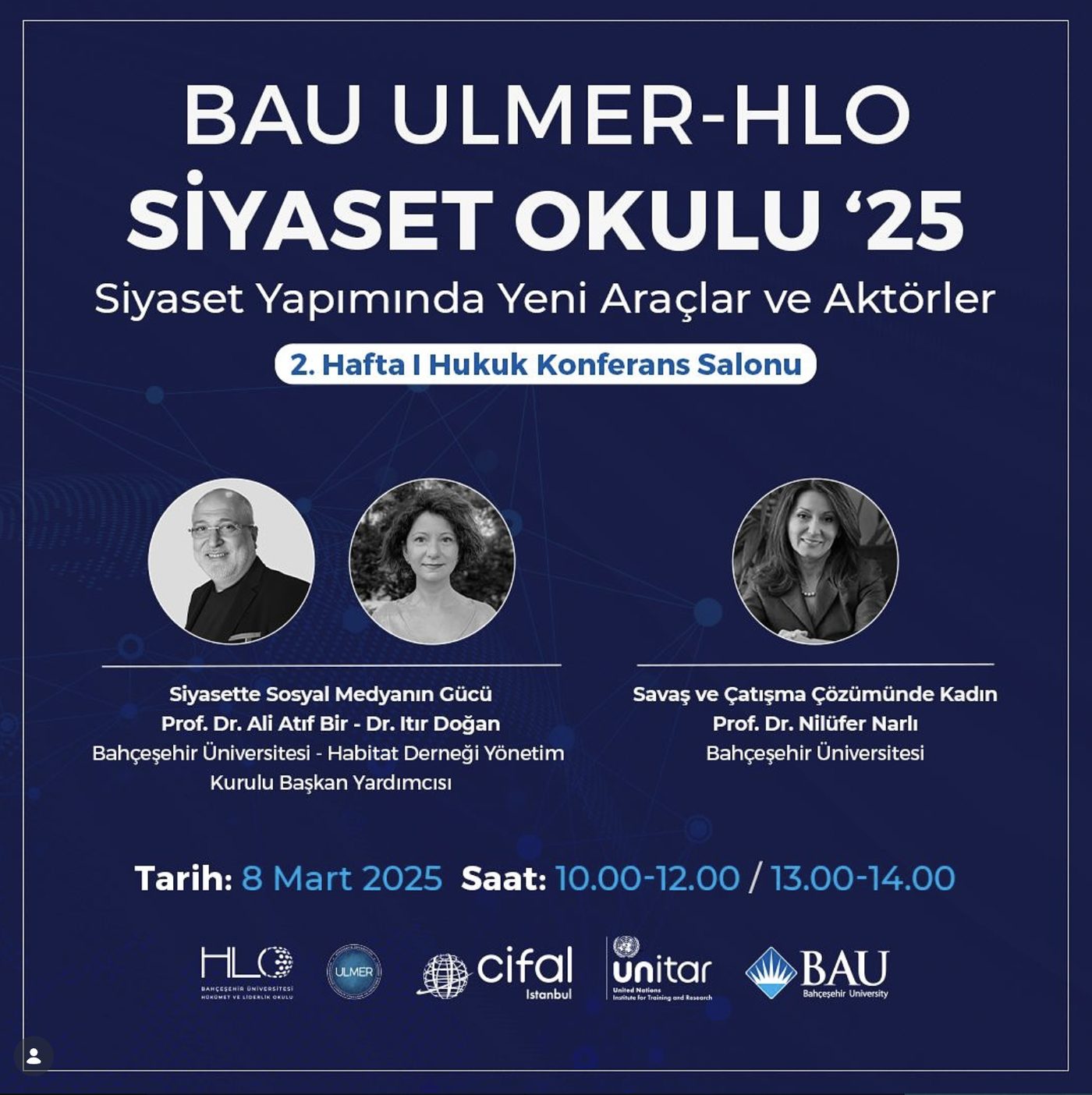
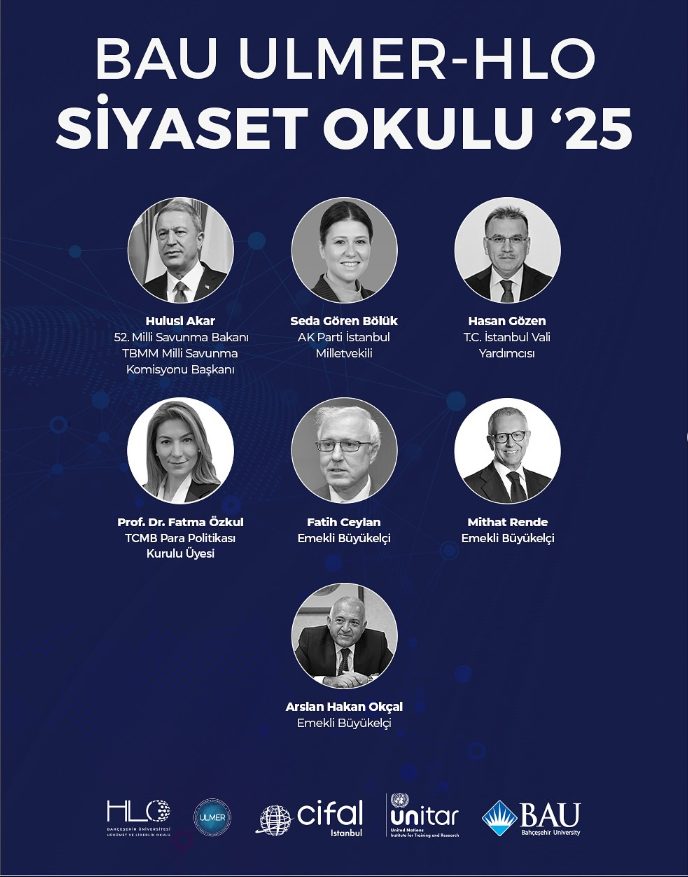
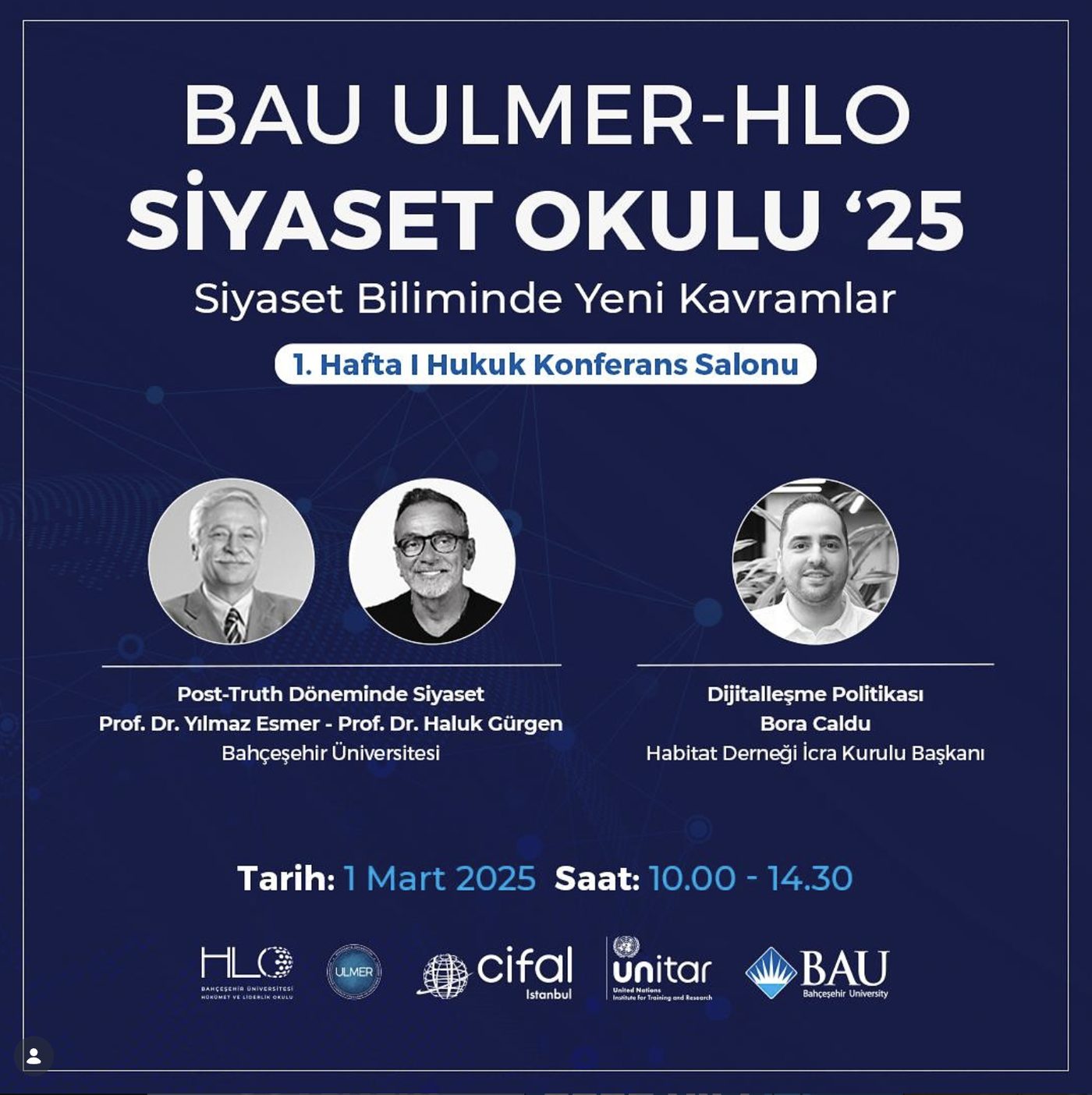
The image below shows the official promotional poster and the content of Bahcesehir University’s Politics School 2024.
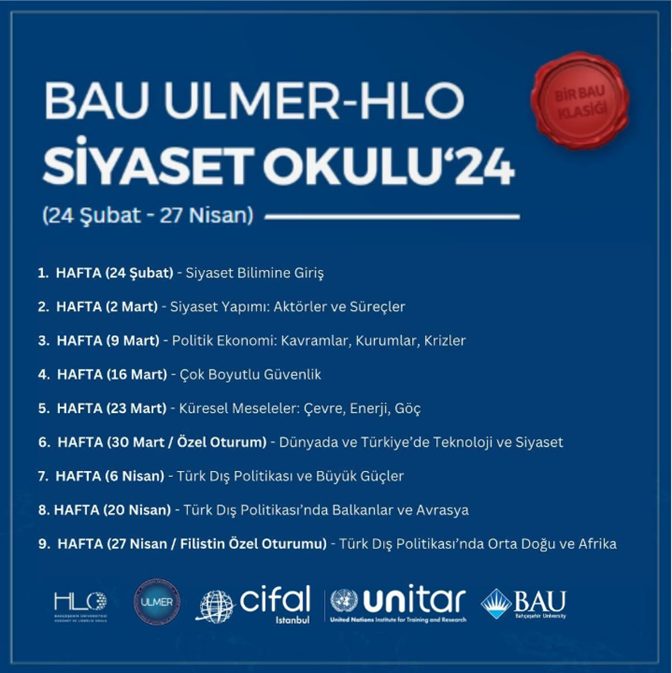
Established under Bahçeşehir University's International Leadership Practice and Research Center (ULMER), the BAU Politics School, operating within the framework of the Government Leadership School, has been a pioneering initiative in Türkiye for over two decades. As one of the country's longest-standing university-based political education and leadership programmes, it provides a neutral, academically grounded, inclusive, and safe environment for political dialogue, policy-oriented learning, and leadership development.
The programme serves two complementary purposes: providing a non-partisan platform where individuals representing different political perspectives can engage in constructive dialogue, and strengthening the knowledge, analytical skills, and policy-making capacities of current and future political and public-sector leaders. By integrating these functions within a university setting, BAU Politics School contributes to informed public debate, professional development, and the exchange of ideas across political and institutional boundaries.
Importantly, the School is not limited to conventional classroom-based education. Its distinctive approach combines academic learning with structured opportunities for dialogue, allowing participants to move beyond theoretical knowledge and engage with different political interpretations, competing policy priorities, and alternative approaches to public challenges. The educational component provides a shared foundation for discussion, while the dialogue component creates space for different viewpoints to be expressed, questioned, and considered within a neutral academic setting.
A Neutral, Safe and Non-Partisan Platform for Political Dialogue
One of the most distinctive features of BAU Politics School is its ability to bring together politicians, lawmakers, policymakers, public officials, academics, and thought leaders from across Türkiye's diverse political spectrum. The programme provides an academically independent and non-partisan environment in which different perspectives can be expressed, examined, and discussed through respectful and evidence-based dialogue.
The concept of a safe and neutral platform is central to the School's institutional identity. Its university-based setting provides common ground for individuals whose political affiliations, ideological positions, or approaches to public policy may differ substantially. Within this environment, participants can engage with sensitive and contested issues without the programme endorsing any particular political perspective or requiring agreement among those involved.
The School promotes academic freedom, openness to differing viewpoints, mutual respect, and constructive engagement, creating opportunities for participants to exchange ideas on complex and sometimes sensitive political, economic, and international issues. Its university-based structure offers a shared educational setting where political differences do not prevent discussion, learning, or professional interaction.
A particularly important feature of the programme is the interaction that follows its academic and expert-led sessions. The issues introduced through lectures and presentations provide a basis for discussion, enabling participants to examine the same policy challenges through different political, institutional, and professional perspectives. These exchanges create opportunities to question assumptions, compare policy alternatives, identify areas of disagreement and shared concern, and develop a more comprehensive understanding of complex public issues.
The value of these discussions lies not in producing a single political position or predetermined consensus, but in enabling different perspectives to contribute to a shared process of critical reflection. In this respect, the programme supports dialogue-based outcomes such as the identification of alternative policy approaches, the exchange of practical experience, and a deeper understanding of the considerations shaping public decisions.
Over the years, BAU Politics School has welcomed distinguished figures including presidents, prime ministers, ministers, ambassadors, members of parliament, and senior bureaucrats. Its extensive alumni network includes 30 members of parliament, 9 ministers, and numerous deputy ministers and senior civil servants representing different political backgrounds.
The participation of individuals from diverse political and professional backgrounds demonstrates the programme's long-standing role as a trusted, cross-partisan platform for dialogue and knowledge exchange. By facilitating encounters between individuals who may hold different views on national and international issues, the School encourages cross-ideological understanding, constructive debate, and engagement with alternative policy perspectives.
Beyond its role as a platform for dialogue, BAU Politics School provides structured policy-oriented education and leadership development relevant to lawmakers, policymakers, political professionals, and public-sector decision-makers.
Through its annually updated curriculum, the programme connects academic knowledge with contemporary governance challenges, developments in political science, international relations, economic transformation, environmental sustainability, and the changing dynamics of public decision-making.
The programme seeks to strengthen participants' capacity to understand complex policy challenges, critically evaluate competing perspectives, interpret political and economic developments, and engage in informed policy discussions. Its educational approach encourages analytical thinking, interdisciplinary understanding, strategic assessment, and the ability to consider the broader societal implications of political decisions.
The learning process extends beyond the delivery of academic content. Expert-led sessions provide the conceptual and analytical foundation, while subsequent discussions encourage participants to apply this knowledge to real-world political and governance challenges. By considering how different political actors interpret the same issues and propose different responses, participants can strengthen their ability to assess policy alternatives, articulate evidence-based arguments, and engage constructively with perspectives other than their own.
By creating direct opportunities for engagement between academic experts, experienced political figures, and participants from different professional backgrounds, the School also supports the exchange of practical experience and academic insight. This combination of academic instruction, expert-led discussion, and cross-sectoral interaction contributes to the continuing education and professional development of individuals involved in, or preparing for, political leadership and public policy processes.
Accordingly, the School's capacity-building contribution is closely connected to its function as a neutral dialogue platform: participants develop not only subject-specific knowledge but also the analytical, deliberative, and communication skills needed to navigate political differences and participate in informed policy discussions.
The 2025 Programme: Contemporary Policy Challenges and Emerging Political Dynamics
During 2025, BAU Politics School continued its policy-oriented educational activities through a curriculum addressing emerging political concepts, new approaches to policymaking, global economic developments, international relations, and major governance challenges. The programme provided an academic framework for examining contemporary issues while encouraging dialogue among participants with differing perspectives and professional experiences.
The curriculum covered nine interconnected areas:
New Concepts in Political Science: Exploring emerging theoretical approaches and conceptual frameworks for understanding contemporary political systems, governance, and societal transformation.
New Tools and Actors in Policymaking: Examining the changing instruments, institutions, stakeholders, and mechanisms influencing political processes and public policy development.
Emerging Trends in the Global Economy: Assessing international economic transformations and their implications for national policy priorities, governance, and strategic decision-making.
Politics in an Age of Insecurity: Discussing political uncertainty, evolving security concerns, and the challenges these developments present for governance and institutional resilience.
Politics in the Shadow of the Climate Crisis: Exploring the political and policy implications of climate change, environmental sustainability, and the transition towards more resilient societies.
Global Energy Balances and Politics: Examining international energy dynamics, energy transitions, and their implications for economic, environmental, and foreign policy.
Türkiye and Transatlantic Relations: Analysing Türkiye's relations with transatlantic actors and institutions within the context of changing international political dynamics.
Türkiye's Regional Policies: Evaluating regional developments, diplomatic priorities, and Türkiye's evolving role in its surrounding geopolitical environment.
Special Topics in Turkish Politics: Providing opportunities to examine selected contemporary issues in Türkiye's political landscape through academic analysis and discussion.
The breadth of the 2025 curriculum reflects the School's commitment to addressing issues directly relevant to contemporary policymaking and public leadership. In particular, its focus on new policymaking tools and actors, global economic change, climate governance, energy politics, and international relations supports participants in developing a more comprehensive understanding of the factors shaping public policy and government decision-making.
Crucially, these topics also provide the starting point for dialogue. Academic presentations and expert contributions establish a common knowledge base, while the discussions that follow allow participants to explore how different political perspectives shape interpretations of the same challenges and lead to different policy responses.
For example, discussions concerning climate policy and global energy balances offer opportunities to consider differing approaches to environmental responsibility, economic development, and energy transition. Similarly, sessions addressing political insecurity, transatlantic relations, and regional policies provide a basis for examining contrasting assessments of international developments and their implications for public decision-making.
Through this combination of learning and dialogue, the programme creates opportunities for participants to compare competing arguments, examine policy trade-offs, and consider alternative responses to contemporary challenges. These deliberative processes represent an important dimension of the School's contribution beyond formal education, helping connect academic knowledge with the diversity of perspectives involved in political and public life.
At the same time, the inclusion of complex and potentially contested political subjects creates opportunities for open, respectful, and academically grounded discussion across differing perspectives, reinforcing the programme's role as a neutral educational forum.
BAU Politics School contributes to SDG 16 (Peace, Justice and Strong Institutions) through its complementary functions as a safe and neutral platform for political dialogue and a university-based capacity-building programme for political and public-sector leadership.
As a safe and non-partisan platform, the School facilitates dialogue among individuals representing different political perspectives and institutional backgrounds. Its emphasis on academic independence, respectful discussion, and the exchange of ideas helps sustain an environment in which complex governance and policy issues can be explored without requiring political consensus.
The programme's contribution extends beyond providing a physical or institutional meeting space. By combining academic presentations with opportunities for cross-political discussion, it creates a structured setting for the exchange of different viewpoints, the examination of competing policy approaches, and the identification of issues that warrant further consideration. Its value as a neutral platform is reflected in its ability to accommodate disagreement while maintaining a shared commitment to informed and respectful dialogue.
As a policy education and capacity-building initiative, the School strengthens access to academic knowledge, expert perspectives, and structured learning opportunities relevant to political leadership, legislative processes, governance, and public policy development. Its longstanding engagement with politicians, lawmakers, ministers, and senior public officials reinforces the connection between higher education and the professional development of public-sector leaders.
Through its structured educational programme and expert-led sessions, BAU Politics School provides policymakers, lawmakers, public officials, and emerging political leaders with opportunities to strengthen their knowledge and competencies in public policy, governance, legislative processes, and evidence-based decision-making.
By combining academic instruction with practical policy discussions, the programme supports continuous professional development and capacity building, equipping participants with analytical and strategic skills relevant to effective policymaking and public leadership.
The integration of academic learning and dialogue also supports the development of skills relevant to public leadership, including critical analysis, evidence-based reasoning, consideration of alternative policy options, and constructive engagement across political differences. In this way, the School contributes to both the knowledge base and the deliberative capacities of individuals involved in political and public-sector environments.
The programme also contributes to SDG 4 (Quality Education) through continuing education and lifelong learning opportunities, and SDG 17 (Partnerships for the Goals) by fostering interaction and knowledge exchange among academic, political, and institutional stakeholders.
Through more than two decades of sustained activity, Bahçeşehir University Politics School demonstrates the University's commitment to providing a trusted academic environment where political diversity, constructive dialogue, policy education, and leadership development can coexist. Its continuing programme in 2025 illustrates how universities can contribute simultaneously to safe and neutral political dialogue and the development of informed, capable, and analytically equipped political and public-sector leaders.











