EN
16.3.1 - Providing Expert Advice to the Government
Bahçeşehir University (BAU) actively engages with local, regional, and national government bodies by providing expert advice, policy guidance, and evidence-based input in areas aligned with its academic expertise and research capacity.
Through formal partnerships, advisory roles, and collaborative projects, BAU contributes to public policy development and supports its implementation in addressing contemporary social, economic, technological, and environmental challenges.
The University’s engagement includes the provision of expert opinions to government institutions, participation in ministerial and municipal committees, joint research and development initiatives, and capacity-building and training programmes for public officials.
These activities reflect BAU’s commitment to fostering informed, data-driven, and inclusive governance while strengthening cooperation between academia and the public sector.
Examples of expert contributions and joint projects carried out with local and national authorities during the reporting period are presented below.
1. BAU Expert Contribution to Türkiye’s 12th Development Plan
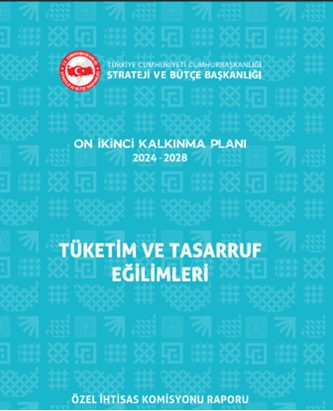
The images below present the cover page and relevant sections of Türkiye’s Twelfth Development Plan and its accompanying Specialization Commission Report on Consumption and Saving Trends, documenting the participation of Bahçeşehir University faculty member Prof. Dr. Ahu Ergen as a Special Expertise Committee Member and highlighting the University's contribution to national policy development through academic expertise.
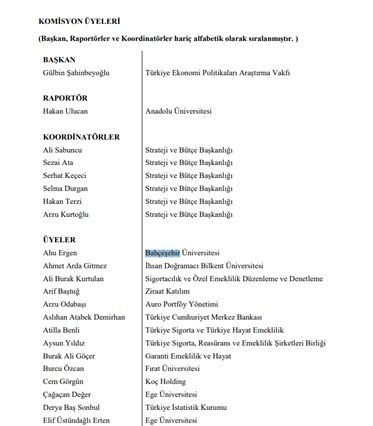
During the 2024–2025 academic year, Bahçeşehir University continued to contribute to national public policy development through the expertise and institutional engagement of its academic staff. An important example of this contribution is the involvement of Prof. Dr. Ahu Ergen in the preparation of Türkiye’s Twelfth Development Plan (2024–2028), one of the country’s principal strategic policy frameworks.
Prof. Dr. Ahu Ergen, faculty member at Bahçeşehir University’s Faculty of Economics, Administrative and Social Sciences, served as a Special Expertise Committee Member to the Republic of Türkiye Presidency of Strategy and Budget Directorate for the Twelfth Development Plan (2024–2028) — Specialization Commission Report on Consumption and Saving Trends.
Her participation represents a concrete example of academic expertise contributing to government policy formulation at the national level. Through this commission, academic knowledge and research-based perspectives were brought into discussions concerning consumption patterns, savings, sustainability, and Türkiye’s long-term development priorities.
Building on Türkiye’s ratification of the Paris Agreement, the commission advanced policy measures to accelerate the green economy transition: expanding green finance and sustainability-linked funds, incentivizing sustainable investment, improving resource efficiency and waste reduction, and scaling circular economy education to promote responsible consumption and production nationwide.
Prof. Ergen’s contributions focused on SDG alignment, sustainable consumption instruments for Türkiye, and integrating sustainability into curricula to strengthen human capital for the transition.
This engagement demonstrates Bahçeşehir University’s contribution to evidence-informed public policymaking through the direct participation of its academic staff in a government-established expert commission. It also illustrates how university expertise can inform national strategies addressing sustainable economic development, responsible consumption, resource efficiency, and the transition towards a more sustainable economy.
By contributing academic expertise to the preparation of a national development policy document, BAU supports the connection between higher education, scientific knowledge, and public decision-making, reflecting the University's broader commitment to contributing to government policy development at national level.
This engagement demonstrates how Bahçeşehir University provides specific expert advice to national government—through formal committee participation and evidence-based policy guidance—thereby advancing SDG 16, while directly supporting SDG 12 via systemic measures that foster responsible, circular, and resource-efficient economic behavior.
Information indicating that Bahçeşehir University provided expert support to the government’s development plan can be found on the related website page of the Republic of Türkiye Presidency of Strategy and Budget Directorate.
2. BAU’s Representation in the Ministry of Agriculture and Forestry’s Sustainable Agriculture Specialized Working Group
The image below presents an excerpt from an official document issued by the Republic of Türkiye's Ministry of Agriculture and Forestry, documenting Bahçeşehir University's representation in the Sustainable Agriculture Specialized Working Group. The document provides official evidence of the University's participation in a government-led consultation mechanism, contributing academic expertise and institutional perspectives to national policy discussions on sustainable agriculture, food systems, and rural development.
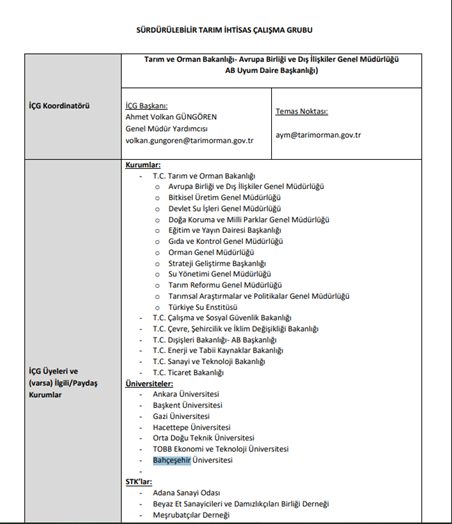
In the 2024-2025 academic year, Bahçeşehir University (BAU) continued to demonstrate its commitment to contributing to national policy development by bringing academic expertise into government-led consultation and policy development processes. An important example of this institutional engagement is the University's representation in the Sustainable Agriculture Specialized Working Group established under the Republic of Türkiye's Ministry of Agriculture and Forestry.
Bahçeşehir University (BAU) contributes to national policy development as a member of the Sustainable Agriculture Specialized Working Group established under the Republic of Türkiye's Ministry of Agriculture and Forestry.
Within this framework, BAU provides expert opinions and research-based insights to support the Ministry's efforts in developing strategies for sustainable agricultural practices, climate resilience, and rural development.
As one of only seven universities in Türkiye represented in this working group, BAU plays a significant role in bridging academic research and governmental policy.
The University's participation provides a direct channel for the exchange of knowledge between academia and public authorities, enabling research-based perspectives to inform discussions on agricultural sustainability, resource efficiency, environmental protection, and the long-term resilience of agricultural systems.
Through this engagement, BAU contributes to a collaborative approach to policy development in which academic knowledge and scientific expertise complement governmental planning and sectoral perspectives. The working group's focus on sustainable agriculture also creates opportunities to address interconnected challenges relating to climate change, responsible resource management, food systems, and rural development.
BAU's participation reflects the University's commitment to contributing academic expertise to national policy development and strengthening collaboration between higher education institutions and public authorities. Through its involvement in the Ministry's specialized working group, BAU supports evidence-informed policymaking and the development of sustainable approaches to agriculture, environmental resilience, and rural development. This engagement also demonstrates the University's broader role in connecting academic knowledge with national development priorities and long-term societal needs.
Details regarding Bahçeşehir University's representation within the Ministry of Agriculture and Forestry's Sustainable Agriculture Specialized Working Group can be found on page 21 of the Ministry's official report, which is publicly available on the Ministry's website.
The official Ministry report provides documentary evidence of BAU's representation within the working group, demonstrating its inclusion in a formal government-led consultation mechanism supporting the development of national agricultural policies.
3. Bahçeşehir University: Providing Academic Expertise to Government in Digital Transformation and Policy Development
The images below present official institutional documents confirming Bahçeşehir University's provision of academic expertise to the Presidency of the Republic of Türkiye's Digital Transformation Office.
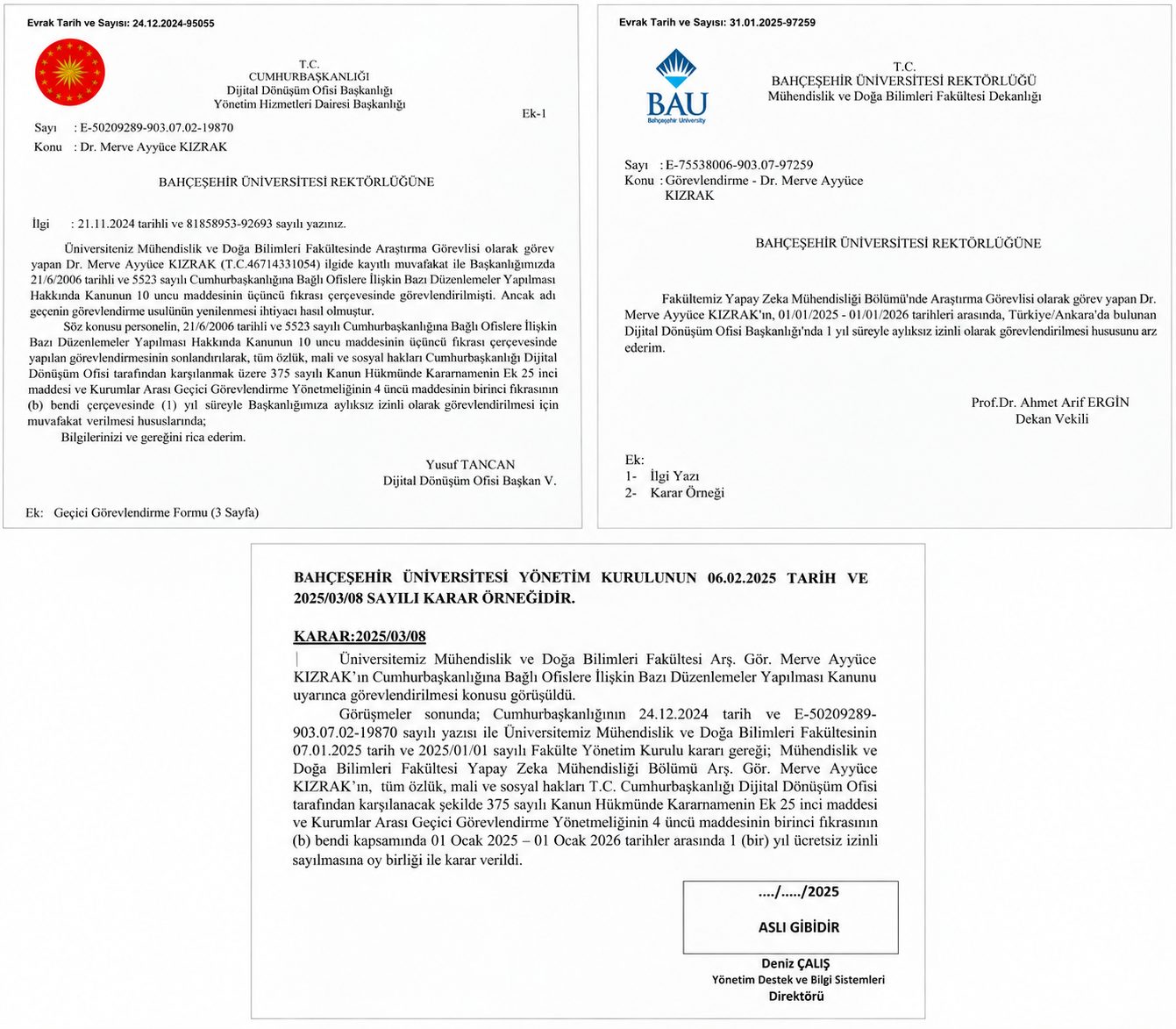
During the 2024–2025 academic year, Bahçeşehir University (BAU) supported the provision of specialized academic expertise to the Government of the Republic of Türkiye through the official assignment of Dr. Merve Ayyüce Kızrak, a Research Assistant in the Department of Artificial Intelligence Engineering within BAU's Faculty of Engineering and Natural Sciences, to the Digital Transformation Office of the Presidency of the Republic of Türkiye.
This institutional cooperation was formally documented through official correspondence issued by the Presidency's Digital Transformation Office on 24 December 2024, requesting the continuation of Dr. Kızrak's assignment under the applicable legal framework. The correspondence was followed by an official faculty-level request dated 31 January 2025 and a Bahçeşehir University Executive Board decision dated 6 February 2025, unanimously approving her one-year assignment covering 1 January 2025 to 1 January 2026.
The assignment represents a formal mechanism through which specialized university expertise in artificial intelligence is made available to a national government institution, with direct relevance to public-sector digital transformation and associated policy priorities. The arrangement was established through official government correspondence and institutional university approval, demonstrating a documented relationship between BAU and a central government body.
The assignment connects BAU's academic expertise in artificial intelligence and advanced technologies with the institutional work of the Presidency's Digital Transformation Office, a national government body operating in the field of public-sector digital transformation and related digital governance and policy priorities.
Artificial intelligence expertise is increasingly relevant to government institutions addressing digital transformation, technological innovation, data-driven systems, and the development of digital public-sector capabilities. Such expertise is also important for evaluating emerging technologies, informing digital transformation strategies, and supporting evidence-based approaches to public policy and government decision-making. By authorizing the assignment of a member of its Artificial Intelligence Engineering Department, BAU enabled specialized academic knowledge and technical competencies to be made available within a governmental institutional setting.
The official documentation establishes the formal assignment of a university researcher to the government body for an extended period, providing an institutional basis for professional knowledge exchange and the application of specialized technical expertise in the public sector. This arrangement creates an opportunity for academic expertise to inform policy-related discussions and institutional approaches to artificial intelligence, digital innovation, and public-sector transformation.
This initiative contributes to SDG 16 (Peace, Justice and Strong Institutions) by demonstrating Bahçeşehir University's institutional engagement with a national government body through the provision of specialized academic expertise relevant to digital transformation and public policy.
The cooperation illustrates a practical channel through which universities can contribute their scientific and technological capabilities to public institutions, supporting connections between higher education, government administration, policy-oriented knowledge exchange, and public-sector expertise.
Through the officially documented assignment of Dr. Merve Ayyüce Kızrak to the Presidency's Digital Transformation Office, BAU demonstrates its commitment to making academic expertise available to government institutions and strengthening university–government engagement in areas of strategic technological and policy importance. The initiative highlights the potential contribution of university-based expertise to evidence-informed policy development, digital governance, and the strengthening of public institutions.
4 .Bahçeşehir University Rector Serves on the Turkish Football Federation’s Fair Play and Social Responsibility Committee under the Ministry of Youth and Sports
The image below shows a screenshot from the official website of the Turkish Football Federation indicating that the Rector of Bahcesehir University serves on the Fair Play and Social Responsibility Committee under the Ministry of Youth and Sports.
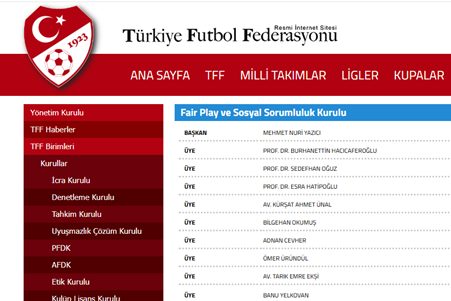
During the 2024–2025 academic year, Bahçeşehir University (BAU) continued to contribute to Türkiye's national sports governance framework through the ongoing membership of its Rector, Prof. Dr. Esra Hatipoğlu, in the Turkish Football Federation's (TFF) Fair Play and Social Responsibility Committee. Her continued service in 2025 reflects the University's sustained engagement with national sports institutions and public-interest initiatives.
By maintaining this representation throughout 2025, BAU demonstrates its continuing contribution to national discussions on ethical sports governance and social responsibility, within a broader public policy environment shaped by Türkiye's Ministry of Youth and Sports.
Bahçeşehir University Rector, Prof. Dr. Esra Hatipoğlu, serves as a member of the Turkish Football Federation's (TFF) Fair Play and Social Responsibility Committee. The TFF is an autonomous national sports governing body operating within Türkiye's legislative framework for sports, a policy area overseen at the national level by the Republic of Türkiye Ministry of Youth and Sports.
In this capacity, Prof. Hatipoğlu contributes expert opinions and ethical guidance to support the Federation's efforts in advancing fair play principles, social inclusion, and institutional accountability in sports governance.
Through this role, Bahçeşehir University contributes academic expertise to an institution operating within Türkiye's national sports governance and public policy framework, supporting discussions on ethical conduct, social responsibility, and community engagement in sports.
Her continued participation in 2025 strengthens the connection between higher education and national sports governance, enabling academic perspectives to contribute to discussions on fairness, integrity, responsible institutional practices, and the societal role of sports.
The committee's work aligns with BAU's broader mission to promote integrity, equality, and participatory governance across different sectors of public life.
This engagement contributes to Sustainable Development Goal 16 (Peace, Justice and Strong Institutions) by fostering transparency and ethical governance; SDG 5 (Gender Equality) by supporting inclusive participation and representation in sports; and SDG 3 (Good Health and Well-Being) by promoting active, fair, and socially responsible sporting environments.
5. Bahçeşehir University Provides Expert Advisory Support to the Ministry of Education yenisi var mı bak
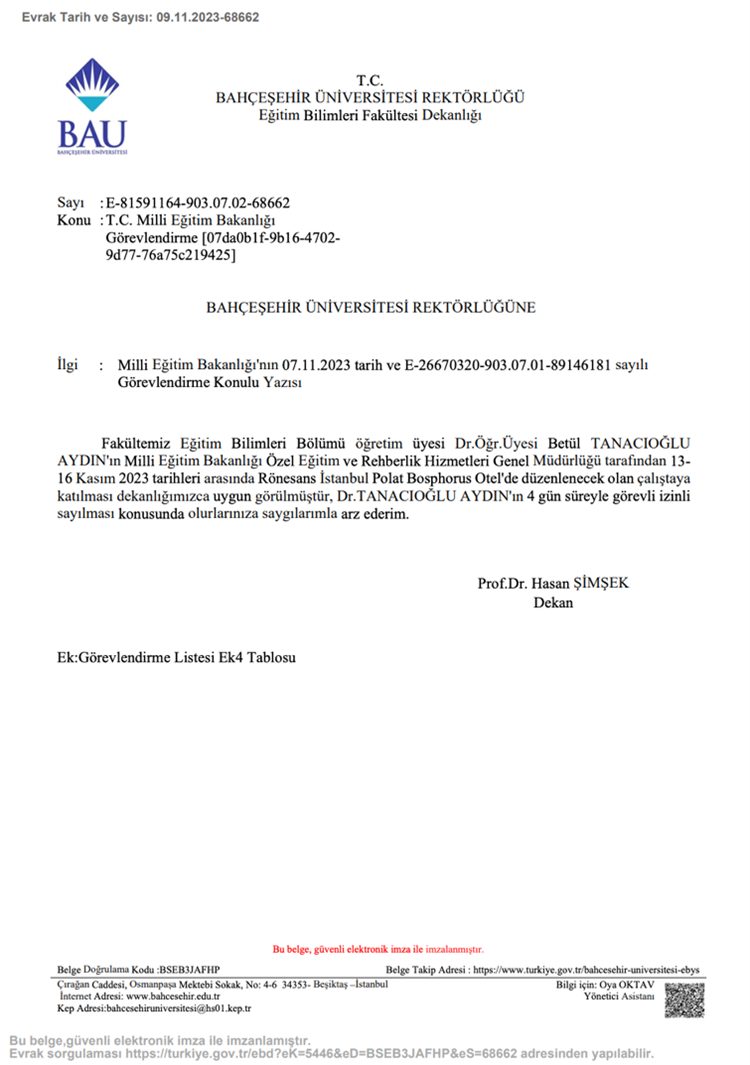
Dr. Betül Tanacıoğlu Aydın, a faculty member in the Department of Educational Sciences at Bahçeşehir University (BAU), contributed her academic expertise to the Ministry of National Education of the Republic of Türkiye.
She participated in a national policy consultation organized by the General Directorate of Special Education and Counseling Services, which focused on strengthening social inclusion, accessibility, and family support for individuals with special needs.
The image below shows the official letter from the Ministry of National Education confirming the expert advisory contribution of Bahcesehir University faculty member Dr. Betul Tanacioglu Aydin to the national policy consultation on inclusive and special education.
6. Strengthening Education through Collaboration: Bahçeşehir University Partners with the Ministry of Education
The image below presents the official cover page of the cooperation protocol signed between Bahçeşehir University and the Beşiktaş District Directorate of National Education, operating under the Republic of Türkiye Ministry of National Education. The document provides formal evidence of the University's institutional partnership with a public education authority, establishing a framework for academic cooperation, educator professional development, and capacity-building activities within the national education system.
Bahçeşehir University (BAU) maintains an ongoing institutional partnership with the Republic of Türkiye Ministry of National Education through a formal cooperation protocol signed with the Beşiktaş District Directorate of National Education. The collaboration continued during the 2024–2025 academic year, reflecting the University's sustained commitment to supporting public education and strengthening professional capacity within the national education system.
Bahçeşehir University signed a cooperation protocol with the Beşiktaş District Directorate of National Education, which operates under the Ministry of National Education of the Republic of Türkiye.
Under this protocol, BAU serves as a “trainer of trainers,” providing educational programmes and academic support for educators affiliated with the Ministry, with a focus on strengthening professional capacity, promoting innovation, and improving educational practices.
The partnership establishes a formal framework through which BAU's academic expertise and educational resources can contribute to the professional development of educators working within the public education system. By supporting the training of trainers, the University helps strengthen the capacity of education professionals to transfer knowledge, develop instructional competencies, and disseminate effective teaching approaches within their respective educational environments.
This cooperation also creates an institutional channel for knowledge exchange between higher education and public education authorities, enabling academic perspectives and educational expertise to inform professional development activities and capacity-building initiatives.
The continuation of the protocol during the 2024–2025 academic year demonstrates the sustained nature of this public–university partnership and BAU's commitment to contributing to national educational priorities through academic collaboration and professional training.
Through this ongoing engagement, Bahçeşehir University reinforces its role as an academic partner of public institutions, supporting educational quality, professional development, and the continuous improvement of teaching practices within Türkiye's national education system.
7. Bahçeşehir University's Ongoing Cooperation with the Ministry of Industry and Technology on National Technology Development and Human Capital
The image below presents the official cover page of the cooperation protocol signed between Bahçeşehir University and the Directorate General of National Technology of the Republic of Türkiye Ministry of Industry and Technology, providing documentary evidence of the formal institutional partnership established to support national technology development and qualified human resource training.
During the 2023–2024 academic year, a cooperation protocol was signed between Bahçeşehir University (BAU) and the Directorate General of National Technology of the Republic of Türkiye Ministry of Industry and Technology, establishing a formal framework for cooperation in human resource development and the training of qualified professionals.
The cooperation remained active throughout the 2024–2025 academic year, reflecting the continuity of BAU's institutional engagement with the Ministry and its contribution to Türkiye's national technology development priorities.
The protocol supports the University's institutional governance capacity, participation in decision-making processes, and the institutionalization of public–university cooperation.
Through this formal partnership, BAU contributes academic expertise, educational capacity, and institutional knowledge to a government-led framework focused on strengthening Türkiye's technological capabilities and developing the human capital required for long-term national development.
The cooperation creates a structured basis for dialogue and coordination between higher education and public authorities, connecting the University's educational and research capabilities with the Ministry's strategic priorities in technology, innovation, and workforce development.
The protocol also establishes a formal administrative framework for cooperation, incorporating documented procedures and institutional accountability. Its provisions concerning secure electronic signatures, registered processes, and public oversight support transparency, traceability, and responsible institutional management.
Building on the ongoing collaboration between the two institutions, the protocol aims to foster innovation, support national technology initiatives, and cultivate highly skilled professionals for Türkiye's future.
The continuation of this partnership during the 2024–2025 academic year demonstrates BAU's sustained commitment to working directly with government institutions and contributing to national priorities through academic expertise, capacity building, and institutional cooperation.
More broadly, this collaboration illustrates the role of universities as active partners in public-sector initiatives, supporting the development of knowledge-based policies, technological innovation, and a qualified workforce while strengthening cooperation between academia and government.
8- Bahçeşehir University Provides Expert Advice to the Ministry of Agriculture and Forestry for Türkiye’s Agricultural Information System Country Model
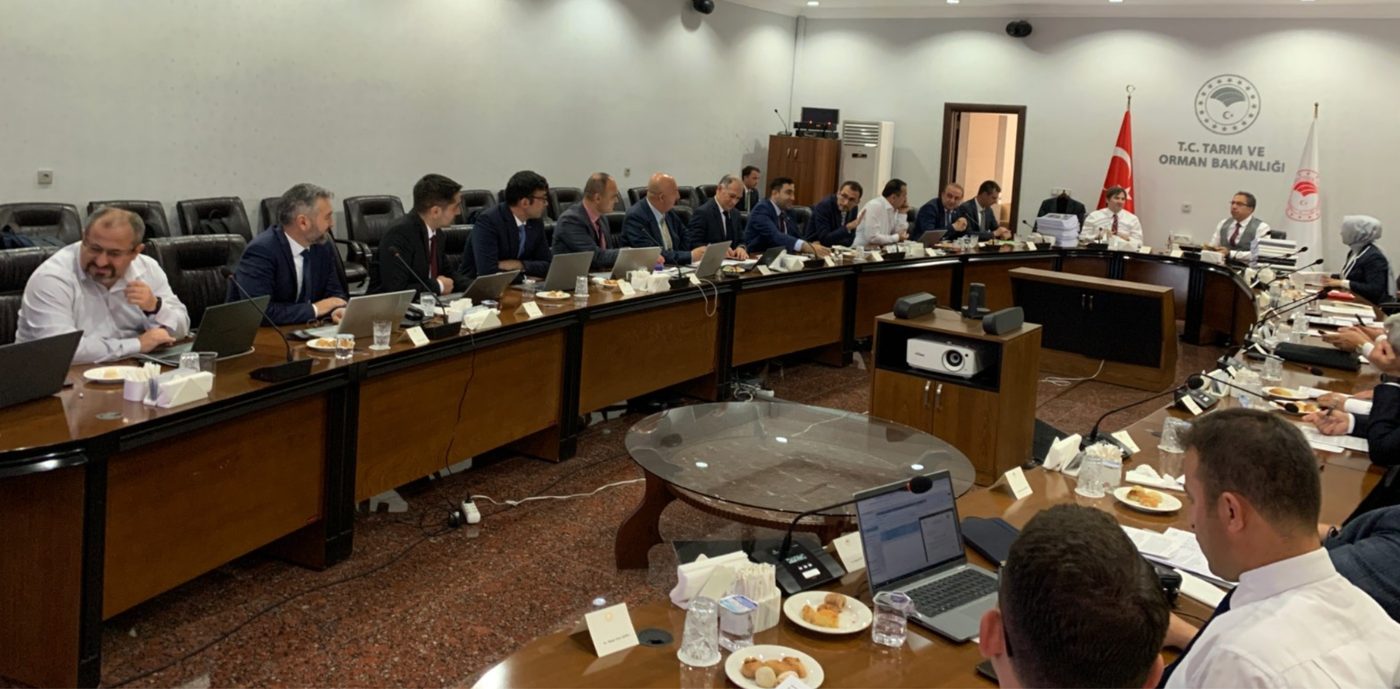
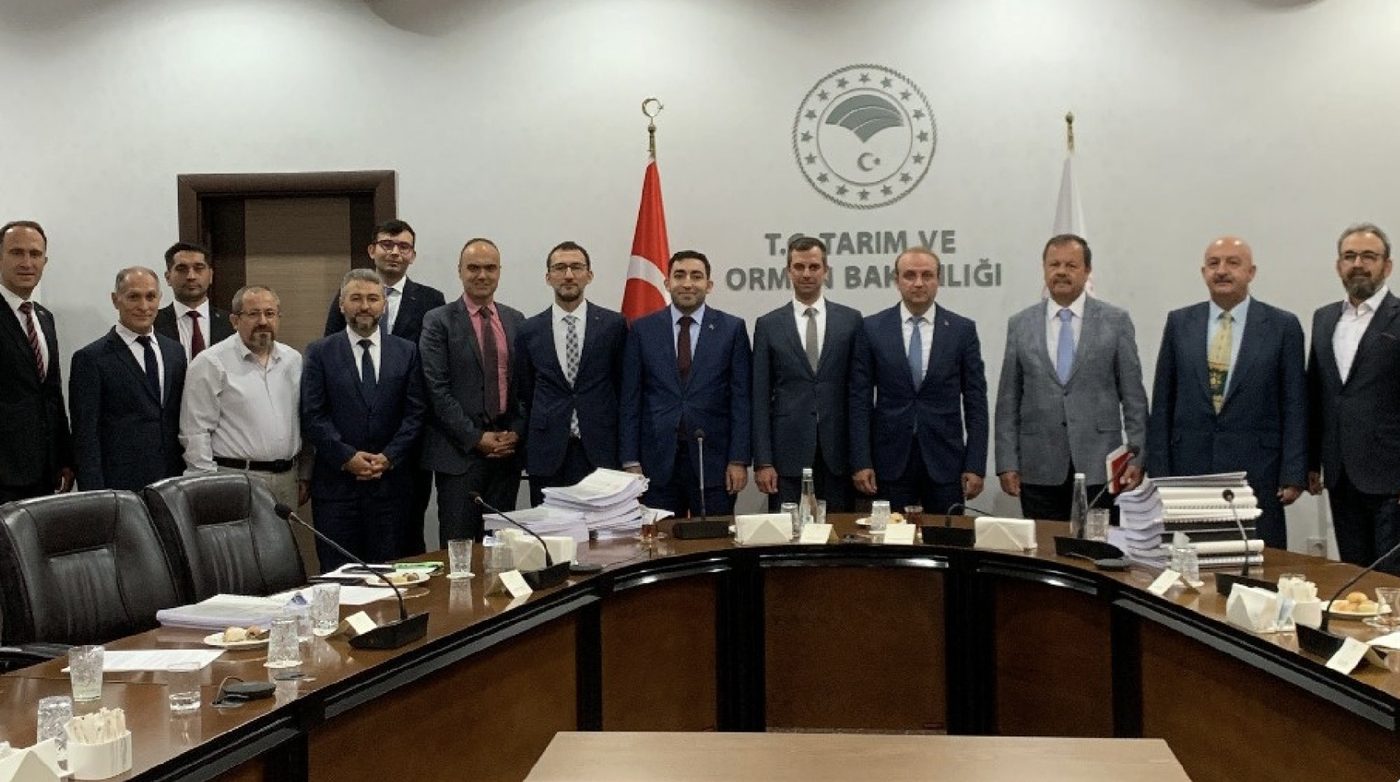
Bahçeşehir University contributed academic expertise directly to the national government through Asst. Prof. Dr. Fatih Kahraman’s participation in the “Agricultural Information System Applications Country Model Feasibility Study.” Conducted through cooperation between the Directorate General of Information Technologies of the Ministry of Agriculture and Forestry and TÜBİTAK TÜSSİDE, the study was designed to inform the development of Türkiye’s national agricultural information infrastructure. Representing BAU’s academic expertise, Dr. Kahraman provided specialist assessments and expert opinions to support the Ministry’s evaluation of digital agriculture systems and their potential use in national agricultural governance.
The feasibility study examined how accurate and reliable agricultural data could be obtained at both macro and micro levels, how the entire production chain from seed to table could be recorded, and how annual monitoring and evaluation could be institutionalised. It also analysed the Ministry’s existing agricultural information systems and observation stations and supported the preparation of a strategy and roadmap for their more effective use. Within this government-led process, Dr. Kahraman contributed subject-matter expertise relevant to data-driven systems, digital technologies and intelligent decision-support mechanisms, supplying academic knowledge for the Ministry’s strategic planning and policy-development work.
BAU’s contribution provided the Ministry of Agriculture and Forestry with university-based expert advice relevant to national policy formulation and implementation. Dr. Kahraman’s participation helped connect academic and technological expertise with practical governmental needs concerning agricultural data, crop-yield forecasting, risk management, food safety and the digital management of the agricultural sector. The resulting country-model study and closing report created an evidence base that can guide institutional decisions, identify science and technology needs and inform future policies for Türkiye’s agricultural information systems.
This activity contributes directly to SDG 16: Peace, Justice and Strong Institutions by demonstrating Bahçeşehir University’s provision of specific expert advice to a national government institution. Through Dr. Kahraman’s involvement, BAU supplied specialized knowledge and professional assessment to a Ministry project concerned with policy guidance, institutional monitoring, public-sector digital capacity and evidence-informed decision-making. By supporting the Ministry in developing a national strategy and roadmap for agricultural information systems, the University contributed to more effective, data-driven and responsive public administration.
The image below shows Asst. Prof. Dr. Fatih Kahraman of Bahçeşehir University participating in the Agricultural Information System Applications Country Model Feasibility Study and contributing his academic expertise to the Ministry of Agriculture and Forestry’s national policy-development process.