EN
16.2.4 - Bahçeşehir University Stakeholder Advisory Boards: Institutionalized Participation of Local Communities and External Stakeholders in University Governance
Bahçeşehir University (BAU) recognizes meaningful stakeholder participation as an essential component of transparent, inclusive, accountable, and responsive university governance. The University acknowledges that its educational, research, administrative, and social contribution activities extend beyond its campuses and interact with a wider community of individuals, organizations, and institutions.
Accordingly, BAU maintains formal mechanisms through which external stakeholders, including representatives of civil society organizations, public institutions, professional associations, businesses, and the wider and local community, can contribute their perspectives to institutional consultation, planning, evaluation, and decision-making processes.
These mechanisms are particularly important for stakeholders who do not ordinarily hold formal positions within its academic or administrative governance structures.
The University's approach to stakeholder participation is supported by its institutional stakeholder analysis and engagement mechanisms, which identify relevant stakeholder groups and establish channels for communication, consultation, and participation.
The identification of stakeholders is not limited to their professional relationship with the University. It also considers their connection to the communities in which BAU operates, the social and economic issues affecting those communities, and the potential impact of University activities on local needs and priorities. In this context, local residents, local government institutions, community representatives, civil society organizations, and locally influential professional and institutional actors constitute important stakeholder categories for engagement.
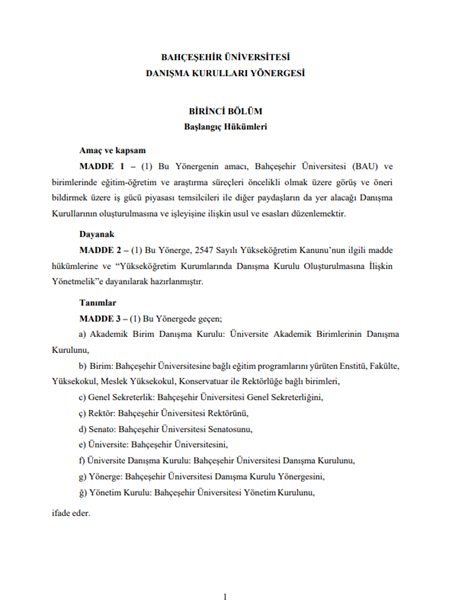
A central component of this framework is the Bahçeşehir University Advisory Boards Directive, approved by the University Senate and updated in the 2024–2025 academic year. The Directive provides the formal institutional foundation for the establishment, composition, responsibilities, and functioning of advisory boards across the University.
In 2025, BAU maintained a four-level advisory board structure consisting of the University-Level Advisory Board, the Social Impact Advisory Board, Faculty-Level Advisory Boards, and Department- and Programme-Level Advisory Boards established within selected academic units.
This structure enables stakeholder consultation to take place at different institutional levels, ensuring that external perspectives can be considered in discussions concerning university-wide priorities, social contribution, faculty development, and individual academic programmes.
BAU's advisory board framework establishes identifiable participatory bodies through which external stakeholders can maintain an institutional relationship with the University. These bodies create opportunities for stakeholders to articulate local needs, communicate community expectations, identify emerging concerns, and contribute recommendations relevant to the University's institutional responsibilities.
All four levels hold regular meetings and additional agenda-specific consultations. Faculty-Level and Department- and Programme-Level Advisory Boards also integrate stakeholder participation into academic-year planning and year-end evaluation processes.
Through these arrangements, BAU provides continuing opportunities for external stakeholders to communicate needs, express expectations, exchange knowledge, and submit recommendations for consideration by the University's relevant academic and administrative bodies.
1. University-Level Advisory Board
External Stakeholder Participation in Institutional Strategy and Development
The University-Level Advisory Board serves as a formal consultative body connecting university leadership with external stakeholders from different professional, economic, academic, and societal fields.
The Board provides opportunities for representatives outside the University's internal governance structure to contribute perspectives on institutional strategy, educational priorities, research and innovation, university–society relations, and long-term development.
Its advisory scope includes developments in higher education, emerging societal needs, institutional cooperation, and opportunities to strengthen the University's contributions to its surrounding environment.
At this level, stakeholder participation provides a mechanism for connecting the University's strategic discussions with perspectives originating outside its internal governance structures. Representatives from different sectors and areas of expertise can raise issues affecting the broader community, identify opportunities for collaboration with local and public institutions, and contribute to discussions about the University's responsibilities toward society.
The Board holds regular meetings to discuss institutional priorities, strategic developments, and matters relevant to the University's relationship with external stakeholders and the wider community.
Additional agenda-specific meetings are convened when particular institutional developments, emerging challenges, or proposed initiatives require focused consultation with external representatives.
These meetings create an established channel through which stakeholder perspectives can be communicated to university leadership and considered in institutional discussions.
The Board's advisory function complements the University's formal decision-making structures. Recommendations are considered within the relevant institutional processes, while responsibility for final decisions remains with the authorized governing bodies.
This arrangement enables external stakeholders to participate in institutional consultation without requiring membership in the University's executive or administrative decision-making bodies. It also creates a distinction between stakeholder representation, advisory participation, and the formal authority to make institutional decisions.
University-Level Advisory Board Membership
The membership documented in the University's advisory board records includes:
Prof. Dr. Ahmet Aydilek
Prof. Dr. Eda Cengiz
Prof. Dr. Haluk Görgün
Prof. Dr. Oussama Khatib
Prof. Dr. Hans-Dieter Klingemann
Prof. Dr. Can Korman
Dr. Shigeyuki Okazaki
Dr. Markus C. Slevogt
Zeynep Atabay Taşkent
Hakan Ateş
Mert Baki
Shashi Caan
Nuri Bilge Ceylan
Hüseyin Diröz
Hediye Güral
Tuncer Köklü
Şafak Müderrisoğlu
Gülsin Onay
Levent Özbilgin
Yalın Özcan
James Pan
Ahmet Pura
Mete Vardar
Reşad Cabirli
Mehmet Akif Güdek
The Board's multidisciplinary composition supports consultation across a range of institutional priorities and provides access to external perspectives that complement those of the University's academic and administrative leadership.
Through regular and issue-specific meetings, the University maintains a continuing dialogue with external stakeholders and creates opportunities for their recommendations to inform institutional planning and development.
The participation of individuals from business, professional, academic, cultural, and other societal fields also broadens the range of perspectives available to University leadership when considering issues affecting the institution's relationship with its surrounding social and economic environment.
2. Social Impact Advisory Board
Participation of Civil Society and Community-Oriented Stakeholders
The Social Impact Advisory Board provides a dedicated institutional mechanism for stakeholder consultation concerning sustainability, social contribution, community engagement, and the University's responsibilities toward society.
The Board brings together representatives of civil society organizations, sustainability networks, professional associations, and organizations involved in social responsibility and community-oriented activities.
Its consultative role focuses on connecting the University's institutional priorities with wider societal needs and expectations.
Within BAU's four-level structure, the Social Impact Advisory Board has particular relevance to engagement with community-oriented stakeholders. It provides a participatory setting in which organizations working on social and environmental issues can contribute perspectives that extend beyond the University's academic and administrative priorities.
Through this structure, civil society and other external stakeholders are provided with a formal channel to communicate their perspectives on social and environmental priorities, community needs, and opportunities for university–society cooperation.
The Board holds regular meetings to discuss social contribution priorities, sustainability-related activities, stakeholder expectations, and opportunities for cooperation with external organizations.
In addition to regular meetings, agenda-specific consultations are organized when emerging social or environmental issues, proposed initiatives, or new partnership opportunities require focused stakeholder input.
These consultations enable external representatives to identify relevant challenges, discuss community expectations, and offer recommendations concerning the development and evaluation of the University's social contribution activities.
Social Impact Advisory Board Membership
The Board's documented membership includes:
Murat Göllü – Corporate Communication Association
Göktürk Demirel – Enerjisa, Sustainability Communication
Melde Çele – UN Global Compact Türkiye
Seçil Sendağ – 360 Social Impact Association
Nuran Aksu – Türkiye Corporate Responsibility Association
The Social Impact Advisory Board provides opportunities for dialogue concerning the social, environmental, and economic challenges affecting communities and the potential contribution of university activities to addressing these challenges.
Its discussions encompass sustainable development, social inclusion, equal opportunities, environmental responsibility, community engagement, and collaboration with external organizations.
The participation of civil society representatives is especially important because these organizations can bring knowledge of community-level challenges, experiences of working with different social groups, and perspectives on issues that may not otherwise be fully represented within university governance.
Through this participatory mechanism, BAU can consider stakeholder perspectives concerning local social needs, barriers to participation, environmental concerns, social inclusion, and opportunities for cooperation with organizations serving communities. The Board thus provides an institutional channel for connecting community-oriented expertise with the University's social contribution priorities.
Stakeholder recommendations may inform discussions concerning the identification of social contribution priorities, the development of community-oriented initiatives, and opportunities to strengthen cooperation between the University and civil society.
The Board also provides a forum for considering how the University's educational, research, and institutional capacities can respond to societal needs.
Through regular and agenda-specific consultation, BAU maintains an ongoing relationship with external stakeholders and incorporates their perspectives into discussions concerning its social contribution agenda.
This approach supports the integration of community engagement and social responsibility into institutional governance.
The Board's continuing consultative role is particularly relevant to the identification of community needs, the exchange of perspectives between the University and civil society, and the consideration of stakeholder recommendations when institutional social contribution priorities are reviewed.
3. Faculty-Level Advisory Boards
External Stakeholder Participation in Faculty Governance and Academic Development
Faculty-Level Advisory Boards extend BAU's participatory governance framework to individual academic units.
These boards bring together faculty leadership and academic representatives with external stakeholders from relevant professional sectors, businesses, public institutions, civil society organizations, professional associations, and the wider community.
Their primary purpose is to provide a structured mechanism through which external stakeholders can contribute perspectives concerning faculty development, educational quality, professional expectations, academic cooperation, and the changing needs of society.
Faculty-Level Advisory Boards enable stakeholders who are not directly involved in the University's internal academic administration to participate in consultations concerning the priorities and development of the academic units with which they are connected.
These boards also create additional points of engagement with local and regional stakeholders whose professional activities, institutional responsibilities, or community-oriented work intersect with particular academic disciplines. By involving representatives from outside the University, faculties can consider the needs and expectations of the surrounding social and professional environment.
Example 1: Faculty of Communication Advisory Board
The Faculty of Communication maintains an Advisory Board involving representatives of professional associations, media organizations, businesses, communication industries, and alumni.
Its documented membership includes:
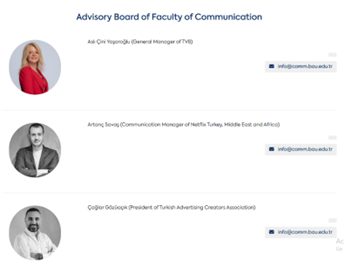
Aslı Çini Yaşaroğlu – TV8
Artanç Savaş – Netflix
Çağlar Gözüaçık – Turkish Association of Advertising Creatives
İpek Özgüden Özen – Turkish Public Relations Association
Mustafa Kuleli – European Federation of Journalists
Ömer Barış Gökpınar – Samsung Türkiye
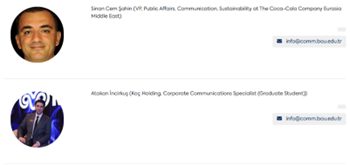
Sinan Cem Şahin – Coca-Cola
Can Büyükalkan
Atakan İncirkuş – Koç Holding, BAU alumnus
Samet Uyanık – Blay Games, BAU alumnus
The Faculty of Communication Advisory Board provides a formal mechanism for consultation with external stakeholders whose activities are connected to communication education and professional practice.
Its membership creates a channel for dialogue with media organizations, professional associations, communication-sector representatives, and alumni whose work intersects with wider societal issues, public communication, professional responsibility, and the changing information environment.
Through regular and agenda-specific meetings, these stakeholders can contribute perspectives on emerging social and professional concerns, cooperation opportunities, ethical responsibilities, digital transformation, and the relationship between communication practices and society. Educational priorities and curriculum relevance may also be considered within this broader consultation framework.
These consultations allow the Faculty to consider external professional and societal expectations when reviewing its academic development priorities and educational activities.
Example 2: Faculty of Economics, Administrative and Social Sciences Advisory Board
The Faculty of Economics, Administrative and Social Sciences maintains a formally established Advisory Board composed of representatives from business, professional services, civil society, and other external organizations, alongside alumni and student representation.
According to the Faculty's official description, the Board was established to strengthen cooperation between the University and the professional world, facilitate the exchange of ideas, and support students' preparation for professional life.
The Board's published membership includes:
Ethem Kutucular – Independent Board Member
Gökşin Durusoy – Chief Executive Officer and Board Member, Akkök Holding
Dr. Hüseyin Mergan – Language Manager, Google
Mutlu Yiğit – Internal Control, Adidas Türkiye; Certified Public Accountant; BAU Faculty Alumnus
Nazan Somer – Chairperson of the Board, Mapfre Sigorta A.Ş.
Onur Candar – Managing Partner, Bain & Company Türkiye
Selen Okay – Chairperson of the Board, Yanındayız Association
Dr. Ceyda Dedeoğlu – Clinical Psychologist, Eflatun Family Counseling Center
Fatih Uysal – Chief Executive Officer, Kariyer.net
Yaren Aktaş – BAU Alumna
Gonca Gürsoy Artunkal – Independent Board Member, Şişecam
Berat Arifoğlu Zaimoğlu – Clinical Psychologist
Demir Kılıç Aslantürk – Founder, Son Okul; EQ Development Manager, Six Seconds – The Emotional Intelligence Network
Onur Mert Türk – Student Representative, BAU Faculty of Economics, Administrative and Social Sciences
The Faculty of Economics, Administrative and Social Sciences Advisory Board provides a formal setting in which representatives of civil society, businesses, professional organizations, and other stakeholders can participate in discussions concerning academic development and educational priorities.
The presence of civil society, business, professional, alumni, and student representatives enables consultation from multiple perspectives, including those relating to social inclusion, economic developments, community well-being, employment, and changing societal expectations.
The Board offers an institutional setting in which external stakeholders can identify concerns, share knowledge of developments affecting the wider community, and propose opportunities for cooperation between the Faculty and relevant organizations.
Regular meetings, academic-year planning and evaluation consultations, and agenda-specific discussions allow these perspectives to be considered alongside educational quality and faculty development priorities.
4. Department- and Programme-Level Advisory Boards
Stakeholder Participation in Programme Planning and Development
In addition to university-wide and faculty-level structures, selected departments and academic programmes at BAU maintain their own advisory boards, establishing a fourth level of stakeholder participation within the University's governance framework.
These boards provide formal opportunities for external stakeholders, including representatives of public institutions, civil society organizations, professional associations, businesses, employers, and other relevant organizations, to contribute to academic consultation at the programme level.
At this level, stakeholder engagement takes place closer to the specific fields in which public institutions, civil society organizations, employers, and professional representatives operate. These connections enable departments and programmes to identify relevant external stakeholders and maintain dialogue about changing needs, emerging issues, and opportunities for cooperation.
Although educational objectives, learning outcomes, and curriculum development form part of their academic responsibilities, these advisory boards also function as participatory mechanisms connecting academic units with organizations and representatives beyond the University.
Example: Department of Economics Advisory Board – Faculty of Economics, Administrative and Social Sciences
The Department of Economics at Bahçeşehir University provides a department-level example of stakeholder participation through an Advisory Board bringing together representatives of public institutions, civil society organizations, professional services, and alumni.
The Board provides a formal mechanism for consultation with external stakeholders whose expertise and institutional activities relate to economic, financial, public-sector, and societal developments.
The published advisory board membership comprises sector representatives and alumni:
Dr. Begüm Şeren Güler – Economist, Directorate for EU Affairs, Republic of Türkiye Ministry of Foreign Affairs; Department of Economic, Financial and Social Policies
Bengisu Özenç – Founding Director, Sustainable Economics and Finance Research Association (SEFiA)
Hakan Demirelli – Partner, Transaction Services, KPMG
Arda Tunca – Economist and Columnist, PolitikYol
Canberk Yalçın – Record Currency Management
Serenay Demir – Calvin Klein Global
Fırat Cem Gök – Foreign Borrowing Specialist, Yapı Kredi; Financial Institutions and Treasury Management
The Department of Economics Advisory Board provides a formal mechanism through which representatives of public institutions, civil society organizations, professional sectors, and alumni can participate in programme-level consultation.
Its composition is particularly relevant to stakeholder engagement because it brings together perspectives from a public institution, an organization working on sustainable economics and finance, and representatives of different professional sectors. These participants can contribute knowledge of economic and social developments, public-sector priorities, sustainability-related concerns, and opportunities for cooperation.
The Board's discussions may also address programme objectives, learning outcomes, curriculum relevance, and graduate competencies, but these academic topics form part of a broader process of consultation with external stakeholders.
Regular meetings and additional agenda-specific consultations provide opportunities for external stakeholders to communicate recommendations that can be considered within the programme's established academic review and improvement processes.
The Board's structure supports the integration of perspectives from outside the University into discussions concerning educational priorities and programme development.
Integration of Stakeholder Participation into University Decision-Making
BAU's four-tier advisory board framework operates within the University's broader stakeholder engagement and quality assurance system.
Through these mechanisms, external representatives can communicate needs, express expectations, identify emerging issues, and provide recommendations concerning matters within the relevant board's scope.
At university level, recommendations may inform discussions concerning institutional strategy, development priorities, and university–society relations and sustainable impact of the university in the society.
At the Social Impact Advisory Board level, recommendations may contribute to discussions concerning sustainability, social contribution, and community engagement.
At faculty level, stakeholder input may inform cooperation with external organizations, responses to emerging societal and professional needs, academic planning, and faculty development.
At department and programme levels, recommendations may contribute to cooperation priorities, consideration of external stakeholder needs, programme review, and academic improvement.
The framework is therefore not presented as transferring decision-making authority to external stakeholders. Its participatory value lies in providing recognized institutional channels through which external perspectives can be heard, discussed, and brought into the University's relevant planning and evaluation processes.
The University-Level Advisory Board, Social Impact Advisory Board, Faculty-Level Advisory Boards, and Department- and Programme-Level Advisory Boards, including their membership information, can be accessed publicly through the official webpages of Bahçeşehir University and the respective academic units.
Participation of Local Communities, Civil Society, Public Institutions, and External Organizations
BAU's stakeholder engagement framework recognizes the importance of maintaining relationships with individuals and organizations outside the University's internal management structure.
These include local community stakeholders, civil society organizations, professional associations, public institutions, businesses, employers, and other external groups whose activities intersect with those of the University.
For the purposes of local stakeholder engagement, the relevant stakeholder environment may include local residents, neighbourhood and community representatives, local government institutions, locally active civil society organizations, professional associations, businesses, and individuals with significant roles in the surrounding social, cultural, and economic community.
These groups have different relationships with the University. Local residents may be affected by the University's presence and activities; local government institutions may share responsibilities relating to community development; civil society organizations may represent particular social needs; and local professional or community leaders may contribute knowledge of economic, cultural, and societal priorities. Recognizing these different perspectives is an important part of meaningful stakeholder identification.
The advisory board system provides formal channels through which participating external representatives can contribute their perspectives to institutional and academic consultation.
Civil society organizations contribute perspectives concerning community needs, social responsibility, sustainability, and societal expectations.
Public institution representatives provide perspectives related to public-sector priorities, professional requirements, and areas of cooperation between universities and public organizations.
Business and professional-sector representatives contribute knowledge concerning changing economic conditions, employment needs, professional competencies, and opportunities for institutional collaboration.
The documented participation of civil society and public-institution representatives within BAU's advisory board system demonstrates how the University's formal consultation mechanisms extend beyond internal academic and administrative membership. These representatives provide institutional connections through which broader community and public-interest perspectives can enter relevant discussions.
Local government institutions and residents are also important stakeholder categories within the University's wider engagement environment. However, their identification as relevant stakeholders should be distinguished from documented membership of a particular advisory board. Evidence of direct representation or participation should be established through the relevant membership records, meeting documentation, or other institutional records.
Stakeholder engagement is therefore understood as a continuing relationship rather than a one-way process of communicating University decisions. Through consultation, external representatives can raise concerns, identify priorities, contribute experience, and suggest forms of cooperation that respond to the needs of communities and institutions outside the University.
At faculty and programme levels, these perspectives can inform discussions concerning academic activities, research collaboration, community-oriented initiatives, and institutional improvement, with curriculum-related matters addressed where relevant.
The involvement of alumni and student representatives in certain boards provides complementary perspectives but does not replace the participation of stakeholders external to the University's governance structure.
By distributing advisory mechanisms across four institutional levels, BAU provides different opportunities for external stakeholder participation according to the nature of the issues being discussed and the responsibilities of the relevant academic or administrative unit.
The framework thus supports continuing dialogue between the University and organizations representing different dimensions of its surrounding social and professional environment.
This multi-level structure is particularly relevant to the 2025 reporting period because it demonstrates that stakeholder participation is supported by formally established bodies operating at more than one institutional level.
Transparency, Accountability, and Continuous Improvement
BAU's advisory board framework is designed to support institutional consultation through established structures.
The Senate-approved Advisory Boards Directive provides a formal foundation for these mechanisms, while the organization of regular and agenda-specific meetings supports continuity in stakeholder engagement.
At faculty and programme levels, academic-year planning and year-end evaluation meetings further connect external consultation with institutional and academic improvement processes.
The recurring nature of these meetings allows stakeholder perspectives to be considered at different stages of planning, implementation, evaluation, and subsequent development.
This continuity is significant because meaningful participation requires opportunities for stakeholders to contribute not only when new initiatives are proposed but also when priorities are reviewed and future actions are discussed. Recurring consultation creates opportunities to revisit concerns and maintain dialogue as institutional and community circumstances evolve.
The advisory boards also complement the University's other quality assurance and stakeholder engagement mechanisms, supporting a broader institutional approach to consultation and responsiveness.
By providing formal opportunities for stakeholders outside the University's internal management structure to participate in relevant discussions, BAU strengthens the connection between external consultation and institutional governance.
The recommendations of advisory boards are considered through the University's established procedures, ensuring that stakeholder participation complements formal academic and administrative decision-making.
The formal recognition of advisory bodies, the identification of participating representatives, and the availability of public membership information contribute to the transparency of BAU's stakeholder engagement arrangements.
The image below presents the first page of Bahçeşehir University's Senate-approved Advisory Boards Directive (Danışma Kurulları Yönergesi), which provides the formal institutional framework for the establishment and operation of advisory boards.
The official web site image below shows the members of the Bahcesehir University Faculty of Communication Advisory Board,