EN
16.2.3 - Bahçeşehir University Stakeholder Relations and Engagement Policy
Purpose and Scope
Bahçeşehir University (BAU) is committed to fostering sustainable, transparent, and mutually beneficial relationships with all its stakeholders. This policy defines the guiding principles and practices that govern the University's engagement with its internal and external stakeholders, ensuring their meaningful participation in institutional decision-making processes.
The policy applies to all individuals, groups, and organizations that interact with, influence, or are affected by the University's academic, administrative, social, and community-oriented activities.
Stakeholder engagement is supported by a structured institutional approach encompassing stakeholder identification, significance and impact assessment, appropriate engagement mechanisms, and the consideration of stakeholder feedback in institutional planning, governance, and continuous improvement.
Internal Stakeholders
Students
As the central focus of all University activities, students are regarded as key stakeholders. Their academic, social, and personal development guide institutional strategies and policies. Student opinions are systematically gathered and incorporated into decision-making processes, reflecting BAU's student-centered and participatory governance model.
The University's Stakeholder Significance–Impact Matrix explicitly classifies students as stakeholders with high significance and strong impact, assigning them a “Collaborate” engagement priority. This classification recognizes students as important participants in institutional consultation, quality assurance, and decision-making processes.
Student Union (BAU Student Council)
The BAU Student Council, recognized under the University's Student Council Directive, serves as a formal representative body through which students can collectively express their views, concerns, and recommendations. Its members are selected through democratic student election processes, and the Council operates through representative and organizational structures established by the Directive.
The Student Council provides an institutional channel for communicating student perspectives to University leadership and relevant administrative bodies. Its representative role complements individual student feedback mechanisms and supports student participation in discussions concerning academic experiences, student welfare, campus life, and institutional development.
Student Clubs and Societies
Student clubs and societies are recognized as a distinct internal stakeholder category within BAU's stakeholder analysis. They provide organized opportunities for students to participate in academic, cultural, social, sporting, and community-oriented activities, while also communicating collective interests and suggestions to the University.
The University's stakeholder analysis assigns student clubs high significance and identifies safeguarding their interests, collaboration, and involvement in institutional processes among their engagement priorities. Their activities and representation complement the formal role of the Student Council and broaden the opportunities available for student participation in University life.
Academic Staff (Faculty Members)
Professors, lecturers, and researchers play a vital role in fulfilling the University's academic mission. Faculty members actively contribute to the design of curricula, development of research initiatives, and formulation of institutional policies.
Administrative Staff
The University's administrative and professional staff ensure the effective and efficient operation of all services. Their experience and insights are integral to shaping administrative processes, improving service quality, and enhancing stakeholder satisfaction.
Academic and Administrative Leadership
The University's academic and administrative leadership, including faculties, the Graduate School, unit managers, department heads, boards, commissions, and research centers, are also identified within the stakeholder analysis. Their engagement supports institutional coordination, academic governance, quality assurance, and the implementation of strategic priorities.
External Stakeholders
Alumni
Graduates of Bahçeşehir University are lifelong members of the BAU community. They contribute to institutional development through mentorship, collaboration in research and innovation projects, and active participation in alumni networks.
Families of Students
Families are valued partners in the educational journey of students. Their feedback is considered in matters concerning student well-being, accommodation, and financial support, ensuring that the University's services align with students' holistic needs.
Business and Industry Partners
BAU collaborates closely with industry stakeholders to promote applied research, internships, entrepreneurship, and employment opportunities. This partnership ensures that academic programs remain responsive to current market demands and future industry trends.
Public Institutions and Government Bodies
The University maintains strong ties with national and local government agencies, contributing to public policy, research collaborations, and national development initiatives. These partnerships support compliance with education standards and the advancement of Türkiye's innovation agenda.
Non-Governmental Organizations (NGOs) and Civil Society
BAU actively engages with NGOs and civil society organizations to promote social responsibility, sustainability, and community engagement. These partnerships amplify the University's impact on issues such as equality, inclusion, and environmental stewardship.
Local Communities
Communities surrounding BAU campuses are important stakeholders who benefit from the University's cultural, social, and economic contributions. The University works collaboratively with local organizations and residents on initiatives that promote urban and regional development.
International Partners
As part of its global mission, BAU maintains partnerships with international universities, research institutions, and global organizations. These collaborations expand opportunities for student mobility, joint research, and cross-border innovation.
Media
The media serves as a strategic communication partner, enabling transparent dissemination of information about the University's achievements, research, and societal contributions. BAU prioritizes proactive and accurate communication to maintain public trust and engagement.
Accreditation Bodies and Professional Associations
BAU works in close alignment with accreditation agencies and professional associations to ensure that all programs meet national and international quality standards, supporting the University's commitment to excellence and accountability.
Suppliers and Contractors
Suppliers and service providers are essential contributors to the University's operational sustainability. BAU ensures that all partnerships are governed by principles of ethical conduct, transparency, and environmental responsibility.
Core Principles
Transparency and Open Communication
BAU prioritizes clarity, honesty, and accessibility in all stakeholder communications, ensuring mutual understanding and accountability.
Mutual Trust and Respect
All stakeholder relationships are grounded in trust and respect, recognizing the value of diverse opinions and perspectives in shaping the University's direction.
Participatory Governance
BAU encourages the active participation of stakeholders in governance and decision-making processes through consultations, advisory committees, and collaborative platforms.
Continuous Improvement
Stakeholder relations are regularly evaluated and enhanced based on feedback, ensuring adaptability to evolving expectations and institutional goals.
Diversity and Inclusion
BAU embraces cultural, disciplinary, and intellectual diversity as a source of strength. The University is committed to inclusive engagement that values every voice and fosters equal participation.
Responsible Stakeholder Management
The University safeguards the rights and interests of all stakeholders and ensures fair and balanced resolution of potential conflicts of interest.
Social Responsibility and Community Impact
In line with its founding mission, BAU prioritizes societal contribution through education, innovation, and outreach. The University collaborates with stakeholders on initiatives that promote social justice, sustainability, and the common good.
Stakeholder Engagement Mechanisms
Feedback and Surveys
Regular stakeholder surveys and feedback mechanisms are conducted to assess satisfaction, identify areas for improvement, and inform strategic decision-making.
Workshops and Consultative Meetings
The University organizes thematic workshops, roundtables, and dialogue sessions that enable stakeholders to exchange ideas and contribute to institutional development.
Collaborative Projects and Partnerships
BAU engages in joint initiatives with industry, government, and civil society actors to co-create solutions that address shared challenges and advance sustainable development.
Stakeholder Representation
Stakeholders are formally represented in various University boards and committees, ensuring that their perspectives are integrated into governance and policy formulation.
Audits and Continuous Development
This policy is periodically reviewed and updated to maintain relevance, alignment with institutional strategy, and responsiveness to stakeholder expectations.
BAU's engagement framework is operationalized through documented mechanisms including Quality Commission meetings, stakeholder surveys, focus groups, Rector–Student meetings, Dean/Department Head–Student meetings, advisory boards, the BAU Solution System, and collaboration with external institutional partners.
These mechanisms are mapped against specific stakeholder groups in the University's Stakeholder Engagement Mechanism Matrix, providing a documented framework for consultation, representation, communication, and collaboration.
Policy Implementation and Responsibilities
The Rectorate holds overall institutional responsibility for the implementation of this policy. Relevant academic and administrative units are responsible for maintaining stakeholder communication, facilitating participation, and considering stakeholder feedback within their respective areas of responsibility.
The University's quality assurance structures support the coordination and evaluation of stakeholder engagement processes and the consideration of stakeholder perspectives in institutional assessment and improvement activities.
Monitoring, Evaluation and Review
The implementation of this policy is monitored through existing institutional quality assurance, evaluation, and stakeholder feedback processes. Findings from stakeholder engagement activities may inform institutional planning, service improvements, and the review of engagement practices.
The Stakeholder Significance–Impact Matrix and Stakeholder Engagement Mechanism Matrix serve as supporting institutional tools for identifying stakeholders, establishing engagement priorities, and documenting participation channels.
The policy is subject to periodic review to maintain its relevance to institutional priorities, stakeholder expectations, and quality assurance requirements.
BAU Stakeholder Analysis
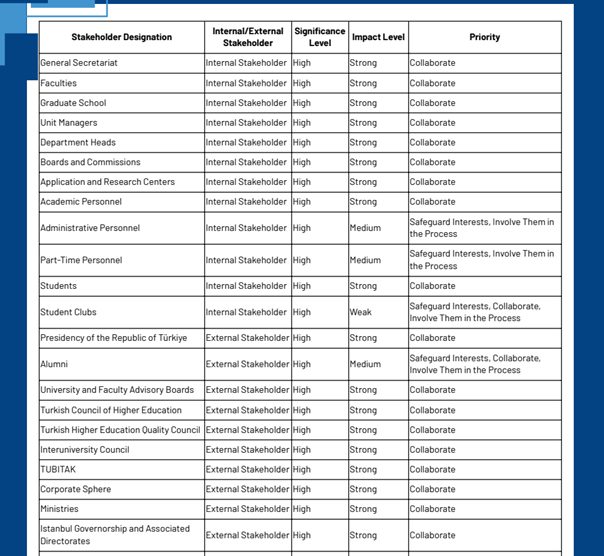
The images below present Bahçeşehir University's stakeholder analysis, defining how different internal and external stakeholders are engaged in and contribute to the University's governance and decision-making processes.
Institutional Framework for Stakeholder Analysis
Bahçeşehir University's stakeholder analysis forms part of its institutional quality assurance framework. It recognizes stakeholders as individuals, groups, and organizations that interact with the University's activities, contribute to institutional processes, or are affected by its decisions and outcomes.
The analysis emphasizes the identification of stakeholder expectations, their relationship to institutional priorities, and the role of stakeholder engagement in continuous improvement.
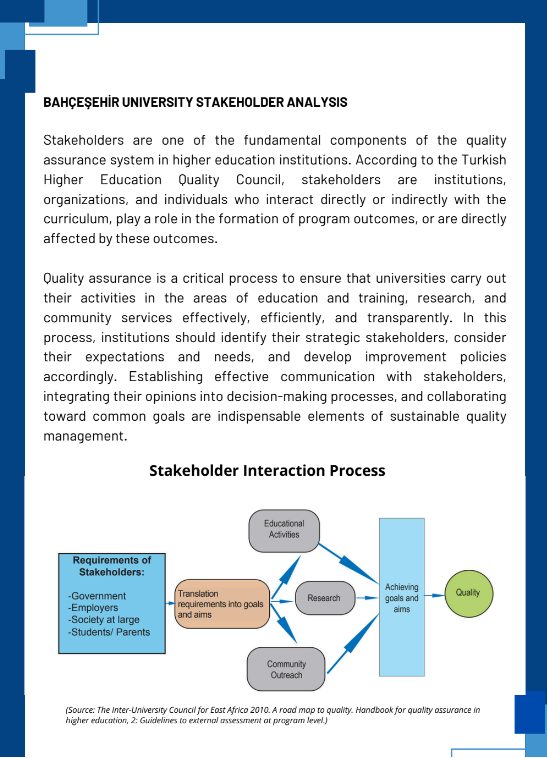
The University's Stakeholder Interaction Process illustrates the relationship between stakeholder requirements and institutional quality. Requirements and expectations associated with government, employers, society, students, and parents are considered in defining institutional goals and aims. These goals inform educational activities, research, and community outreach, with institutional quality linked to the achievement and evaluation of those goals.
Stakeholder Significance–Impact Matrix
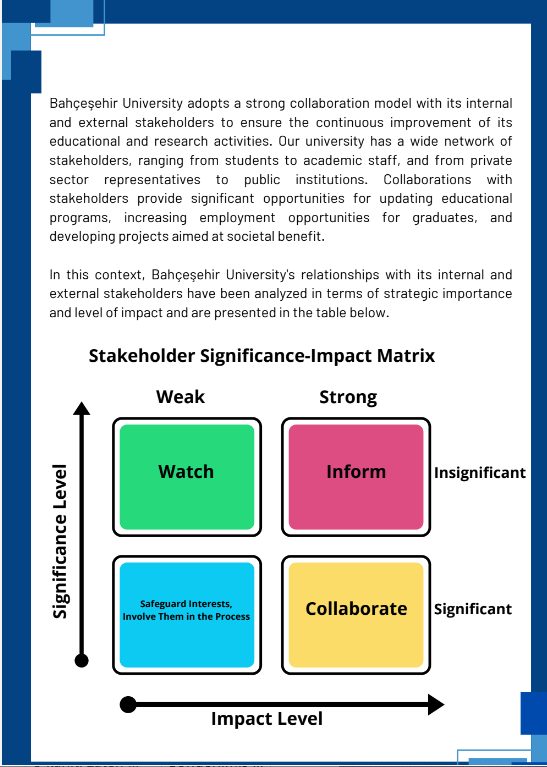
BAU uses a Stakeholder Significance–Impact Matrix to assess stakeholder groups according to two dimensions: their significance to the institution and their level of impact. The matrix identifies different engagement priorities based on these assessments.
| Significance Level | Impact Level | Engagement Priority |
|---|---|---|
| Low | Weak | Watch |
| Low | Strong | Inform |
| High | Weak | Safeguard Interests, Involve Them in the Process |
| High | Strong | Collaborate |
The matrix provides a structured basis for differentiating engagement approaches. Stakeholders assessed as having high significance and strong impact are assigned a collaboration priority, while other combinations of significance and impact are associated with monitoring, information sharing, or specific forms of involvement.
The detailed stakeholder classifications also include medium assessments and, for certain stakeholder groups, combined engagement priorities. These classifications are reproduced below as documented in the University's stakeholder analysis.
Recognition and Prioritization of Internal Stakeholders
The University's stakeholder analysis identifies the following internal stakeholder groups and engagement priorities:
| Internal Stakeholder | Significance | Impact | Engagement Priority |
|---|---|---|---|
| General Secretariat | High | Strong | Collaborate |
| Faculties | High | Strong | Collaborate |
| Graduate School | High | Strong | Collaborate |
| Unit Managers | High | Strong | Collaborate |
| Department Heads | High | Strong | Collaborate |
| Boards and Commissions | High | Strong | Collaborate |
| Application and Research Centers | High | Strong | Collaborate |
| Academic Personnel | High | Strong | Collaborate |
| Administrative Personnel | High | Medium | Safeguard Interests, Involve Them in the Process |
| Part-Time Personnel | High | Medium | Safeguard Interests, Involve Them in the Process |
| Students | High | Strong | Collaborate |
| Student Union and Clubs | High | Strong | Safeguard Interests, Collaborate, Involve Them in the Process |
The classification of students as high-significance, strong-impact stakeholders with a “Collaborate” engagement priority is particularly relevant to institutional governance. It documents the University's recognition of students as an important stakeholder group whose perspectives should be considered through collaborative engagement.
The separate recognition of student clubs demonstrates that BAU also considers organized student groups within its stakeholder framework. Although the matrix assigns student clubs a weak impact classification, it identifies their significance as high and includes collaboration and involvement in institutional processes among their engagement priorities.
The BAU Student Council provides an additional formal representative mechanism for students under the University's Student Council Directive. Its role complements the stakeholder analysis by providing a defined structure through which elected student representatives can communicate collective student perspectives.
Recognition and Prioritization of External Stakeholders
The stakeholder analysis identifies a broad range of external stakeholders and assigns engagement priorities according to their assessed significance and impact:
| External Stakeholder | Significance | Impact | Engagement Priority |
|---|---|---|---|
| Presidency of the Republic of Türkiye | High | Strong | Collaborate |
| Alumni | High | Medium | Safeguard Interests, Collaborate, Involve Them in the Process |
| University and Faculty Advisory Boards | High | Strong | Collaborate |
| Turkish Council of Higher Education | High | Strong | Collaborate |
| Turkish Higher Education Quality Council | High | Strong | Collaborate |
| Interuniversity Council | High | Strong | Collaborate |
| TÜBİTAK | High | Strong | Collaborate |
| Corporate Sphere | High | Strong | Collaborate |
| Ministries | High | Strong | Collaborate |
| Istanbul Governorship and Associated Directorates | High | Strong | Collaborate |
| Istanbul Metropolitan Municipality and Local District Municipalities | High | Strong | Collaborate |
| Civil Society Organizations | High | Strong | Collaborate |
| Media Institutions | High | Strong | Collaborate |
| Other Universities | High | Strong | Collaborate |
| Suppliers | High | Weak | Safeguard Interests, Collaborate, Involve Them in the Process |
| International Organizations | Low/Medium | Weak/Medium | Watch |
| Cultural and Artistic Institutions | Low/Medium | Weak/Medium | Watch |
| Educational and Research Institutions | Low/Medium | Weak/Medium | Watch |
| Local Communities | Low/Medium | Weak/Medium | Inform |
| Student Applicants | High | Weak | Safeguard Interests, Involve Them in the Process |
These classifications demonstrate the scope of BAU's stakeholder relationships, encompassing public authorities, quality assurance bodies, industry, civil society, alumni, other universities, community groups, and international organizations.
Relationship Between Stakeholder Analysis and Institutional Governance
The Stakeholder Significance–Impact Matrix establishes a documented framework for identifying stakeholders and defining appropriate engagement priorities.
For students, the framework explicitly prioritizes collaboration, while the separate recognition of student clubs demonstrates attention to collective student interests and participation.
This analysis provides the institutional context for the specific engagement channels documented in the Stakeholder Engagement Mechanism Matrix.
BAU Stakeholder Engagement Mechanism
Institutional Stakeholder Engagement Framework
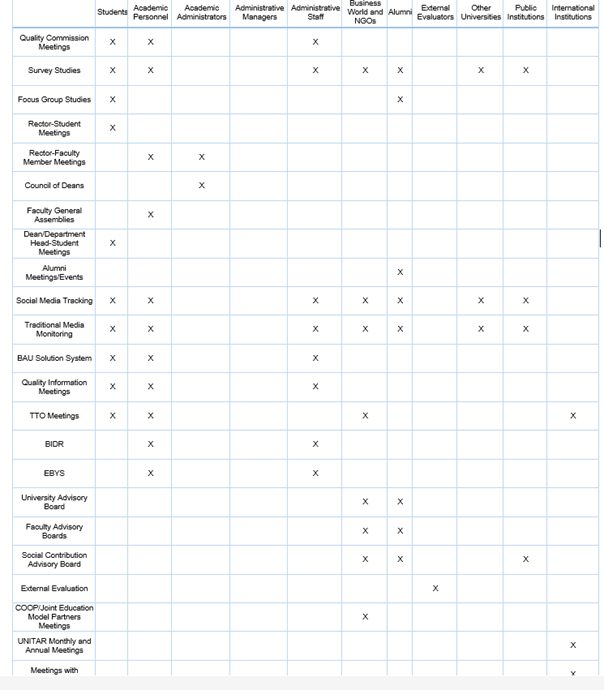
Bahçeşehir University's Stakeholder Engagement Mechanism Matrix documents the channels used to communicate and engage with different internal and external stakeholder groups.
The matrix distinguishes between students, academic personnel, academic administrators, administrative managers, administrative staff, business and industry representatives/non-governmental organizations, alumni, external evaluators, other universities, public institutions, and international institutions.
By identifying engagement channels for different stakeholder groups, the matrix demonstrates that stakeholder participation is supported through multiple institutional mechanisms.
Stakeholder Engagement Mechanisms and Participating Groups
The following table reproduces the stakeholder–mechanism relationships documented in the University's engagement matrix.
| Engagement Mechanism | Stakeholder Groups Identified |
|---|---|
| Quality Commission Meetings | Students; academic personnel; administrative staff |
| Survey Studies | Students; academic personnel; administrative staff; business world and NGOs; alumni; other universities; public institutions |
| Focus Group Studies | Students; alumni |
| Rector–Student Meetings | Students |
| Rector–Faculty Member Meetings | Academic personnel; academic administrators |
| Council of Deans | Academic administrators |
| Faculty General Assemblies | Academic personnel |
| Dean/Department Head–Student Meetings | Students |
| Alumni Meetings/Events | Alumni |
| Social Media Tracking | Students; academic personnel; administrative staff; business world and NGOs; alumni; other universities; public institutions |
| Traditional Media Monitoring | Students; academic personnel; administrative staff; business world and NGOs; alumni; other universities; public institutions |
| BAU Solution System | Students; academic personnel; administrative staff |
| Quality Information Meetings | Students; academic personnel; administrative staff |
| Technology Transfer Office (TTO) Meetings | Students; academic personnel; business world and NGOs; international institutions |
| BİDR – Institutional Internal Evaluation Report | Academic personnel; administrative staff |
| EBYS – Electronic Document Management System | Academic personnel; administrative staff |
| University Advisory Board | Business world and NGOs; alumni |
| Faculty Advisory Boards | Business world and NGOs; alumni |
| Social Contribution Advisory Board | Business world and NGOs; alumni; public institutions |
| External Evaluation | External evaluators |
| COOP/Joint Education Model Partners Meetings | Business world and NGOs |
| UNITAR Monthly and Annual Meetings | International institutions |
The documented mechanisms encompass quality assurance, academic governance, student consultation, administrative communication, research and industry collaboration, alumni engagement, societal contribution, external evaluation, and international institutional coordination.
Student Participation and Representation
The matrix identifies students as participants in multiple engagement mechanisms, including Quality Commission meetings, survey studies, focus groups, Rector–Student meetings, Dean/Department Head–Student meetings, Quality Information Meetings, Technology Transfer Office meetings, and the BAU Solution System.
These channels support different forms of student participation, including institutional consultation, communication with academic and executive leadership, feedback on University services, and involvement in quality-related discussions.
The inclusion of students in Quality Commission meetings is particularly significant because it connects student participation with the University's formal institutional quality assurance processes.
Rector–Student meetings and Dean/Department Head–Student meetings provide direct communication channels between students and decision-makers at different levels of the University's organizational structure.
These engagement mechanisms are complemented by the BAU Student Council, which provides formal student representation under the Student Council Directive, and by student clubs and societies, which create additional opportunities for collective student participation.
Academic and Administrative Stakeholder Engagement
Academic personnel are engaged through Quality Commission meetings, surveys, Rector–Faculty Member meetings, Faculty General Assemblies, Quality Information Meetings, Technology Transfer Office meetings, the BAU Solution System, and institutional evaluation and reporting processes.
Academic administrators participate in governance mechanisms such as the Council of Deans and Rector–Faculty Member meetings.
Administrative staff are included in Quality Commission meetings, surveys, Quality Information Meetings, communication monitoring, the BAU Solution System, and institutional reporting and document management processes.
These arrangements provide multiple channels through which academic and administrative perspectives can be communicated within the University's institutional governance and quality assurance framework.
Engagement with Business, Industry, Civil Society, and Alumni
The matrix identifies engagement with business and industry representatives, non-governmental organizations, and alumni through a combination of consultation, advisory, and collaborative mechanisms.
Business and industry representatives and NGOs are included in surveys, communication monitoring, Technology Transfer Office meetings, University and Faculty Advisory Boards, the Social Contribution Advisory Board, and COOP/Joint Education Model Partners Meetings.
Alumni participate through surveys, focus groups, alumni meetings and events, communication monitoring, and advisory boards.
These mechanisms provide opportunities for external stakeholder perspectives to inform discussions concerning academic development, professional expectations, institutional partnerships, and societal contribution.
Engagement with Public Institutions, External Evaluators, and Other Universities
Public institutions are identified in survey studies, communication monitoring, and the Social Contribution Advisory Board.
External evaluators are included through formal external evaluation processes, supporting institutional quality assurance and assessment.
Other universities are identified in stakeholder surveys and communication monitoring, reflecting their place within BAU's wider institutional stakeholder environment.
Engagement with International Institutions
International institutions are explicitly included in the Stakeholder Engagement Mechanism Matrix through Technology Transfer Office meetings and UNITAR monthly and annual meetings.
These mechanisms document channels for international institutional dialogue and coordination within the University's wider stakeholder engagement framework.
Integration of Stakeholder Engagement into Decision-Making and Continuous Improvement
The Stakeholder Significance–Impact Matrix and Stakeholder Engagement Mechanism Matrix serve complementary purposes.
The first identifies stakeholders, assesses their significance and impact, and defines engagement priorities. The second documents the institutional channels through which stakeholder groups are consulted, represented, informed, or involved in University activities.
Together, these documents provide evidence of a structured approach to stakeholder relations, linking stakeholder recognition and prioritization with practical engagement mechanisms.
For students, the combination of a high-significance, strong-impact classification, formal student representation through the Student Council, recognition of student clubs, and participation in quality assurance and leadership consultation mechanisms demonstrates the University's institutional commitment to student engagement.
More broadly, the documented participation of academic personnel, administrative staff, alumni, industry partners, civil society organizations, public institutions, external evaluators, and international institutions demonstrates the breadth of BAU's stakeholder engagement framework.
Conclusion
Bahçeşehir University regards stakeholder engagement as a strategic cornerstone of its governance and sustainability model. Through transparent communication, participatory structures, and collaborative partnerships, BAU ensures that all stakeholders—internal and external—are empowered to contribute meaningfully to the University's mission, vision, and long-term development.
Policy Established: 2021
Revised: 2025
Policy Owner: Bahçeşehir University Rectorate
Scope: All academic and administrative units of Bahçeşehir University, and all internal and external stakeholders engaged in or affected by the University's educational, research, administrative, and societal activities.
Responsible Units: Rectorate, Quality Coordination Office, and relevant academic and administrative units.
Implementation: Through institutional stakeholder engagement mechanisms, including representative bodies, committees, advisory boards, surveys, consultation meetings, feedback systems, and collaborative partnerships.
Monitoring and Evaluation: Through the University's institutional quality assurance, stakeholder feedback, and continuous improvement processes.
Review Cycle: Periodically reviewed and updated as necessary to reflect institutional priorities, stakeholder expectations, and quality assurance requirements.
The images below present Bahcesehir University’s stakeholder analysis, defining how different internal and external stakeholders are engaged in and contribute to the The images below present Bahçeşehir University's stakeholder analysis, defining how different internal and external stakeholders are engaged in and contribute to the university's governance and decision-making processes.
The image below presents Bahçeşehir University's Stakeholder Engagement Mechanism Matrix, illustrating the various communication, consultation, and participation mechanisms through which the University engages its internal and external stakeholders and supports their involvement in institutional governance and decision-making processes.