





 EN
5.6.6 - Women's Mentoring Schemes
Bahçeşehir University (BAU) is committed to advancing gender equality and supporting the academic, personal, and professional development of its female students through structured mentoring opportunities. These initiatives connect students with experienced professionals, academics, and role models, providing guidance, knowledge-sharing, networking opportunities, and support for career development and leadership aspirations.
Through its women's mentoring programmes, BAU seeks to strengthen female students' confidence, expand their professional networks, develop their leadership potential, and support their transition from higher education into professional life. The University also systematically monitors participation in these programmes to evaluate their reach, assess student engagement, and inform the continuous development of mentoring opportunities for women.
Bahçeşehir University Women Student Mentorship Program
The image below portrays a promotional poster for the Women Students Mentorship Program
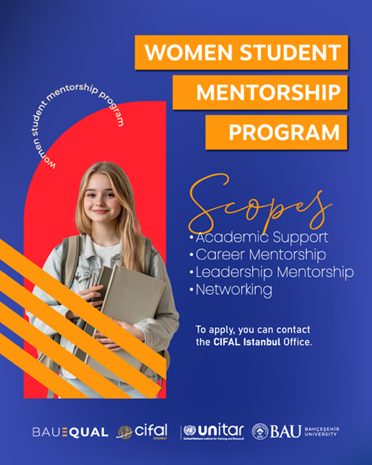
Bahçeşehir University (BAU) recognizes that advancing gender equality in higher education requires more than ensuring equal opportunities for admission. It also involves creating an inclusive and supportive educational environment in which women can pursue their academic ambitions, develop their professional potential, access meaningful networks, and participate fully in university life.
Within this framework, the Bahçeşehir University Women Students Mentorship Program is a structured, university-wide initiative that connects female students with experienced women professionals, entrepreneurs, and academics. Coordinated through CIFAL Istanbul, BAU EQUAL, and the BAU Social Impact and Responsibility Directorate, the program provides opportunities for individualized guidance, professional knowledge exchange, leadership development, and intergenerational learning.
CIFAL Istanbul, hosted by Bahçeşehir University as a training centre affiliated with the United Nations Institute for Training and Research (UNITAR), contributes its educational and professional networks to the initiative. The involvement of BAU EQUAL reflects the University's institutional commitment to equality, inclusion, and women's empowerment.
The program is founded on the understanding that women's educational and professional advancement is influenced not only by academic achievement but also by access to mentoring relationships, professional networks, role models, and opportunities to develop confidence and leadership capabilities.
By bringing together female students and accomplished women from different professional backgrounds, the initiative seeks to strengthen women's academic and professional development and support their transition from higher education into professional life.
The program contributes to Sustainable Development Goal 5 (Gender Equality) and Sustainable Development Goal 4 (Quality Education) by expanding access to structured mentoring and development opportunities for women across the University.
1. Programme Objectives and Women's Empowerment
The primary objective of the Women Students Mentorship Program is to support the academic, personal, and professional development of female students through sustained mentoring relationships with experienced women.
The program aims to:
Strengthen women's access to educational, professional, and leadership opportunities by connecting students with experienced mentors and professional networks.
Support students in making informed decisions about their academic development, career pathways, and future aspirations.
Develop confidence, communication, networking, leadership, and decision-making capabilities.
Increase students' understanding of professional environments, organizational cultures, workplace expectations, and career development opportunities.
Provide access to women role models whose experiences offer practical insights into professional advancement and leadership.
Help participants recognize and navigate barriers associated with gender stereotypes, limited professional networks, or unequal access to opportunities.
Encourage intergenerational knowledge exchange, mutual learning, and solidarity among women.
Support students in identifying their individual strengths, interests, development needs, and long-term professional goals.
The program recognizes that women may encounter different challenges depending on their academic disciplines, professional ambitions, and individual circumstances. Its mentoring approach therefore emphasizes personalized guidance.
Through direct engagement with experienced women, participants are encouraged to explore their potential, broaden their professional perspectives, and develop the knowledge and confidence needed to pursue their ambitions.
2. Eligibility, Applications, and Mentor–Mentee Matching
2.1. Mentee Eligibility and Access
The Women Students Mentorship Program is open to female students enrolled at Bahçeşehir University across all academic disciplines, including undergraduate and postgraduate students.
The program's university-wide approach reflects BAU's commitment to ensuring that mentoring opportunities are not restricted to particular faculties, departments, or fields of study.
While recognizing that women may face additional barriers in certain academic disciplines and professional sectors, the initiative adopts an inclusive approach that supports women's development regardless of their chosen educational or career pathways.
Interested students apply through the online application process announced for the relevant program cycle.
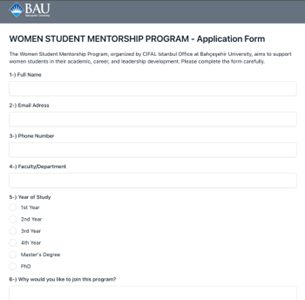
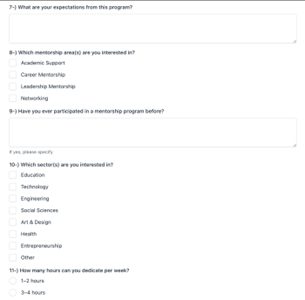
The application form collects information about applicants' academic backgrounds, interests, motivations, previous mentoring experiences, career aspirations, and expectations from the program.
These details help the coordinating team understand each student's individual development needs and identify suitable mentoring opportunities.
2.2. Mentor Eligibility and Responsibilities
Mentors are women professionals, entrepreneurs, or academics with at least five years of relevant experience in their respective fields.
They bring professional knowledge, practical experience, and diverse perspectives from academia, business, entrepreneurship, public institutions, and other professional environments.
Experienced women from the BAU alumni network and the University's wider professional community may also contribute as mentors.
Mentors support participating students by:
Sharing professional experiences, career journeys, and lessons learned;
Providing guidance on academic and career-related decisions;
Discussing professional expectations, organizational cultures, and workplace challenges;
Supporting the development of leadership, communication, and networking skills;
Encouraging students to recognize their strengths and explore professional opportunities;
Offering perspectives on navigating challenges and making informed decisions;
Promoting mutual learning, professional solidarity, and constructive dialogue.
The program places particular value on the involvement of accomplished women role models, whose experiences can help students broaden their understanding of possible career paths and leadership opportunities.
2.3. Mentor–Mentee Matching Process
The program follows a structured application and matching process coordinated by the CIFAL Istanbul Office, BAU EQUAL, and the BAU Social Impact and Responsibility Directorate.
Prospective mentors and mentees complete application forms designed to collect information relevant to their backgrounds, professional experience, academic interests, motivations, and expectations.
Application questions address matters such as applicants' reasons for participating, previous involvement in mentoring programs, areas of expertise, career interests, and the type of guidance sought.
The coordinating team reviews the information provided and identifies suitable mentor–mentee pairings by considering the alignment between mentors' professional backgrounds and mentees' academic interests, career aspirations, and development needs.
Each participating female student is matched with one designated mentor. Depending on their availability and capacity, individual mentors may support more than one mentee.
This matching model is designed to establish constructive mentoring relationships in which professional experience, student expectations, and individual development goals are meaningfully aligned.
The application forms and matching documentation provide supporting evidence of the program's organized and structured implementation.
3. Programme Structure, Duration, and Mentoring Activities
3.1. Fourteen-Week Mentoring Framework
The Women Students Mentorship Program operates through a structured 14-week mentoring framework designed to provide sustained engagement.
During the program, each mentor–mentee pair is expected to complete at least four individual meetings, each lasting a minimum of one hour.
Meetings may take place in person or online, according to the mutual availability and preferences of mentors and mentees.
This flexible arrangement accommodates participants' academic, professional, and personal responsibilities while maintaining a defined framework for engagement.
The 14-week period allows mentoring relationships to develop over time. Participants can identify objectives, discuss academic and professional challenges, explore possible solutions, receive feedback, and reflect on their development throughout the program.
3.2. Individual Mentorship and Academic Guidance
Individual mentoring sessions form the central component of the program.
These meetings provide students with opportunities to discuss their educational experiences, academic interests, professional ambitions, career planning, and personal development goals.
Mentors share insights from their own experiences and support mentees in considering different approaches to academic and professional decision-making.
The individualized nature of these interactions allows the mentoring relationship to respond to each student's circumstances, interests, and aspirations.
3.3. Leadership and Professional Development
The program places emphasis on the development of competencies that can support women's academic progression and professional participation.
Mentoring discussions may address leadership, communication, decision-making, professional confidence, networking, career preparation, and the transition from university to employment.
Through these exchanges, students gain exposure to professional expectations and develop a broader understanding of the knowledge, skills, and relationships that contribute to career development.
The program encourages participants to reflect on their strengths, articulate their ambitions, and approach professional opportunities with greater awareness and confidence.
3.4. Group Events and Engagement with Women Role Models
In addition to individual mentoring sessions, the program incorporates group events and opportunities for collective engagement with inspiring women leaders from academia, industry, and entrepreneurship.
These activities complement one-to-one mentoring by bringing participants together and exposing them to a wider range of professional experiences, career journeys, and leadership perspectives.
Group engagement also provides opportunities for professional networking, peer interaction, and the exchange of ideas among students and experienced professionals.
By creating connections beyond individual mentor–mentee pairs, the program supports a broader community of learning and solidarity among women.
3.5. Intergenerational Knowledge Exchange and Professional Networks
An important dimension of the program is the opportunity for female students to engage directly with women who have established careers in different professional fields.
These relationships create space for exchanging practical knowledge, discussing professional challenges, and understanding how academic learning connects with professional experience.
The program also encourages connections among participating students, contributing to peer solidarity and a supportive environment in which women can learn from one another's experiences.
The combination of individual guidance, group engagement, and intergenerational knowledge exchange strengthens the program's contribution to women's personal and professional development.
4. Application Process and Institutional Coordination
The Women Students Mentorship Program is implemented through a coordinated institutional process involving application management, mentor engagement, matching, communication, and program delivery.
Mentee Applications
Female students interested in participating submit their applications through the designated online application form.
Applicants provide information about their academic background, motivation, professional interests, and expectations from the mentoring experience.
The application process enables the organizing team to assess the interests and development needs of prospective mentees and facilitate appropriate matching.
Mentor Applications
Mentor participation is managed and coordinated by CIFAL Istanbul, which engages experienced women professionals, entrepreneurs, and academics through its institutional and professional networks.
Prospective mentors provide information about their experience, expertise, professional background, and availability.
Matching and Participant Communication
The CIFAL Istanbul Office, BAU EQUAL, and the BAU Social Impact and Responsibility Directorate contribute to the review and matching process within their respective areas of responsibility.
Following the matching process, the organizing team communicates mentor–mentee assignments to participants and provides relevant information for initiating their mentoring relationships.
Institutional Collaboration
CIFAL Istanbul supports program coordination and communication with mentors, mentees, and relevant stakeholders.
BAU EQUAL contributes the University's institutional perspective on gender equality and inclusion, while the BAU Social Impact and Responsibility Directorate participates in the program's coordination and implementation.
The program also draws upon the wider BAU academic community, alumni, external professionals, and institutional networks to connect female students with diverse sources of professional knowledge and experience.
Where relevant, other University units may contribute to complementary professional development and networking activities within their areas of responsibility.
This collaborative structure connects the University's commitment to gender equality with practical mentoring opportunities for its female students.
5. Addressing Barriers to Women's Academic and Professional Advancement
BAU recognizes that women students may encounter barriers that extend beyond formal access to higher education.
These barriers can include limited exposure to professional networks, insufficient access to experienced women role models, gender stereotypes, uncertainty about career pathways, and unequal opportunities for professional development.
Some students may also face additional challenges associated with socioeconomic circumstances, disability, family responsibilities, or other intersecting forms of disadvantage.
The Women Students Mentorship Program seeks to address these challenges by providing accessible mentoring relationships and opportunities for professional knowledge exchange.
Its university-wide approach allows female students from different academic disciplines to benefit from guidance that reflects their individual interests and aspirations.
The program recognizes the diversity of their ambitions, circumstances, and development needs.
By connecting students with experienced women who can share practical insights, the initiative seeks to strengthen participants' confidence, broaden their professional perspectives, and support informed decisions about their futures.
The program's contribution is therefore not limited to immediate career guidance. It also supports the development of professional relationships, personal agency, and leadership potential that may remain valuable beyond students' university years.
6. Programme Feedback and Continuous Improvement
Bahçeşehir University recognizes the importance of reviewing participants' experiences and identifying opportunities to strengthen the quality and relevance of its mentoring initiatives.
Feedback from mentors and mentees can provide valuable insights into the effectiveness of matching arrangements, the relevance of mentoring discussions, the accessibility of program activities, and participants' development needs.
Such feedback may inform improvements to program communication, mentor engagement, professional networking opportunities, and the organization of future mentoring cycles.
The University also recognizes the value of monitoring participation trends to understand the reach of mentoring opportunities among its female student population.
Through continued review and institutional coordination, BAU seeks to maintain a mentoring framework that responds to students' evolving academic and professional aspirations.
7. Contribution to SDG 5: Gender Equality
The Women Students Mentorship Program represents a practical expression of Bahçeşehir University's commitment to SDG 5 (Gender Equality) and SDG 4 (Quality Education).
By combining university-wide access, individualized mentoring, sustained engagement, and connections with experienced women role models, the program contributes to an educational environment in which female students are supported in developing their academic, personal, and professional potential.
The initiative recognizes that advancing gender equality involves not only ensuring access to education but also strengthening women's ability to benefit from educational opportunities, develop professional networks, exercise leadership, and pursue their ambitions.
Its structured mentoring model creates opportunities for students to engage with accomplished women, learn from professional experience, build confidence, and develop competencies relevant to their future careers.
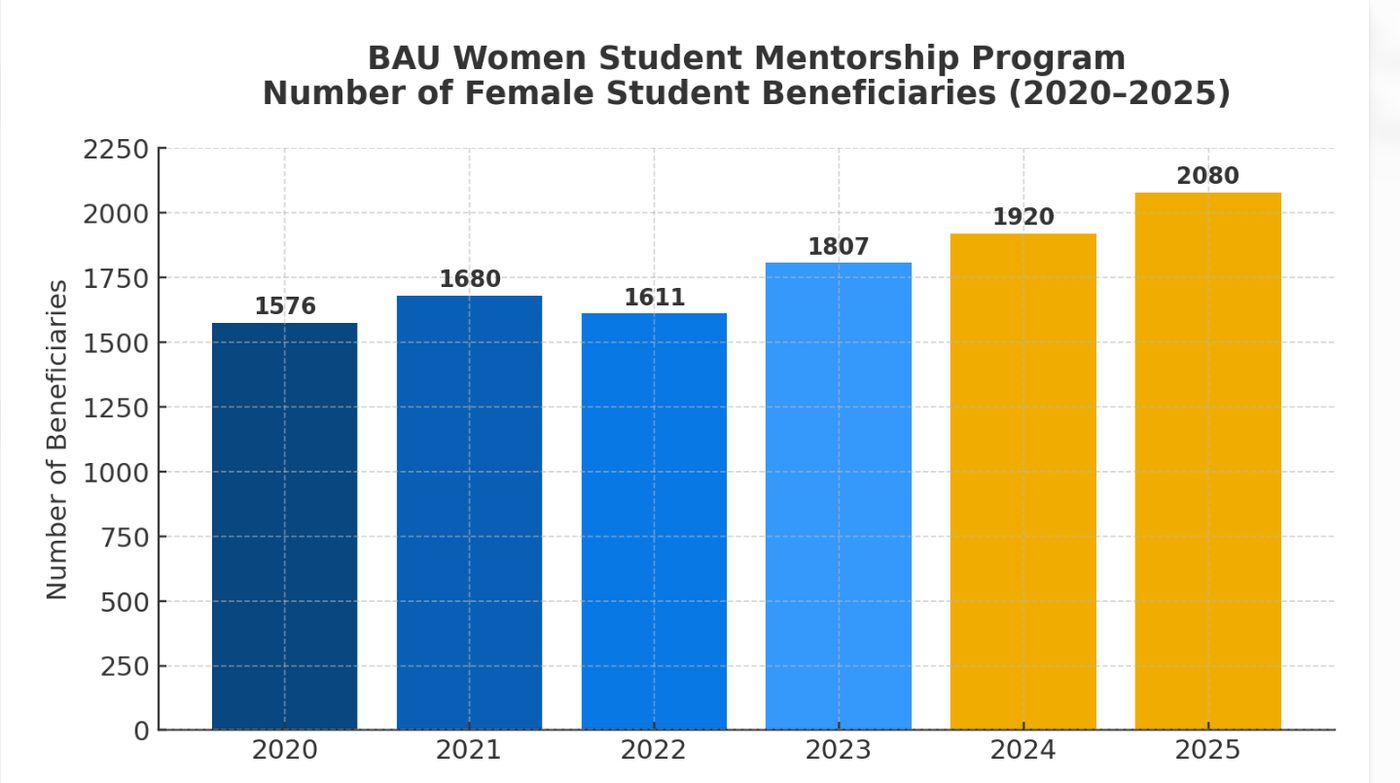
The expansion in reported female student beneficiaries between 2020 and 2025 further demonstrates the University's continuing investment in mentoring and women's development opportunities.
Through the Women Students Mentorship Program, Bahçeşehir University seeks to ensure that women across academic disciplines have meaningful opportunities to access guidance, build professional connections, develop leadership potential, and pursue their academic and career aspirations.
In doing so, BAU reinforces its broader institutional commitment to empowering women and promoting more equitable participation in higher education and professional life.
The images below portray the application form for the Women Student Mentorship Program
Participation data from 2020 to 2025 demonstrate the sustained expansion of the Bahçeşehir University Women Student Mentorship Program. The number of female student beneficiaries increased from 1,576 in 2020 to 2,080 in 2025, representing an overall increase of approximately 32%.
The graph below illustrates the annual number of female students benefiting from the mentorship program between 2020 and 2025, highlighting the expansion of mentoring opportunities and Bahçeşehir University's sustained commitment to advancing gender equality and women's academic and professional development.
Bahçeşehir University Career and Long-Term Internship Program Supporting Women Students
Advancing Women's Equal Access to Professional Development and Career Opportunities
Bahçeşehir University (BAU) recognizes that achieving gender equality in higher education requires not only equitable access to academic programmes but also meaningful opportunities for women to develop professional competencies, gain practical experience, and prepare for successful transitions into employment.
Within this framework, BAU's CO-OP Education Model and COOPER Program provide an institutional mechanism for supporting women's access to long-term internships, career development opportunities, professional networks, and workplace experience.
The programme forms part of the University's broader commitment to SDG 5 (Gender Equality) by promoting women's equal participation in professional development activities and helping address barriers that may affect their transition from higher education into the labour market.
An Integrated Career Development and Long-Term Internship Model
The BAU CO-OP Education Model integrates academic learning with practical professional experience through long-term internships and complementary career development activities.
The programme provides students with access to career counselling, professional development workshops, mock job interviews, seminars, industry mentorship, and opportunities to engage directly with employers.
These activities are designed to strengthen students' professional competencies, confidence, career planning abilities, and understanding of workplace expectations.
For female students, this integrated approach is particularly important in expanding access to professional environments, developing networks, and strengthening their readiness to pursue career opportunities across different sectors.
The programme supports women students across all academic disciplines and professional interests, while recognizing the importance of additional encouragement in sectors and positions where women have historically been underrepresented.
Application, Selection, and Placement Process
The BAU CO-OP Career Center coordinates long-term internship placements in collaboration with the Human Resources departments of partner companies.
The placement process follows a structured model that reflects professional recruitment practices.
It includes:
Internship Announcements: Long-term internship opportunities are communicated to eligible students through relevant programme channels.
Student Applications: Interested students apply for available opportunities according to the requirements of the relevant positions.
Candidate Evaluation: Applications are reviewed in relation to the qualifications, competencies, and expectations associated with each internship.
Interviews and Shortlisting: Candidates participate in relevant selection procedures, including interviews and shortlisting conducted in cooperation with partner companies.
Internship Placement: Selected students are placed in professional environments where they can gain practical experience and develop workplace competencies.
Administrative Coordination: Relevant administrative and insurance procedures are managed by the University under the supervision of the CO-OP team.
By participating in these stages, students gain direct experience of professional recruitment processes before graduation.
Promoting Women's Equal Access and Participation
Ensuring equal access for women students is a central principle of BAU's COOPER Program.
The University is committed to providing female students with fair opportunities to apply for and participate in long-term internships and career development activities.
BAU actively encourages women's participation across all sectors and professional fields, ensuring that opportunities are not limited to particular disciplines or traditionally female-dominated occupations.
Within this university-wide approach, additional attention is given to encouraging female participation in sectors and positions where women remain underrepresented.
The programme supports women's career development through:
Equal access to long-term internship opportunities and transparent application procedures.
Career counselling and guidance to support informed professional decisions.
Workshops and mock interviews that strengthen career readiness and confidence.
Industry mentorship and engagement with experienced professionals.
Opportunities to establish professional networks and gain workplace experience.
Encouragement to explore diverse career pathways, including sectors where women have historically faced barriers to participation.
Through these activities, BAU seeks to strengthen women's professional independence, confidence, and capacity to pursue their career ambitions.
Collaboration with Industry and Professional Networks
A defining feature of the CO-OP Education Model is its collaboration with partner companies and their Human Resources departments.
These partnerships enable students to engage with professional recruitment procedures and experience workplace environments relevant to their academic backgrounds and career aspirations.
For women students, access to these partnerships creates opportunities to develop professional networks, gain practical experience, and engage with employers before graduation.
The programme also complements academic learning by connecting students with industry expectations and helping them develop competencies that support future employability.
By facilitating women's access to professional environments and employer networks, BAU contributes to reducing barriers between higher education and career opportunities.
BAU systematically monitors female students' participation and placement outcomes within the COOPER Program as part of its commitment to gender equality.
Gender-disaggregated programme data are used to assess participation patterns and evaluate women's access to long-term internship opportunities.
Relevant monitoring includes the number of participating female and male students, their representation among internship placements, and changes in participation across academic years.
The programme's monitoring approach supports the identification of potential gender disparities and informs efforts to encourage women's participation across different professional fields.
Programme data from previous years indicate consistently strong participation among female students, demonstrating their substantial engagement with the opportunities provided through the COOPER model.
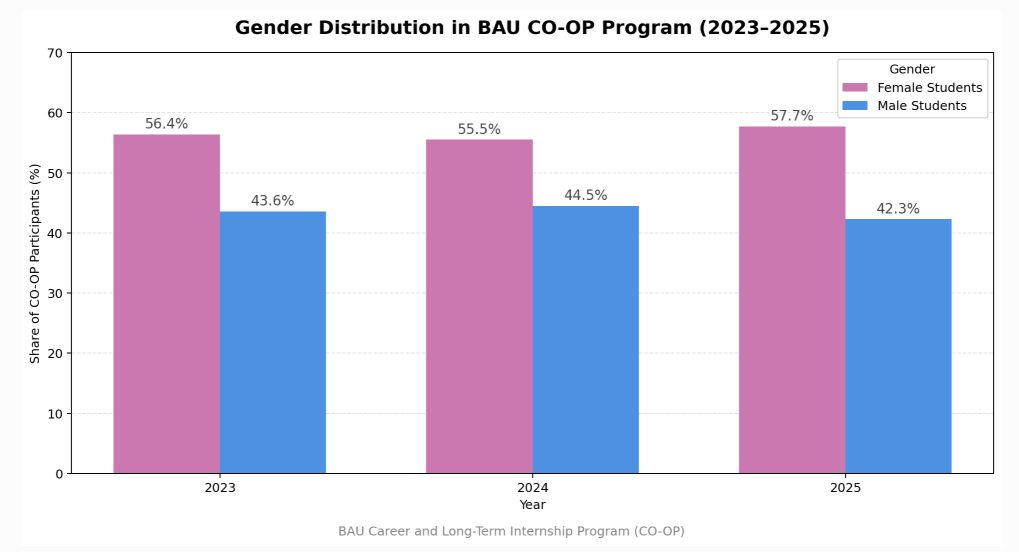
In 2023, female students represented 56.4% of all CO-OP participants, while male students accounted for 43.6%. In 2024, women comprised 55.5% and men 44.5% of total participants, maintaining a female majority.
In 2025, female students accounted for 57.7% of CO-OP participants, compared to 42.3% male students. This represents an increase of 2.2 percentage points in female participation compared to the previous year, further demonstrating the sustained engagement of women in BAU's experiential learning and professional development opportunities.
These figures demonstrate that female students continue to actively engage in experiential learning and long-term internship opportunities, benefiting from BAU's inclusive approach to career-oriented education.
The graph below illustrates the gender distribution of participants in BAU's CO-OP Program from 2023 to 2025, highlighting the University's ongoing commitment to promoting equal access to practical training, experiential learning, and professional development opportunities for all students.
Through these inclusive practices, Bahçeşehir University continues to align its education and employment strategies with SDG 4 (Quality Education), SDG 5 (Gender Equality), and SDG 8 (Decent Work and Economic Growth) — fostering an equitable, diverse, and empowered new generation of professionals.











