





 EN
5.3.1 - Tracking Women's Access to Higher Education: A Data-Driven Institutional Approach
Bahçeşehir University’s Central Admissions Office systematically monitors and reports gender-disaggregated application, admission, and enrollment data as part of the University’s institutional commitment to gender equality and equitable access to higher education. This established monitoring practice enables BAU to track women's representation at successive stages of the admissions process, assess differences between female and male applicants and entrants, and identify potential gender disparities across academic disciplines.
Through the systematic collection and annual review of these data, the University monitors changes in women's access to higher education over time and maintains an institutional evidence base for informing outreach, mentoring, and support initiatives aimed at promoting equitable participation across all fields of study.
1- Systematic Tracking of Gender Representation in Undergraduate Admissions and Enrolment
Bahçeşehir University systematically monitors women's access to higher education through multiple institutional data sources and monitoring tools, including YÖK Atlas for Turkish students, enrolment records maintained by the International Office for international students, and the ApplyBAU scholarship system for tracking gender representation in scholarship applications and awards. Together, these sources enable the University to collect, analyse, and review gender-disaggregated data across different student groups and stages of the admissions process.
This comprehensive approach enables the University to assess overall patterns in women's access to higher education while also examining differences in female and male participation across individual academic disciplines. The three-year data presented below, covering 2023–2025, provide an example of BAU's established monitoring practices and demonstrate how gender-disaggregated information is collected, compared, and analysed over time.
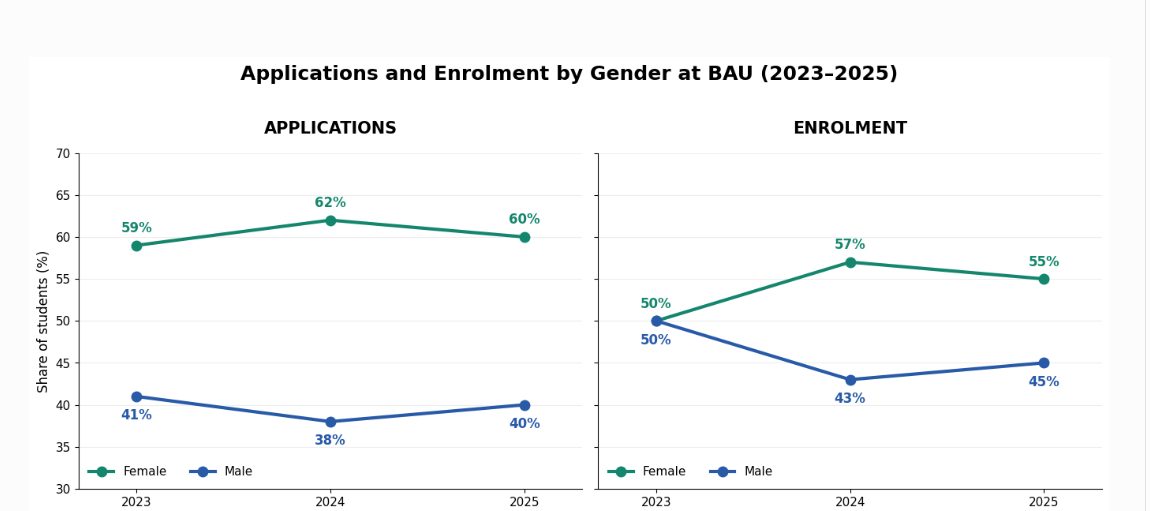
At the university-wide level, women consistently accounted for the majority of undergraduate applicants between 2023 and 2025, representing 59% in 2023, 62% in 2024, and 60% in 2025. These figures demonstrate sustained female representation among applicants throughout the reporting period.
Regarding undergraduate enrolment, female students accounted for 50% of newly enrolled students in 2023, 57% in 2024, and 55% in 2025. Women therefore represented at least half of newly enrolled students throughout the three-year period, with a clear female majority in 2024 and 2025.
The image below presents a visual summary of the findings from BAU’s systematic tracking of gender-disaggregated application and enrollment data between 2023 and 2025.
In addition to university-wide monitoring, Bahçeşehir University (BAU) systematically tracks gender-disaggregated undergraduate enrolment data at the faculty and school levels. This approach enables the University to examine differences in female and male student representation across academic disciplines, identify fields where gender disparities persist, and monitor women's access to higher education beyond aggregate institutional figures.
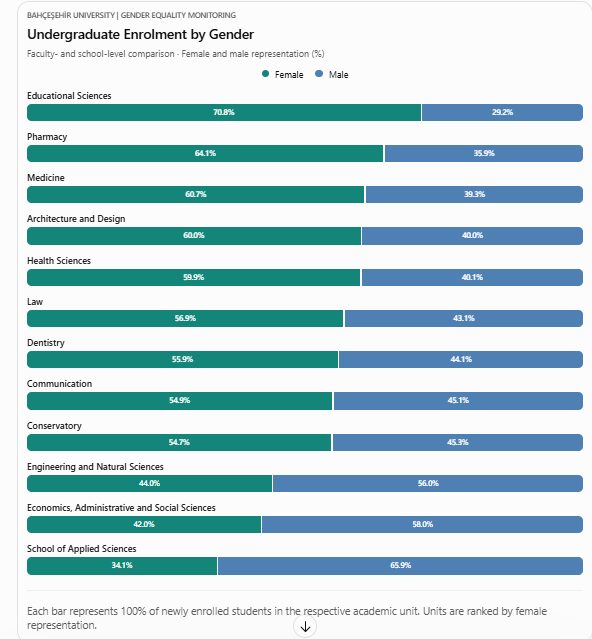
The faculty-level analysis reveals variations in gender representation across academic disciplines. Female students represented the majority in several faculties, including the Faculty of Educational Sciences (70.8%), Faculty of Pharmacy (64.1%), Faculty of Medicine (60.7%), Faculty of Architecture and Design (60.0%), Faculty of Health Sciences (59.9%), Faculty of Law (56.9%), and Faculty of Dentistry (55.9%). Female representation also exceeded 50% in the Faculty of Communication (54.9%) and the Conservatory (54.7%).
In contrast, male students represented the majority in the School of Applied Sciences (65.9%), where female representation stood at 34.1%, the Faculty of Economics, Administrative and Social Sciences (58.0%), where women accounted for 42.0%, and the Faculty of Engineering and Natural Sciences (56.0%), where female representation reached 44.0%.
These findings demonstrate the importance of examining gender representation at the faculty and school levels, as university-wide averages may conceal differences in women's participation across academic disciplines. By systematically collecting and reviewing gender-disaggregated enrolment data across these academic units, BAU maintains a detailed evidence base for identifying potential gender disparities, monitoring participation patterns, and informing institutional outreach, mentoring, and student support initiatives aimed at promoting equitable access to undergraduate education.
The following chart, presented in image format, illustrates the gender distribution of newly enrolled undergraduate students across academic units at Bahçeşehir University. By comparing female and male representation at the faculty and school levels, the chart highlights variations in gender participation across academic disciplines and complements the University's systematic monitoring of undergraduate access.
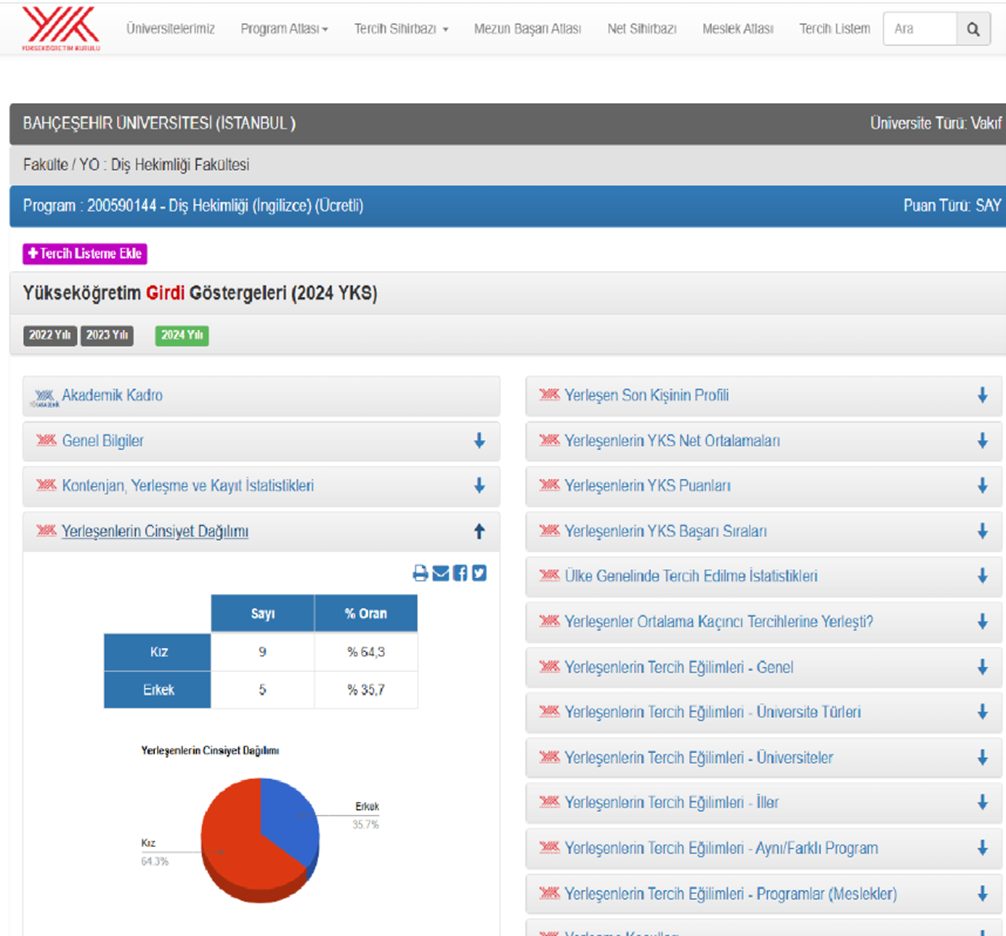
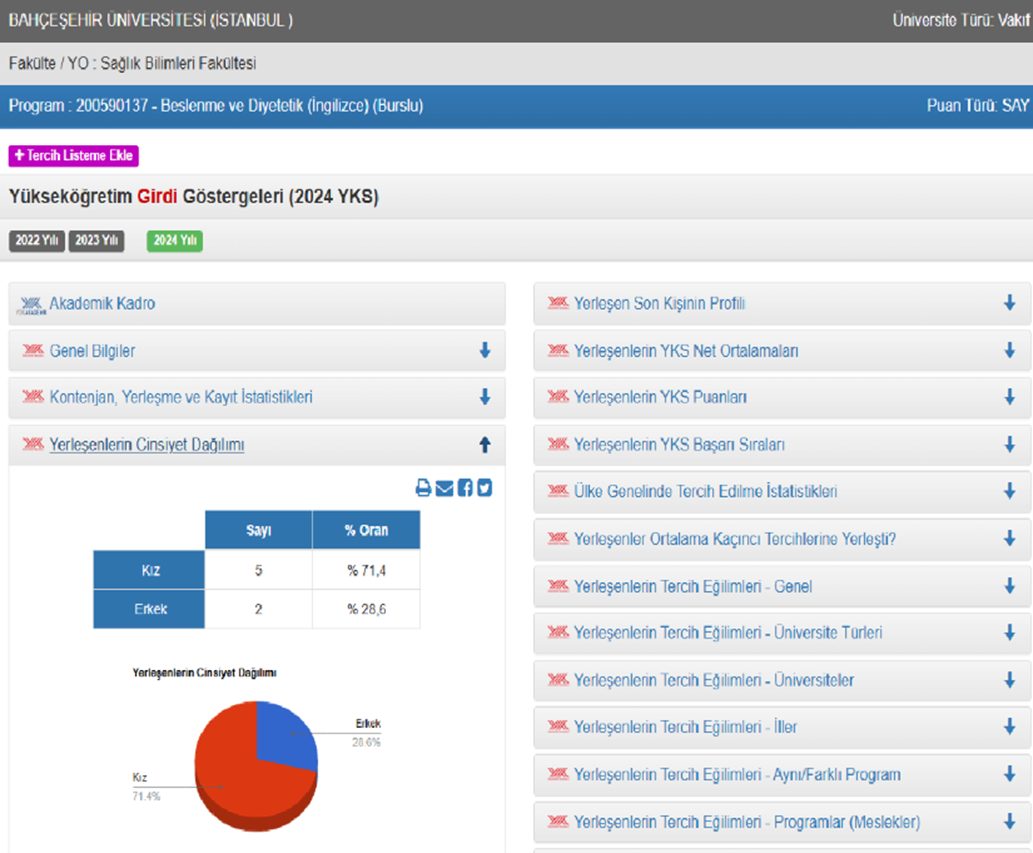
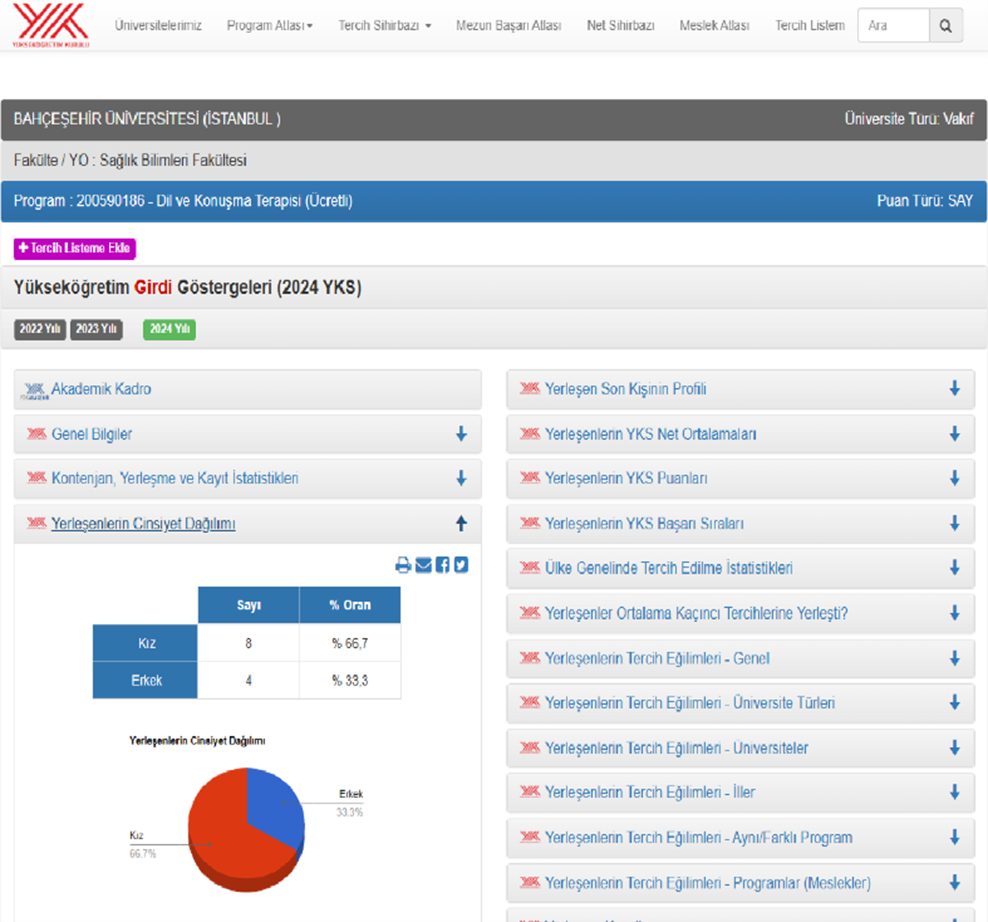
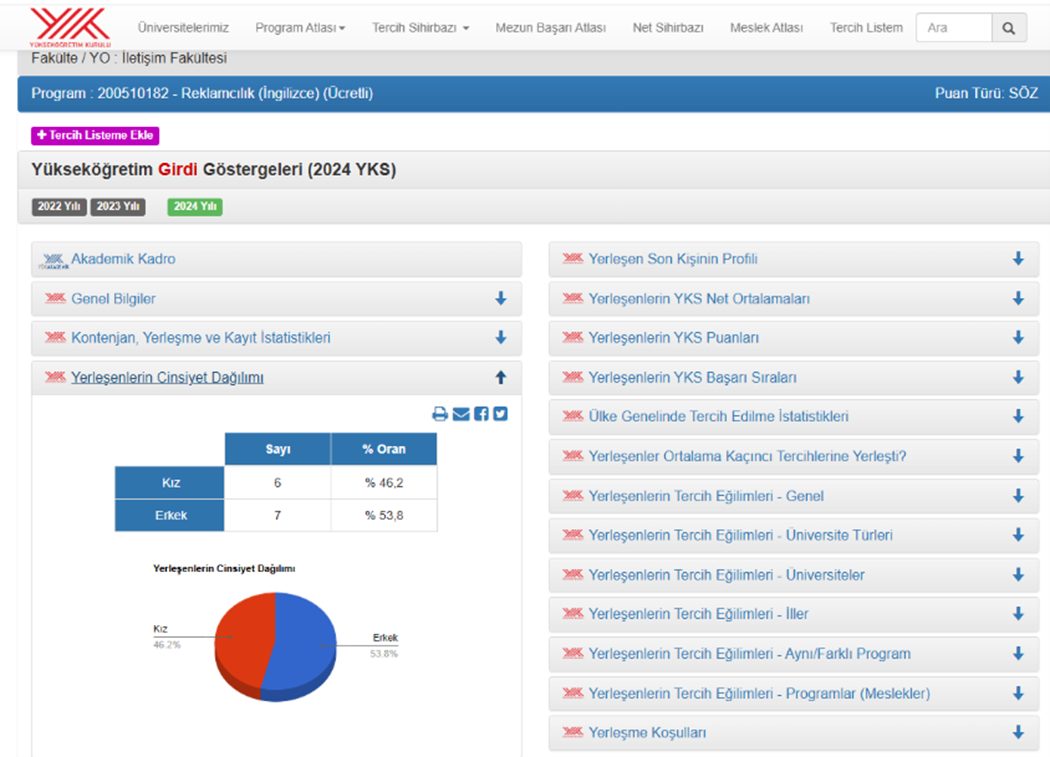
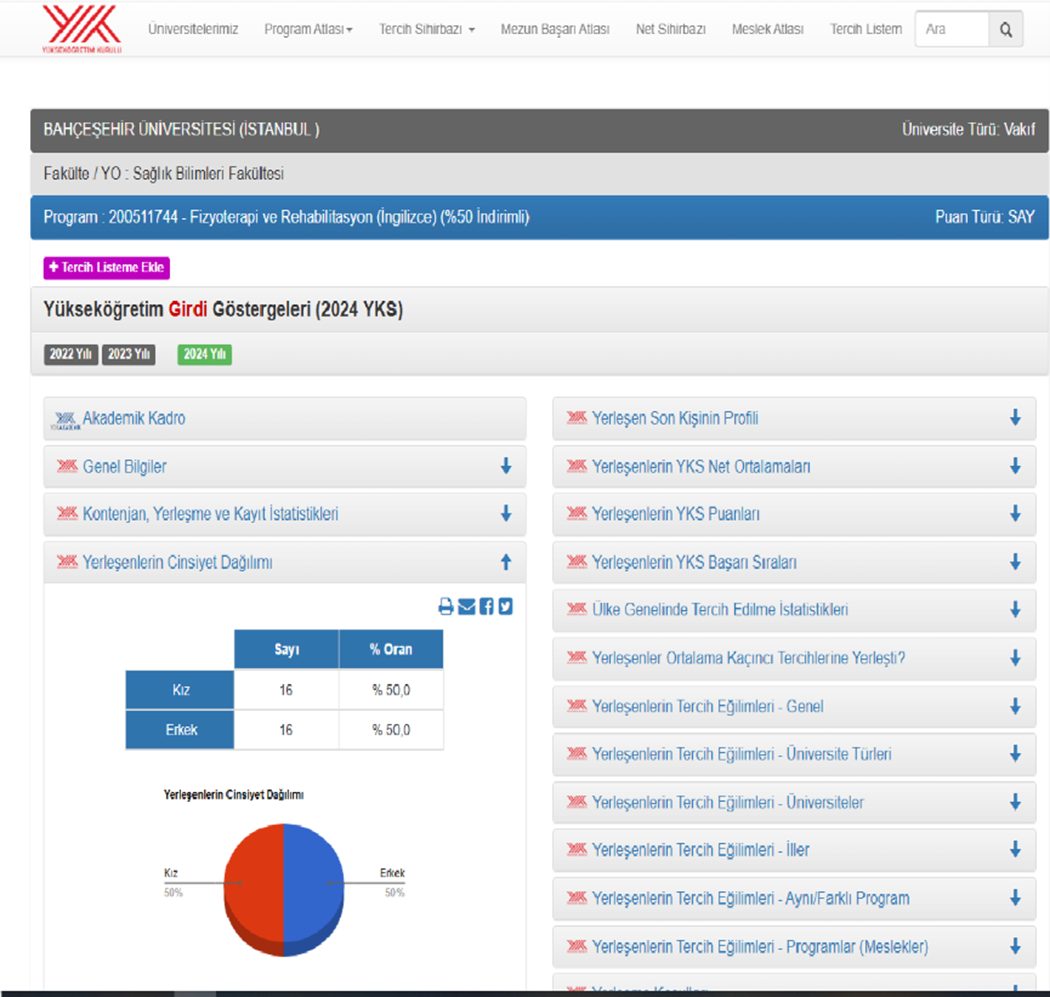
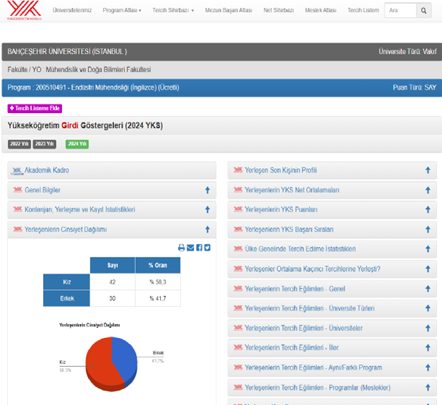
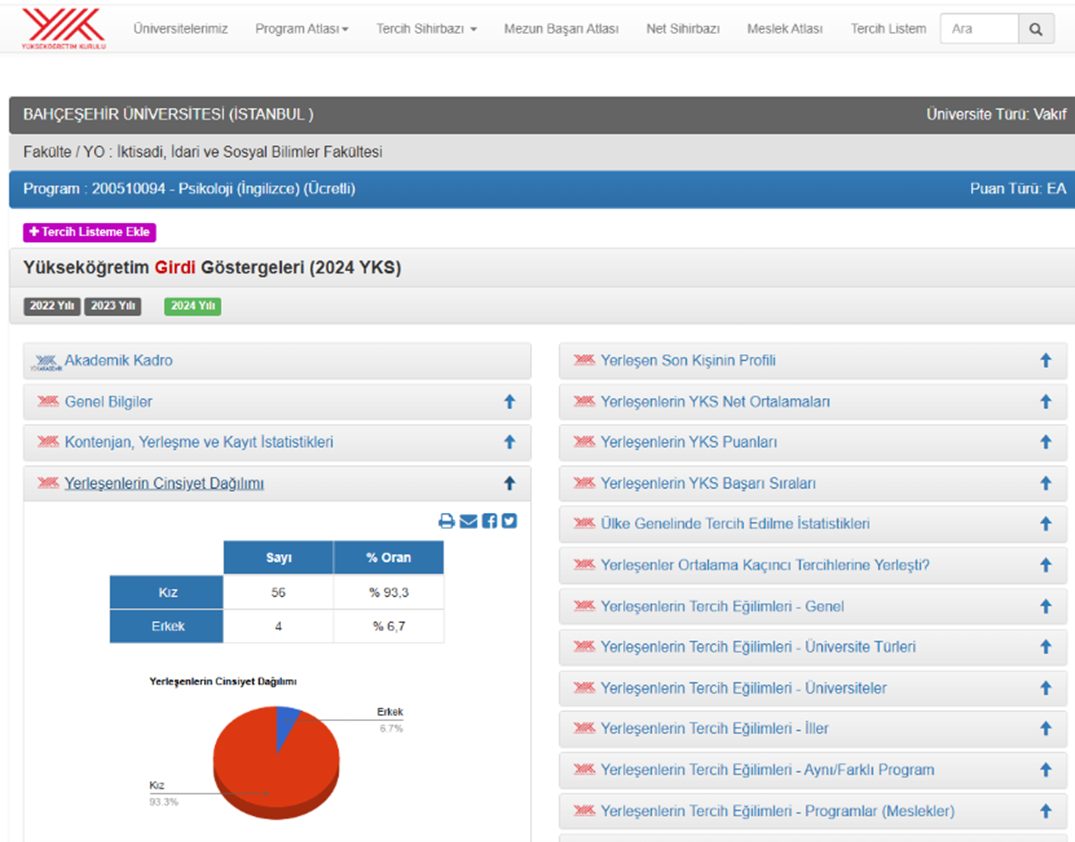
The screenshots below, taken from YÖK Atlas, Türkiye’s national higher education data platform, illustrate how gender-disaggregated student data are recorded and monitored across academic programmes, enabling BAU to track female and male representation and identify differences in participation across disciplines.
PS: “Yerleşenlerin Cinsiyet Dağılımı” means Gender Breakdown of Placed Students / “Kız”: Female / “Erkek”: Male
2- Systematic Tracking of Gender Equality in Scholarship through ApplyBAU (2022–2025)
Through the ApplyBAU digital platform, Bahçeşehir University systematically monitors gender representation in scholarship applications and awards across its faculties. This ongoing monitoring enables the University to assess female students' access to financial support, identify differences in scholarship allocation across academic disciplines, and inform evidence-based approaches to promoting gender equality in higher education.
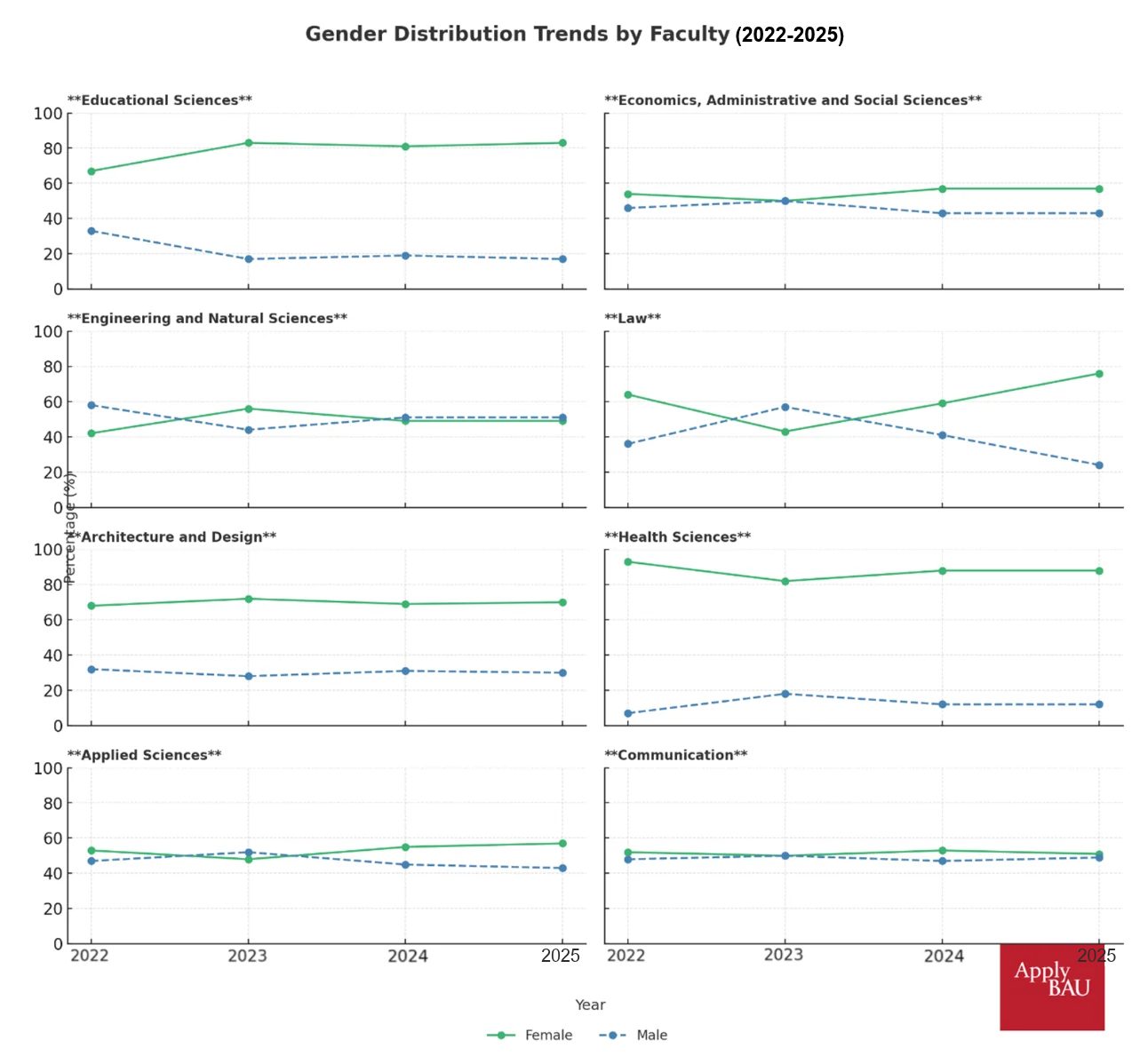
Between 2022 and 2025, BAU consistently tracked the gender distribution of scholarship recipients at the faculty level, revealing distinct patterns of female participation across academic fields. Women continued to represent a substantial majority of scholarship recipients in the Faculty of Educational Sciences, accounting for approximately 80% of awards. Similarly, the Faculties of Health Sciences and Architecture and Design maintained high levels of female representation, generally ranging between 70% and 85% during the reporting period.
Other faculties demonstrated different patterns of gender representation. The Faculty of Law showed a notable increase in the proportion of scholarships awarded to female students over the four-year period. In Engineering and Natural Sciences, where women have historically been underrepresented, scholarship allocation has moved towards a more balanced gender distribution, in line with BAU's institutional commitment to encouraging and supporting women's participation in these academic fields. Meanwhile, the Faculties of Economics, Administrative and Social Sciences and Communication maintained relatively balanced scholarship distributions, with female and male recipients representing comparable proportions in several reporting years.
These faculty-level findings demonstrate the importance of examining scholarship allocation beyond university-wide averages. By systematically reviewing gender-disaggregated data through ApplyBAU, the University can identify areas where disparities persist, monitor changes in women's access to financial support, and strengthen the evidence base for its admissions and scholarship policies.
This approach reflects BAU's continued commitment to transparent monitoring, equitable access to educational opportunities, and the advancement of gender equality across academic disciplines.
The graphs below illustrate gender distribution trends in scholarship awards across faculties between 2022 and 2025.
3- For Graduate Students: Systematic Tracking of Gender Representation in Enrolment and Scholarship Allocation
BAU systematically monitors access to graduate education to support gender equality and inclusion across its master’s and doctoral programmes. By tracking gender representation at each stage—from application and admission to enrollment—the University assesses participation patterns and identifies areas where additional support may be needed to ensure equitable access to advanced study.
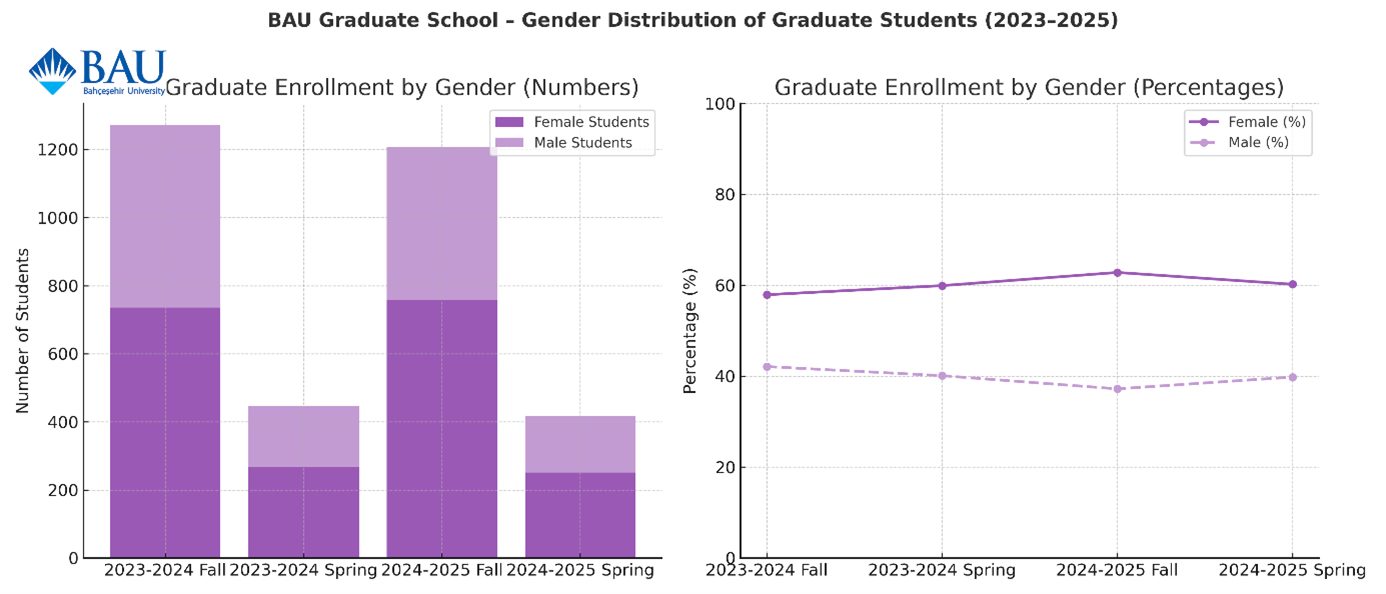
Data for 2023, 2024 and 2025 show that women consistently represented the majority of students enrolling in graduate programmes at Bahçeşehir University. Female representation reached 58% in 2023, while the data for 2024 also confirmed a female majority.
In 2025, women accounted for 62.13% of graduate enrollees. Female representation reached 61.91% in master’s programmes and 65.91% in doctoral programmes, demonstrating strong participation at both levels of graduate education.
These findings inform BAU’s ongoing efforts to support gender equality and inclusive access to postgraduate education. Monitoring gender representation over time enables the University to assess participation patterns across master’s and doctoral programmes and identify areas that may require further attention.
The graphs below present annual student numbers and percentage distributions by gender, drawing on the University’s systematic monitoring of access to graduate education.
As part of its commitment to promoting equal opportunities in postgraduate education, Bahçeşehir University systematically monitors the distribution of scholarships and financial support by gender, alongside graduate application and enrolment trends. This integrated approach enables the University to assess not only women's access to advanced education but also their access to the financial resources that support academic progression and research opportunities.
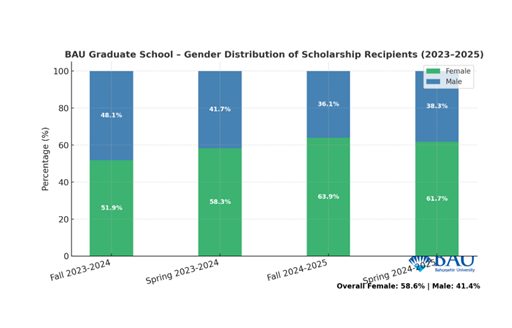
Across the two reporting years, female students accounted for 58.6% of graduate scholarship recipients, compared with 41.4% male students. Women represented the majority of scholarship beneficiaries in both years, reflecting their continued access to financial support for postgraduate education.
By regularly reviewing gender-disaggregated scholarship data, BAU strengthens its ability to monitor funding patterns, identify potential disparities, and inform institutional efforts to promote equitable access to graduate education. This systematic monitoring forms part of the University's broader commitment to gender equality, inclusive academic opportunities, and women's continued participation in advanced education and research.
The graph image below illustrates the gender distribution of graduate scholarship recipients in 2024 and 2025.
All results are reported through institutional equality and admissions reports, reflecting BAU’s dedication to data-driven, transparent, and inclusive admissions practices that advance gender equality and equitable access for all learners.











