





 EN
17.2.2 - CROSS SECTORAL DIALOGUE About SDGs
Bahçeşehir University (BAU) plays an active role in facilitating cross-sectoral dialogue to advance the implementation of the United Nations Sustainable Development Goals (SDGs). Through sustained collaboration with a wide range of partners—including international organizations such as the United Nations Institute for Training and Research (UNITAR) and the Food and Agriculture Organization (FAO), as well as regional and national civil society organizations, local governments, and public institutions—BAU fosters open dialogue, knowledge exchange, and joint action on sustainable development.
These collaborations take the form of policy dialogues, conferences, workshops, and expert roundtables that bring together representatives from academia, government, the private sector, and civil society.
The section below presents examples of cross-sectoral
dialogue activities carried out by Bahçeşehir
University (BAU) during the reporting year to promote
collaboration and partnership on the UN Sustainable Development
Goals (SDGs).
Further information can be found in the University’s SDG 17 –
Partnerships for the Goals Report.
1- Bahçeşehir University Games for Change Türkiye Festival 2025: International NGO Partnership and Cross-Sectoral Dialogue on Sustainable Cities, Climate Action and Social Impact
The image below presents the official promotional poster for Bahçeşehir University Games for Change Türkiye Festival 2025
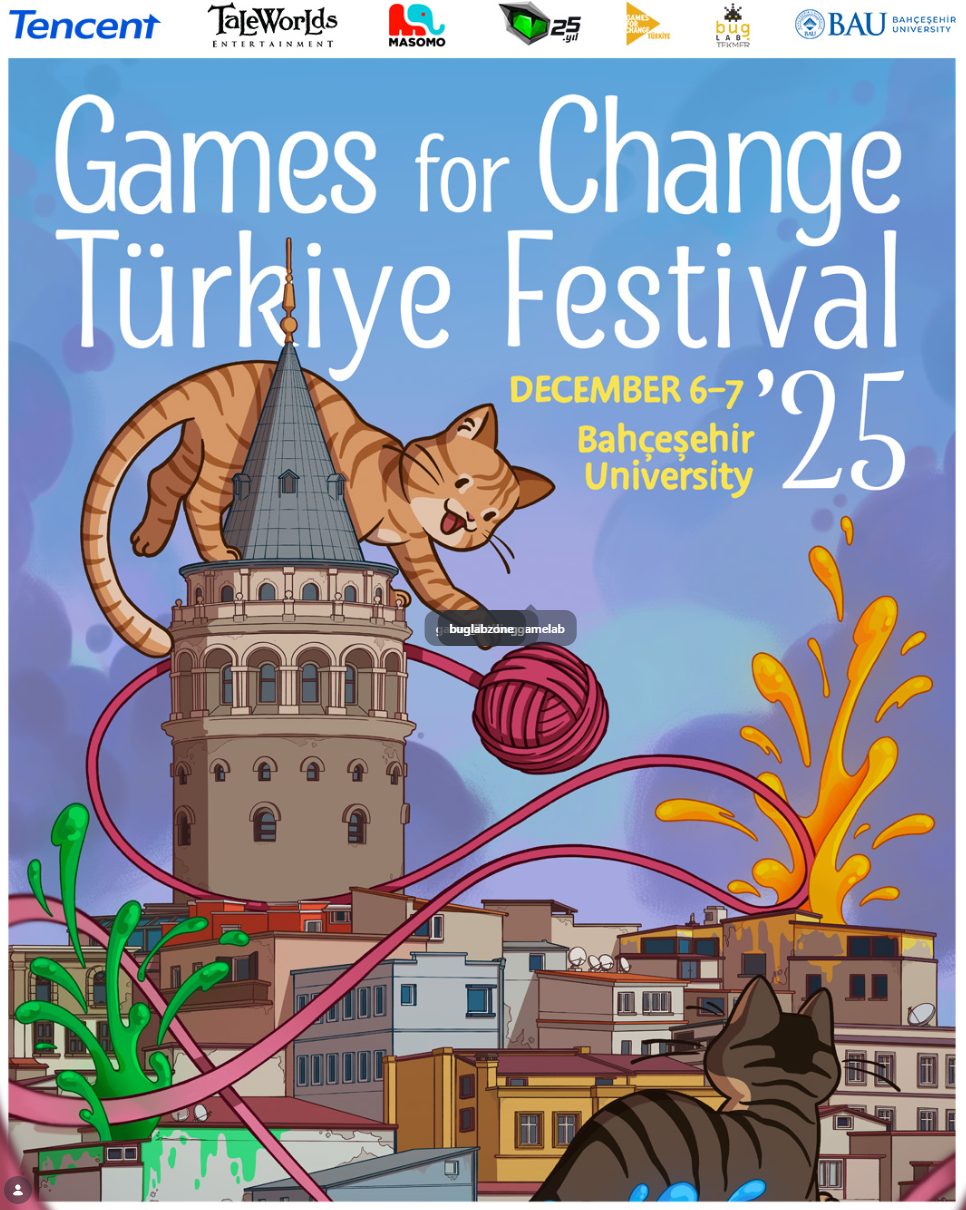
On 6–7 December 2025, Bahçeşehir University (BAU), through its BAU Game Lab (BUG Lab), organized and hosted the Games for Change Türkiye Festival 2025 at its Beşiktaş Campus, in collaboration with Games for Change Türkiye, the Turkish chapter of Games for Change Global, an international non-profit organization founded in 2004 that promotes social impact through games and interactive media.
Games for Change Türkiye was established in 2024 within BAU BUG Lab, creating an institutional connection between the University and the international Games for Change network. At the global level, Games for Change has developed collaborations with international organizations, including UNESCO, UNICEF, and the World Food Programme (WFP), demonstrating the network's broader engagement with education, social development, and the United Nations Sustainable Development Goals (SDGs).
Held under the theme “City and Play: Gaming the City, Modding the Future,” the festival brought together over 500 participants, including more than 100 international attendees from 10 countries, providing a platform for dialogue among academia, public institutions, civil society, international networks, urban planning professionals, and the private sector.
The programme featured contributions from the Istanbul Planning Agency (İPA), alongside urban design and participatory planning organizations such as Superpool and Play the City, as well as international academics, game developers, and creative industry representatives. Private-sector sponsors, including Tencent, TaleWorlds Entertainment, Masomo, and Monster Notebook, further supported the initiative, demonstrating cooperation between higher education and the technology and gaming industries.
Through expert panels, presentations, interactive discussions, and game exhibitions, participants explored sustainable cities, climate action, gender equality, cultural heritage preservation, environmental awareness, and inclusive community development. Sessions on participatory public-space transformation, urban planning, and game-based approaches to social challenges demonstrated how collaboration among public institutions, academia, civil society, and the creative industries can generate innovative solutions to complex urban and societal challenges. The programme highlighted the potential of games and digital technologies to strengthen community participation, promote sustainability awareness, and support more inclusive and resilient cities.
By bringing together an international non-profit network, public-sector urban planning stakeholders, academic institutions, civil society actors, and private-sector partners, BAU facilitated cross-sectoral dialogue and knowledge exchange on SDG-related challenges. The programme connected different forms of expertise and encouraged collaborative approaches to sustainable cities, inclusive communities, and social innovation.
Importantly, BAU's engagement extended beyond hosting a single event. Through BUG Lab's institutional role in Games for Change Türkiye, the University contributed to an ongoing international collaboration linking academic research, public policy, civil society initiatives, and the creative industries in support of sustainable development.
The initiative contributed primarily to SDG 17 (Partnerships for the Goals) by strengthening international and cross-sectoral partnerships. It also supported SDG 11 (Sustainable Cities and Communities) through participatory urban development, SDG 13 (Climate Action) through sustainability-focused discussions, SDG 5 (Gender Equality) through social inclusion, and SDG 4 (Quality Education) through public knowledge exchange and innovative learning approaches.
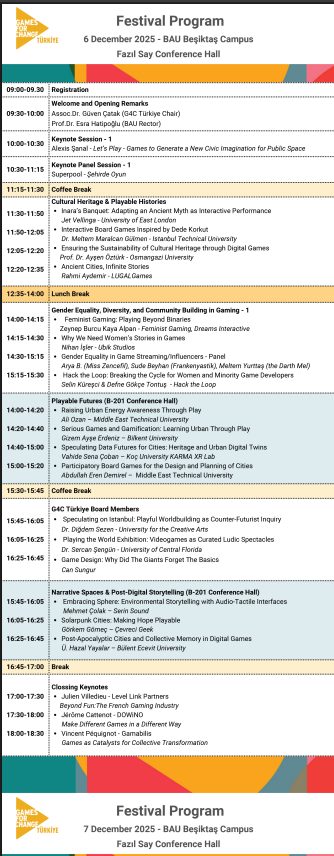
The official festival programme below documents the Games for Change Türkiye Festival 2025, highlighting expert panels and discussions on sustainable cities, participatory urban planning, gender equality, diversity, community building, and the role of games in addressing social and environmental challenges.
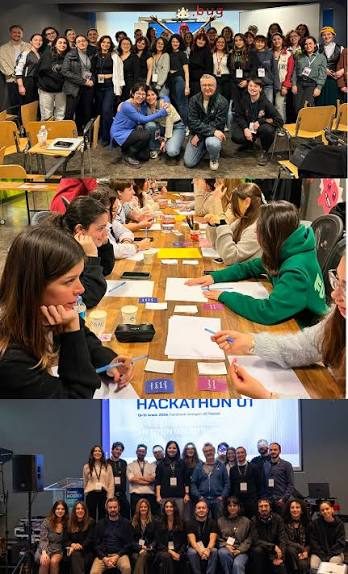
The three photographs below document the Games for Change Türkiye Festival 2025 held at Bahçeşehir University's Beşiktaş Campus, illustrating the event's international participation, expert discussions, and interactive activities that brought together stakeholders from academia, civil society, public institutions, and the creative industries to explore sustainability and social impact through games.
2- Advancing Sustainability Education Beyond Campus: Bahçeşehir University's SME Sustainability Transformation Training and Consultancy Programme in Manisa
The images below present highlights from the programme's launch and introductory training session in Manisa on February 12, 2025, documenting the participation of Prof. Dr. Çisil Sohodol and Asst. Prof. Dr. Nilüfer Geysi.
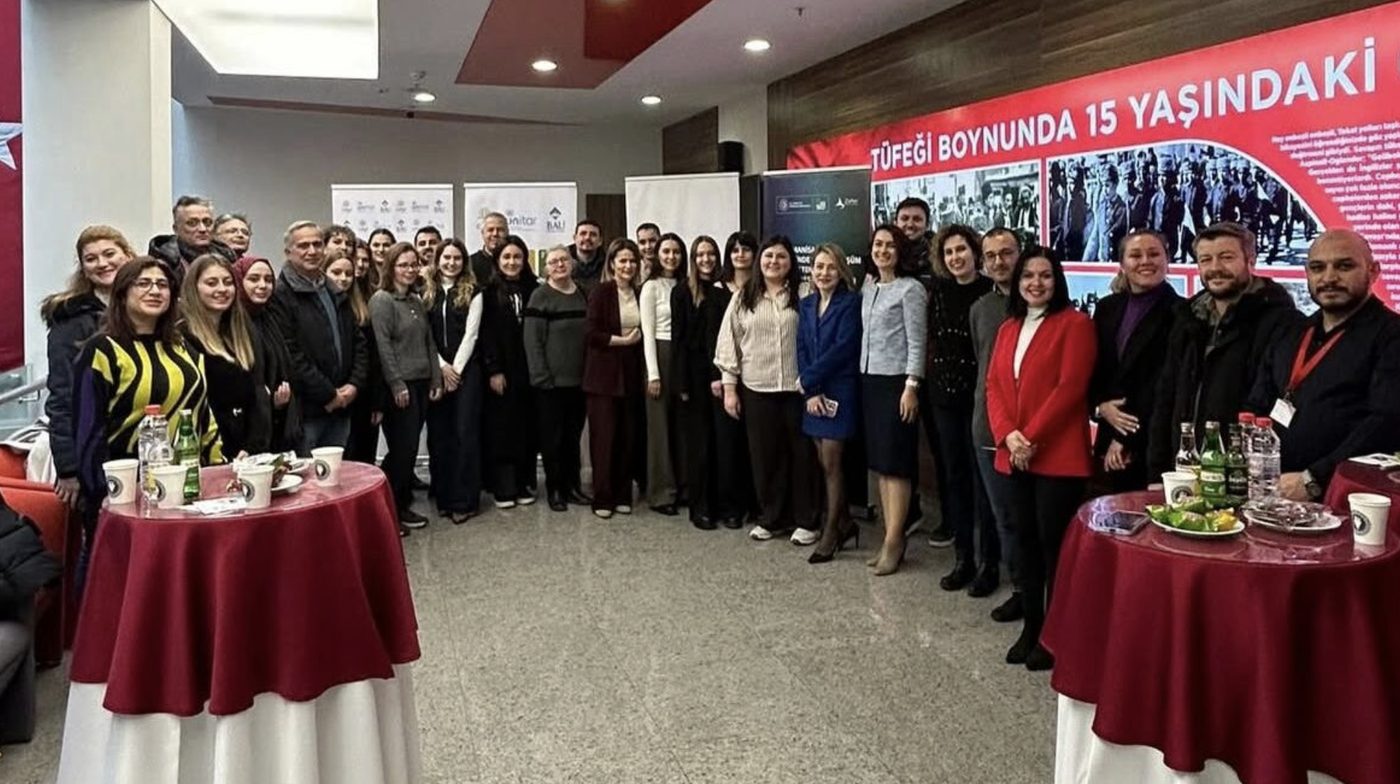
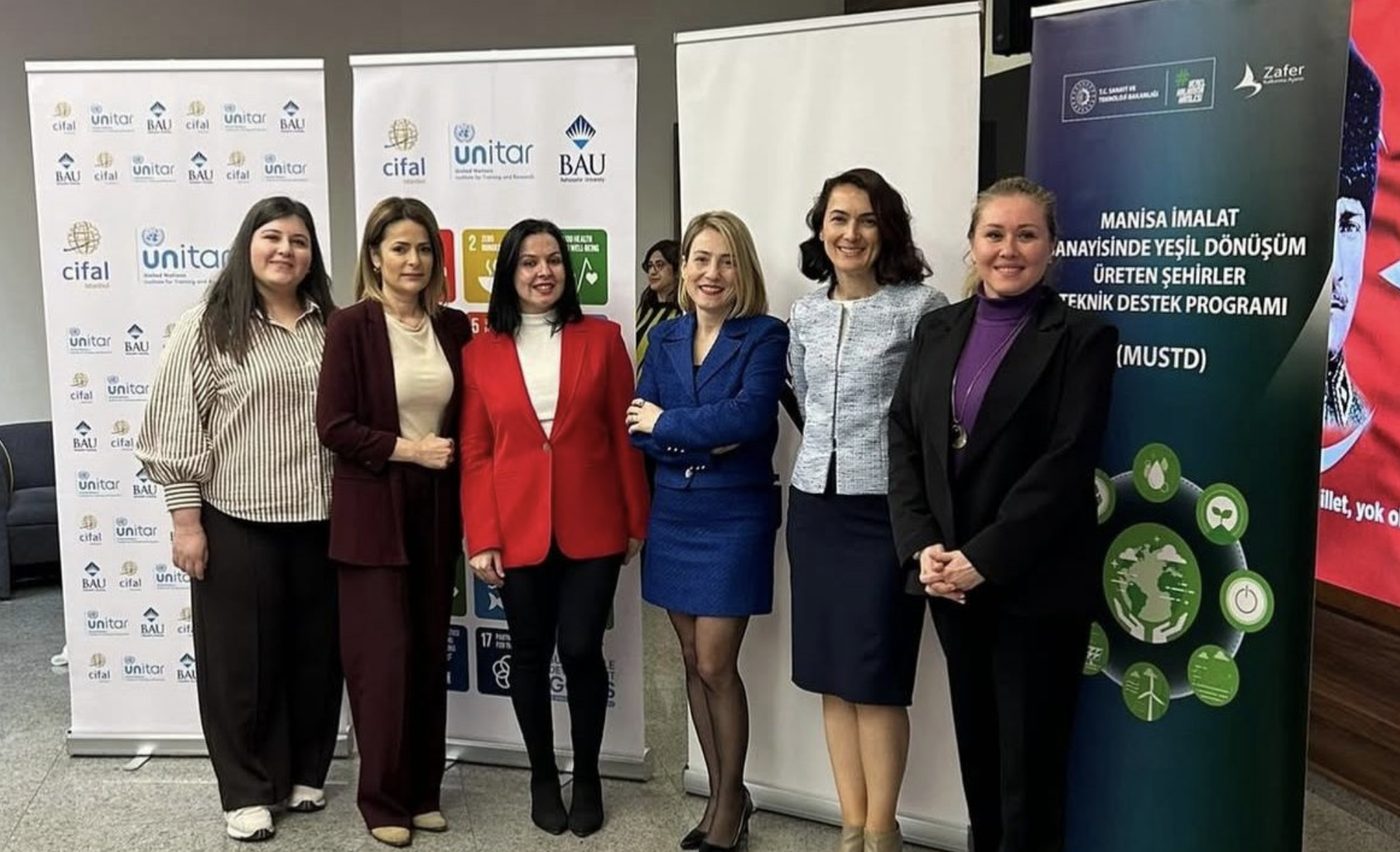
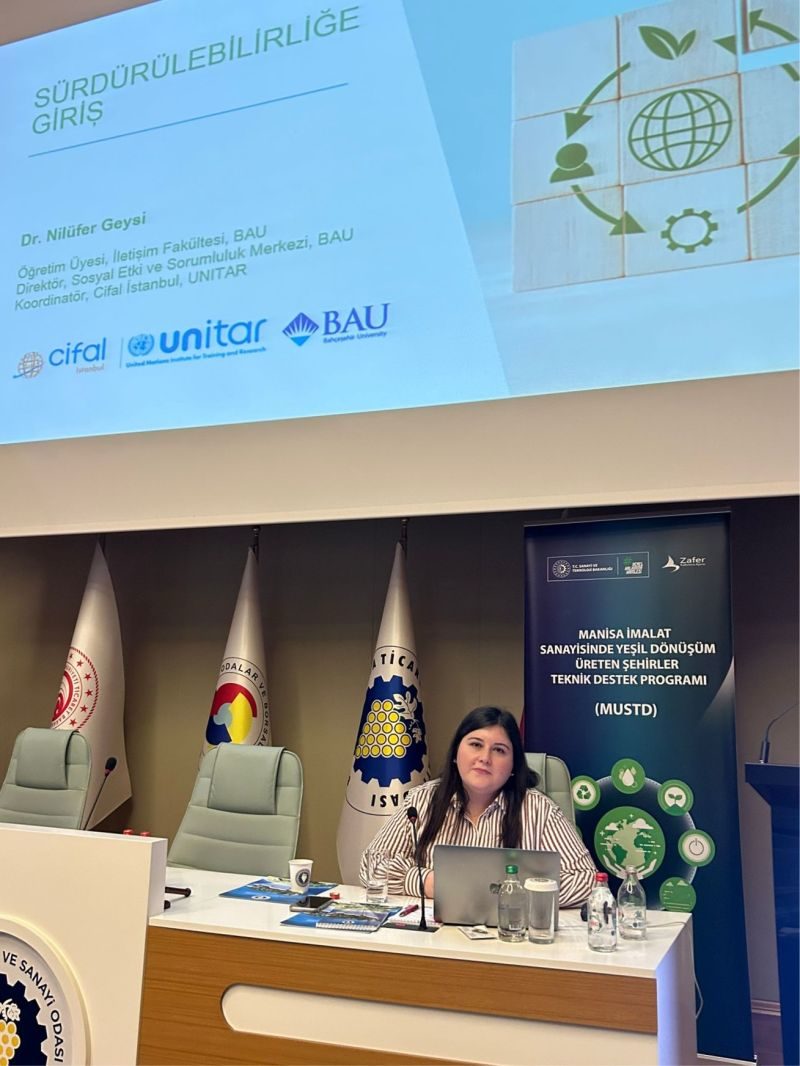
On February 12, 2025, Bahçeşehir University (BAU), CIFAL Istanbul, the United Nations Institute for Training and Research (UNITAR), TÜBİTAK Marmara Research Center (MAM), Zafer Development Agency, and Manisa Celal Bayar University jointly launched the “Training and Consultancy Programme for the Sustainability Transformation of Small and Medium-Sized Enterprises (SMEs)” in Manisa, Türkiye. Designed as a 90-hour professional training and capacity-building initiative, the programme aimed to equip local businesses with the knowledge, competencies, and practical tools necessary to integrate sustainability into their operations and long-term strategies.
The collaboration also created a framework for cross-sectoral knowledge exchange among higher education institutions, an international training network, a national research institution, a regional development agency, and local businesses, connecting academic and technical expertise with the practical sustainability challenges faced by SMEs.
The initiative represents a comprehensive example of Bahçeşehir University's educational outreach beyond campus, extending academic expertise and professional training opportunities to SME representatives and business professionals outside the University's enrolled student population. By bringing university-level education directly to the regional business community, the programme supported lifelong learning and the practical application of sustainability knowledge in professional environments.
The programme was launched with the participation of Prof. Dr. Çisil Sohodol, a faculty member at Bahçeşehir University and Director of CIFAL Istanbul, and Asst. Prof. Dr. Nilüfer Geysi, Coordinator of CIFAL Istanbul. During the opening session, Prof. Dr. Sohodol emphasized the urgency of climate change, rising global temperatures, and the importance of collective responsibility in advancing sustainable economic development.
The opening was followed by a six-hour interactive sustainability training session delivered by Asst. Prof. Dr. Nilüfer Geysi.
Following the launch and introductory training, Bahçeşehir University continued its academic contribution through a comprehensive series of specialized training modules delivered by faculty members from different disciplines. BAU's involvement formed a central component of the programme's 90-hour educational framework, bringing together expertise in sustainability management, environmental responsibility, finance, law, human resources, communication, and organizational transformation.
Through these contributions, BAU academics supported the professional development of SME representatives by sharing specialized knowledge and practical approaches to sustainability transformation. The interdisciplinary curriculum was designed to help participating businesses understand emerging sustainability requirements, strengthen their organizational capabilities, and develop more responsible and resilient business practices..
BAU's academic training programme covered a broad range of sustainability-related topics, including sustainability fundamentals, legal and regulatory frameworks, quality management, sustainable production, sustainability management systems, sustainable economics and finance, human resources management, occupational health and safety, corporate social responsibility, gender equality, sustainability communication, and sustainability performance measurement. Delivered by BAU academics from various disciplines, the programme also addressed the role of SMEs in sustainability transformation, providing participants with interdisciplinary knowledge and practical approaches to sustainable business development.
The programme also incorporated specialized technical training supported by TÜBİTAK MAM, addressing green transformation, carbon footprint assessment, and water footprint assessment. These components complemented BAU's interdisciplinary academic contributions by connecting scientific and technical knowledge with the practical sustainability challenges faced by businesses.
Importantly, the programme was delivered for SME representatives and business professionals in Manisa, extending access to BAU's academic expertise beyond the University's campuses and enrolled student population. This approach reflects BAU's commitment to supporting regional communities through educational outreach, professional capacity-building, and lifelong learning opportunities.
The programme contributed to SDG 4 (Quality Education) by extending sustainability education and lifelong learning opportunities to local SMEs and business professionals beyond BAU's campus. It also supported SDG 8 (Decent Work and Economic Growth), SDG 9 (Industry, Innovation and Infrastructure), and SDG 13 (Climate Action) by strengthening sustainable business practices, green transformation, and climate awareness. Through collaboration with CIFAL Istanbul, UNITAR, TÜBİTAK MAM, Zafer Development Agency, and Manisa Celal Bayar University, the initiative advanced SDG 17 (Partnerships for the Goals), demonstrating BAU's commitment to community-based sustainability education and regional capacity-building.
3- Bahçeşehir University's Digital Skills Training for Women-Led Agricultural Cooperatives in Ankara: Advancing Digital Literacy and Women's Empowerment Beyond Campus with Food and Agriculture Organisation of the United Nations and Ministry of Agriculture and Forestry of Türkiye
The image below highlights the collaboration between the Ministry of Agriculture and Forestry of Türkiye, the Food and Agriculture Organization of the United Nations (FAO), and Bahçeşehir University (BAU) through the Digital Villages initiative, demonstrating cross-sectoral cooperation to empower rural women and women's cooperatives through digital education, capacity building, and sustainable rural development.
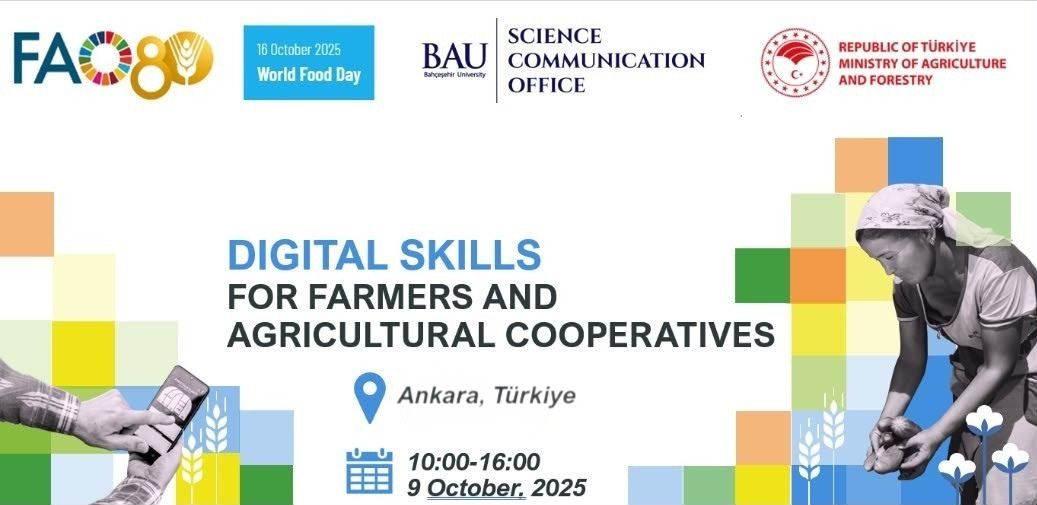
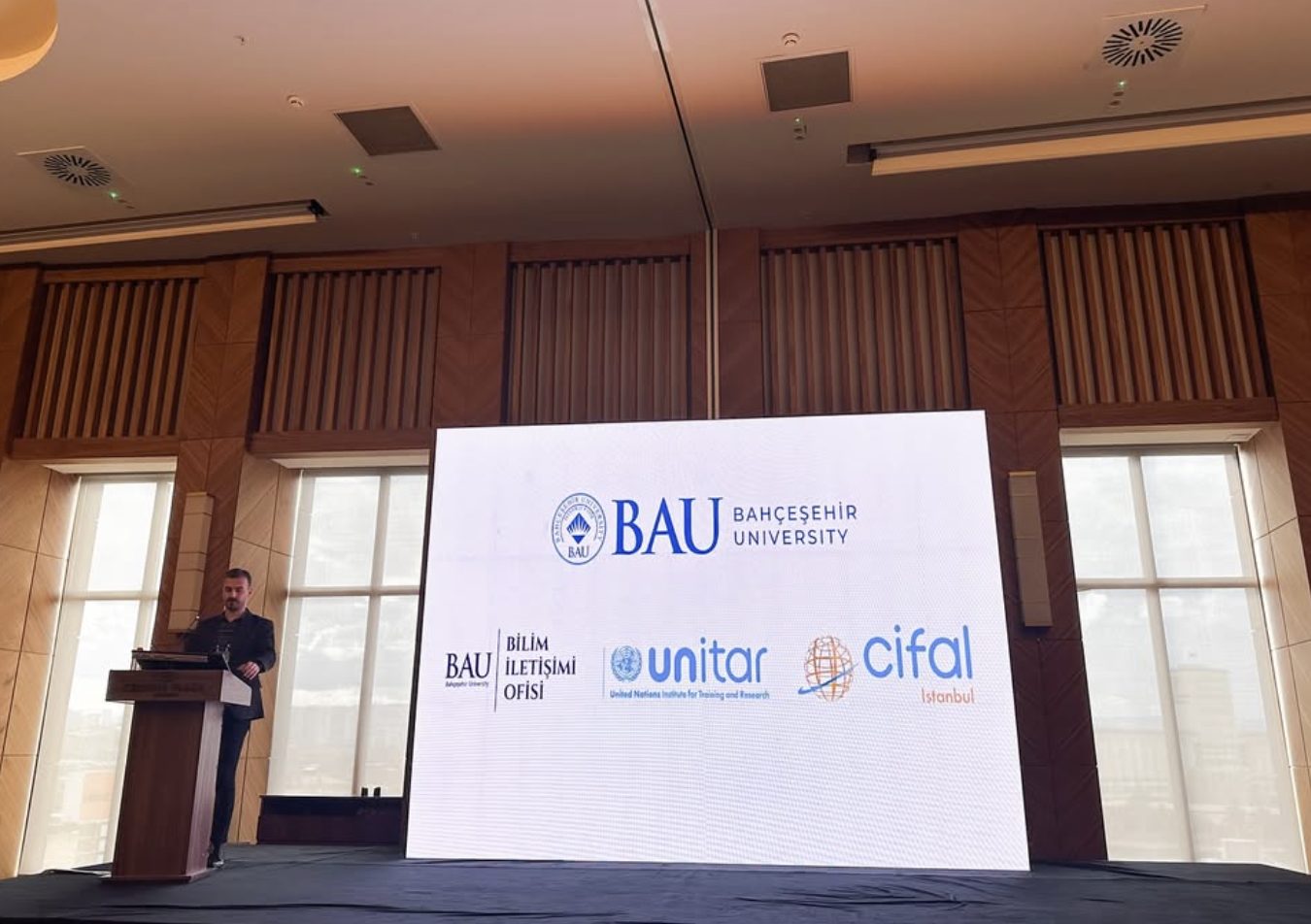
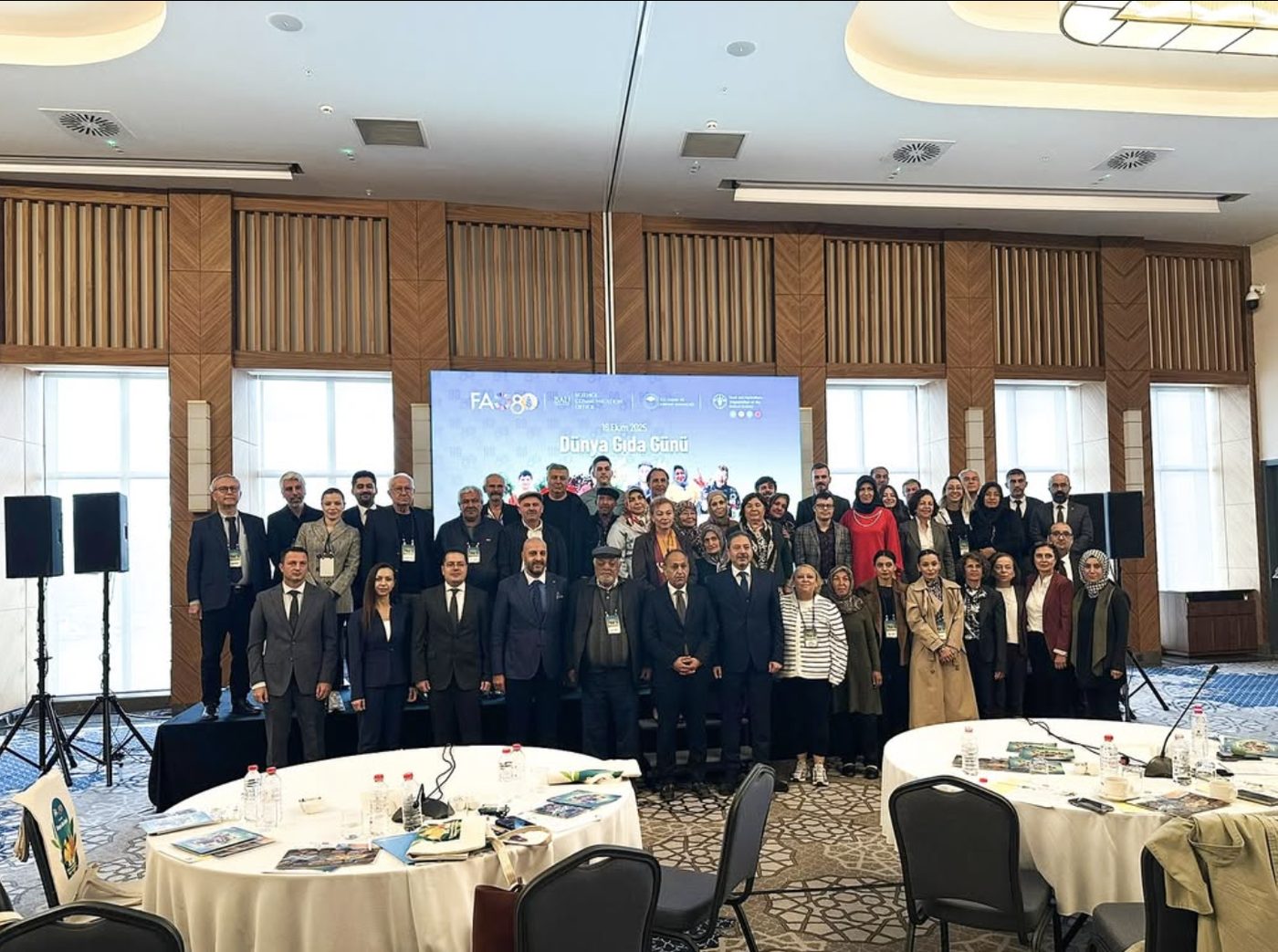
On October 9, 2025, Bahçeşehir University's (BAU) Science Communication Office and CIFAL Istanbul contributed to the design and delivery of the “Digital Skills Development Training for Women-Led Cooperatives”, held in Ankara as part of World Food Day activities. The training was organized within the framework of the Food and Agriculture Organization of the United Nations (FAO) Digital Villages Initiative (DVI), in collaboration with the Republic of Türkiye Ministry of Agriculture and Forestry and Bahçeşehir University.
The initiative aimed to strengthen the digital competencies of women producers, enhance their access to digital markets, and support the sustainable development of rural communities. By delivering educational activities directly to agricultural stakeholders outside the university environment, BAU extended its academic expertise and educational resources to women entrepreneurs and local producers, demonstrating its commitment to community-oriented education, knowledge transfer, and lifelong learning.
The training provided practical, hands-on learning opportunities focused on the effective use of digital tools, online sales and marketing strategies, and social media management. Through applied learning activities, participants explored how digital platforms could be used to promote agricultural products, improve online visibility, communicate with potential customers, and reach broader markets.
A central objective of the programme was to address the digital literacy needs of women-led agricultural cooperatives, particularly in rural communities where access to specialized training and technological resources may be limited. By introducing accessible digital tools and practical communication strategies, the initiative supported participants in developing competencies relevant to their entrepreneurial activities and everyday business operations.
Bahçeşehir University's contribution through its Science Communication Office and CIFAL Istanbul connected academic knowledge with the practical educational needs of women producers. Rather than limiting university-supported learning to formal degree programmes or campus-based activities, the training brought specialized knowledge directly to a community of agricultural entrepreneurs, enabling participants to engage with digital technologies in ways relevant to their professional activities.
The programme also demonstrated the importance of collaboration between universities, international organizations, and public institutions in expanding access to education. By combining FAO's rural development framework, the Ministry of Agriculture and Forestry's engagement with agricultural communities, and BAU's educational contribution, the initiative created a platform for knowledge exchange and practical skills development.
This cooperation also facilitated knowledge exchange between academic institutions, an international development organization, public authorities, and women-led agricultural cooperatives, connecting institutional expertise with the practical digital transformation needs of rural producers.
Importantly, the training was designed for women producers and cooperative members outside Bahçeşehir University's enrolled student population. Its emphasis on applied digital competencies and community-based delivery illustrates BAU's approach to educational outreach beyond campus, particularly for groups that can benefit from greater access to professional learning opportunities.
The initiative contributed to SDG 4 (Quality Education) by providing practical digital skills training and lifelong learning opportunities to rural women and women-led cooperatives beyond BAU's campus. It also supported SDG 5 (Gender Equality), SDG 8 (Decent Work and Economic Growth), and SDG 10 (Reduced Inequalities) by strengthening women's digital competencies, entrepreneurship, and access to digital markets. Through collaboration with CIFAL Istanbul, FAO Türkiye, and the Republic of Türkiye Ministry of Agriculture and Forestry, the programme advanced SDG 17 (Partnerships for the Goals), demonstrating BAU's commitment to inclusive rural development and community-based education.
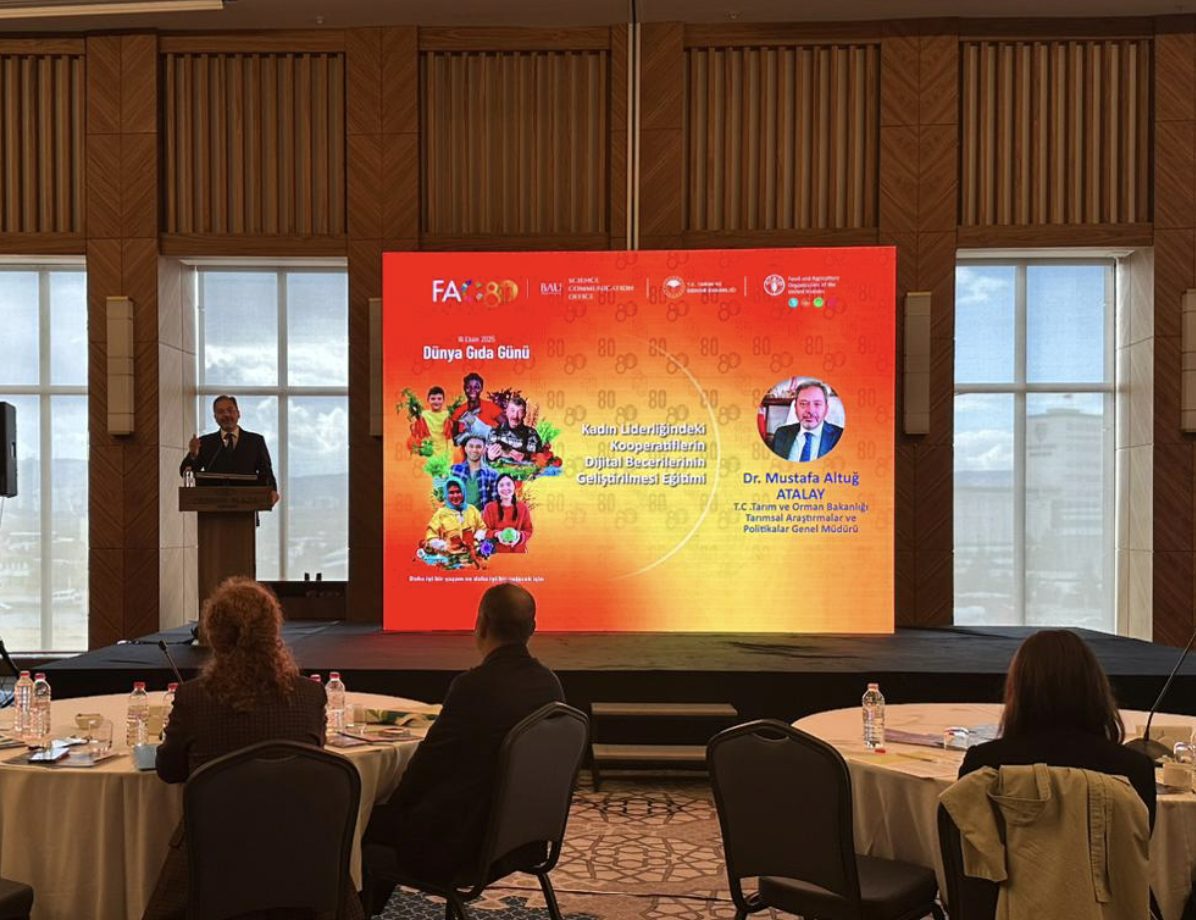
The image below portrays a keynote speech from the programme, featuring the official poster of the event on the background as well as other highlights from the Digital Skills Training for Women-Led Agricultural Cooperatives program:
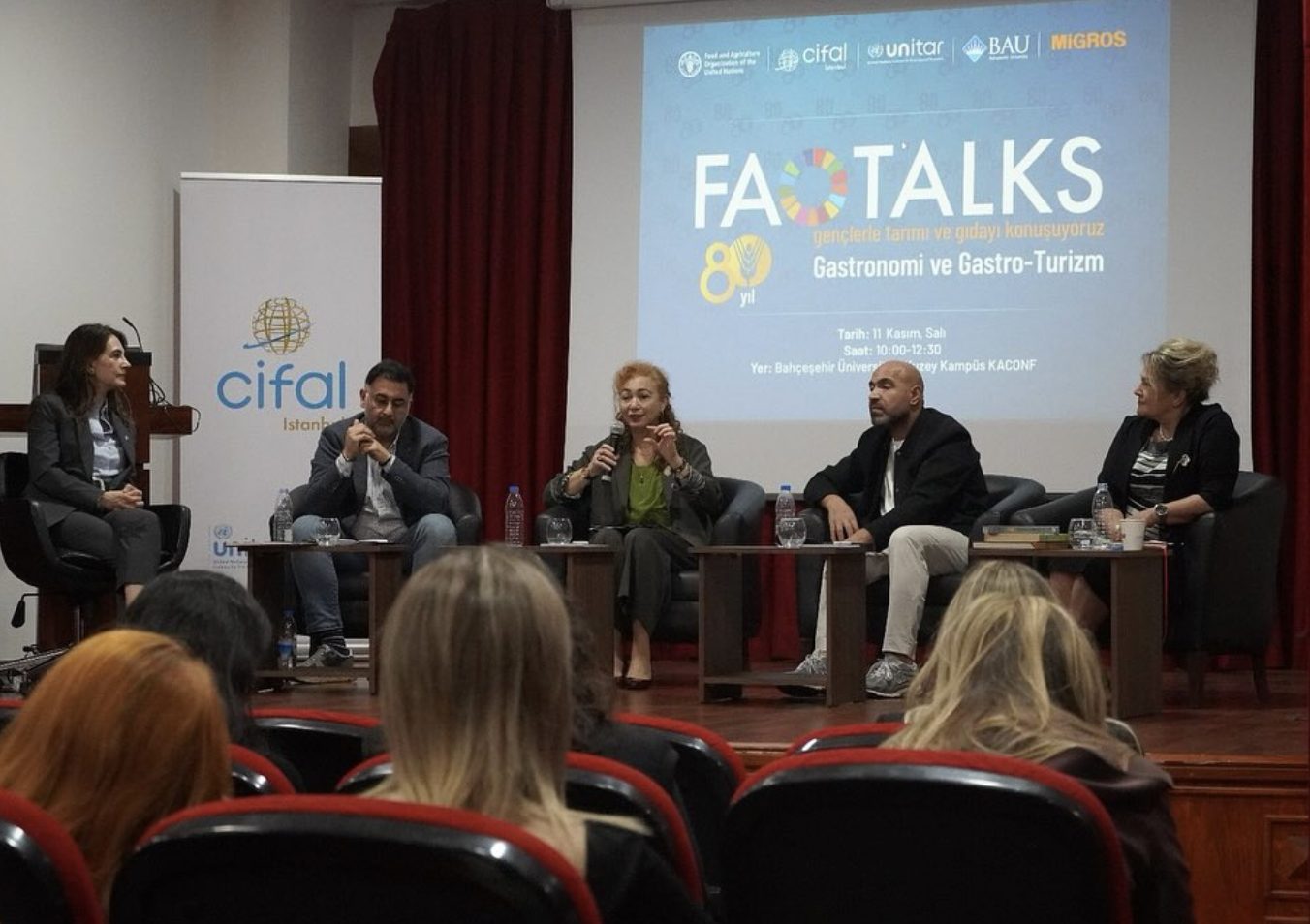
4- Bahçeşehir University, CIFAL Istanbul and the Food and Agriculture Organization of the United Nations: Cross-Sector Collaboration through FAO Talks
The image below displays the official promotional poster for the “FAO Talks: Gastronomy and Gastro-Tourism - Engaging Youth in Food and Agriculture” event:
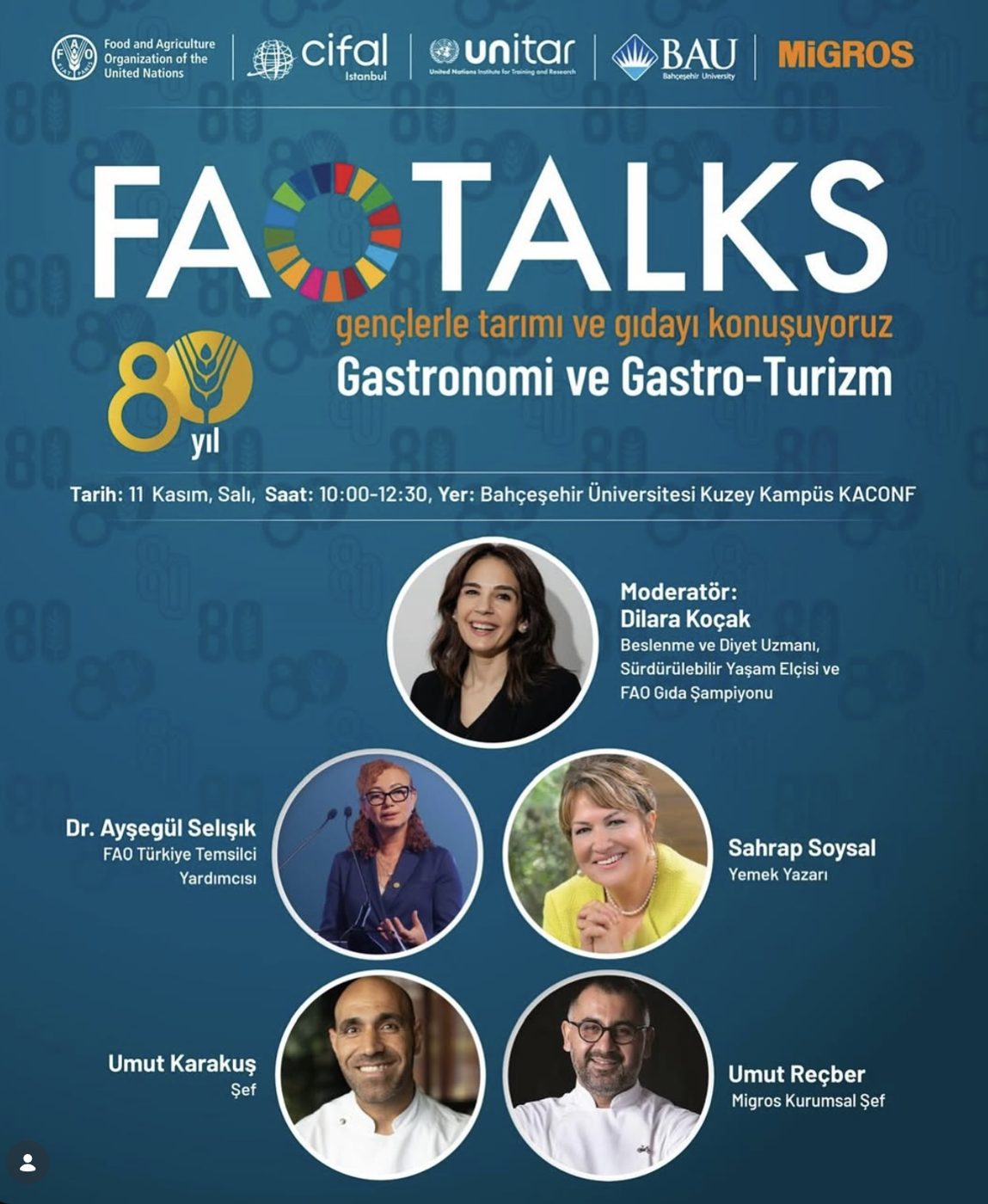
On November 11, 2025, Bahçeşehir University, CIFAL Istanbul—part of the United Nations Institute for Training and Research network—and the Food and Agriculture Organization of the United Nations jointly organised “Gastronomy and Gastro-Tourism: Engaging Youth in Food and Agriculture,” with the participation of Migros. Held at Bahçeşehir University’s North Campus during the organisation’s 80th anniversary year, the event brought together academics, international development professionals, culinary practitioners, private-sector representatives and young people. The collaboration created a platform for examining food and agriculture through their interconnected educational, cultural, environmental and economic dimensions.
Opening remarks were delivered by Prof. Dr. Çisil Sohodol, Director of CIFAL Istanbul; Prof. Dr. Kazım Ozan Özer, Director of the School of Applied Sciences; and Dr. İlâyda Altun Cevahir, Vice Dean of the Faculty of Health Sciences. The panel was moderated by sustainable living advocate and FAO Food Champion Dilara Koçak and featured Dr. Ayşegül Selışık, FAO Türkiye Deputy Representative; food writer Sahrap Soysal; Chef Umut Karakuş; and Migros Corporate Chef Umut Reçber. Their different professional backgrounds connected international food-system priorities with culinary knowledge, academic perspectives and experience from the food sector.
Discussions addressed sustainable gastronomy, local ingredients, small producers and the contribution of young people to the future of food and agriculture. These themes positioned gastronomy as a way to understand the relationships between agricultural production, cultural heritage and everyday consumption. Attention to local products and culinary traditions highlighted how food choices can connect consumers with producers and preserve knowledge passed between generations. The gastro-tourism focus also provided a context for considering how the promotion of local cuisine can support regional economies while encouraging respect for the communities and resources behind food production.
Youth engagement was central to the event’s purpose. By bringing young participants into direct dialogue with specialists and practitioners, the programme encouraged them to consider their potential roles as informed consumers, future professionals and contributors to sustainable food systems. Food literacy was particularly relevant to this exchange: understanding where food comes from, how it is produced and what social and environmental consequences accompany its consumption can inform decisions across different careers and daily life. Hosting this dialogue within a university connected sustainability learning with professional fields including gastronomy, nutrition, agriculture and tourism.
The event contributes primarily to SDG 17: Partnerships for the Goals by combining Bahçeşehir University’s educational setting, CIFAL Istanbul’s sustainability-learning role and the Food and Agriculture Organization’s international expertise, alongside private-sector and culinary participation. This cross-sector cooperation enabled participants to approach shared challenges from several professional perspectives and strengthened opportunities for knowledge exchange. The programme also supports SDG 2: Zero Hunger through awareness of sustainable agriculture and food systems, SDG 12: Responsible Consumption and Production through food literacy and responsible consumption, and SDG 4: Quality Education through learning for sustainable development. Its emphasis on local producers, culinary heritage and gastro-tourism further relates to SDG 8: Decent Work and Economic Growth, particularly sustainable tourism that promotes local culture and products.
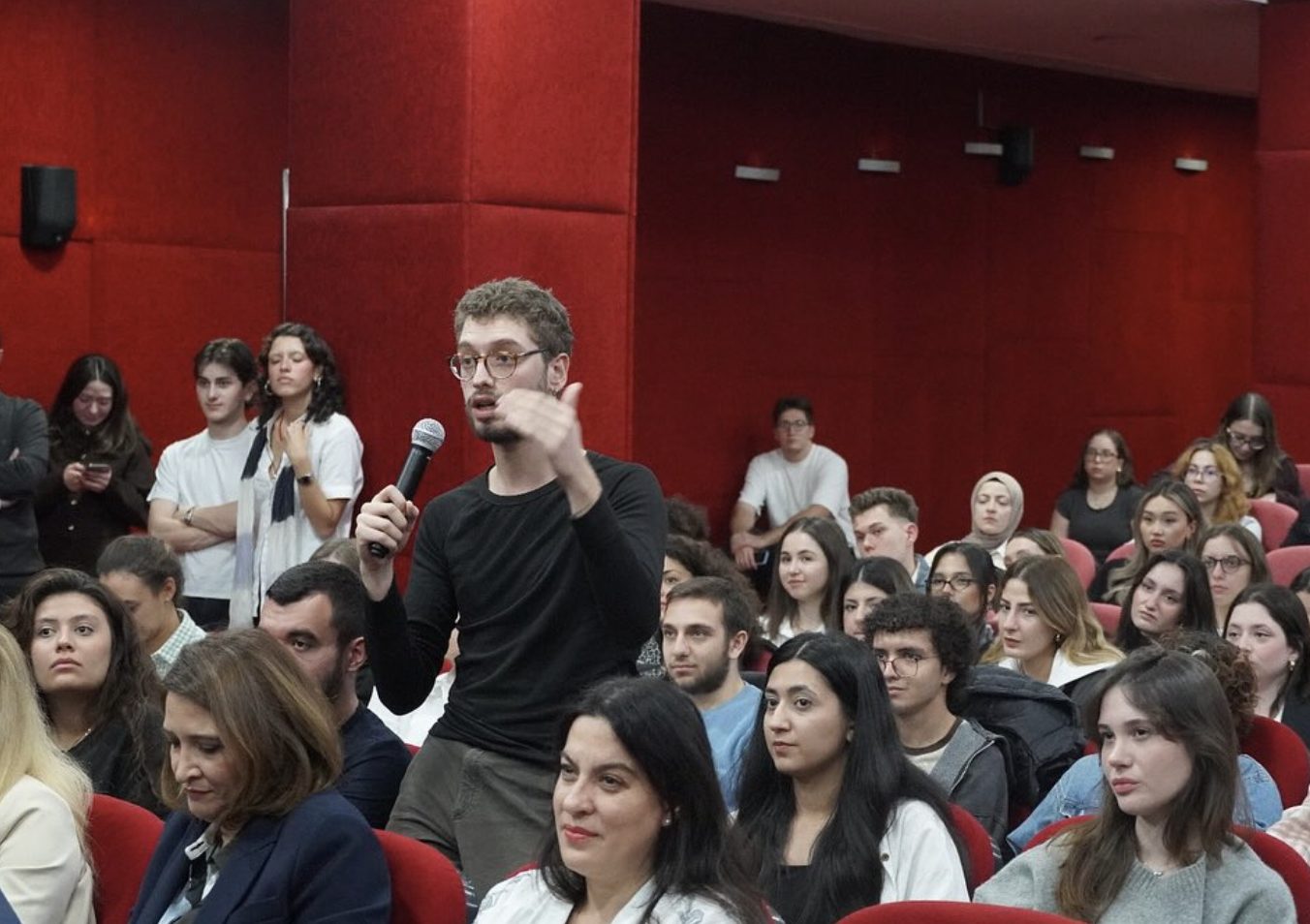
The images below illustrate highlights from the program:
5- Bahcesehir University Equal Opportunity in Technology Certification Program: Equal Opportunity in Technology: Advancing Women's Empowerment, Inclusive Education and International Partnerships through Free Technology Training with UNITAR, CIFAL Global Network and Yapı Kredi Bank
The official programme poster below presents the Equal Opportunity in Technology Certification Program, highlighting the collaboration between Bahçeşehir University, UNITAR, CIFAL Istanbul, and Yapı Kredi Bank in providing free and inclusive technology education to women.

Bahçeşehir University (BAU), in partnership with the United Nations Institute for Training and Research (UNITAR), CIFAL Istanbul, and Yapı Kredi Bank, implements the Equal Opportunity in Technology Certification Program (Teknolojide Fırsat Eşitliği). UNITAR serves as a direct international institutional partner of the initiative, while CIFAL Istanbul, a UNITAR-affiliated training centre within the global CIFAL Network hosted by BAU, contributes to its international educational and capacity-building framework. Launched in 2023, this large-scale initiative aims to empower women through free and inclusive access to technology education, address gender disparities in technology-related fields, and extend university-level learning opportunities to individuals beyond formal higher education enrollment.
The programme responds to the persistent underrepresentation of women in technology, digital innovation, and other traditionally male-dominated fields, where unequal access to technical knowledge, professional networks, and development opportunities can limit women's educational and career prospects. By providing accessible technology training, the initiative seeks to strengthen women's digital competencies, encourage their participation in emerging technological sectors, and support greater gender equality in education and employment.
A central feature of the programme is its open and tuition-free educational model. All training is delivered by Bahçeşehir University's academic staff, extending the University's educational resources and academic expertise to the wider public. The curriculum covers six areas of digital transformation: Big Data, Artificial Intelligence, Cloud Technologies, Cybersecurity, the Internet of Things (IoT), and Industry 5.0. These modules provide participants with foundational technological knowledge and skills relevant to an increasingly digital economy, while promoting lifelong learning and professional development.
In 2025, the programme expanded its eligibility criteria to all women aged 15 and above, without an upper age limit or any requirement for university enrollment or affiliation. This inclusive approach enables women from different generations, educational backgrounds, employment situations, and socioeconomic circumstances to participate, including those who may otherwise face barriers to accessing technology education. By removing tuition fees and formal university admission requirements, BAU makes academic learning opportunities available to women beyond its own student community.
In 2025, the programme further expanded its international reach by opening participation to women in Azerbaijan, creating opportunities for cross-border educational engagement and the exchange of technological knowledge across national boundaries. This development strengthened the initiative's international dimension and demonstrated how cooperation among higher education, the private sector, and international education networks can support wider access to learning.
The programme also incorporates a dedicated inclusion measure for communities affected by the Kahramanmaraş-centered earthquakes. Individuals of any gender residing in the “Hope Cities” established by Koç Holding are eligible to participate free of charge. This provision extends educational outreach to disaster-affected communities and reflects BAU's commitment to reducing inequalities in access to learning opportunities among populations facing additional social and economic challenges.
Participants who successfully complete the training and achieve a minimum score of 70 in the final assessment are eligible to receive an e-Government-verifiable Certificate of Achievement through the programme's certification framework involving BAU and UNITAR. Participants who complete at least 75% of the coursework may receive a Certificate of Participation. These certification opportunities recognize acquired competencies and support participants in demonstrating their learning achievements for personal and professional development.
The initiative represents a significant example of cross-sectoral cooperation and international partnership for sustainable development, bringing together Bahçeşehir University as a higher education institution, UNITAR as a United Nations organization and direct international programme partner, Yapı Kredi Bank as a private-sector partner, and CIFAL Istanbul as a UNITAR-affiliated training centre hosted by BAU. This institutional partnership connects academic expertise, international capacity-building resources, and corporate engagement to expand access to technology education and promote gender equality. The programme's expansion to Azerbaijan in 2025 further strengthens its international outreach and cross-border educational cooperation, demonstrating how partnerships across sectors and national boundaries can contribute to shared Sustainable Development Goals.
Through this sustained partnership, the participating institutions bring together educational expertise, international capacity-building experience, and private-sector perspectives to address shared challenges in women's access to technology education and digital inclusion.
Since its launch in 2023, the programme has achieved substantial measurable impact. By the end of 2025, a total of 34,563 women had successfully completed the training and received certificates. With activities planned to continue through 2027, the initiative demonstrates a sustained commitment to expanding women's access to technology education and strengthening digital inclusion over time.
Through the Equal Opportunity in Technology Certification Program, BAU demonstrates how universities can extend educational opportunities beyond campus boundaries, address women's underrepresentation in technology, reduce barriers to lifelong learning, and contribute to international cooperation for sustainable development.
The programme contributes to SDG 4 (Quality Education), SDG 5 (Gender Equality), SDG 8 (Decent Work and Economic Growth), and SDG 10 (Reduced Inequalities) by providing free technology education, strengthening women's digital competencies, improving employability, and expanding learning opportunities beyond formal university enrollment. It also advances SDG 17 (Partnerships for the Goals) through collaboration between BAU, CIFAL Istanbul, UNITAR, and private-sector partners,
The course content photo below outlines the programme's technology-focused curriculum, including Big Data, Artificial Intelligence, Cloud Technologies, Cybersecurity, the Internet of Things (IoT), and Industry 5.0, demonstrating BAU's commitment to expanding access to digital education and strengthening women's competencies in traditionally male-dominated technology fields.
6- Bahçeşehir University's Participation in the LEAP-FAST Programme: Cross-Sectoral Dialogue and International Collaboration for Sustainability in Higher Education in Saudi Arabia
The visual below displays the official promotional poster of the LEAP-FAST Programme Edition II
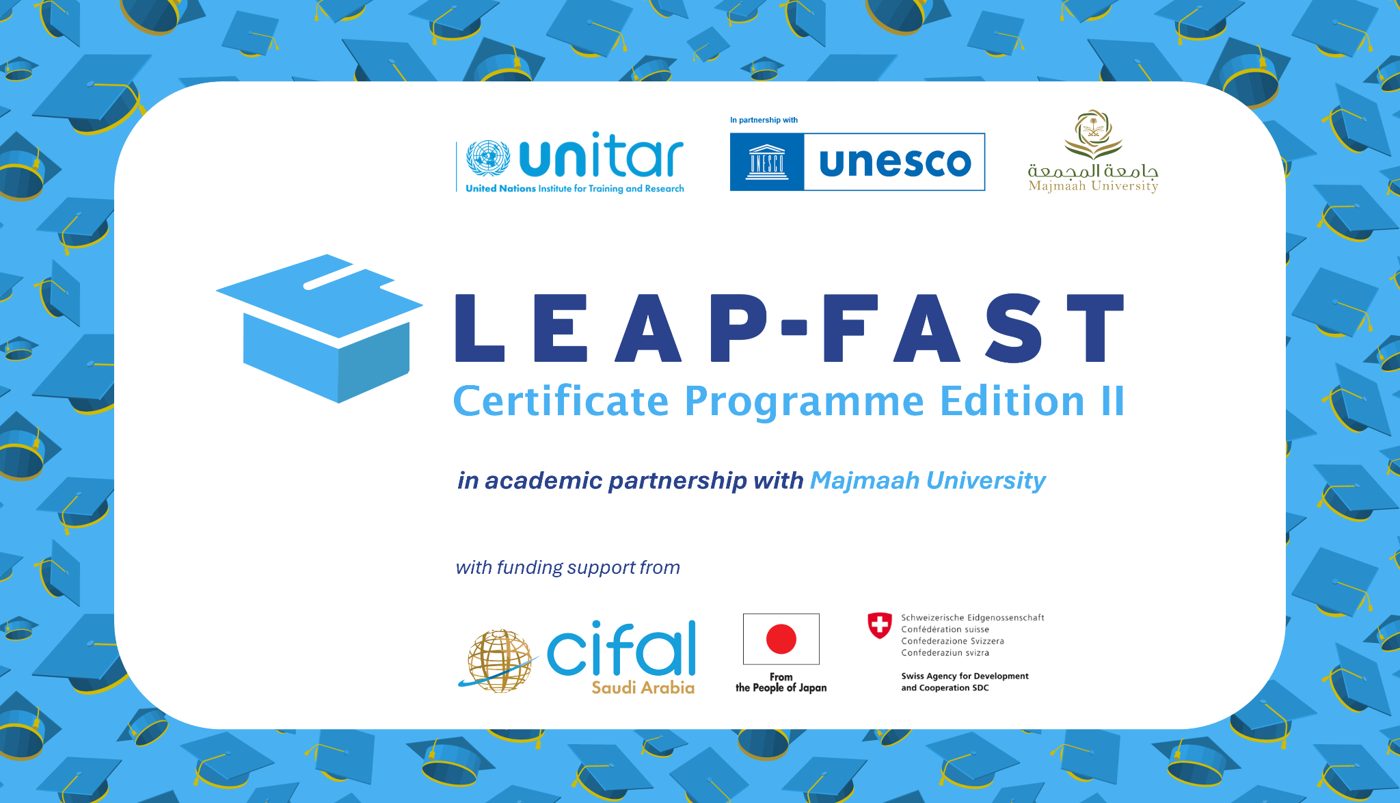
During the 2024–2025 academic year, Bahçeşehir University (BAU) participated in the LEAP-FAST Programme, an international multi-stakeholder initiative involving Majmaah University as a higher education institution, the United Nations Institute for Training and Research (UNITAR) as a United Nations organization, UNESCO as a UN specialized agency, and CIFAL Saudi Arabia as a UNITAR-affiliated training centre within the global CIFAL Network. The programme promoted cross-sectoral collaboration among academia, international organizations, and non-governmental organizations (NGOs), strengthening sustainability education, institutional cooperation, and the integration of the Sustainable Development Goals (SDGs) into higher education.
BAU contributed to the programme through three faculty members from its Faculty of Educational Sciences, Assoc. Prof. Dr. Seda Saraç, Assoc. Prof. Dr Nihal Yurtseven, Dr. Burçak Çağla GARİPOĞLU who participated in the international activities hosted by Majmaah University in Saudi Arabia on 1 April - 2 May 2025.
The LEAP-FAST Programme provided a platform for cross-sectoral dialogue among universities, international organizations, and sustainability education stakeholders, enabling participants to exchange knowledge, share educational practices, and explore collaborative approaches to advancing the SDGs.
Through expert discussions and international knowledge exchange, participating institutions addressed sustainability-oriented teaching, the integration of SDGs into educational practices, and the role of higher education in addressing global environmental and societal challenges. The programme encouraged cooperation across institutional and national boundaries, connecting academic expertise with the broader sustainable development agenda promoted by international organizations.
By actively participating in this international initiative, BAU contributed to cross-sectoral SDG dialogue and collaborative knowledge exchange, strengthening partnerships between higher education institutions and international organizations and supporting collective approaches to sustainability education.
BAU's participation enabled its academic representatives to engage with international sustainability education stakeholders, exchange institutional experiences, and contribute to discussions on how universities and international organizations can work together to integrate the SDGs into educational practices.
The initiative contributed primarily to SDG 17 (Partnerships for the Goals) through international and cross-sectoral cooperation and SDG 4 (Quality Education) through sustainability-focused academic exchange and professional learning.
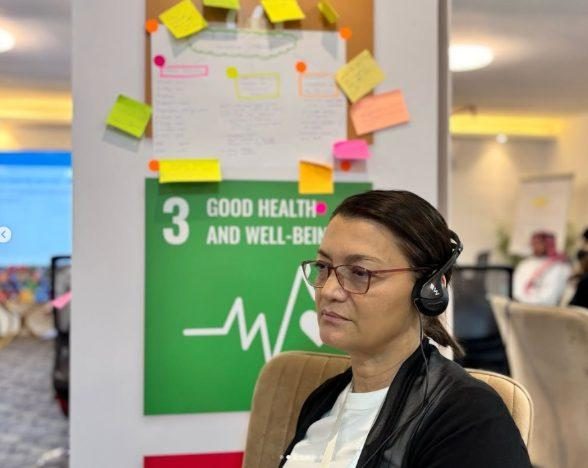
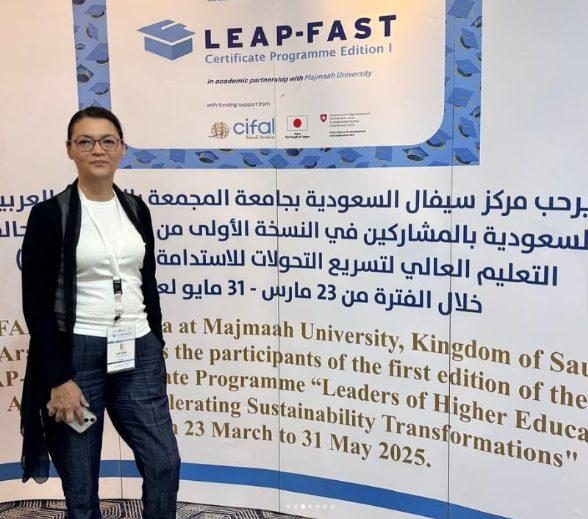
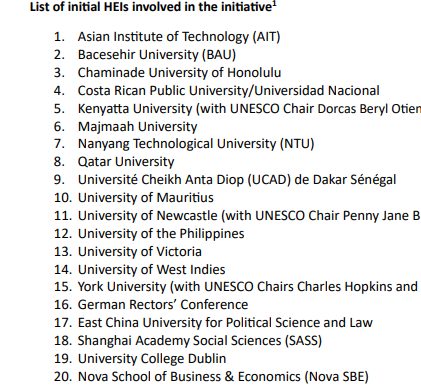
The materials below include the official LEAP-FAST Programme document listing participating universities, including Bahçeşehir University (BAU), and two photographs from the event illustrating international collaboration, knowledge exchange, and engagement with the Sustainable Development Goals (SDGs).
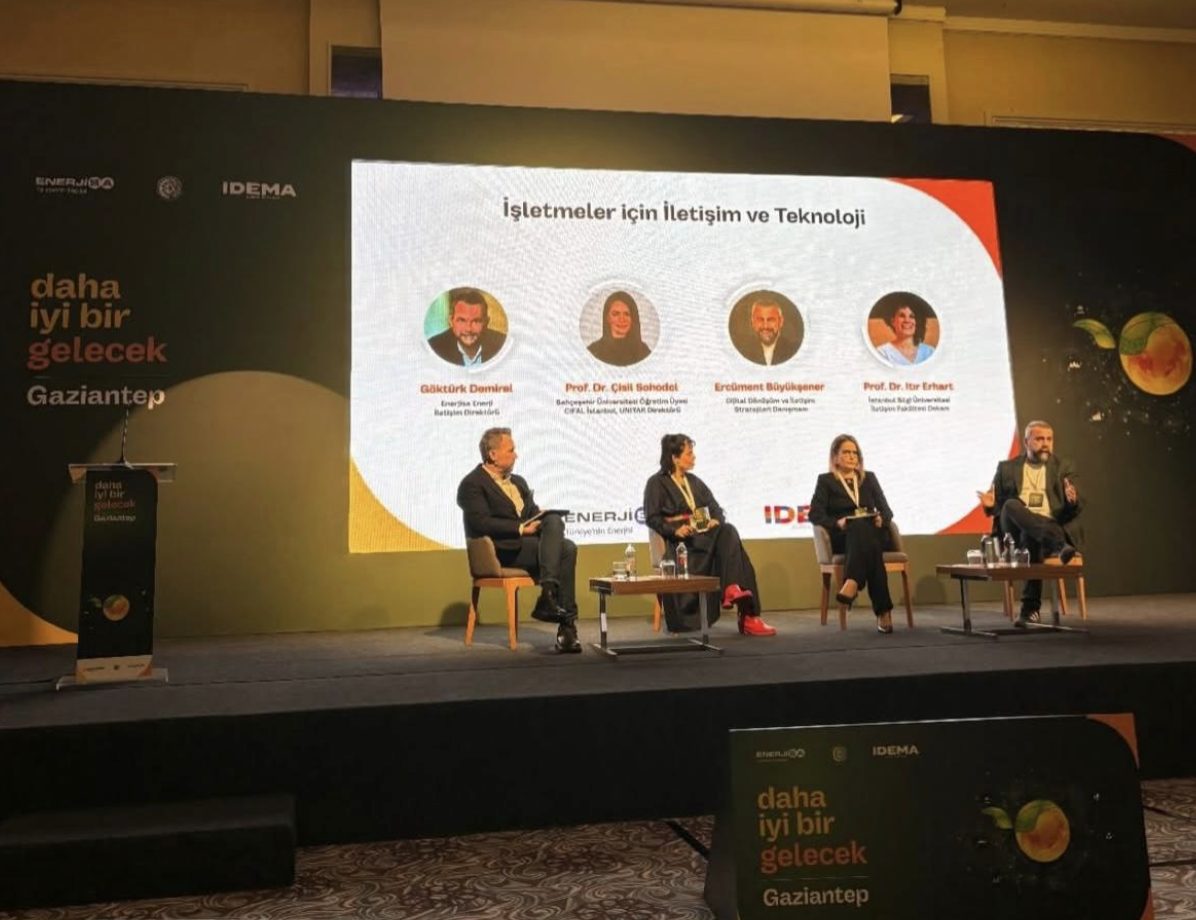
7- Bahçeşehir University's Contribution to Cross-Sectoral Dialogue on Sustainable Development: Enerjisa's “Daha İyi Bir Gelecek” Meeting in Gaziantep with the Gaziantep Chamber of Commerce and IDEMA
The image below shows the promotional poster of the meeting:
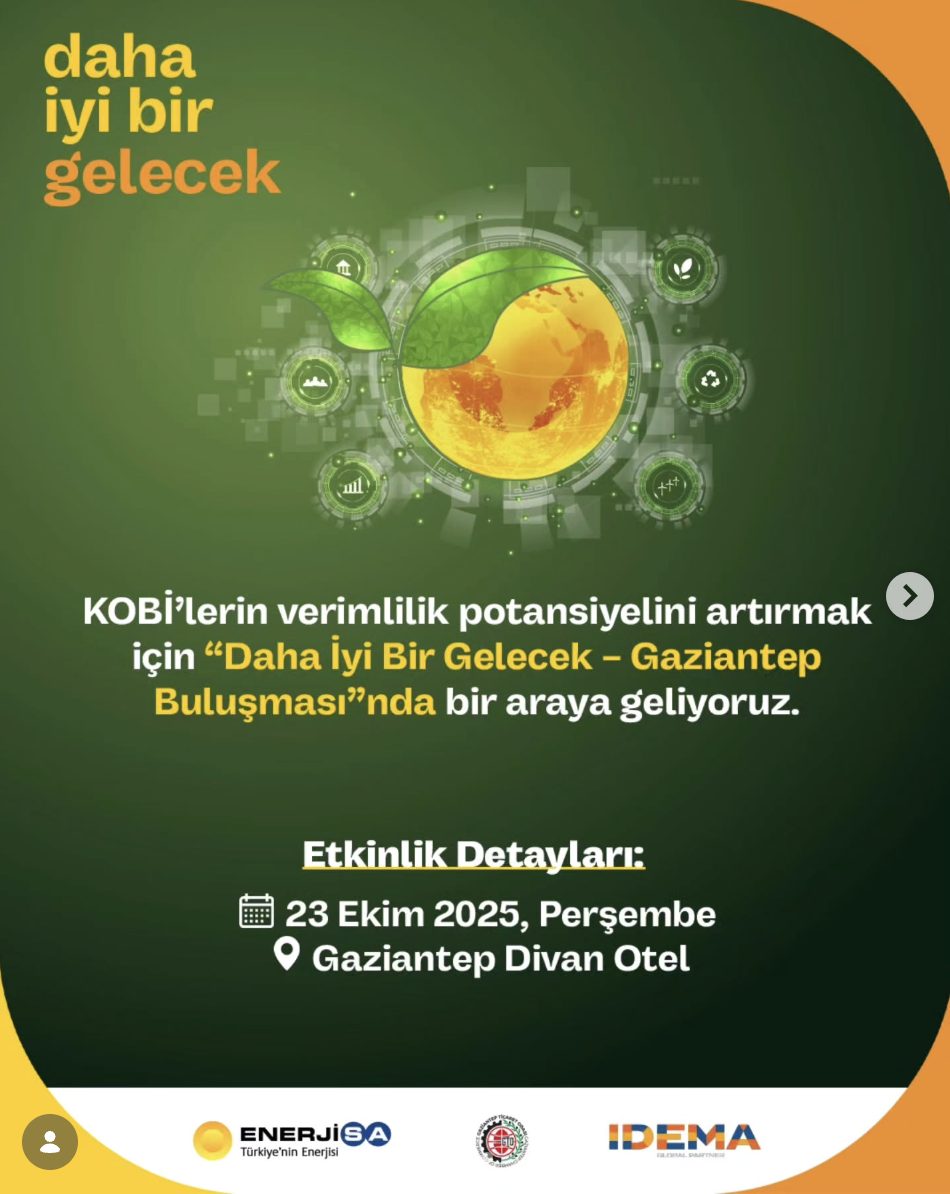
On 23 October 2025, Bahçeşehir University (BAU), and CIFAL Istanbul,UNITAR contributed to the “Daha İyi Bir Gelecek” (A Better Future) Meeting held in Gaziantep, organized by Enerjisa Enerji in collaboration with the Gaziantep Chamber of Commerce and IDEMA. The event formed part of the broader activities of the Enerjisa A Better Sustainable Future Platform, of which Prof. Dr. Çisil Sohodol, Faculty Member at Bahçeşehir University, Rector's Advisor Responsible for Sustainability, and Director of CIFAL Istanbul, is a partner member.
The meeting brought together more than 200 participants, including representatives of small and medium-sized enterprises (SMEs), academia, public institutions, civil society organizations, and university students, creating a platform for cross-sectoral dialogue on sustainable economic development, digital transformation, energy efficiency, and responsible business practices.
Representing Bahçeşehir University and CIFAL Istanbul, Prof. Dr. Çisil Sohodol participated as a speaker, contributing academic expertise and international sustainable development perspectives to discussions connecting business innovation, sustainability communication, and local development priorities. Her participation strengthened the exchange of knowledge between higher education, the private sector, and community stakeholders, supporting a shared understanding of the challenges and opportunities associated with sustainable transformation.
The programme addressed economic efficiency, digital and data literacy, energy efficiency, sustainable communication, and technology-driven innovation. A key component was the presentation of FutureBright's SME Data Analytics Report, which highlighted gaps in data literacy and the importance of strengthening digital competencies among SMEs. These discussions connected research-based insights with the practical needs of businesses and encouraged dialogue on collaborative approaches to sustainable economic growth.
Through its engagement in the Enerjisa platform and participation in the Gaziantep meeting, BAU contributed to an ongoing multi-stakeholder partnership involving academia, industry, public institutions, and civil society. The initiative facilitated knowledge exchange across sectors and encouraged the application of sustainability-related expertise to local economic and social development challenges.
The initiative contributed primarily to SDG 17 (Partnerships for the Goals) by promoting cross-sectoral cooperation and dialogue. It also supported SDG 8 (Decent Work and Economic Growth) through sustainable business development, SDG 9 (Industry, Innovation and Infrastructure) through digital transformation and innovation, SDG 7 (Affordable and Clean Energy) through discussions on energy efficiency, and SDG 4 (Quality Education) through knowledge sharing and professional capacity development.
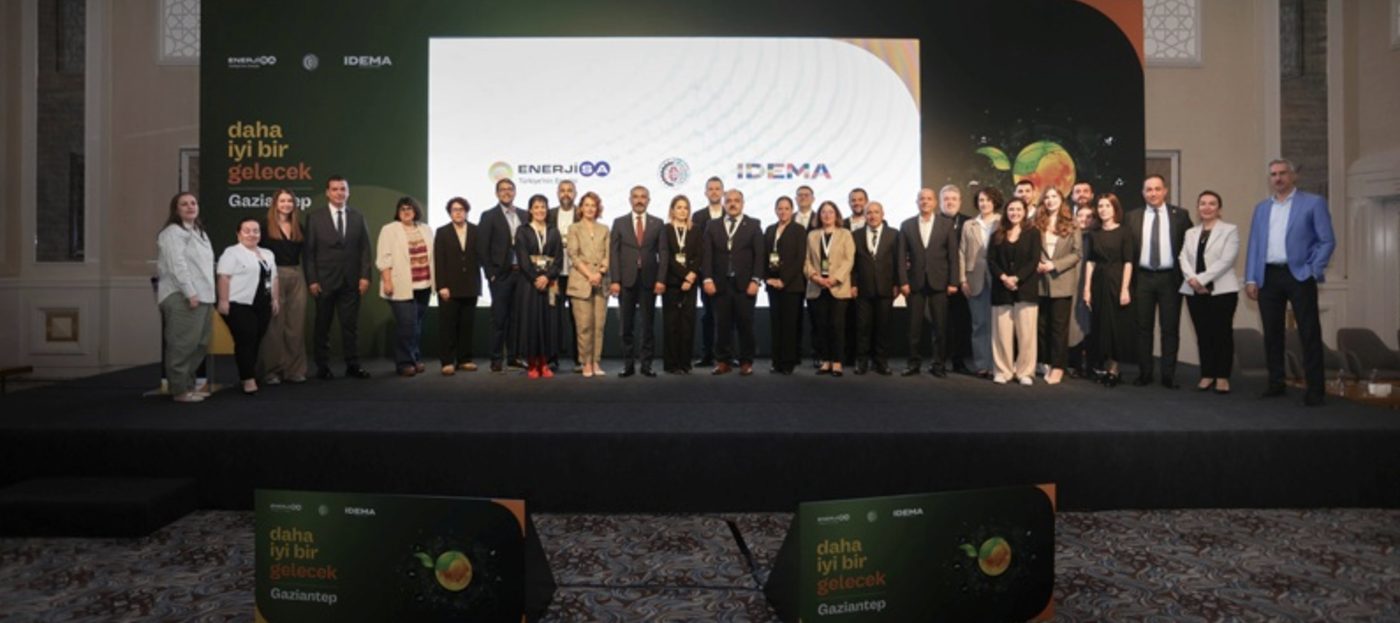
The images below showcase pictures from the meeting:
8- Bahçeşehir University's Collaboration with Trauma and Disaster Mental Health Studies Association: Cross-Sectoral Support for Post-Disaster Mental Health and Community Resilience in Kahramanmaraş
The official event poster below documents the “Art-Based Support Group for Field Workers” held on 7 March 2025 at Kahramanmaraş Airport Container City, highlighting Prof. Dr. Özlem Karaırmak's contribution and the collaboration with the Trauma and Disaster Mental Health Studies Association (TARDE) in providing psychosocial support to professionals working in the earthquake-affected region.
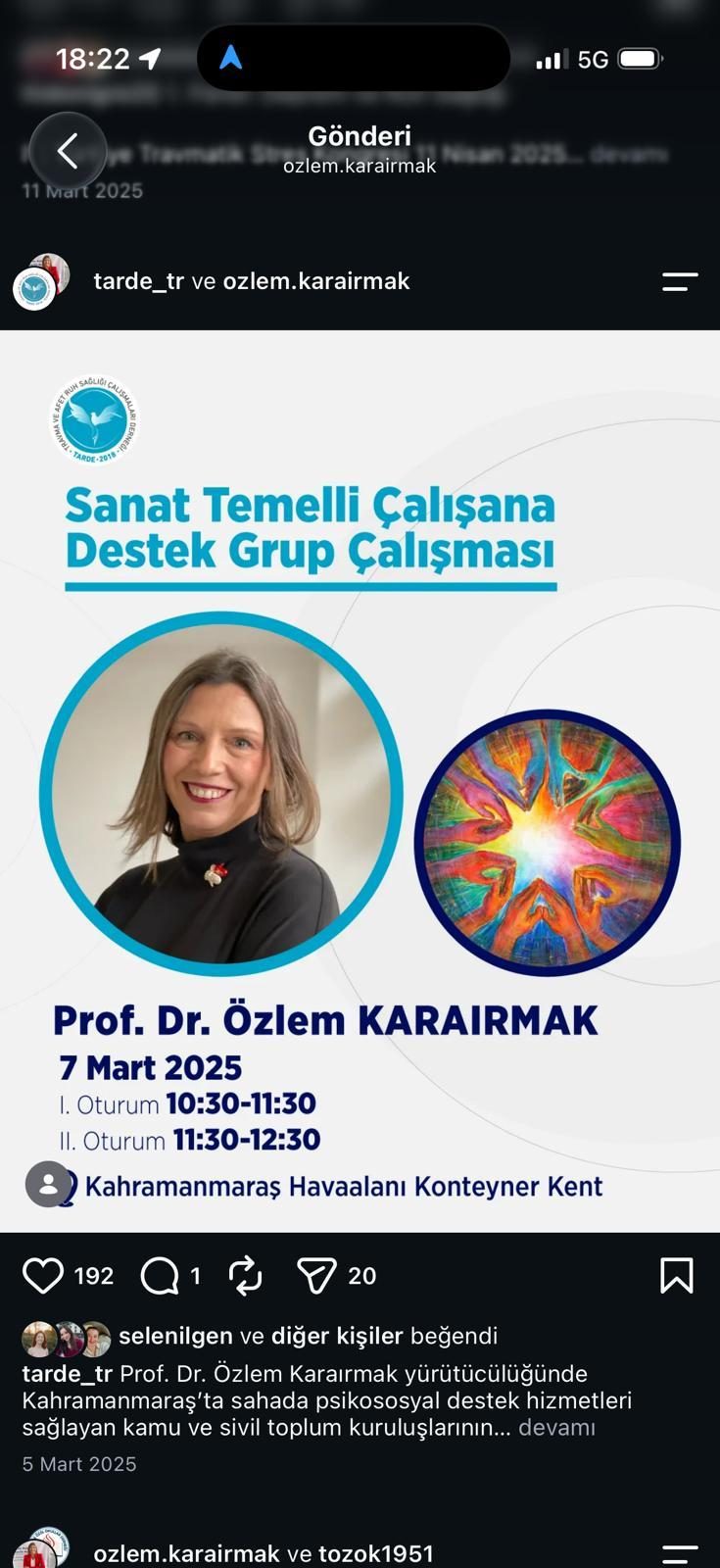
On 7 March 2025, Prof. Dr. Özlem Karaırmak, a faculty member in the Department of Guidance and Psychological Counseling at Bahçeşehir University's Faculty of Educational Sciences, led an “Art-Based Support Group for Field Workers” (Sanat Temelli Çalışana Destek Grup Çalışması) in collaboration with the Trauma and Disaster Mental Health Studies Association (TARDE), a civil society organization specializing in trauma and disaster-related mental health.
Held at the Kahramanmaraş Airport Container City, the initiative consisted of two structured sessions designed for field professionals working in public institutions and non-governmental organizations who provide ongoing psychosocial support to communities affected by the earthquakes.
The initiative brought together academic expertise, civil society engagement, and public-sector frontline professionals, creating an opportunity for cross-sectoral knowledge exchange and cooperation in post-disaster mental health support. Through structured art-based group activities, participants engaged in practices aimed at strengthening psychological well-being, managing occupational stress, and reducing the risk of burnout among professionals working in challenging post-disaster conditions.
By connecting university-based expertise with the practical experiences of professionals from public institutions and civil society organizations, the programme supported collaborative approaches to disaster recovery, psychosocial resilience, and the sustainability of community support services. It also demonstrated the importance of cooperation across sectors in addressing the long-term social and psychological consequences of disasters.
Through Prof. Dr. Karaırmak's direct academic contribution, BAU supported the exchange of specialized knowledge and the strengthening of professional capacities among organizations involved in disaster response and recovery.
The initiative contributed to SDG 17 (Partnerships for the Goals) through cooperation between academia, civil society, and public-sector professionals; SDG 3 (Good Health and Well-being) through psychosocial support and mental health promotion; and SDG 11 (Sustainable Cities and Communities) through efforts to strengthen community resilience and post-disaster recovery.
9- Bahçeşehir University’s Cross-Sectoral Collaboration with UNICEF, TARDE and the Ministry of Family and Social Services: Strengthening Child Protection and Post-Disaster Psychosocial Support
The image below presents a highlight of the event.
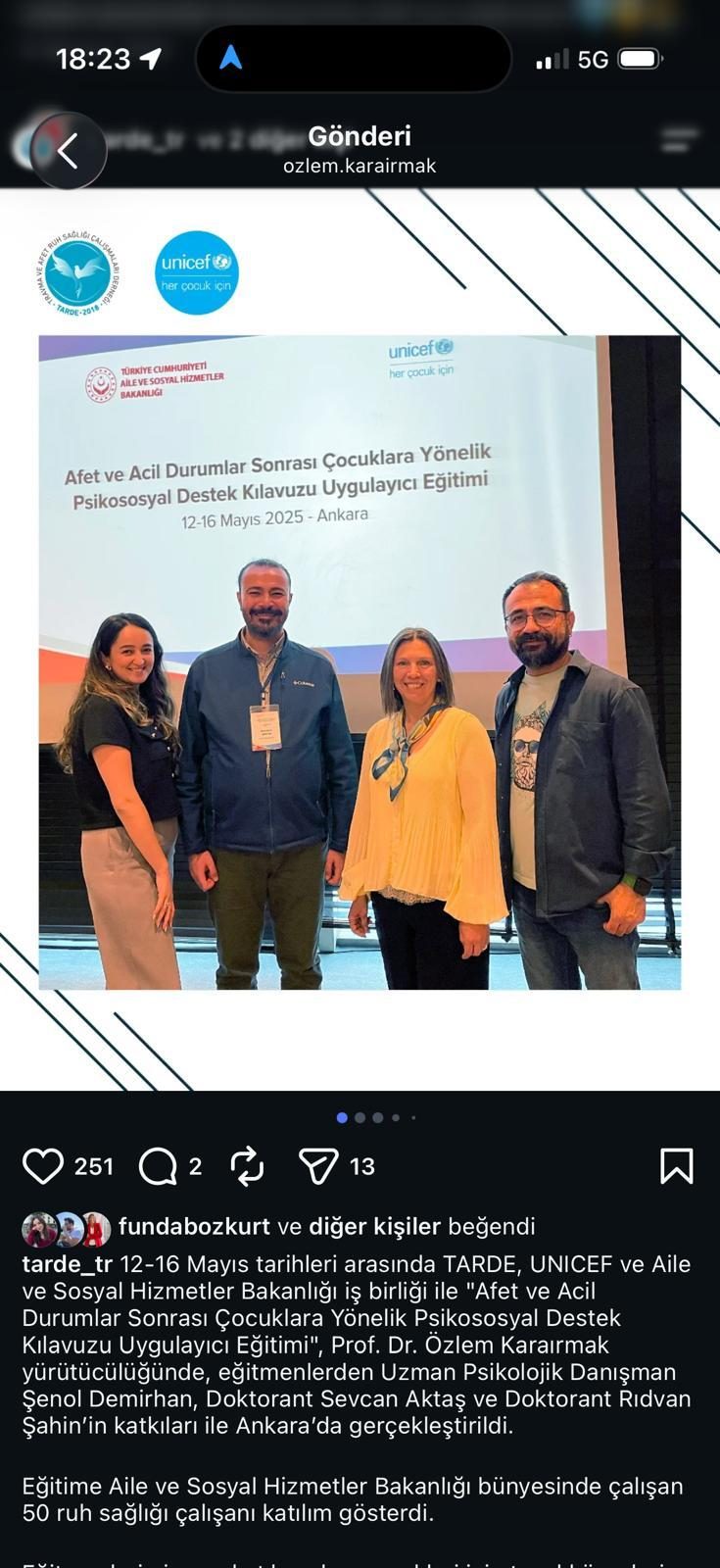
During 12–16 May 2025, Bahçeşehir University (BAU) contributed to a five-day specialized practitioner training programme on the “Post-Disaster and Emergency Psychosocial Support Guide for Children”, held in Ankara through collaboration among the Ministry of Family and Social Services of the Republic of Türkiye as a public institution, UNICEF as a United Nations organization, and the Trauma and Disaster Mental Health Studies Association (TARDE) as a non-governmental organization (NGO).
BAU's contribution was provided through Prof. Dr. Özlem Karaırmak, a faculty member in the Department of Guidance and Psychological Counseling at BAU's Faculty of Educational Sciences, who led the training alongside expert practitioners Şenol Demirhan, Sevcan Aktaş, and Rıdvan Şahin. The programme brought together academic expertise, international child protection perspectives, civil society experience, and public-sector professionals to strengthen institutional responses to the psychosocial needs of children affected by disasters and emergencies.
The initiative provided specialized training to 50 mental health professionals employed by the Ministry of Family and Social Services, creating opportunities for cross-sectoral knowledge exchange and professional dialogue on child-sensitive psychosocial interventions, trauma-informed approaches, and coordinated disaster response practices.
Through the collaboration, participating institutions connected academic research, international child protection frameworks, NGO expertise, and public-sector service delivery, supporting the exchange of knowledge and practical approaches to addressing the long-term psychological and social consequences of disasters. The programme demonstrated how cooperation among different sectors can strengthen the capacity of public institutions to provide effective, coordinated, and sustainable psychosocial services.
By contributing academic expertise to this multi-stakeholder initiative, BAU actively participated in cross-sectoral cooperation addressing SDG-related challenges, particularly the protection of vulnerable children, mental health and well-being, and the development of resilient public institutions. The partnership also highlighted the role of universities in connecting research-based knowledge with international organizations, civil society initiatives, and government services to address shared social development priorities.
The initiative contributed primarily to SDG 17 (Partnerships for the Goals) through cooperation among academia, a United Nations organization, an NGO, and a government ministry. It also supported SDG 16 (Peace, Justice and Strong Institutions) by strengthening institutional child protection and disaster response capacities, SDG 3 (Good Health and Well-being) through psychosocial support and mental health promotion, and SDG 4 (Quality Education) through professional training and capacity development.
10- Bahçeşehir University's Consumer Law Symposium in Collaboration with Istanbul Arel University and the Confederation of Consumer Organizations (TÖK): Policy Education, Capacity Building and Cross-Sectoral Dialogue on Consumer Rights and Regulatory Governance
The image below presents the official programme of the 2nd Symposium on Current Issues in Consumer Law, held on 14 March 2025, documenting the collaboration among universities and consumer protection organizations, as well as the participation of public-sector representatives, legal professionals, and experts in consumer law and regulatory governance.
On 14 March 2025, Bahçeşehir University (BAU), in collaboration with Istanbul Arel University and the Confederation of Consumer Organizations (TÖK), a non-governmental organization (NGO) representing consumer rights organizations in Türkiye, organized the “2nd Symposium on Current Issues in Consumer Law”, bringing together policymakers, public-sector representatives, legal professionals, consumer rights organizations, regulatory stakeholders, and academic experts for specialized legal education and capacity building.
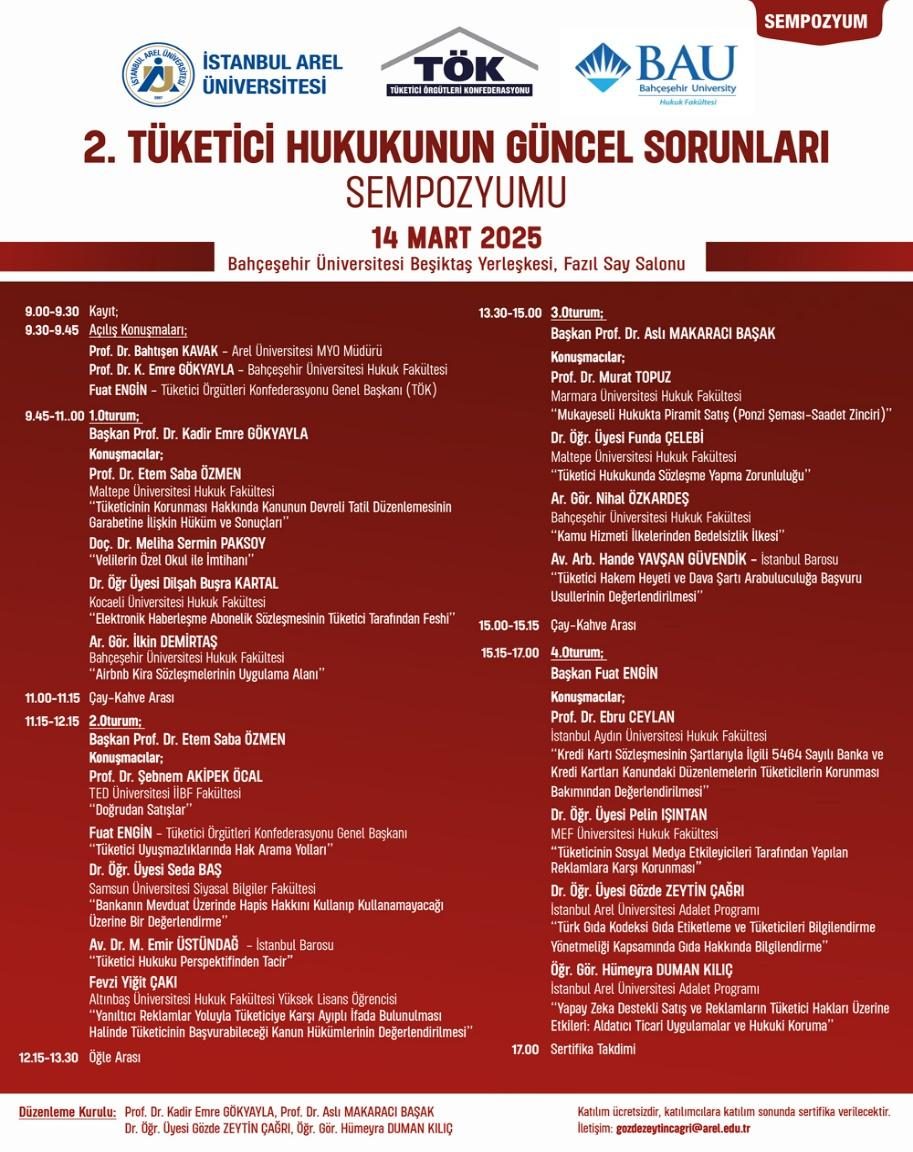
The symposium provided a platform for policy-oriented education, professional upskilling, and institutional knowledge exchange on consumer protection legislation, regulatory enforcement, and emerging challenges in consumer markets. By connecting academic expertise with public institutions, legal practitioners, and civil society organizations, the programme supported knowledge development relevant to consumer policy formulation, legal implementation, and institutional decision-making. It also facilitated cross-sectoral dialogue among academia, government institutions, professional organizations, and NGOs on shared challenges related to consumer rights, responsible market practices, and access to justice.
The programme featured contributions from representatives of the Ministry of Trade, the Istanbul Bar Association, the Consumer Confederation (TÖK), alongside legal scholars and practitioners from participating universities. Their involvement brought together regulatory, professional, and civil society perspectives, strengthening the exchange of practical knowledge on consumer rights and the effectiveness of consumer protection mechanisms.
The educational sessions examined consumer rights under Turkish legislation, unfair commercial practices, consumer dispute resolution, digital consumer protection, misleading advertising, product and service liability, and the responsibilities of regulatory and judicial institutions. Discussions addressed contemporary challenges in applying consumer protection rules and ensuring that legal safeguards remain effective as markets and commercial practices evolve.
Particular attention was given to the role of public authorities, consumer protection organizations, and legal institutions in enforcing consumer rights, improving regulatory oversight, and ensuring access to effective remedies. The participation of consumer advocacy organizations also introduced civil society perspectives on regulatory gaps and emerging consumer protection needs, contributing to policy-relevant dialogue and institutional learning.
Through expert-led presentations and discussions, the symposium contributed to the education, upskilling, and capacity development of policymakers, public-sector representatives, and legal professionals, strengthening their understanding of consumer protection legislation, regulatory responsibilities, and rights-based approaches to market governance.
By facilitating knowledge exchange among universities, public authorities, professional legal institutions, and consumer advocacy organizations, BAU supported evidence-informed policymaking, effective regulatory implementation, and institutional capacity building in consumer protection. The collaboration with TÖK as an NGO, alongside government representatives and academic institutions, further demonstrated BAU's role in facilitating cross-sectoral dialogue and multi-stakeholder cooperation on SDG-related legal, social, and regulatory challenges.
The initiative contributed primarily to SDG 16 (Peace, Justice and Strong Institutions) through legal education, access to justice, regulatory accountability, and stronger consumer protection institutions. It also supported SDG 12 (Responsible Consumption and Production) through fair and transparent market practices, SDG 4 (Quality Education) through specialized professional learning, and SDG 17 (Partnerships for the Goals) through cross-sectoral dialogue and cooperation among academic institutions, government authorities, professional legal bodies, and civil society organizations, including NGOs.
11- Bahçeşehir University's International Dialogue on Femicide and Women's Rights with IBERO University and Mor Çatı Women's Shelter Foundation: Cross-Sectoral Cooperation for Gender Equality and Access to Justice
The official event poster below documents the international panel held on 13 May 2025, highlighting the participation of Bahçeşehir University, IBERO University, and Mor Çatı Women's Shelter Foundation, alongside feminist activists and legal experts from Türkiye and Mexico. It demonstrates BAU's role in facilitating international academic–NGO dialogue on gender equality, women's rights, femicide prevention, and access to justice.
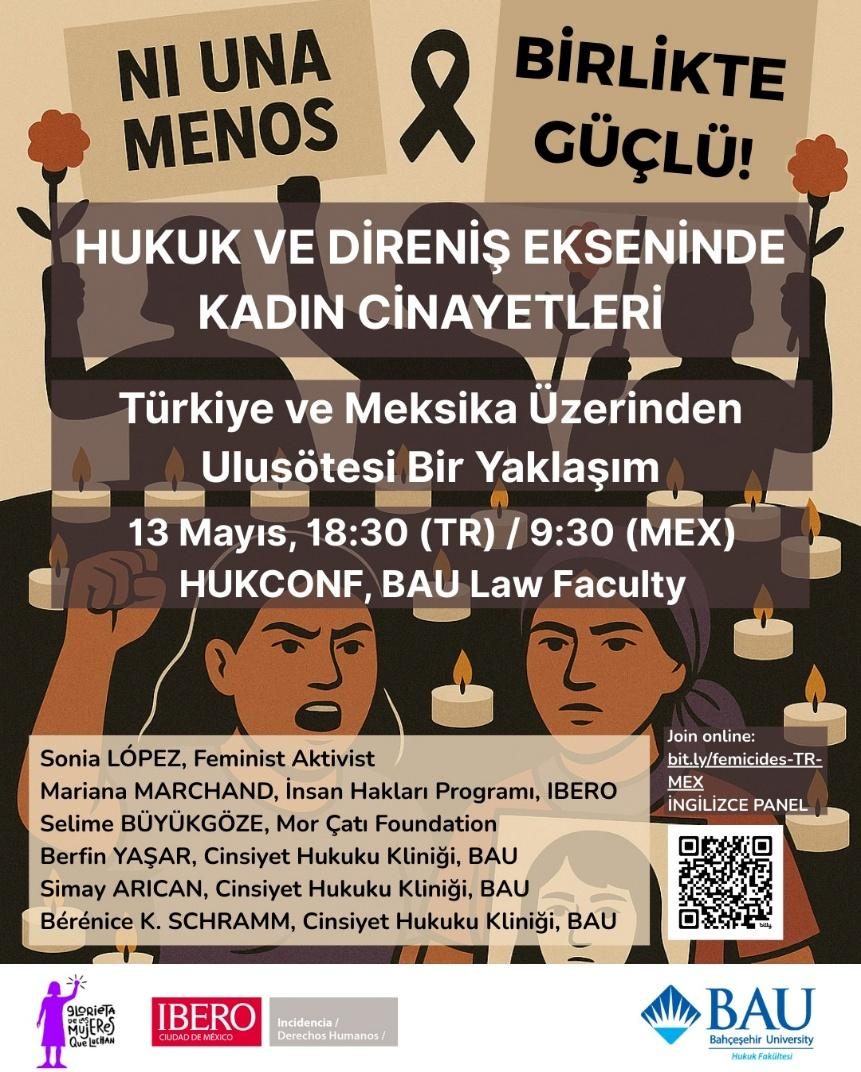
On 13 May 2025, Bahçeşehir University (BAU), through its Faculty of Law, organized the international online panel “Femicide at the Intersection of Law and Resistance: A Transnational Perspective on Türkiye and Mexico”, bringing together academic experts, legal scholars, feminist activists, and civil society representatives from Türkiye and Mexico to address femicide, gender-based violence, women's rights, and institutional accountability.
The event featured contributions from Sonia López, a feminist activist; Mariana Marchand from the Human Rights Programme at IBERO University in Mexico; Selime Büyükgöze from Mor Çatı Women's Shelter Foundation, a non-governmental organization (NGO) working to combat violence against women; and BAU Faculty of Law academics Berfin Yaşar, Simay Arıcan, and Bérénice K. Schramm.
By connecting Bahçeşehir University, IBERO University, women's rights advocates, and civil society representatives, the initiative created an international platform for cross-sectoral dialogue and knowledge exchange on shared challenges related to gender equality, human rights, legal protection, and access to justice. The participation of Mor Çatı brought an important NGO perspective to the discussion, connecting academic and legal analysis with civil society experience in supporting women affected by violence.
The exchange connected academic and legal perspectives with the practical experience of women's rights organizations, enabling participants to examine shared challenges and different approaches to institutional protection, gender equality, and access to justice.
The panel examined the relationship between femicide, structural gender inequality, discriminatory social norms, unequal power relations, and gaps in institutional protection. Drawing on experiences from Türkiye and Mexico, speakers explored how legal frameworks, judicial practices, and institutional responses influence women's safety and their ability to exercise fundamental rights.
Particular attention was given to legislation, judicial enforcement, institutional accountability, survivor protection, and civil society advocacy. Discussions highlighted the importance of ensuring that legal protections are not merely established in legislation but are effectively implemented through accessible support mechanisms, responsive institutions, and accountable judicial processes.
The international exchange also enabled participants to examine common challenges and different approaches to preventing femicide, combating impunity, strengthening legal safeguards, and promoting gender equality. By bringing together perspectives from two national contexts, the event encouraged comparative learning and dialogue on how academic institutions, legal professionals, and civil society organizations can contribute to addressing gender-based violence.
Through this initiative, BAU facilitated cross-sectoral engagement between higher education institutions and an NGO, demonstrating the role of universities in creating inclusive spaces for dialogue on complex social and legal challenges. The participation of international academic and civil society representatives strengthened knowledge exchange across institutional and national boundaries, supporting collaborative approaches to advancing the Sustainable Development Goals (SDGs).
The initiative contributed primarily to SDG 5 (Gender Equality) by addressing femicide, violence against women, structural discrimination, and the need for effective protection of women's rights. It also supported SDG 16 (Peace, Justice and Strong Institutions) through dialogue on access to justice, legal protection, institutional accountability, and responses to gender-based violence; SDG 17 (Partnerships for the Goals) through international and cross-sectoral engagement among universities, civil society organizations, and women's rights advocates; and SDG 4 (Quality Education) through expert-led public education, international knowledge exchange, and human rights awareness.
12- Bahçeşehir University's 21st Green Dialogue Meeting: Climate Policy Education, Capacity Building and Cross-Sectoral Dialogue with Environmental NGOs for Sustainable Governance
The image below presents the official poster of the 21st Green Dialogue Meeting, held on 27 December 2025, highlighting the educational programme, expert speakers, and key topics addressed in climate legislation, just transition, and environmental governance.
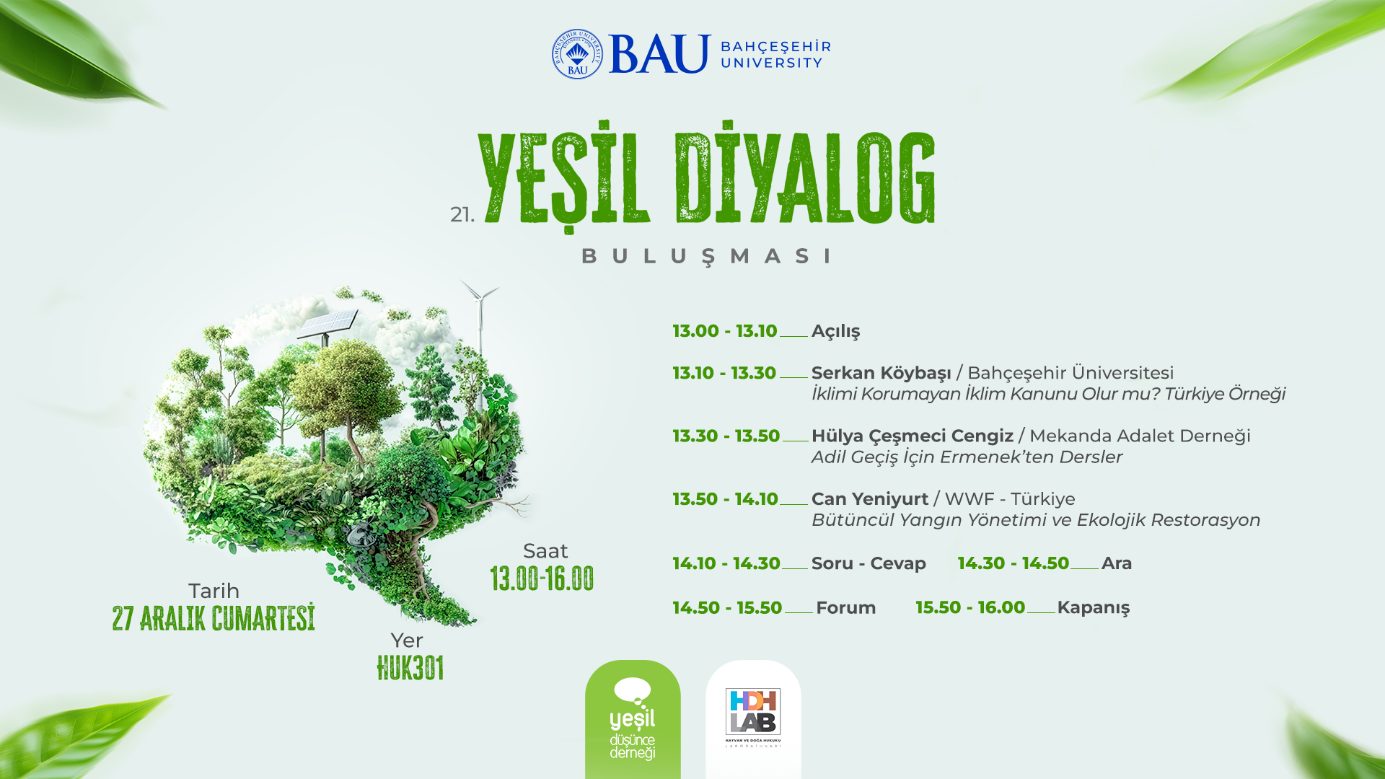
On 27 December 2025, Bahçeşehir University (BAU) hosted the 21st Green Dialogue Meeting (21. Yeşil Diyalog Buluşması), bringing together policymakers, lawmakers, public-sector representatives, local government officials, civil society organizations, and academic experts for an educational programme focused on climate legislation, environmental governance, and the green transition. The initiative also provided a platform for cross-sectoral dialogue among academia, public institutions, and environmental non-governmental organizations (NGOs) on shared sustainability challenges and the implementation of the Sustainable Development Goals (SDGs).
The education programme aimed to strengthen the knowledge and capacities of policymakers and public-sector decision-makers by providing expert-led education on the legal, institutional, and social dimensions of sustainable development. Through presentations and interactive discussions, participants engaged with policy-relevant approaches to climate regulation, institutional accountability, environmental protection, and sustainable public administration.
The programme featured Serkan Köybaşı from Bahçeşehir University, who examined the effectiveness of climate legislation and institutional accountability; Hülya Çeşme Cengiz from Mekanda Adalet Derneği (Centre for Spatial Justice), a non-governmental organization working on spatial justice and social equity, who discussed just transition and lessons from Ermenek; and Can Yeniyurt from WWF-Türkiye, an environmental non-governmental organization, who addressed integrated fire management and ecological restoration. Together, the presentations provided multidisciplinary perspectives on climate policy, social equity, and environmental governance. The participation of these NGOs connected academic and legal expertise with civil society perspectives on environmental protection, climate justice, and sustainable development.
The educational programme contributed directly to policy- and lawmakers' outreach, education, and capacity development, strengthening participants' understanding of climate-related legal frameworks, evidence-informed policymaking, socially inclusive transition strategies, and integrated environmental management.
The question-and-answer session and open forum enabled policymakers, public administrators, and other stakeholders to exchange perspectives, discuss implementation challenges, and consider how the knowledge presented could inform public policy development and institutional practices. These interactive exchanges also facilitated cross-sectoral dialogue on the relationship between climate legislation, environmental justice, ecological resilience, and institutional responsibilities, allowing academic, public-sector, and NGO perspectives to inform discussions of shared SDG-related challenges.
By bringing together public-sector decision-makers, academic experts, and civil society representatives, BAU facilitated knowledge transfer, professional learning, and capacity building, supporting more informed, transparent, and accountable approaches to climate governance. Through its engagement with Mekanda Adalet Derneği and WWF-Türkiye, BAU also strengthened dialogue between higher education and civil society, demonstrating the role of universities in connecting research-based knowledge, environmental advocacy, and public policy discussions.
The meeting's multi-stakeholder format supported collaborative approaches to sustainable development, bringing together perspectives from different sectors to address the interconnected legal, environmental, and social dimensions of the green transition. By providing a common platform for discussion, BAU contributed to cross-sectoral knowledge exchange on climate action, just transition, and environmental governance.
The initiative contributed to SDG 16 (Peace, Justice and Strong Institutions) through its emphasis on effective legislation, institutional accountability, and policy-related capacity building; SDG 13 (Climate Action) through climate policy education and dialogue; SDG 10 (Reduced Inequalities) through its focus on just transition; and SDG 15 (Life on Land) through ecological restoration and integrated fire management. It also supported SDG 17 (Partnerships for the Goals) through cross-sectoral dialogue and knowledge exchange among Bahçeşehir University, environmental NGOs, public-sector stakeholders, and academic experts, encouraging collaborative approaches to SDG-related challenges.
13- Strengthening Post-Disaster Psychosocial Support Beyond Campus: Professional Capacity Building in Gaziantep with the Trauma and Disaster Mental Health Studies Association (TARDE)
The pictures below showcases relevant highlights from the capacity-building programme in Gaziantep:
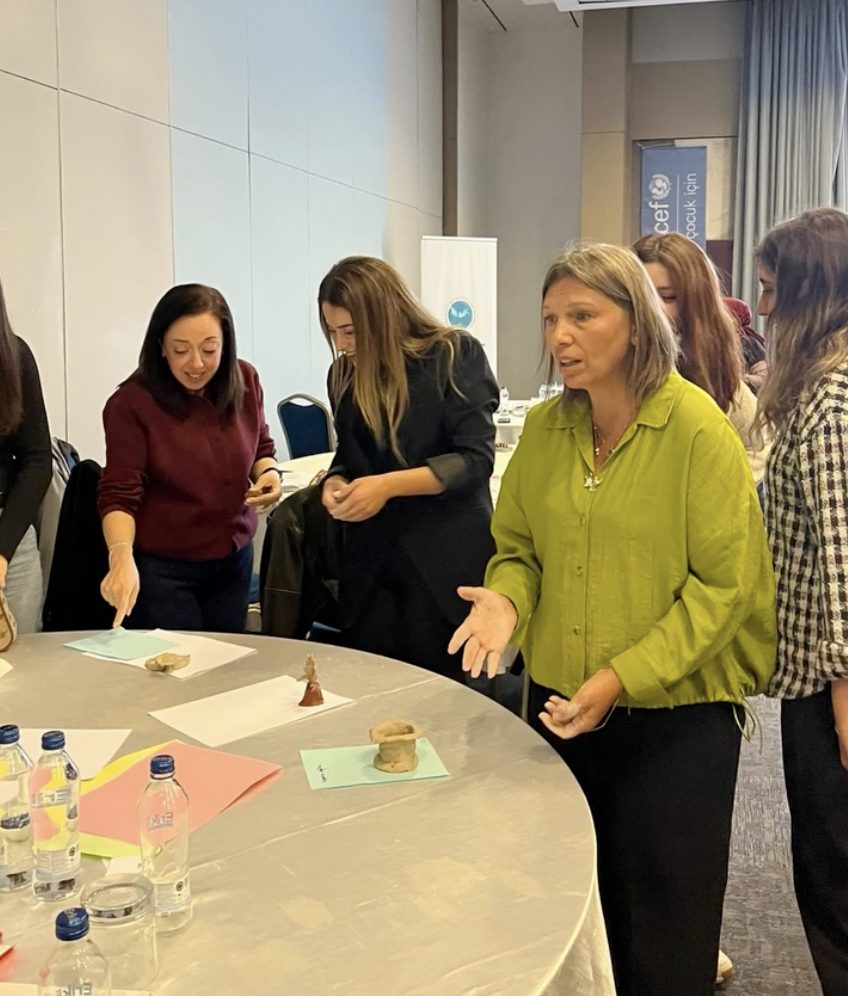
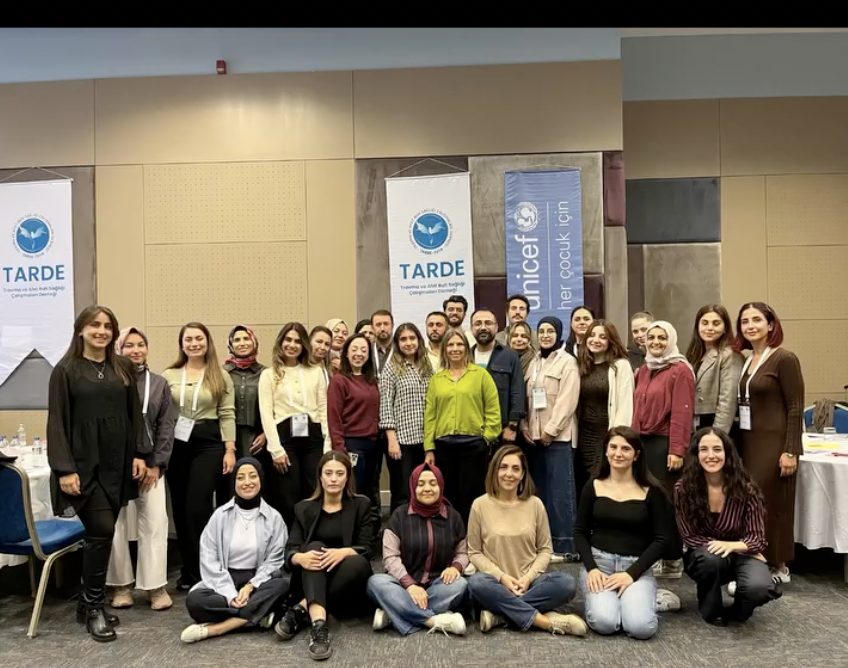
On 16 November 2025, Prof. Dr. Özlem Karaırmak, representing Bahçeşehir University and the Trauma and Disaster Mental Health Studies Association (TARDE), delivered a specialized training session titled “Fundamentals of Psychosocial Work with Traumatized Children” in Gaziantep, Türkiye. The training brought together field practitioners working across earthquake-affected provinces, focusing on strengthening their professional knowledge and competencies in providing trauma-informed psychosocial support to children affected by disasters. Drawing on cognitive and somatic awareness approaches, Prof. Dr. Karaırmak addressed the importance of understanding children's psychological and emotional responses to traumatic experiences and introduced methods for responding to their post-disaster psychosocial needs. By delivering this specialized training directly in an earthquake-affected region, Bahçeşehir University extended its academic expertise beyond its campus to professionals working with vulnerable communities.
The initiative represented an important educational outreach and professional capacity-building activity, connecting university-level psychological expertise with the practical needs of professionals supporting disaster-affected children and families. Through Prof. Dr. Karaırmak's training, participants explored trauma-sensitive approaches intended to strengthen their ability to recognize children's psychosocial needs and provide appropriate support during recovery processes. The programme emphasized the importance of equipping local practitioners with specialized knowledge applicable to community-based psychosocial services and child-focused recovery activities. By bringing professional education directly to practitioners in Gaziantep, the initiative facilitated knowledge transfer beyond formal higher education settings and supported the development of local capacities for long-term psychosocial recovery.
The initiative directly contributed to SDG 4: Quality Education by providing specialized professional development opportunities, promoting lifelong learning, and strengthening practitioners' competencies in trauma-informed approaches that can support children's emotional well-being and educational development. It demonstrated Bahçeşehir University's commitment to making academic knowledge accessible to professionals outside the university community, particularly those working in regions experiencing significant social and educational challenges. Furthermore, the programme strongly aligned with SDG 3: Good Health and Well-Being by supporting psychosocial recovery and mental health awareness, and SDG 11: Sustainable Cities and Communities by contributing to the development of resilient community support systems in earthquake-affected areas. Through this initiative, Bahçeşehir University reinforced its role in connecting academic expertise with community needs and supporting sustainable, inclusive post-disaster recovery through education.
14- Advancing Sustainability Education and Community Outreach through CIFAL Istanbul–FAO Türkiye Collaboration
The image below showcases a picture taken at FAO Türkiye Headquarters in Ankara from Prof. Sohodol’s visit:
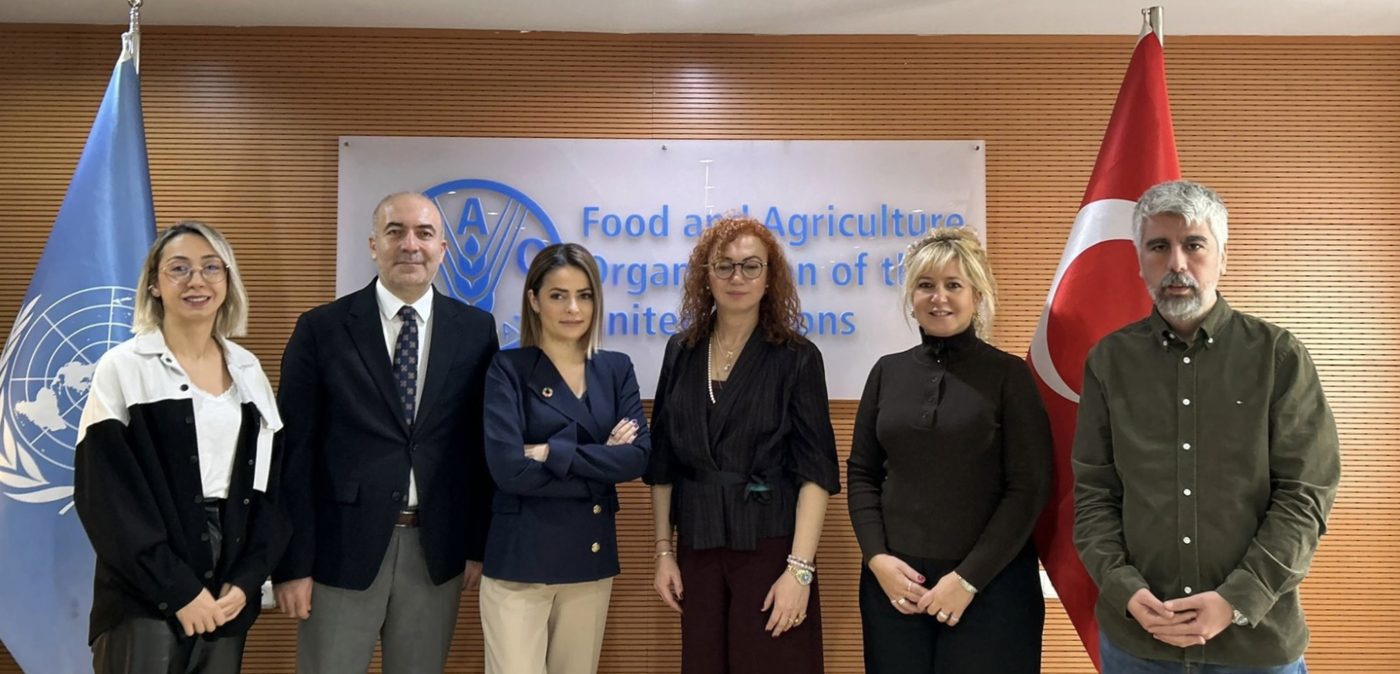
On 8 January 2025, Prof. Dr. Çisil Sohodol, Director of CIFAL Istanbul, visited the Food and Agriculture Organization of the United Nations (FAO) Türkiye Headquarters in Ankara to explore opportunities for strengthening institutional cooperation in sustainable agriculture, food security, and environmental education. Building on the existing partnership between CIFAL Istanbul and FAO Türkiye, the meeting focused on developing collaborative initiatives addressing global sustainability challenges, including regenerative agriculture, biodiversity conservation, responsible natural resource management, and the empowerment of agricultural communities. Particular attention was given to expanding educational awareness and promoting sustainability knowledge beyond academic institutions, emphasizing the importance of making environmental education accessible to different segments of society.
A key educational dimension of the discussions was the shared commitment to promoting sustainability education across all generations, beginning at the primary school level. The participants emphasized the importance of raising awareness about the interconnected roles of water, soil, biodiversity, environmental protection, and food systems in sustaining human life. Through its connection with Bahçeşehir University, CIFAL Istanbul provides a platform for linking academic expertise with community-oriented educational initiatives and international development priorities. The proposed collaboration highlighted opportunities to extend sustainability knowledge beyond university campuses to school communities, agricultural stakeholders, and wider public audiences. Discussions also addressed the potential for educational and capacity-building initiatives supporting women in agricultural cooperatives, particularly by strengthening awareness of sustainable agricultural practices and opportunities for women's participation.
15- Bahçeşehir University, the Young Executives and Businesspeople Association and TULIP Sustainability Center: Cross-Sector Collaboration on “Leading a Sustainable Future”
The images below demonstrate the official promotional posters for the “Leading a Sustainable Future” event:
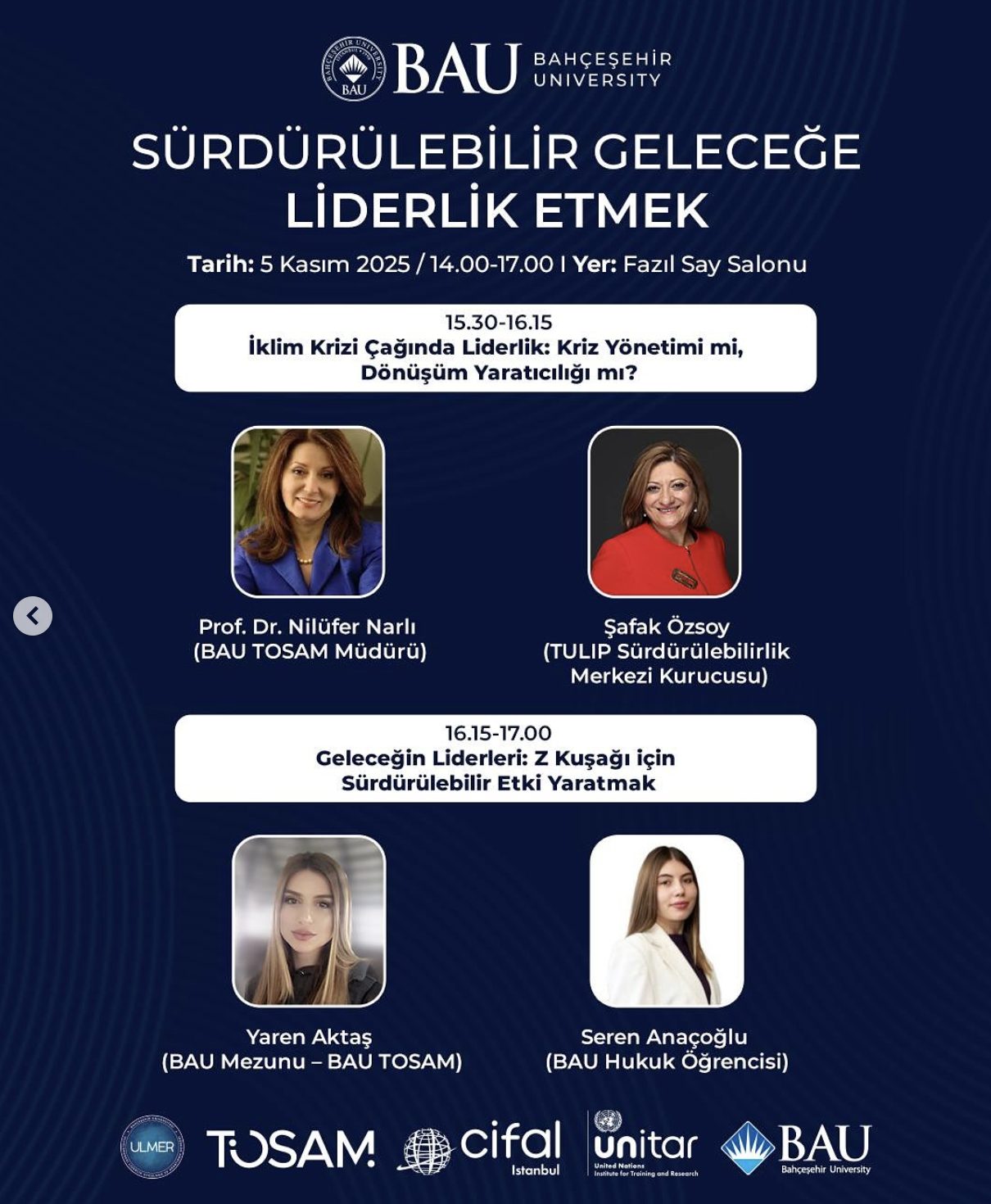
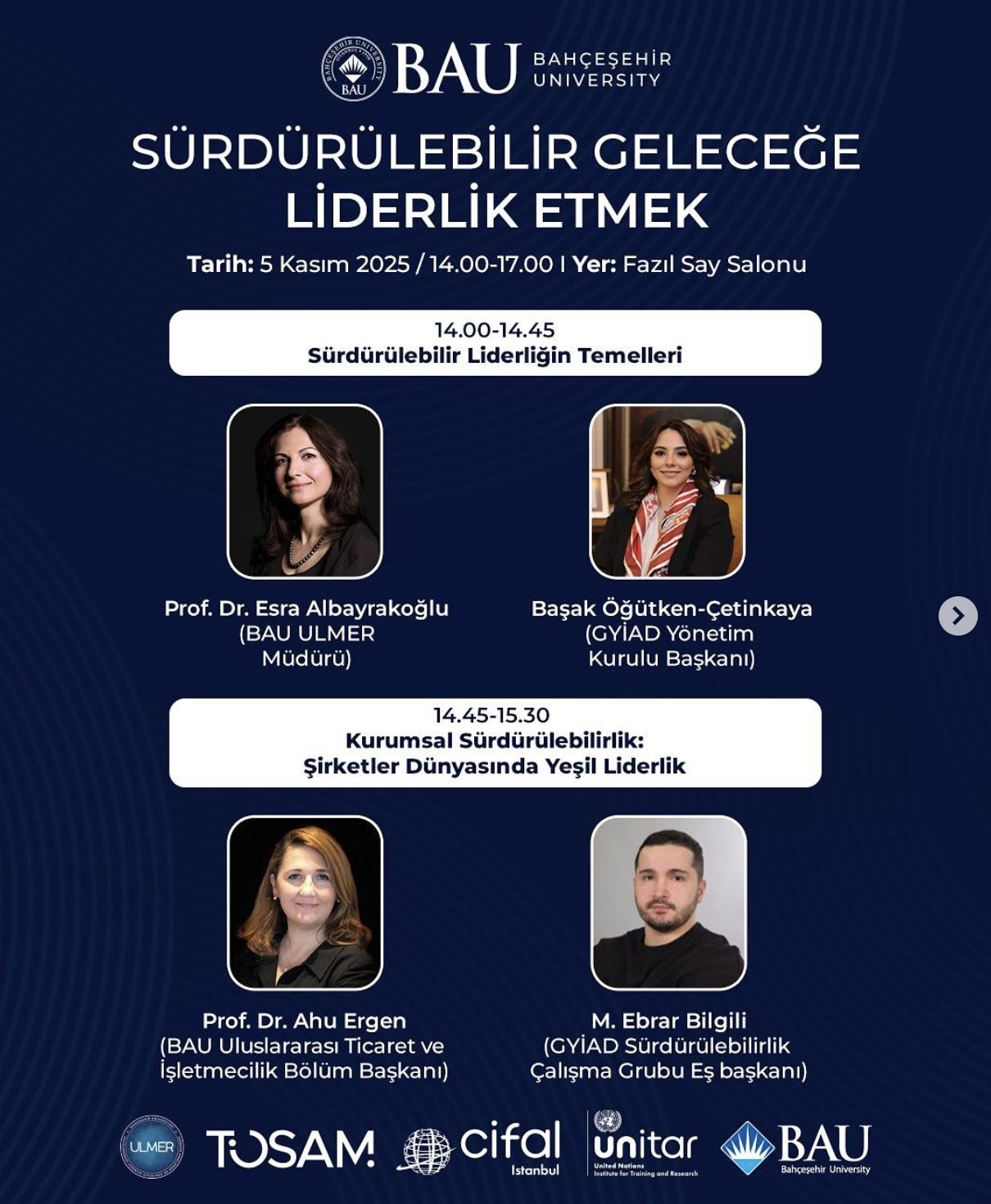
On November 5 2025, “Leading a Sustainable Future” was organised by Bahçeşehir University’s ULMER-HLO, TOSAM and CIFAL Istanbul–UNITAR in cooperation with the Young Executives and Businesspeople Association (GYİAD) and TULIP Sustainability Center. Held at Fazıl Say Hall from 14:00 to 17:00, the event connected university-based expertise with external organisations engaged in business leadership and sustainability practice, bringing academic, civil society and business perspectives into a shared discussion.
Expert speakers addressed the foundations of sustainable leadership, green leadership and creative approaches to transformation during periods of crisis. The programme also explored Generation Z’s leadership expectations and potential to generate sustainable impact. Together, these themes examined how leaders can respond to changing social and environmental needs, consider the long-term consequences of organisational decisions and encourage younger generations to participate in sustainability efforts.
By bringing together academic, civil society, and business perspectives, the event provided a shared setting for discussing sustainable leadership and the responsibilities of organizations in responding to social and environmental change.
The initiative contributes primarily to SDG 17: Partnerships for the Goals through cross-sector cooperation between Bahçeşehir University, the Young Executives and Businesspeople Association and TULIP Sustainability Center. Their collaboration connected academic knowledge with practical experience around a shared sustainability agenda. The event also supports SDG 4: Quality Education through learning on sustainable development and leadership, and relates to SDG 8: Decent Work and Economic Growth through responsible organisational leadership and the expectations of future professionals.
16- Bahçeşehir University’s CIFAL Istanbul and Sustainable Brands Summit: Cross-Sector Dialogue on Shared Value and Sustainability
The image below displays the official promotional poster of the Sustainable Brands Summit 2025:
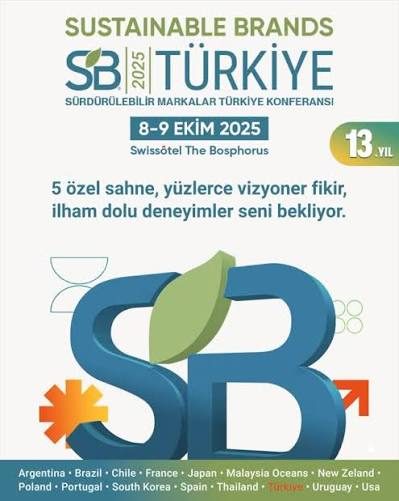
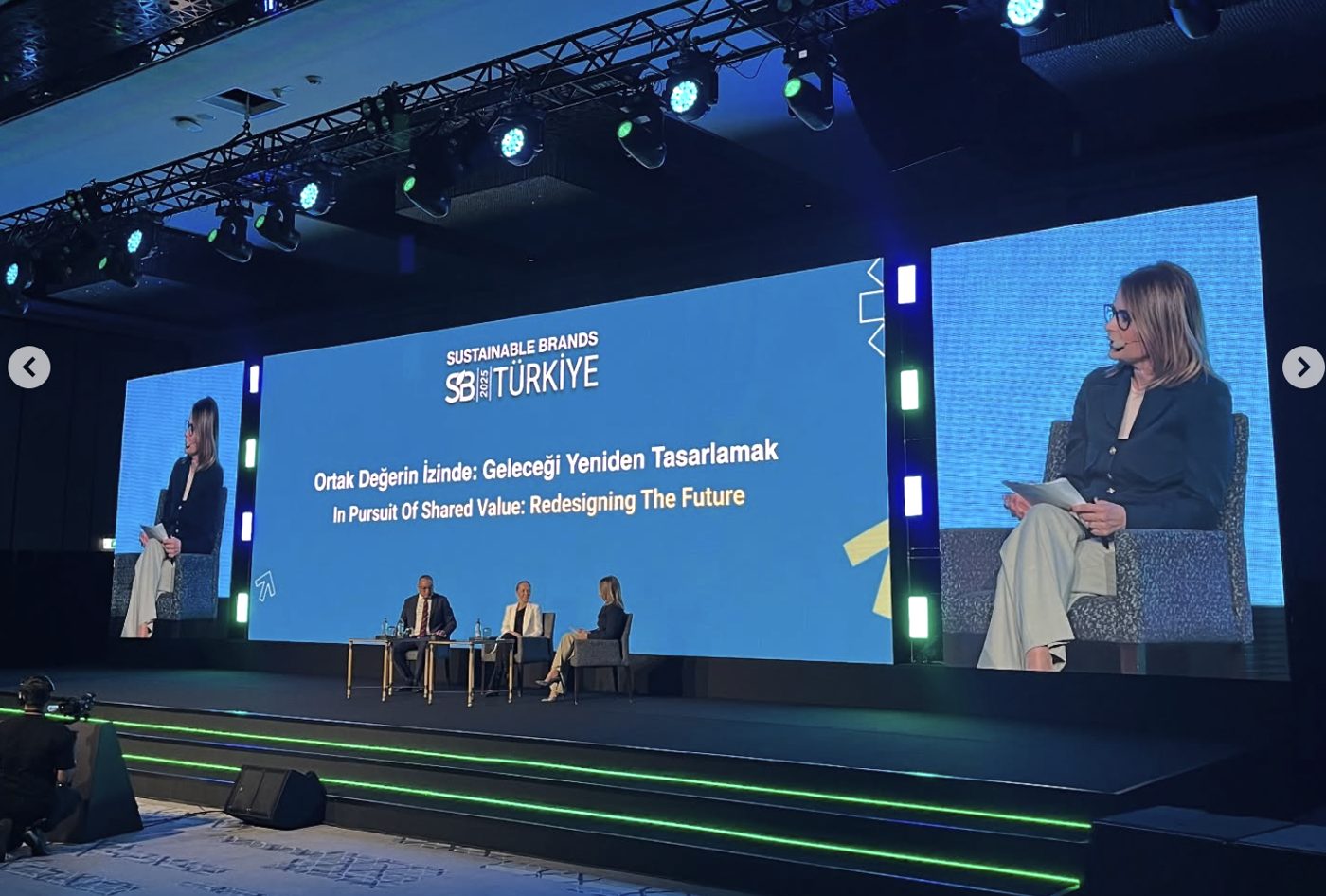
On October 8, 2025, Bahçeşehir University’s CIFAL Istanbul contributed to the Sustainable Brands Summit through the participation of its Director, Prof. Dr. Çisil Sohodol, as a panel moderator. Held under the theme “Shared Values and Sustainability,” the summit brought together brands, academics and communication professionals to discuss the transformative role of sustainability in business. CIFAL Istanbul’s involvement connected the university’s sustainability expertise with a platform for exchange across academic and corporate settings.
Prof. Dr. Sohodol moderated “In Pursuit of Shared Value: Redesigning the Future,” featuring Başak Ünal, Nestlé Türkiye’s Marketing, Corporate Communications and Sustainability Director, and journalist and writer Cem Seymen. The session brought academic, business and media perspectives into dialogue on approaches to a sustainable future. Its focus on shared value provided a basis for considering how business strategies can respond to societal needs alongside organisational objectives.
Across the summit, panels, workshops and other sessions addressed sustainable agriculture, value-focused corporate strategies, crisis management and crisis communication. These interconnected topics highlighted how sustainability influences production, organisational decision-making and relationships with stakeholders. The programme offered opportunities for participants from different professional backgrounds to exchange knowledge and explore how shared values can inform business practice.
CIFAL Istanbul’s participation contributes to SDG 17: Partnerships for the Goals by connecting Bahçeşehir University with business and communication professionals through the Sustainable Brands Summit. This cross-sector engagement supported dialogue between academic expertise and corporate experience on shared sustainability challenges. The summit also relates to SDG 12: Responsible Consumption and Production through its attention to sustainable business strategies, SDG 2: Zero Hunger through sustainable agriculture, and SDG 4: Quality Education through professional learning and knowledge exchange.
The image below portrays a picture during Prof. Sohodol’s moderation of the panel:
17- Bahçeşehir University and Rotary: Cross-Sector Collaboration through the BAU Otto and Fran Walter Rotary Peace Center 1st Capstone Conference
The image below displays the official poster for the 1st Capstone Conference organised by BAU Otto and Fran Walter Rotary Peace Center:
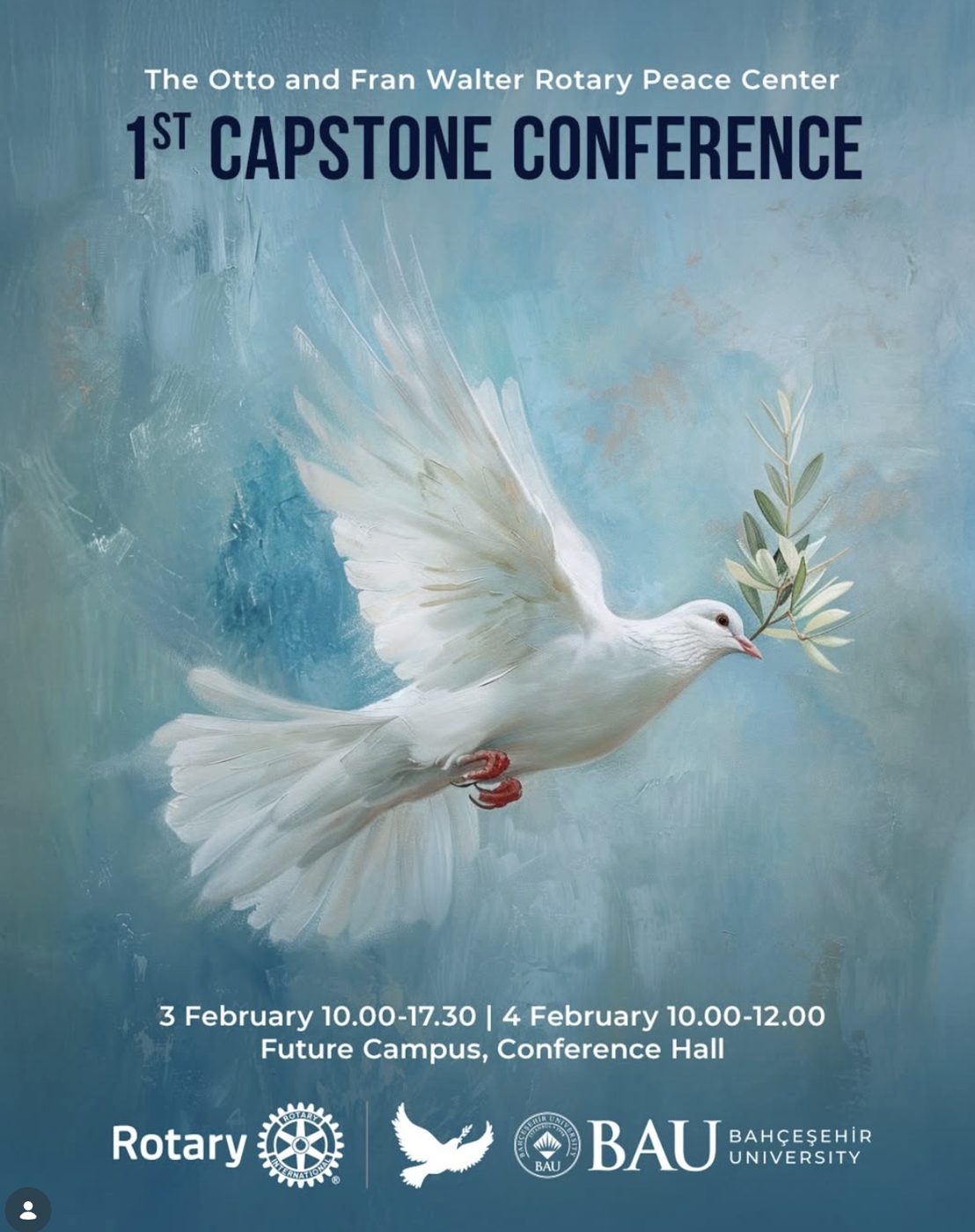
On February 3, 2025, Bahçeşehir University and Rotary brought academic expertise and civil society experience together at a conference hosted by the BAU Otto and Fran Walter Rotary Peace Center. The event provided a platform for the Center’s first cohort of 13 Peace Fellows to present their projects and participate in workshops delivered by Bahçeşehir University academics. This cross-sector setting connected the fellows’ practical peacebuilding work with university-based learning, creating opportunities to exchange ideas and strengthen approaches relevant to peace, diplomacy and civil society.
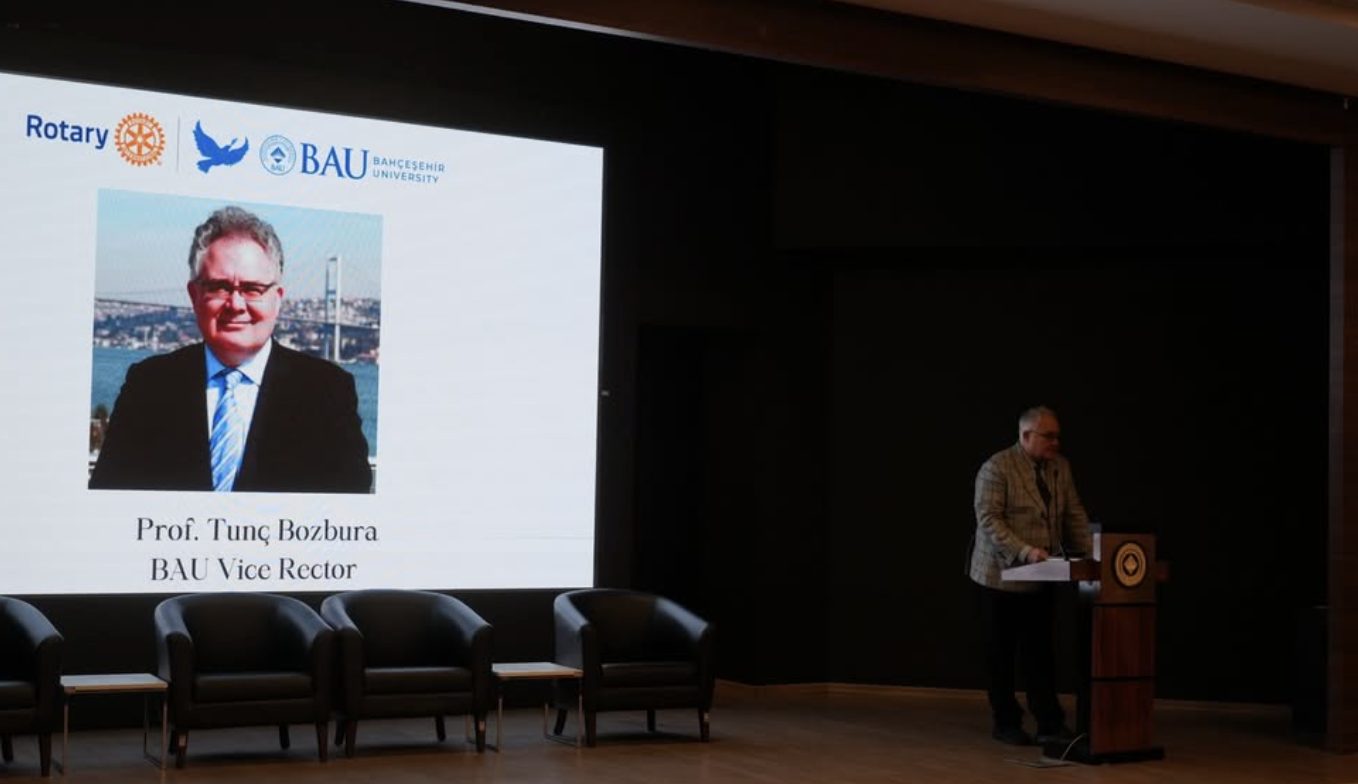
The conference opened with a welcome address by Executive Director Assoc. Prof. Yüksel Alper Ecevit, followed by remarks from Marty Helman, President of the Otto and Fran Walter Foundation; Suat Baysan, HAC Committee Chair; Erden Gökmen, Rotary District 2420 Governor-Elect; and Prof. Dr. Tunç Bozbura, Bahçeşehir University Vice Rector. Bringing university leadership, foundation representatives and Rotary members into the same programme demonstrated the institutional breadth of the partnership. Speakers highlighted the importance of the Center and the need for peacebuilding, particularly in the Middle East and North Africa.
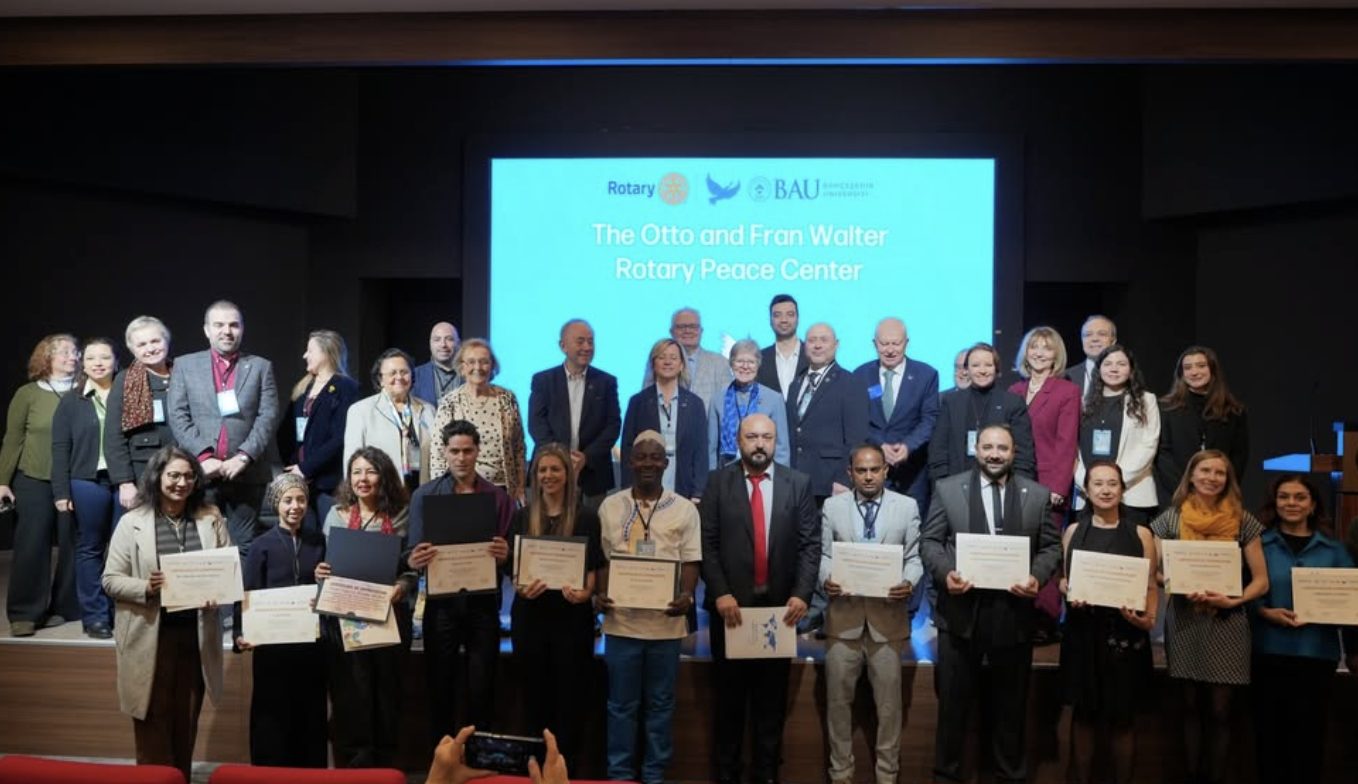
Through their project presentations, the fellows shared work developed during their one-year term, while the subsequent academic workshops connected their experiences with additional knowledge and professional perspectives. The exchange between fellows, university academics, counselors and Rotary participants illustrated how cross-sector cooperation can support both learning and practical peacebuilding. The certificate ceremony marked the completion of the first cohort’s programme and recognised the fellows’ dedication alongside the contributions of those who supported their development.
The conference contributes primarily to SDG 17: Partnerships for the Goals through the sustained cooperation between Bahçeşehir University and Rotary. The Center demonstrates the importance Bahçeşehir University places on working with organisations in other sectors, combining its educational and research capacity with civil society networks and philanthropic support. By providing an institutional setting for this cooperation, the university creates opportunities for academic knowledge to inform practice and for practitioners’ experiences to enrich university-based learning.
This university–civil society partnership also supports SDG 16: Peace, Justice and Strong Institutions through its focus on peacebuilding and the development of professionals working in peace, diplomacy and civic life. Its workshops, project exchange and professional learning contribute to SDG 4: Quality Education. Together, these educational and peacebuilding dimensions show how collaboration across sectors can connect individual capacity development with wider sustainable development objectives.
The pictures below portray highlights from the conference:
18- Bahçeşehir University's Contribution to the National Policy Forum on AI and Technology in Hazelnut Farming: Policy Capacity Building and Cross-Sectoral Dialogue for Sustainable Agriculture Ministry of Agriculture and Forestry, Giresun Governorship, Giresun University, and the Eastern Black Sea Development Agency (DOKA)
The official poster below presents the National Policy Forum on Artificial Intelligence and Technology in Hazelnut Farming held in Giresun, highlighting the involvement of Bahçeşehir University, government institutions, academic partners, and other stakeholders in policy-oriented capacity building and cross-sectoral dialogue on sustainable agriculture and digital transformation.
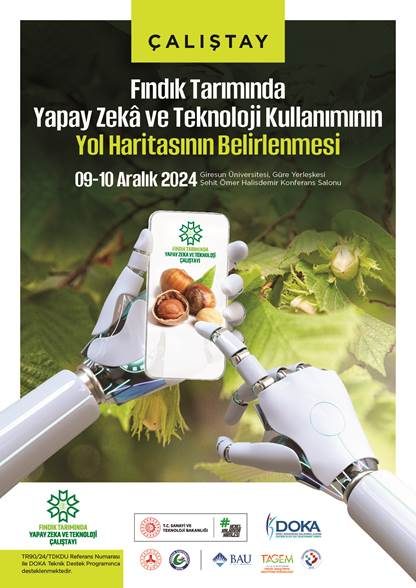
During the 2024–2025 academic year, Bahçeşehir University (BAU) participated in the National Policy Forum on Artificial Intelligence and Technology in Hazelnut Farming, held in Giresun under the coordination of the Ministry of Agriculture and Forestry of the Republic of Türkiye and the Giresun Governorship.
The forum brought together a broad network of stakeholders, including Bahçeşehir University, Giresun University, the Eastern Black Sea Development Agency (DOKA), government institutions, researchers, and private-sector representatives, establishing a platform for policy-oriented education, institutional capacity development, and cross-sectoral dialogue on the digital transformation of agriculture.
The initiative aimed to support the development of a national roadmap for integrating artificial intelligence (AI) and digital technologies into Türkiye's agricultural production systems, with particular emphasis on the hazelnut sector. Discussions addressed opportunities to improve agricultural productivity, strengthen climate resilience, encourage technological innovation, and support the long-term sustainability of rural economies.
Bahçeşehir University contributed its academic expertise in AI applications, sustainable food systems, and policy innovation, supporting knowledge exchange among public authorities, universities, development institutions, and industry stakeholders. Through its participation, BAU contributed to discussions on data-driven agricultural strategies, evidence-based policymaking, and the practical application of emerging technologies to agricultural development.
The forum provided opportunities for government officials, public-sector decision-makers, researchers, and industry representatives to exchange expertise on the opportunities and challenges associated with agricultural digitalization. This engagement supported policy-relevant learning and institutional capacity building, connecting scientific and technological knowledge with public policy priorities and implementation needs.
At the same time, the initiative facilitated cross-sectoral dialogue among national and local government institutions, higher education institutions, development agencies, and the private sector. By bringing together stakeholders with different responsibilities and areas of expertise, the forum encouraged coordinated approaches to agricultural innovation, sustainable production, rural development, and climate adaptation.
The participation of the Ministry of Agriculture and Forestry, Giresun Governorship, DOKA, Giresun University, BAU, and industry stakeholders demonstrated the importance of multi-stakeholder engagement in addressing complex sustainable development challenges. The forum connected national agricultural policy priorities with regional economic needs, academic research, and private-sector innovation.
Through its involvement, BAU contributed to both policy-oriented capacity development and SDG-focused cross-sectoral knowledge exchange, supporting collaborative approaches to integrating emerging technologies into sustainable agricultural systems.
The initiative contributed to SDG 2 (Zero Hunger) through sustainable and resilient agricultural production; SDG 1 (No Poverty) through its focus on rural livelihoods and agricultural development; SDG 9 (Industry, Innovation and Infrastructure) through AI applications and digital transformation; SDG 13 (Climate Action) through climate-smart agricultural approaches; and SDG 17 (Partnerships for the Goals) through cooperation among government institutions, universities, development agencies, and the private sector. It also supported SDG 16 (Peace, Justice and Strong Institutions) through evidence-based policy development, institutional knowledge exchange, and capacity building for sustainable agricultural governance.
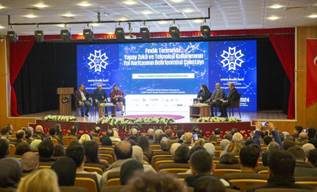
The photographs below document the National Policy Forum on Artificial Intelligence and Technology in Hazelnut Farming, illustrating the participation of government officials, academic experts, and industry representatives in cross-sectoral knowledge exchange, policy discussions, and collaborative approaches to sustainable agricultural development.
19- Advancing Policy Pathways for Sustainable Food and Land Systems: Bahçeşehir University and NGOs within the FABLE Consortium
The image below is from the official website of the FABLE Consortium, visualizing Bahçeşehir University’s partnership:
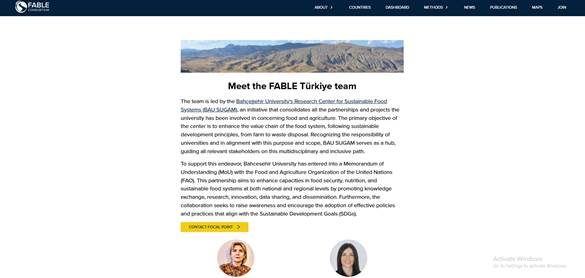
Bahçeşehir University serves as the Turkish partner of the global FABLE Consortium (Food, Agriculture, Biodiversity, Land-Use, and Energy), a network of research institutions and NGOs dedicated to developing nationally coherent and globally aligned pathways for achieving the Sustainable Development Goals (SDGs) and the Paris Climate Agreement targets.
Within this framework, country teams work to design bottom-up policy pathways for sustainable food and land-use systems and engage directly with national governments to promote data-driven and ambitious sustainability policies. The FABLE Secretariat is jointly led by the Sustainable Development Solutions Network (SDSN), the International Institute for Applied Systems Analysis (IIASA), and the Alliance of Bioversity International and CIAT.
In Türkiye, the initiative is led by the BAU Research Center for Sustainable Food Systems (BAU SUGAM), which consolidates all of the University’s partnerships and research efforts related to food, agriculture, and sustainability policy. Through research, data modeling, and policy analysis, BAU contributes to defining science-based policy recommendations, supporting national strategies on food security, climate action, and sustainable rural development:
By linking academia, civil society, and government, Bahçeşehir University strengthens the national capacity for evidence-based decision-making and contributes directly to global policy dialogues on sustainable development.
20- Bahçeşehir University as a Member of the Agroecology Coalition for Transforming Global Food Systems
The image below is from the official website of the Agroecology Coalition for Transforming Global Food Systems, visualizing Bahçeşehir University’s partnership:
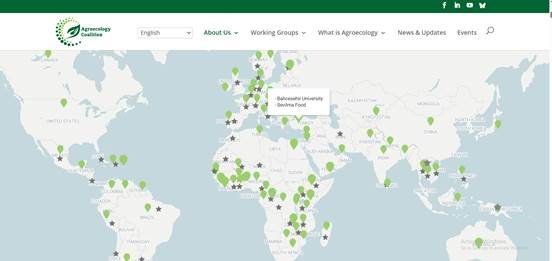
The interconnected crises in food, climate, and biodiversity have created an urgent need for transformative, cross-sectoral action. Recognizing this global imperative, Bahçeşehir University (BAU) joined the Agroecology Coalition, a United Nations–supported global initiative established in the wake of the 2021 United Nations Food Systems Summit (UNFSS) to advance the transformation of food systems through agroecology.
The Coalition was created to provide a collaborative mechanism for countries, academic institutions, and organizations to address multiple challenges simultaneously—ensuring sustainable food production, ecosystem restoration, and climate resilience. Its work is guided by the 13 Principles of Agroecology defined by the High-Level Panel of Experts for Food Security and Nutrition (HLPE-FSN) under the Committee on World Food Security (CFS), aligned with the 10 Elements of Agroecology adopted by the FAO Council in 2019.
Today, the Agroecology Coalition serves as a key
global voice for science-based policy dialogue and the
implementation of sustainable food systems, bringing
together more than 300 members from governments,
academia, NGOs, and international organizations.
Its mission is structured around five workstreams:
· Facilitating co-creation and exchange of knowledge on agroecology,
· Fostering increased investments in agroecological transformation,
· Advocating for and amplifying supportive policies,
· Supporting market pathways for agroecological products, and
· Strengthening member engagement through capacity building and technical collaboration.
Bahçeşehir University is an official member of the Coalition and contributes actively to several working groups, including those on Policies, Research, Innovation and Education, and Implementation.
Within these platforms, BAU provides expert insight, contributes to the formulation of international policy frameworks, and engages in research-driven collaboration aimed at scaling up agroecological practices and integrating sustainability principles into national and regional strategies.
Through this participation, BAU supports the development and dissemination of international best practices for sustainable food systems, bridging academic research with policy action. Its role within the Agroecology Coalition strengthens the University’s contribution to SDG 2 (Zero Hunger) — advancing food security through sustainable agriculture, SDG 13 (Climate Action) — promoting ecosystem-based approaches to climate resilience; and SDG 17 (Partnerships for the Goals) — fostering international cooperation for systemic transformation.
By working alongside global partners, Bahçeşehir University continues to shape the global discourse on agroecological policy development, supporting the creation of evidence-based, inclusive, and resilient food systems for future generations.
21- Right to Food: For a Better Today and a Better Tomorrow Poster Competition with Food and Agriculture Organisation of the United Nations (FAO) and Bahçeşehir University
The image below is the official promotional poster for the Right to Food: For a Better Today and a Better Tomorrow Poster Competition
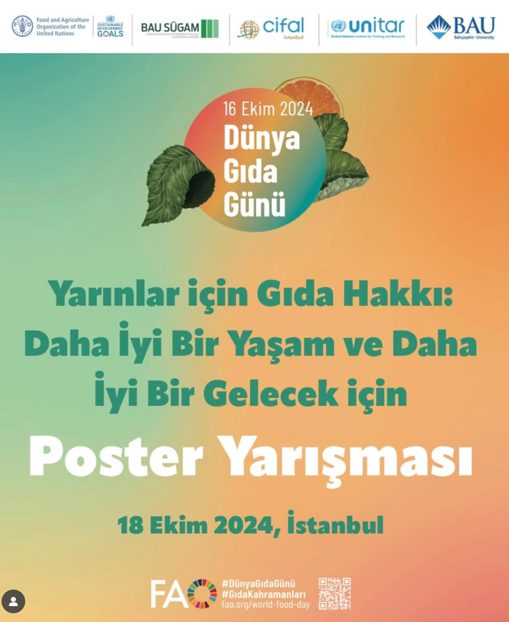
In the 2024-2025 academic year, Bahçeşehir University, in collaboration with the Food and Agriculture Organization (FAO), BAU SÜGAM, and CIFAL Istanbul, organized the “Right to Food: For a Better Today and a Better Tomorrow” Poster Competition to commemorate World Food Day. The event provided a creative platform for students to explore the global challenges of food security, nutrition, and equitable access to resources, encouraging artistic expression as a tool for social change.
Participants visualized the concept of the right to adequate and nutritious food through their artwork, shedding light on the pressing realities of hunger and malnutrition affecting communities worldwide. The initiative not only emphasized the importance of responsible consumption and sustainable production practices but also underscored how access to food is a fundamental human right that links directly to health, education, and equality.
By engaging young people from diverse backgrounds, the competition fostered dialogue on the shared responsibility of individuals and institutions in building more resilient and inclusive food systems. It also encouraged interdisciplinary collaboration within the university and with international partners, promoting a culture of awareness, empathy, and action toward a world free from hunger. Outstanding works were recognized with awards at the conclusion of the event, symbolizing Bahçeşehir University’s ongoing commitment to nurturing creativity, social responsibility, and sustainable solutions for global food challenges.
The image below portrays a highlight from the program
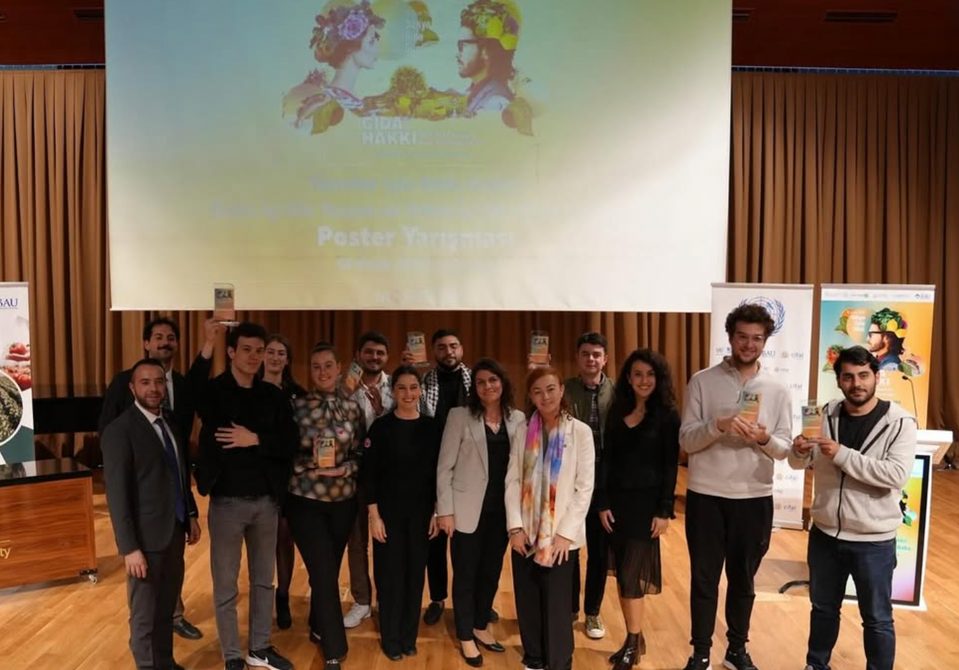
22- Bahçeşehir University’s Participation in the 3rd Food Innovation Summit with Food, Beverage and Agriculture Policy Research Center (GİFT)
The image below displays the official promotional poster of the 3rd Food Innovation Summit, showcasing Prof. Sohodol’s keynote speech
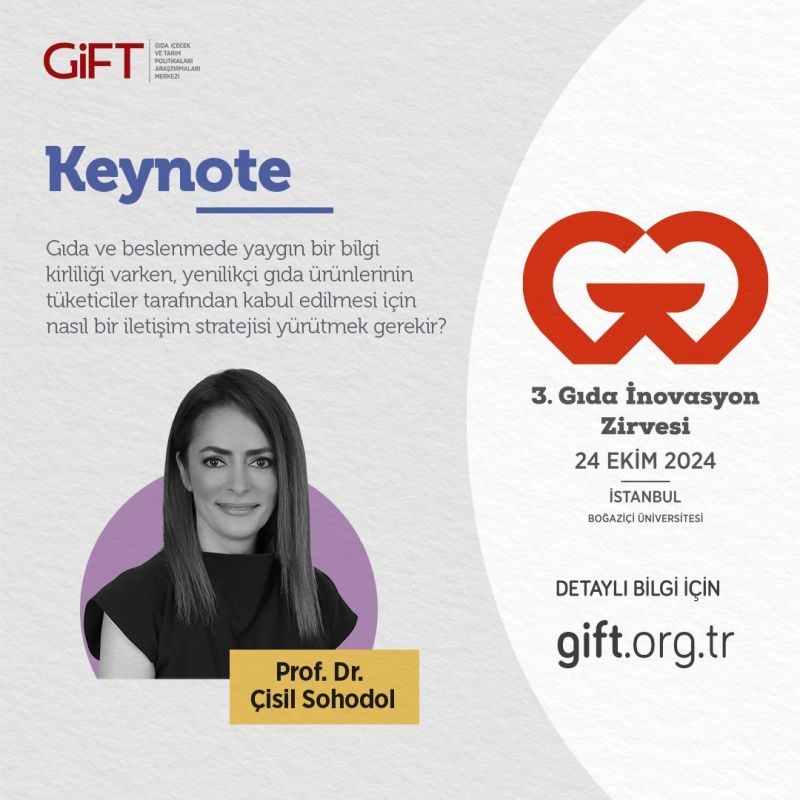
During the 2024-2025 academic year, Bahçeşehir University Professor and Director of CIFAL Istanbul – UNITAR, Prof. Çisil Sohodol, delivered a keynote speech at the 3rd Food Innovation Summit, organized by the Center for Food, Beverage and Agricultural Policies (GİFT) at Boğaziçi University. Her talk, titled “Being a Food Brand in the Age of Crises: How Do We Survive?”, addressed how innovative food brands can build trust and resilience in an era marked by misinformation and global uncertainty.
Focusing on nutrition, planetary health, and sustainable food economies, Prof. Sohodol emphasized that ensuring access to safe, nutritious, and reliable food requires not only technological innovation but also effective communication strategies that promote transparency and consumer awareness. Her contribution underlined how informed public dialogue can support the acceptance of innovative and sustainable food products, fostering a food ecosystem that values both health and sustainability.
The summit featured 75 distinguished speakers across 21 presentations and 15 panels, bringing together representatives from public institutions, the private sector, academia, embassies, industry associations, health professionals, media, and influencers. Discussions explored pathways to value-added food production, sustainable branding, and research-driven innovation, highlighting the critical role of cross-sector collaboration in achieving global food security.
Through its academic representation at this summit, Bahçeşehir University reaffirmed its commitment to advancing knowledge and innovation in sustainable food systems, aligning with the principles of Zero Hunger and contributing to the development of resilient, ethical, and inclusive food networks.
23- Research on the Psychological and Social Impacts of the February 6 Earthquakes with the Trauma and Disaster Mental Health Studies Association (TARDE), UNICEF and Bahçeşehir University
The image below displays the official promotional poster of the event
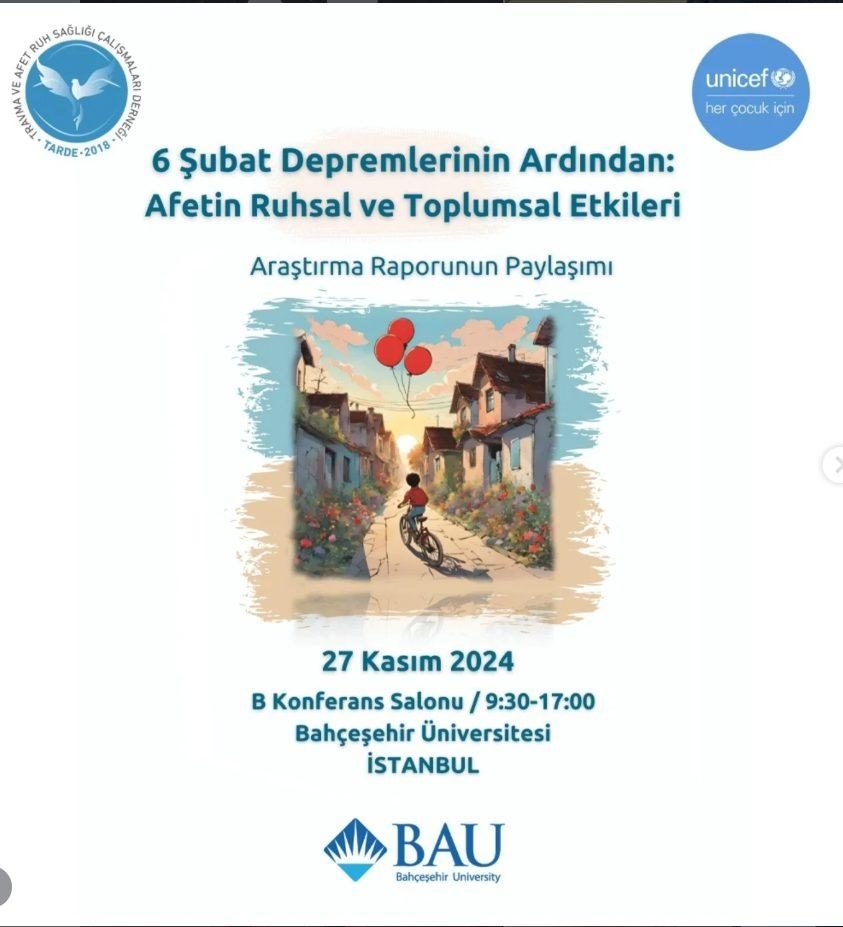
During the 2024-2025 academic year, UNICEF and the Association for Trauma and Disaster Mental Health Studies (TARDE) organized a scientific event at Bahçeşehir University to examine the psychological and social impacts of the February 6 earthquakes in Türkiye. Bringing together university faculty and students, TARDE field teams, UNICEF representatives, and specialists from public institutions and civil society organizations, the programme shared findings from a social impact analysis of mental health and psychosocial support activities carried out by UNICEF and TARDE over the preceding eighteen months.
By focusing on field-based evidence, continuing needs, emerging challenges, and possible response strategies, the event contributed to SDG 3: Good Health and Well-Being through its emphasis on post-disaster mental health, psychosocial support, and trauma-informed recovery. The gathering also reflected Bahçeşehir University’s role as a platform for research, dialogue, and applied knowledge exchange, supporting SDG 4: Quality Education and SDG 17: Partnerships for the Goals through collaboration among academic, international, public, and civil society actors working to strengthen disaster response and community resilience.
24- Bahçeşehir University, the Trauma and Disaster Mental Health Studies Association and the United Nations Children’s Fund: Cross-Sector Collaboration through an Expressive Arts-Based Workshop
The image below presents the official promotional poster of the event:
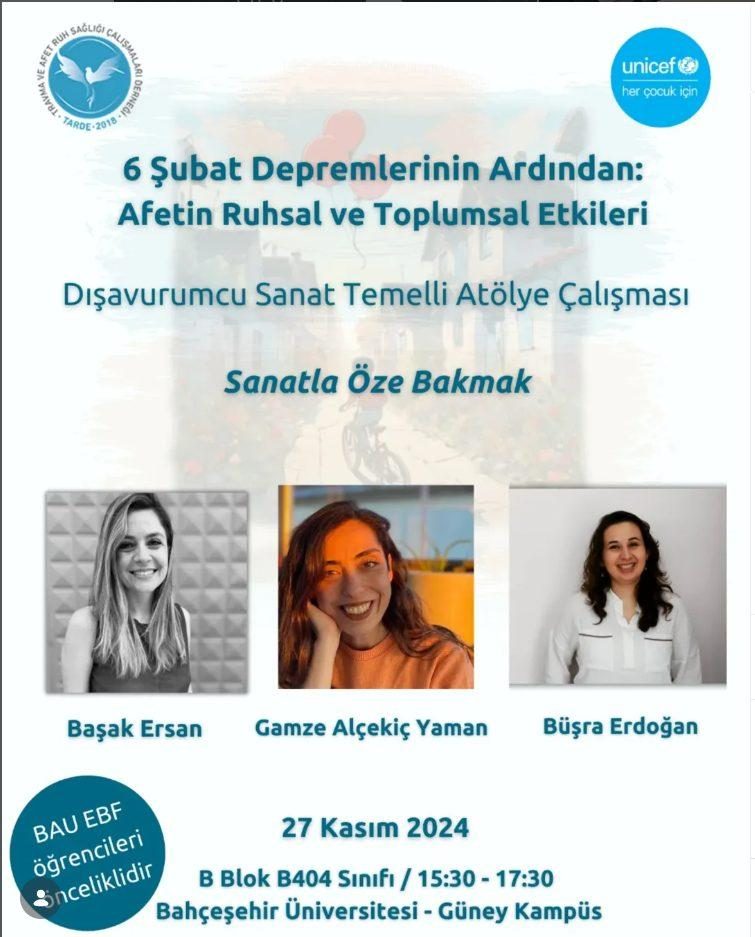
During the 2024-2025 academic year, held at Bahçeşehir University as part of “After the February 6 Earthquakes: Psychological and Social Impacts,” the Expressive Arts-Based Workshop brought together the university, the Trauma and Disaster Mental Health Studies Association (TARDE) and the United Nations Children’s Fund (UNICEF). This cross-sector collaboration connected academic knowledge, civil society expertise and an international organisation’s psychosocial support perspective. Bahçeşehir University provided a setting for participants to engage with the emotional and social consequences of the earthquakes through creative expression and shared reflection.
The workshop used expressive and participatory arts practices to create a structured, sensitive space for processing experiences, sharing perspectives and exploring disaster-related psychosocial needs. Within this university–civil society–international organisation collaboration, creative methods offered a practical connection between learning and psychosocial support. The activity illustrated how Bahçeşehir University’s educational environment can bring different forms of expertise together to deepen understanding of trauma and community recovery.
The workshop contributes primarily to SDG 17: Partnerships for the Goals through cooperation between Bahçeşehir University, TARDE and UNICEF around post-disaster psychosocial needs. It reflects the value of connecting the university with organisations from other sectors to support community-oriented learning and exchange. The collaboration also contributes to SDG 3: Good Health and Well-Being through attention to mental health, emotional recovery and psychosocial resilience, and SDG 4: Quality Education through experiential and interdisciplinary learning on the psychological and social impacts of disaster.
25- Empowering Future Generations: Darüşşafaka High School Students Career Development Programme – Collaboration Between Bahçeşehir University, CIFAL Istanbul–UNITAR, CO-OP, and Darüşşafaka Society (2024-2025 Academic Year)
The image below shows the promotional poster of the Bahcesehir University CO-OP Responsibility: High School Students Career Development Program.
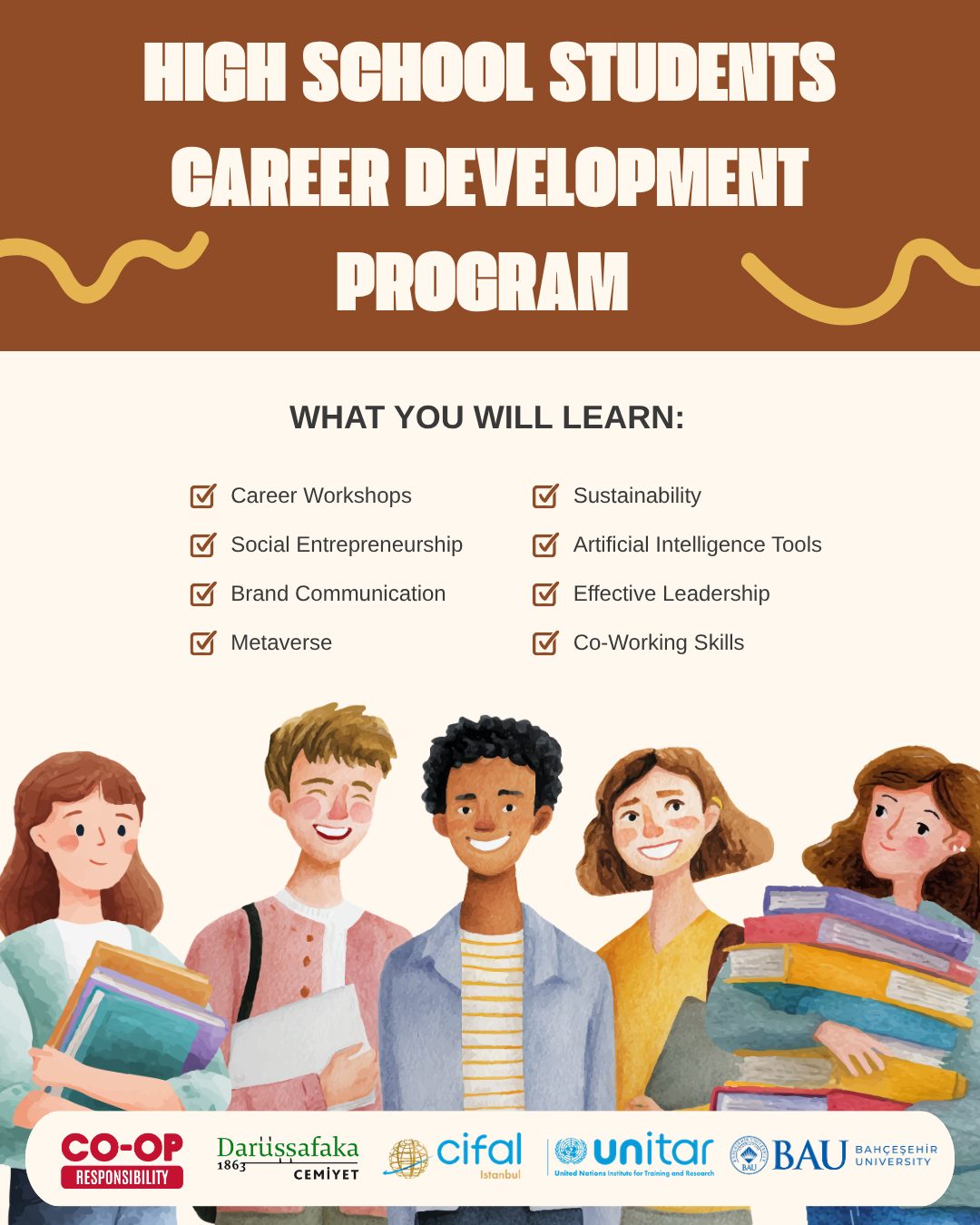
Originally launched in 2023, the program continued in the 2024-2025 Academic Year. The High School Students Career Development Programme has been led by Bahçeşehir University as a part of its CO-OP Responsibility initiative. The programme embodies Bahçeşehir University’s commitment to ensuring equal opportunities in education and expanding access to quality learning experiences beyond the university campus.
Through interactive sessions such as “Artificial Intelligence and Digital Transformation,” “Sustainability and the Future of Work,” “Technology and Creativity,” and “Cybersecurity and Digital Ethics,” participants explored how innovation, ethics, and environmental responsibility shape modern professions. The program encouraged students to use technology as a means to create positive social and environmental impact.
By integrating personal development with global awareness, the initiative fostered the values of sustainability, inclusion, and lifelong learning, exemplifying the power of multi-stakeholder collaboration in education. Through this partnership between academia, international organizations, and a leading educational foundation, the program advanced SDG 4 (Quality Education), SDG 8 (Decent Work and Economic Growth), SDG 9 (Industry, Innovation and Infrastructure), and SDG 13 (Climate Action)—while embodying SDG 17 (Partnerships for the Goals) through its collective commitment to empowering future generations.
The images below present the official programme poster, the 13-week course schedule, photographs documenting educational activities delivered at Darüşşafaka High School, and a sample completion certificate. Together, these materials illustrate the programme's structure, on-site implementation, academic engagement, and recognition of participants' learning achievements.
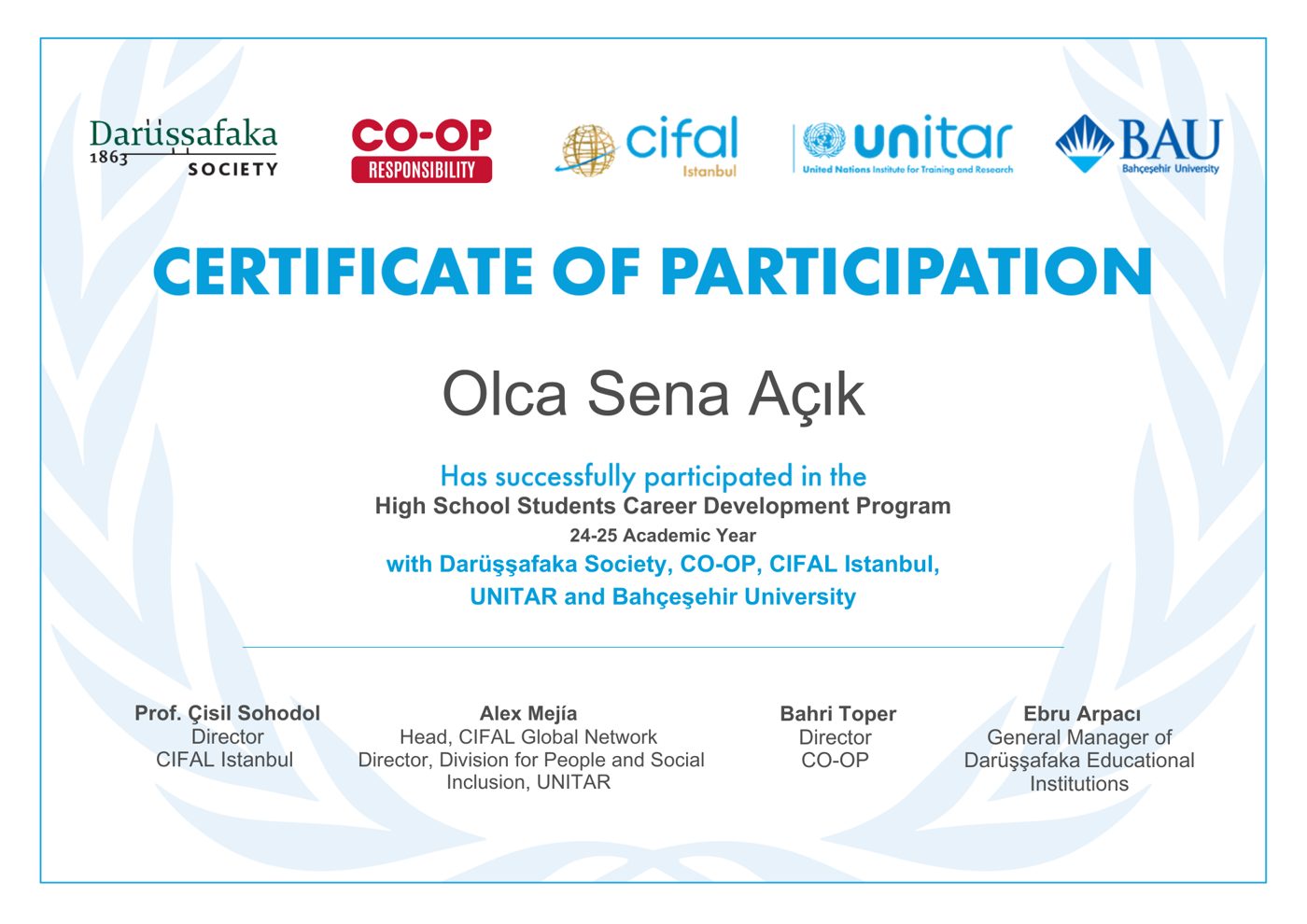
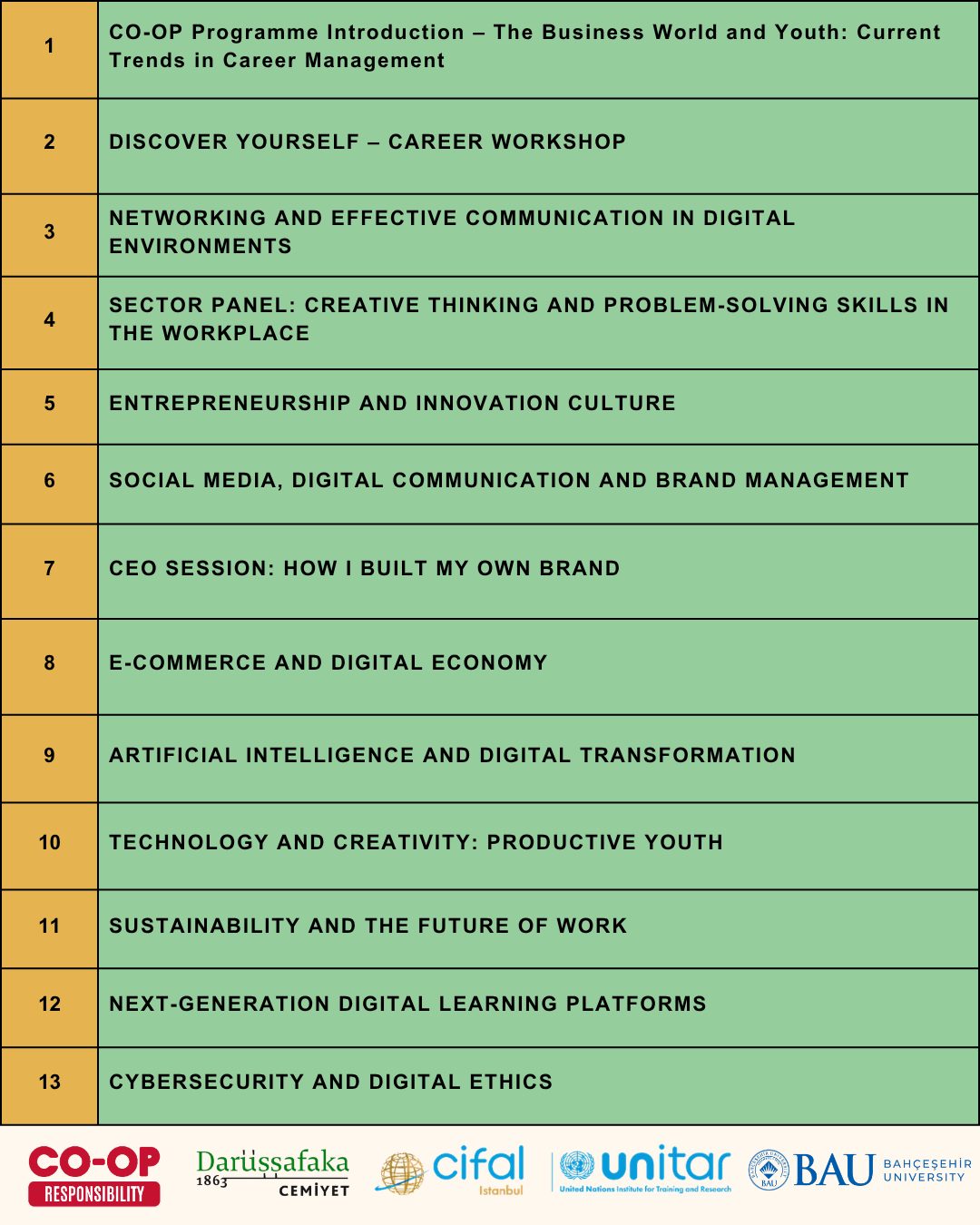
The images below display highlights from the program
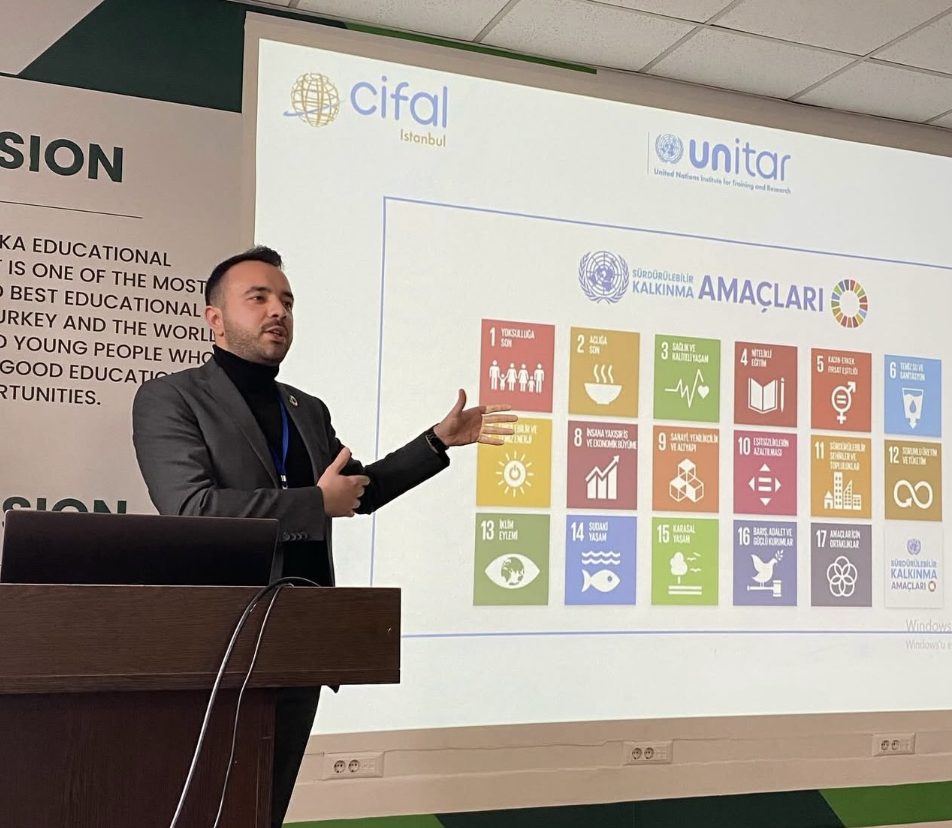
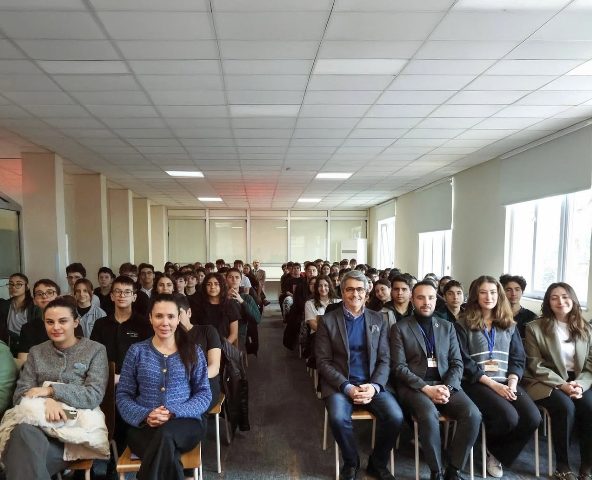
26- Bahçeşehir University and Turkish Soroptimist Clubs Federation Come Together for the “Recognising the Signs of Cyberviolence” Event
The picture below displays the promotional poster of the “Recognising the Signs of Cyberviolence” Event
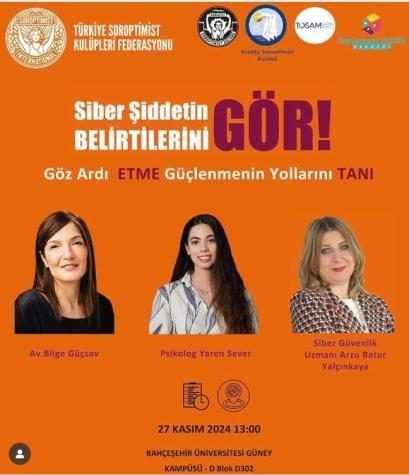
During the 2024-2025 academic year, BAU TOSAM organised an educational event on recognising cyberviolence in cooperation with the Boğaziçi and Ataköy Soroptimist Clubs of the Turkish Soroptimist Federation and the Toplumsal Eşitlik Association. The event created a learning space where participants could better understand the psychological, social, and legal dimensions of online abuse, while gaining practical awareness of warning signs, prevention methods, and available response mechanisms. By translating expert knowledge into accessible public learning, the activity contributed directly to SDG 4 by strengthening digital literacy, rights awareness, and lifelong learning around safe participation in online environments.
The event also reflected Bahçeşehir University’s broader role in supporting education that responds to contemporary social risks. Its focus on the mental health consequences of abuse linked the activity to SDG 3, while its attention to gender-based violence and unequal exposure to online harm supported SDG 5 and SDG 10. Through this intersectional approach, the event positioned quality education not only as classroom-based learning, but also as a tool for empowering individuals to recognise, prevent, and respond to emerging forms of violence in digital life.
The picture below showcases a highlight from the event
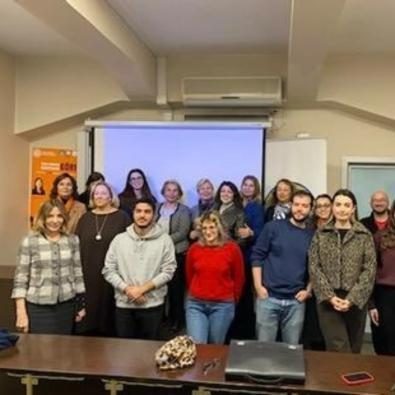
27- Climate Change Summit: “The Climate Crisis from a Sustainability Perspective” Co-Organized by Bahçeşehir University, CIFAL Istanbul (UNITAR), Azerbaijan Technical University, the Young Researchers Innovation Club, and BilimSenOl
The image below shows the promotional poster of the Bahcesehir University Climate Change Summit in Baku, Azerbaijan.
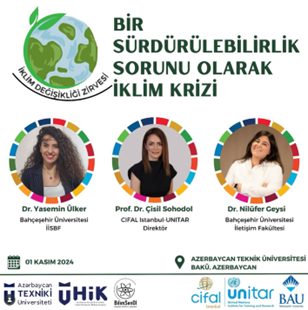
During the 2024–2025 academic year, Bahçeşehir University (BAU), through its CIFAL Istanbul Centre affiliated with UNITAR, co-organized the “Climate Change Summit: The Climate Crisis from a Sustainability Perspective” in collaboration with Azerbaijan Technical University, the Young Researchers Innovation Club, and BilimSenOl (NGO). Held at Azerbaijan Technical University in Baku, the summit exemplified cross-border academic partnership and Bahçeşehir University’s ongoing commitment to advancing sustainability education and climate action through international cooperation.
Featuring contributions from BAU academicians Dr. Yasemin Ülker, Prof. Dr. Çisil Sohodol, and Prof. Dr. Nilüfer Geysi, the event addressed the pressing global challenges of climate change, resource management, and sustainable development. By bringing together experts, researchers, and students, the summit fostered knowledge exchange and collective action among academic institutions dedicated to building a more resilient and sustainable future. Through this partnership-driven initiative, Bahçeşehir University and its collaborators reaffirmed their shared responsibility to promote dialogue, innovation, and coordinated solutions for global climate resilience.
The image below presents a highlight of the event
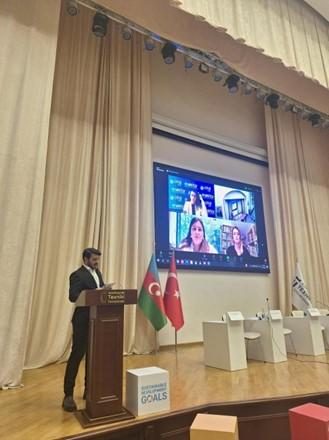
28- Cross-Sectoral Collaboration for Quality Education: BAU's Contribution Strengthening Parent Education and Children's Learning Development: Parenting Summit Organised by the Beşiktaş District Directorate of National Education
The image below documents the promotional poster of Beşiktaş Parenting Summit, highlighting the collaboration between the Beşiktaş District Directorate of National Education and BAU academics in promoting educational dialogue and community engagement.
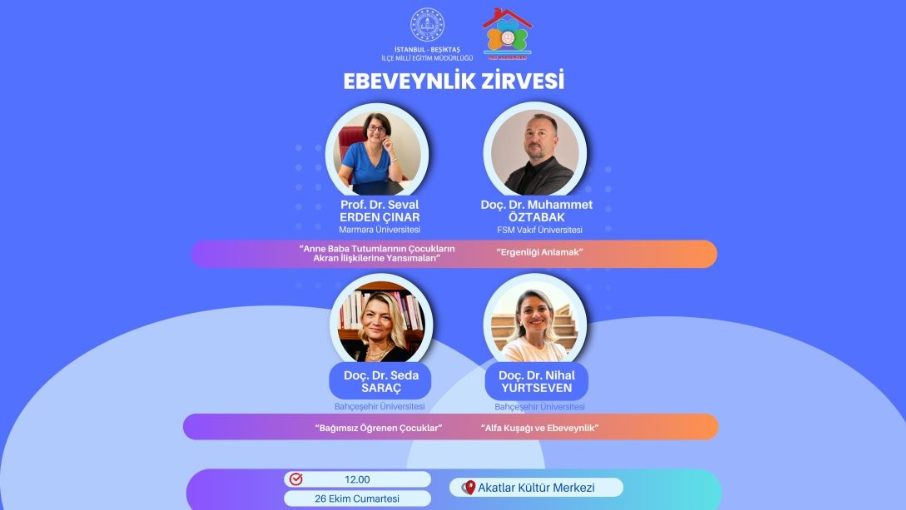
During the 2024–2025 academic year, Bahçeşehir University (BAU) participated in the Beşiktaş Parenting Summit, organized by the Beşiktaş District Directorate of National Education under its Parent Academies programme. Held at Akatlar Cultural Centre in Istanbul on 26 October 2024, the summit brought together public education authorities, university academics, educators, and families to exchange knowledge and discuss shared challenges in children's education and development.
BAU contributed through Assoc. Prof. Dr. Nihal Yurtseven and Assoc. Prof. Dr. Seda Saraç, who delivered expert presentations on “Generation Alpha and Parenting” and “Children as Independent Learners.” Their contributions addressed changing parental responsibilities, children's developmental needs, and approaches to fostering independent learning. Additional discussions explored parenting attitudes, peer relationships, and adolescence.
The summit facilitated cross-sectoral dialogue between higher education, public education authorities, and the wider community, connecting academic research with practical educational challenges faced by families and schools. Through this collaboration, BAU contributed to knowledge exchange and the development of shared approaches to strengthening parental engagement and supporting children's learning.This exchange brought together academic perspectives, public education priorities, and the experiences of families, supporting dialogue on shared approaches to children's learning and development.
The initiative advanced SDG 17 (Partnerships for the Goals) by strengthening cooperation between academia and public institutions, while directly supporting SDG 4 (Quality Education) through community education, parental engagement, and the dissemination of evidence-informed educational practices.
29- Heroes of Nature: Cross-Sectoral Collaboration for SDG Education and Community Engagement with Malatya Metropolitan Municipality, Battalgazi Municipality, Battalgazi District Directorate of National Education, Parlak Gelecekler Association, BilimSenOl, CIFAL Istanbul, UNITAR, and Bahçeşehir University
The two images below show the promotional poster and an event picture of the Bahcesehir University Sustainability Training Program conducted in the earthquake zone in Malatya.
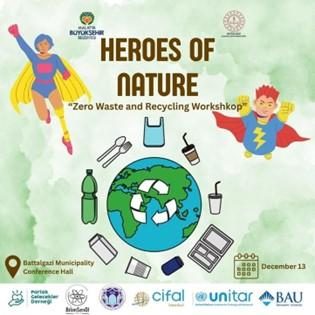
During the 2024–2025 academic year, Bahçeşehir University (BAU), through CIFAL Istanbul, collaborated with Parlak Gelecekler Association and BilimSenOl, two non-governmental organizations, and the Battalgazi District Directorate of National Education to organize “Heroes of Nature: Raising Awareness on Sustainability” in Battalgazi, Malatya, on 13 December 2024.
The initiative brought together academia, civil society organizations, and public education authorities in a cross-sectoral partnership aimed at advancing the United Nations Sustainable Development Goals (SDGs) and strengthening sustainability awareness in a community affected by the February 2023 earthquakes.
Through joint planning and implementation, the participating institutions combined their educational expertise, community outreach capacities, and local networks to deliver interactive learning activities for children and parents. The programme introduced the mission of the United Nations and explored practical contributions to the SDGs, focusing on clean water, renewable energy, climate action, waste reduction, and sustainable lifestyles.
The collaboration demonstrated how universities, NGOs, and public institutions can work together to address local sustainability challenges, combining complementary resources and perspectives to promote environmental awareness, community participation, and sustainable development.
By initiating and participating in this multi-stakeholder educational initiative, BAU facilitated cross-sectoral engagement and cooperation on SDG-related priorities, strengthening connections between academic knowledge, civil society action, and public education.
The initiative contributed primarily to SDG 17 (Partnerships for the Goals) through cross-sectoral collaboration, while also supporting SDG 4 (Quality Education), SDG 6 (Clean Water and Sanitation), SDG 11 (Sustainable Cities and Communities), and SDG 13 (Climate Action).
The pictures below display highlights from the “Heroes of Nature: Raising Awareness on Sustainability” program
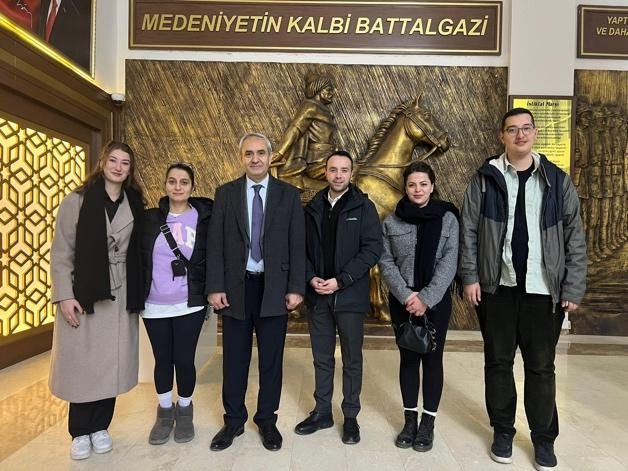
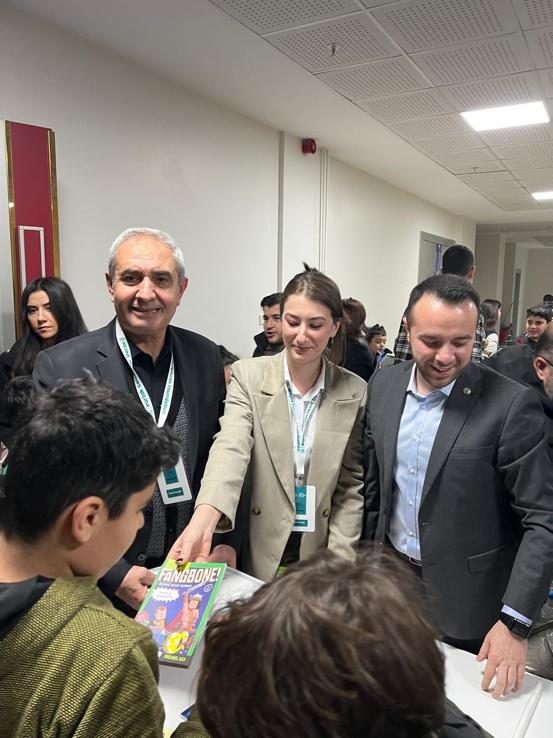
30- Open Lecture: “What Is Social Benefit?” in Collaboration with the Community Volunteers Foundation (TOG) and Bahçeşehir University
The image below shows the promotional poster of the Bahcesehir University What Is Social Benefit Event.
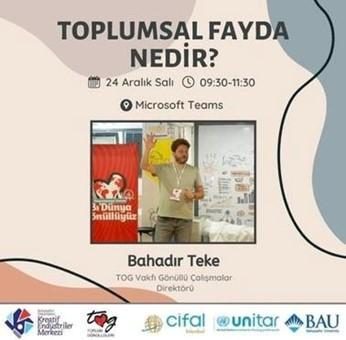
In the 2024-2025 academic year, Bahçeşehir University, in collaboration with the Community Volunteers Foundation (TOG), hosted the open lecture “What Is Social Benefit?” as part of its ongoing dedication to public education, civic participation, and social awareness. The event aimed to strengthen the culture of volunteerism and collective responsibility among students and the wider community, reflecting the university’s mission to bridge academic learning with societal engagement.
The session explored the meanings of social benefit, impact, and community involvement, encouraging participants to reflect on how collaborative action and civic partnerships can help address inequalities and foster a more inclusive society. Through interactive discussions and real-life examples, the lecture underscored the transformative power of partnerships for social good and the role of education in driving sustainable community impact. By opening its doors to the public, Bahçeşehir University reaffirmed its commitment to shared learning, empathy, and joint action toward building a more just and participatory society.
31- BAU Radio Fest: Open Seminar on Animal Welfare in the Context of the Sustainable Development Goals in Collaboration with CIFAL Istanbul (UNITAR) and HAÇİKO – Association for the Protection of Animals from Desperation and Indifference
The image below shows the promotional poster of the Bahcesehir University and HAÇİKO – Association’s Open Seminar on Animal Welfare in the Context of the Sustainable Development Goals.
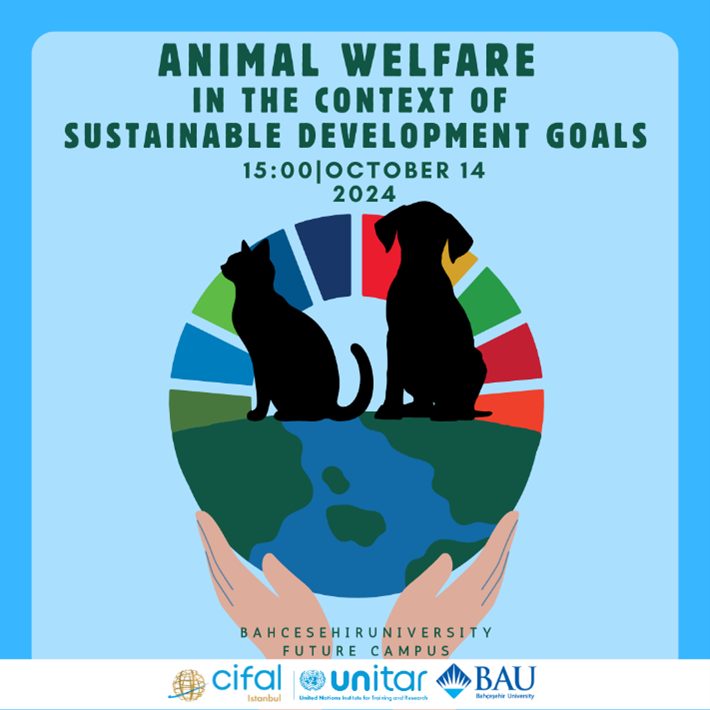
In the 2024-2025 academic year and during the BAU Radio Fest, BAU Radio Fest, Bahçeşehir- Bahcesehir - University, in collaboration with CIFAL Istanbul (UNITAR) and HAÇİKO – Association for the Protection of Animals from Desperation and Indifference, a prominent non-governmental organization dedicated to animal welfare, hosted an open and public seminar titled “Animal Welfare in the Context of the Sustainable Development Goals.” The event engaged both BAU students and members of the wider public, reflecting the university’s ongoing commitment to sustainability, ethics, and community engagement.
The session examined the interconnections between animal
welfare and sustainable development, emphasizing how
compassion, ethical awareness, and collective responsibility contribute
to healthier and more livable urban environments. Discussions addressed
the protection of stray animals’ rights, the promotion of sustainable
urban practices, and the crucial role of civic participation and public
awareness in advancing the United Nations Sustainable
Development Goals, particularly SDG 11 (Sustainable
Cities and Communities) and SDG 15 (Life on
Land). Through this partnership-based initiative, Bahçeşehir
University and its collaborators reaffirmed their commitment
to collective action, environmental stewardship, and the humane
treatment of all living beings.
The initiative also contributes to SDG 17 (Partnerships for the Goals)
by bringing together Bahçeşehir University, CIFAL Istanbul (UNITAR), and
HAÇİKO in a university–civil society partnership that promotes public
awareness, knowledge sharing, and collective action for animal welfare
and sustainable communities.
32- Webinar on “Women’s Human Rights and Participatory Democracy” Co-Organized by FEJUST, the Gender Equality Monitoring Association (CEİD), Bahçeşehir University Political Science and International Relations Club, CIFAL Istanbul (UNITAR), and Bahçeşehir University (05.12.2024)
The image below shows the promotional poster of Women’s Human Rights and Participatory Democracy Webinar by BAU.
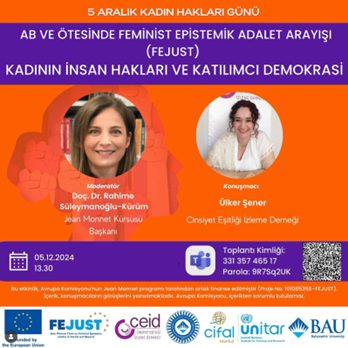
In the 2024-2025 academic year, in recognition of Women’s Rights Day, the webinar “Women’s Human Rights and Participatory Democracy” was co-organized by FEJUST, the Gender Equality Monitoring Association (CEİD), the Bahcesehir University Political Science and International Relations Club, CIFAL Istanbul, UNITAR, and Bahçeşehir University. The event explored the interconnection between women’s rights and democratic participation, emphasizing the role of inclusion, representation, and civic engagement in advancing social justice and gender equality.
Through expert-led discussions and interactive dialogue, participants examined how empowering women’s voices in governance contributes to more equitable, participatory, and transparent decision-making processes. This collaborative initiative exemplified the strength of multi-stakeholder partnerships in fostering inclusive democracy and collective advocacy for equality. By bringing together academia, civil society, and international organizations, the event advanced the principles of Sustainable Development Goal 5 (Gender Equality) and aligned with SDG 10 (Reduced Inequalities), SDG 16 (Peace, Justice and Strong Institutions), and SDG 17 (Partnerships for the Goals)—highlighting the transformative impact of cooperation and shared commitment toward gender-just societies.
The webinar provided a common platform for academic and civil society perspectives on women's participation in democratic processes, connecting gender equality advocacy with broader discussions of inclusive governance and institutional accountability.
33- Bahçeşehir University Zero Tolerance for Violence on My Campus: Gender and Dating Violence Training in Collaboration with CIFAL Istanbul (UNITAR), Yanındayız Association, and the Consulate General of the Federal Republic of Germany in Istanbul
The images below displays the promotional poster and pictures of sessions of the Bahcesehir University and Yanındayız Association’s Zero Tolerance for Violence on My Campus trainings.
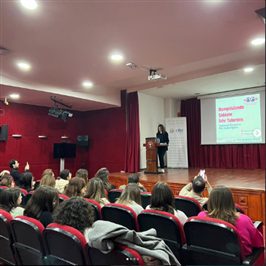
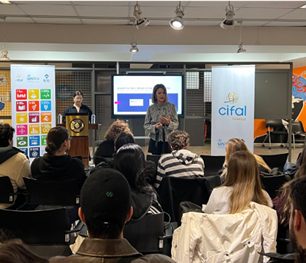
During the 2025-2025 academic year, Bahceşehir University hosted two sessions of the “Gender and Dating Violence Training” as part of the “Zero Tolerance for Violence on My Campus” project, organized in collaboration with CIFAL Istanbul (UNITAR), the Yanındayız Association, and supported by the Consulate General of the Federal Republic of Germany in Istanbul. The initiative aimed to raise awareness among university students about dating violence and to promote gender-sensitive, inclusive, and respectful approaches within academic environments.
The training addressed both the psychological and physical impacts of relationship violence, encouraging participants to engage in preventive education and open discussion about safety and mutual respect. Through interactive workshops and problem-solving sessions, students explored practical strategies to prevent gender-based violence and promote emotional well-being on campus.
By bringing together academia, international partners, and civil society, this collaborative initiative strengthened collective action toward safer and more equitable learning environments. It directly contributed to SDG 5 (Gender Equality) by advancing women’s protection and empowerment, and to SDG 10 (Reduced Inequalities) and SDG 16 (Peace, Justice and Strong Institutions) through its focus on inclusion, justice, and the creation of violence-free educational spaces.
34- Webinar: “Women’s Leadership and Governance in Sports” in Collaboration with the Sport Integrity Global Alliance (SIGA) and Bahçeşehir University
The image below shows the promotional poster of the Bahçeşehir University and Sport Integrity Global Alliance’s Women’s Leadership and Governance in Sports Webinar.
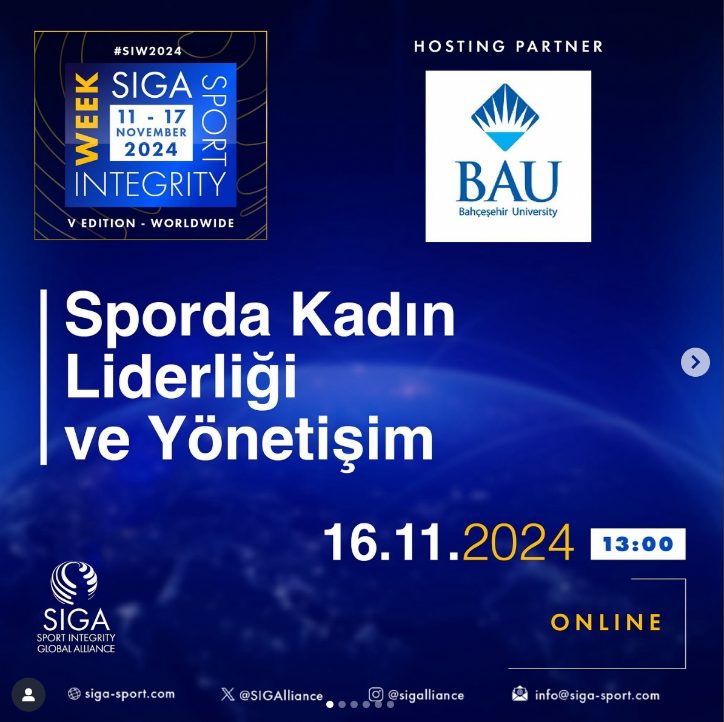
In the 2024-2025 academic year, Bahçeşehir University, in collaboration with the Sport Integrity Global Alliance (SIGA), hosted the online webinar “Women’s Leadership and Governance in Sports” as part of the 2024 Sport Integrity Week. The session focused on advancing women’s participation and leadership in sports governance, addressing existing barriers to gender equality and identifying strategies to strengthen women’s roles as decision-makers, executives, and change leaders within sports institutions.
Through this international partnership, Bahçeşehir University and SIGA demonstrated the transformative power of cross-sector collaboration in promoting integrity, inclusivity, and gender equality across all areas of leadership. The event created a valuable platform for dialogue among academics, practitioners, and advocates, reinforcing the idea that collective action and global cooperation are essential to ensuring equal opportunities in sports and beyond.
This initiative directly contributed to SDG 5 (Gender Equality) by supporting women’s empowerment and representation in governance, while aligning with SDG 10 (Reduced Inequalities) and SDG 17 (Partnerships for the Goals) through its focus on collaborative advocacy, knowledge exchange, and shared responsibility for sustainable progress.
35- The Role of Higher Education in Addressing Climate Change – Leadership, Innovation, and Impact Panel in Collaboration with UNITAR, CIFAL Istanbul, Bahçeşehir University, and CIFAL City of London
The image below shows a highlight picture of BAU and UNITAR’s COP29 Panel.
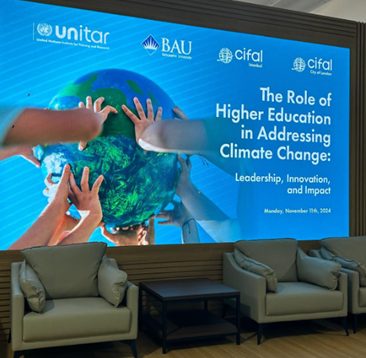
In the 2024-2025 academic year, during the United Nations Climate Change Conference (COP29) held in Baku, Azerbaijan, a high-level session titled “The Role of Higher Education in Addressing Climate Change: Leadership, Innovation, and Impact” was co-organized by the United Nations Institute for Training and Research (UNITAR), CIFAL Istanbul, Bahçeşehir University, and CIFAL City of London. The event convened academic leaders, policymakers, and sustainability experts to explore how higher education institutions can strengthen their contributions to global climate action through research, innovation, education, and partnership.
Discussions addressed strategies for integrating sustainability and energy transition into university curricula, fostering interdisciplinary collaboration, and developing practical, scalable solutions to enhance resilience and resource efficiency. Prof. Esra Hatipoğlu, Rector of Bahçeşehir University, and Prof. Çisil Sohodol, Director of CIFAL Istanbul, shared insights from the university’s experience in sustainability-driven education and multi-stakeholder engagement. The session was moderated by Dr. Ebru Canan-Sokullu, Associate Director at the CIFAL Global Network (UNITAR), who emphasized the essential role of cooperation between academia and international organizations in achieving climate resilience and advancing the 2030 Agenda.
Through this collaborative initiative, Bahçeşehir University and CIFAL Istanbul reaffirmed their commitment to global partnership, knowledge sharing, and innovation for sustainable climate solutions. The session exemplified the impact of SDG 17 (Partnerships for the Goals) in action—showcasing how collective leadership in higher education can drive systemic change, environmental responsibility, and a more sustainable future.
36- Giresun Science Festival: “Green Technology – Scientific Solutions for a Sustainable Future” in Partnership with the Giresun Provincial Directorate of National Education, Giresun Municipality, Giresun University, and Bahçeşehir University
The images below show the promotional poster and the event picture of the Bahçeşehir University and Provincial Directorate of National Education, Giresun Municipality, Giresun University’s Festival: “Green Technology – Scientific Solutions for a Sustainable Future.
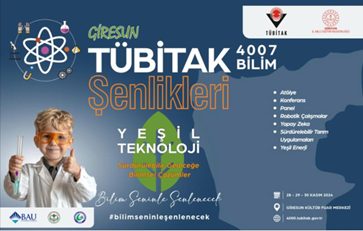
In the 2024-2025 academic year, the TÜBİTAK 4007 Giresun Science Festival was held under the coordination of the Giresun Provincial Directorate of National Education and in partnership with Giresun Municipality, Giresun University, and Bahçeşehir University. Themed “Green Technology: Scientific Solutions for a Sustainable Future,” the festival brought together students, educators, and community members for an engaging three-day program featuring 23 workshops, two conferences, one panel, and one scientific public lecture centered on clean energy, sustainable innovation, and environmental awareness.
With the active participation of Bahçeşehir University academics, the festival promoted scientific literacy, renewable energy education, and environmental responsibility through interactive sessions and hands-on learning. By fostering collaboration among local authorities, universities, and civil society, the initiative exemplified the power of partnerships in advancing sustainability-focused education and public engagement.
The programme also created opportunities for knowledge exchange among academic institutions, local public authorities, educators, and community participants on the role of science and technology in addressing environmental challenges.
Through this multi-stakeholder collaboration, the event not only strengthened community understanding of sustainable technologies but also encouraged collective responsibility for environmental protection. It reflected the spirit of SDG 4 (Quality Education), SDG 7 (Affordable and Clean Energy), SDG 11 (Sustainable Cities and Communities), and SDG 17 (Partnerships for the Goals)—showcasing how cooperative scientific initiatives can drive innovation and inspire a greener, more sustainable future.
The image below displays a highlight from the event
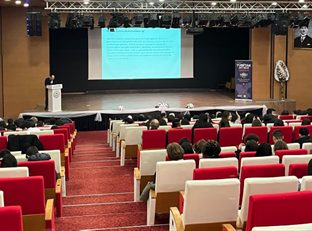
37- Panel: “Invisible Chains – Multidimensional Strategies to End Modern Slavery” in Collaboration with the Equality Association , CIFAL Istanbul (UNITAR), and Bahçeşehir University TOSAM (Center for Social, Health, Behavioral, and Preventive Studies)
The image below shows the promotional poster of the Bahçeşehir University and Equality Association’s Invisible Chains – Multidimensional Strategies to End Modern Slavery panel.
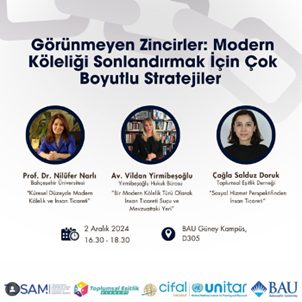
During the 2024-2025 academic year, marking the International Day for the Abolition of Slavery, Bahçeşehir University’s Center for Social, Health, Behavioral, and Preventive Studies (TOSAM) organized the panel “Invisible Chains: Multidimensional Strategies to End Modern Slavery” in collaboration with the Equality Association (Toplumsal Eşitlik Derneği) and CIFAL Istanbul (UNITAR). The event brought together experts from law, academia, and social work to examine the persistence of modern slavery and human trafficking through legal, social, and global perspectives.
Moderated by Prof. Dr. Nilüfer Narlı, who delivered a presentation titled “Modern Slavery and Human Trafficking at the Global Level,” the panel also featured Attorney Vildan Yirmibeşoğlu discussing “Human Trafficking as a Crime of Modern Slavery and Its Place in Legislation,” and Çağla Salduz Doruk presenting “Human Trafficking from a Social Work Perspective.” The session explored strategies to strengthen prevention, protection, and rehabilitation mechanisms, emphasizing the importance of multi-sectoral cooperation in combating labor exploitation and trafficking.
By fostering inclusive dialogue and joint action between academia, civil society, and international institutions, the event reflected the transformative impact of cross-sector partnerships in advancing ethical labor standards and protecting human rights. This initiative directly contributed to SDG 8 (Decent Work and Economic Growth) and SDG 5 (Gender Equality), while aligning with SDG 16 (Peace, Justice and Strong Institutions) and SDG 17 (Partnerships for the Goals)—demonstrating Bahçeşehir University’s commitment to collaborative, justice-oriented, and sustainable approaches that promote human dignity and equitable economic participation for all.
38- Bahçeşehir University, CIFAL Istanbul, the United Nations Institute for Training and Research, Bağcılar Municipality and VMI Consulting: Cross-Sectoral Collaboration on Digital Transformation and Leadership in Local Government (4 December 2024)
The image below presents the official promotional poster of the “Digital Transformation and Leadership in Local Government” event
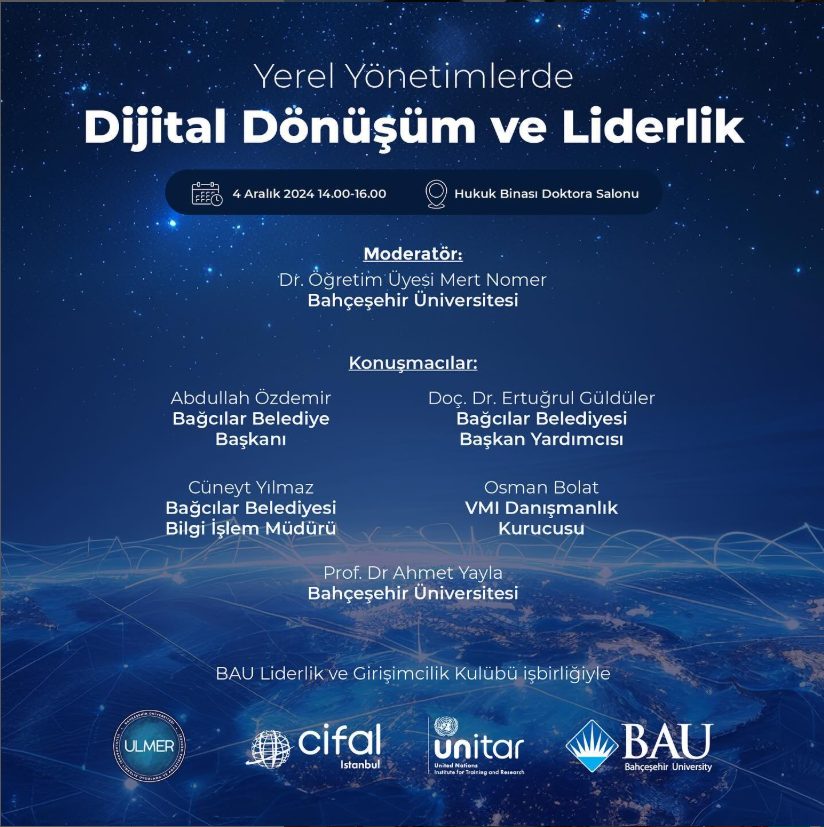
“Digital Transformation and Leadership in Local Government” brought together Bahçeşehir University, CIFAL Istanbul, the United Nations Institute for Training and Research, Bağcılar Municipality and VMI Consulting to explore digital change in local public services. Held at Bahçeşehir University’s Law Building Doctoral Hall, the event also involved the university’s Leadership and Entrepreneurship Club. Its cross-sectoral format provided a platform for connecting research and education with the practical organisational and technological challenges facing municipalities.
The programme connected higher education through Bahçeşehir University, the public sector through Bağcılar Municipality, private-sector cybersecurity expertise through VMI Consulting, and international sustainability training through CIFAL Istanbul and the United Nations Institute for Training and Research. This cross-sectoral partnership brought complementary perspectives to digital transformation and leadership, linking academic knowledge with municipal experience and technical expertise. The exchange offered an opportunity to consider how cooperation across sectors can strengthen institutional capacity and support the digital development of local government.
The event highlights Bahçeşehir University’s role in facilitating cross-sectoral dialogue and knowledge exchange around public-sector challenges. It contributes primarily to SDG 17: Partnerships for the Goals through cooperation between academic, public, private and international actors. Its focus on digital transformation also supports SDG 9: Industry, Innovation and Infrastructure, while its attention to local government capacity relates to SDG 16: Peace, Justice and Strong Institutions and SDG 11: Sustainable Cities and Communities.











