





 EN
17.2.1 - Relationships with NGOs and Government for SDG Policy
Bahçeşehir University (BAU) actively collaborates with government institutions, intergovernmental bodies, and non-governmental organizations (NGOs) to support the formulation, implementation, and monitoring of Sustainable Development Goal (SDG) policies at local, national, and international levels.
Through these partnerships, BAU contributes research-based expertise, policy analysis, and capacity-building initiatives that support evidence-informed policy discussions and strategies addressing social, economic, and environmental challenges.
The University's engagement includes joint projects, advisory roles, and institutional collaborations designed to align policy development with the SDGs.
By maintaining continuous dialogue with governmental and non-governmental stakeholders, BAU creates opportunities for its academic expertise, research findings, and institutional experience to contribute to policy frameworks, strategic planning, and institutional decision-making.
Examples of BAU's partnerships and policy-oriented initiatives with governments and NGOs are presented in the following section.
1- Collaborating for Change: Policy, Innovation, and Capacity Building in the Bahcesehir University– United Nations Food and Agriculture Organization Partnership
The images below show Bahcesehir University’s partnership with the Food and Agriculture Organization (FAO), including a screenshot from the FAO website and the signing of the FAO–BAU Memorandum of Understanding (MoU)
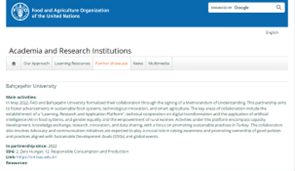
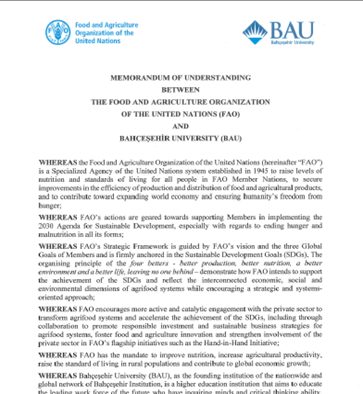
Since May 2022, Bahçeşehir University (BAU) and the Food and Agriculture Organization of the United Nations (FAO) have maintained a strategic institutional partnership to advance sustainable food systems, smart agriculture, rural development, and policy development in alignment with the United Nations Sustainable Development Goals (SDGs).
Formalized through a Memorandum of Understanding (MoU), the partnership establishes a long-term framework for cooperation through a Learning, Research, and Application Platform, promoting innovation, knowledge exchange, institutional capacity development, and policy-oriented collaboration in sustainable agriculture and food systems.
The cooperation encompasses several strategic areas, including:
Technical collaboration on digital transformation and the application of artificial intelligence (AI) in food systems;
Joint initiatives on gender equality, rural women's empowerment, and inclusive agricultural development;
Knowledge exchange and capacity building on sustainable agriculture, food security, and responsible resource management;
Advocacy, communication, and policy-oriented engagement to raise awareness and strengthen the development, dissemination, and adoption of good policies and practices aligned with the SDGs and global food security priorities.
The BAU–FAO partnership remained active throughout 2025, with both institutions continuing their cooperation through initiatives addressing the digital transformation of agriculture, the empowerment of rural communities, sustainable food systems, and inclusive policy dialogue.
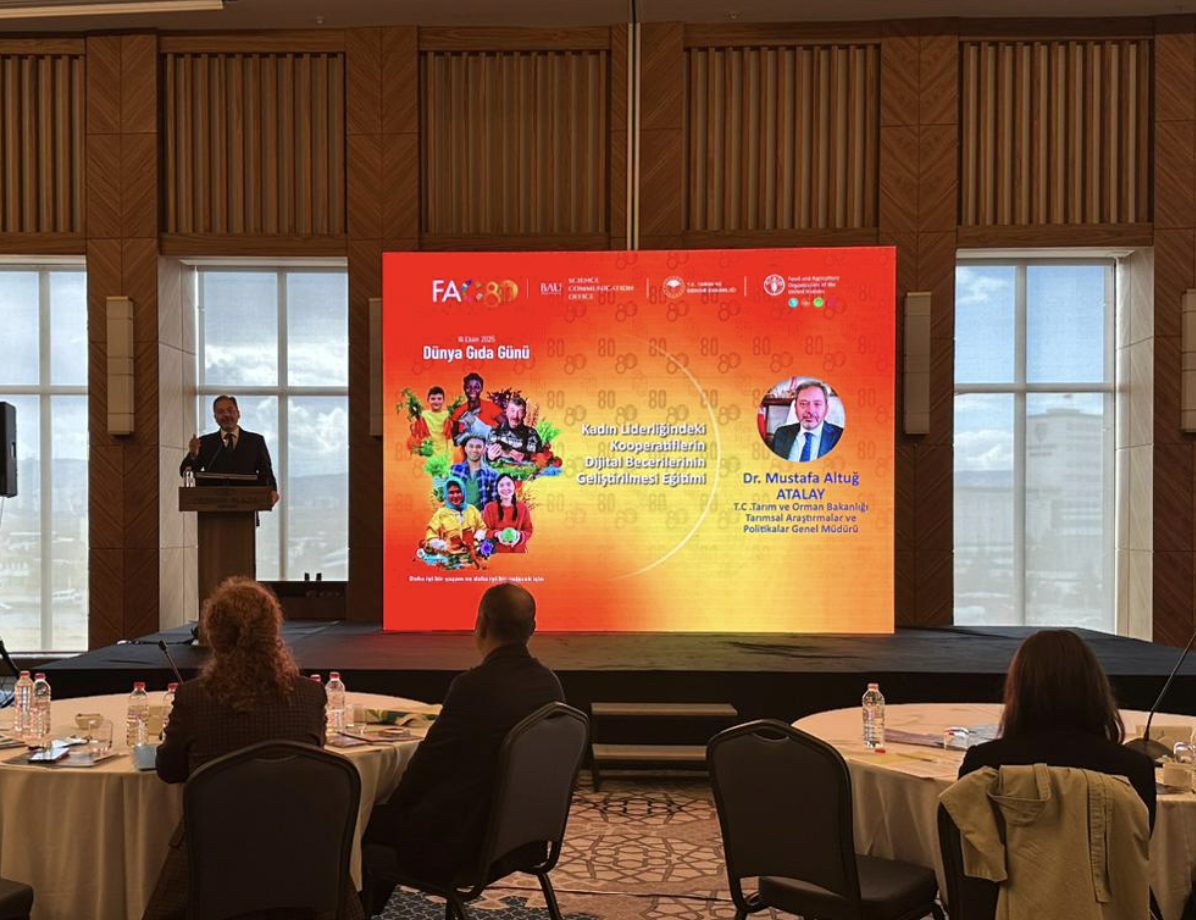
A key area of continued collaboration was the Digital Villages initiative, which focuses on strengthening digital literacy, technological capabilities, and access to educational opportunities in rural communities, particularly among rural women and women's cooperatives. By connecting BAU's academic expertise with FAO's international experience in agricultural development, the initiative supports the digital inclusion of rural populations and promotes more equitable participation in agricultural innovation and local economic development.
The initiative also contributes to broader policy-related priorities concerning gender-responsive rural development, digital inclusion, agricultural modernization, and the economic empowerment of women. Through educational outreach and engagement with rural communities, the cooperation connects practical experiences and local development needs with wider discussions on sustainable agricultural strategies and inclusive food systems.
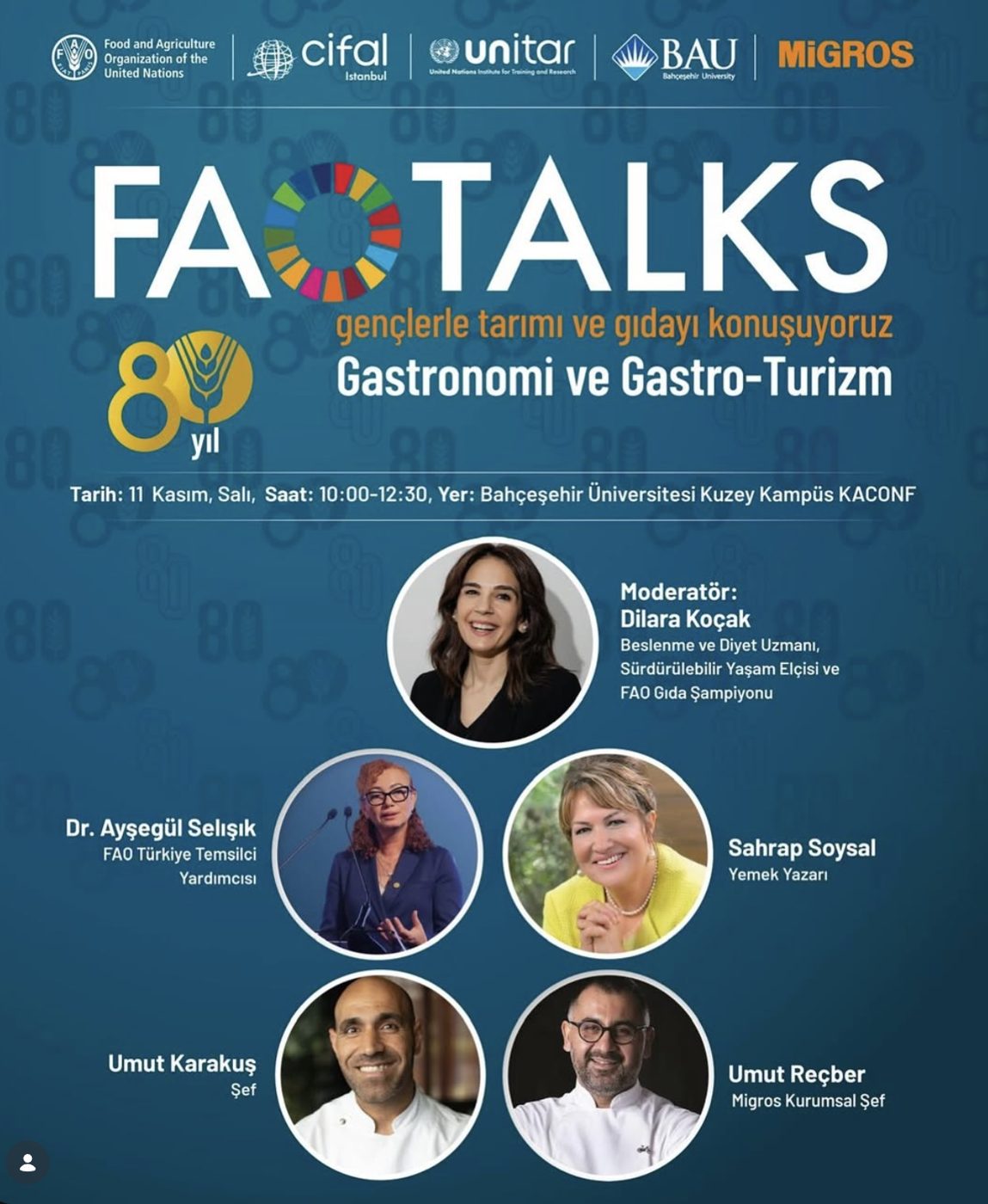
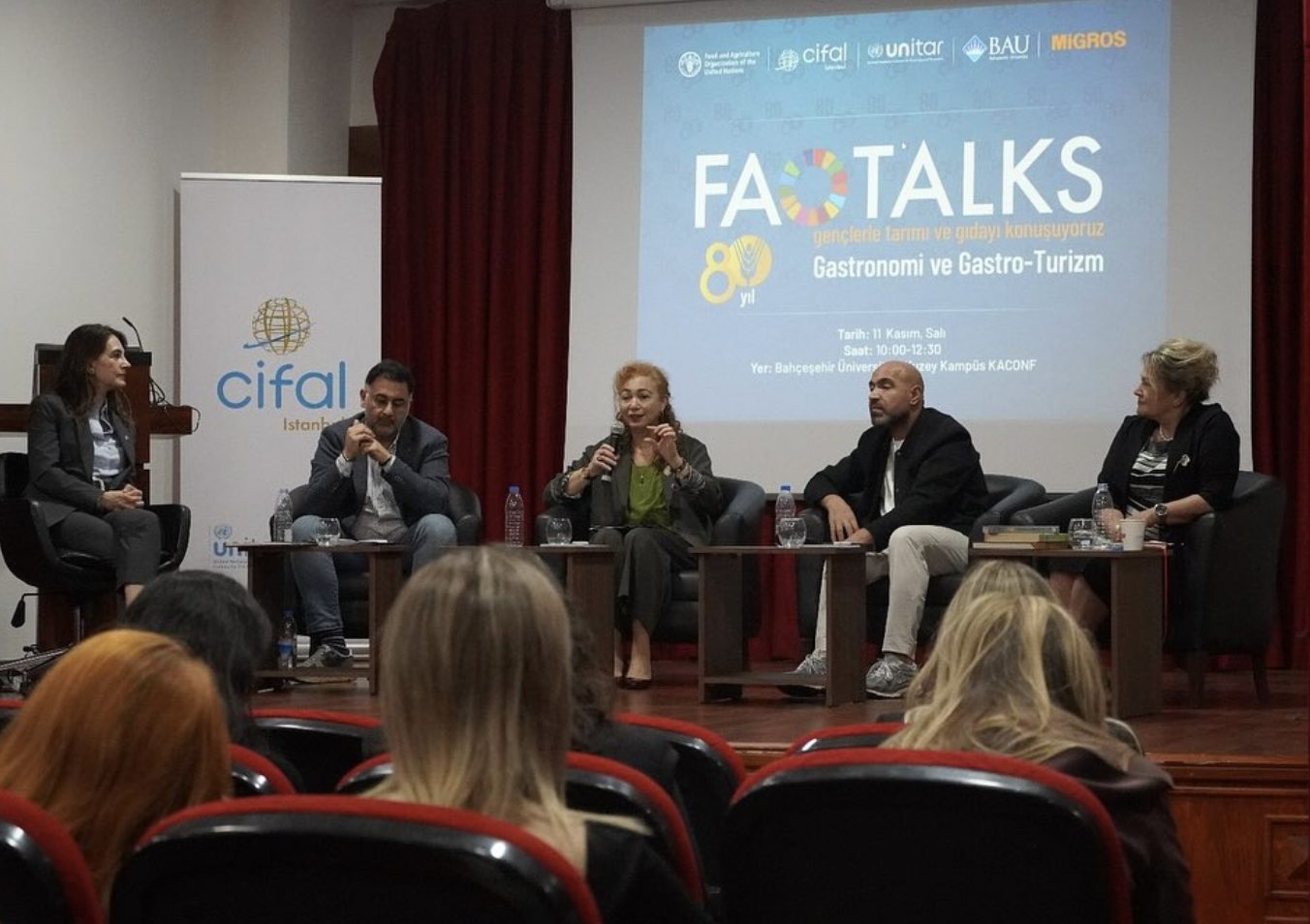
Another significant component of the partnership in 2025 was the organization of FAO Talks as part of World Food Day activities. The initiative brought together FAO representatives, non-governmental organizations (NGOs), private-sector companies, academic stakeholders, and young people to discuss sustainable food systems, food security, responsible agricultural practices, and the future of food production and consumption.
FAO Talks was designed not only as an educational and awareness-raising activity but also as a multi-stakeholder platform for policy dialogue and cross-sectoral knowledge exchange. By connecting international expertise with civil society perspectives, private-sector experience, academic knowledge, and youth participation, the programme encouraged discussions on the challenges facing contemporary food systems and the identification of shared priorities for more sustainable and inclusive food policies.
The discussions addressed the importance of sustainable food production and consumption, food system resilience, responsible resource management, and collaborative approaches to food security. Particular emphasis was placed on the need to engage different sectors in developing effective responses to environmental, economic, and social challenges affecting food systems.
The participation of NGOs and private-sector representatives strengthened the policy dialogue by bringing together different institutional perspectives on sustainable food systems, while the involvement of young people helped incorporate the expectations and priorities of future generations into discussions on food security, agricultural sustainability, and long-term environmental responsibility.
Through FAO Talks, BAU and FAO facilitated policy-oriented dialogue among international organizations, civil society, industry, academia, and youth, creating opportunities to exchange knowledge, consider policy priorities, and explore collaborative approaches to sustainable food system transformation. This engagement reinforced the role of universities as platforms connecting research-based expertise, stakeholder participation, and policy-relevant discussions.
Together, the Digital Villages initiative and FAO Talks demonstrated the continued implementation of the BAU–FAO cooperation framework in 2025. While Digital Villages addressed the practical dimensions of digital inclusion, rural women's empowerment, and sustainable agricultural development, FAO Talks provided a complementary platform for cross-sectoral dialogue on food security, sustainability priorities, and policy-related challenges.
Beyond individual activities, the partnership provides an ongoing institutional mechanism for SDG-related policy engagement, knowledge exchange, and the development of evidence-informed approaches to sustainable agriculture, food security, digital transformation, and rural development. Through its collaboration with FAO, BAU contributes academic expertise and facilitates stakeholder engagement relevant to the identification of policy priorities, the exchange of good practices, and the consideration of inclusive, technology-driven, and gender-sensitive agricultural strategies.
The continued cooperation also demonstrates how universities and international organizations can work together to connect global sustainable development agendas with national and local priorities, bringing academic knowledge, international expertise, civil society perspectives, private-sector participation, and community-level experience into discussions relevant to sustainable development policies.
By maintaining and implementing its institutional partnership with FAO throughout 2025, Bahçeşehir University contributed to SDG-related policy dialogue and cross-sectoral cooperation, supporting participatory, evidence-informed, and inclusive approaches to sustainable food systems and agricultural development.
The partnership contributes primarily to SDG 2 (Zero Hunger) through food security and sustainable agricultural development; SDG 5 (Gender Equality) through rural women's empowerment and inclusive participation; SDG 9 (Industry, Innovation and Infrastructure) through agricultural digitalization and technological innovation; SDG 12 (Responsible Consumption and Production) through sustainable food production and consumption; SDG 13 (Climate Action) through resilient and sustainable agricultural practices; and SDG 17 (Partnerships for the Goals) through sustained institutional cooperation between BAU and FAO and cross-sectoral dialogue involving NGOs, the private sector, academia, and youth. It also supports SDG 4 (Quality Education) through educational outreach, knowledge sharing, and capacity development.
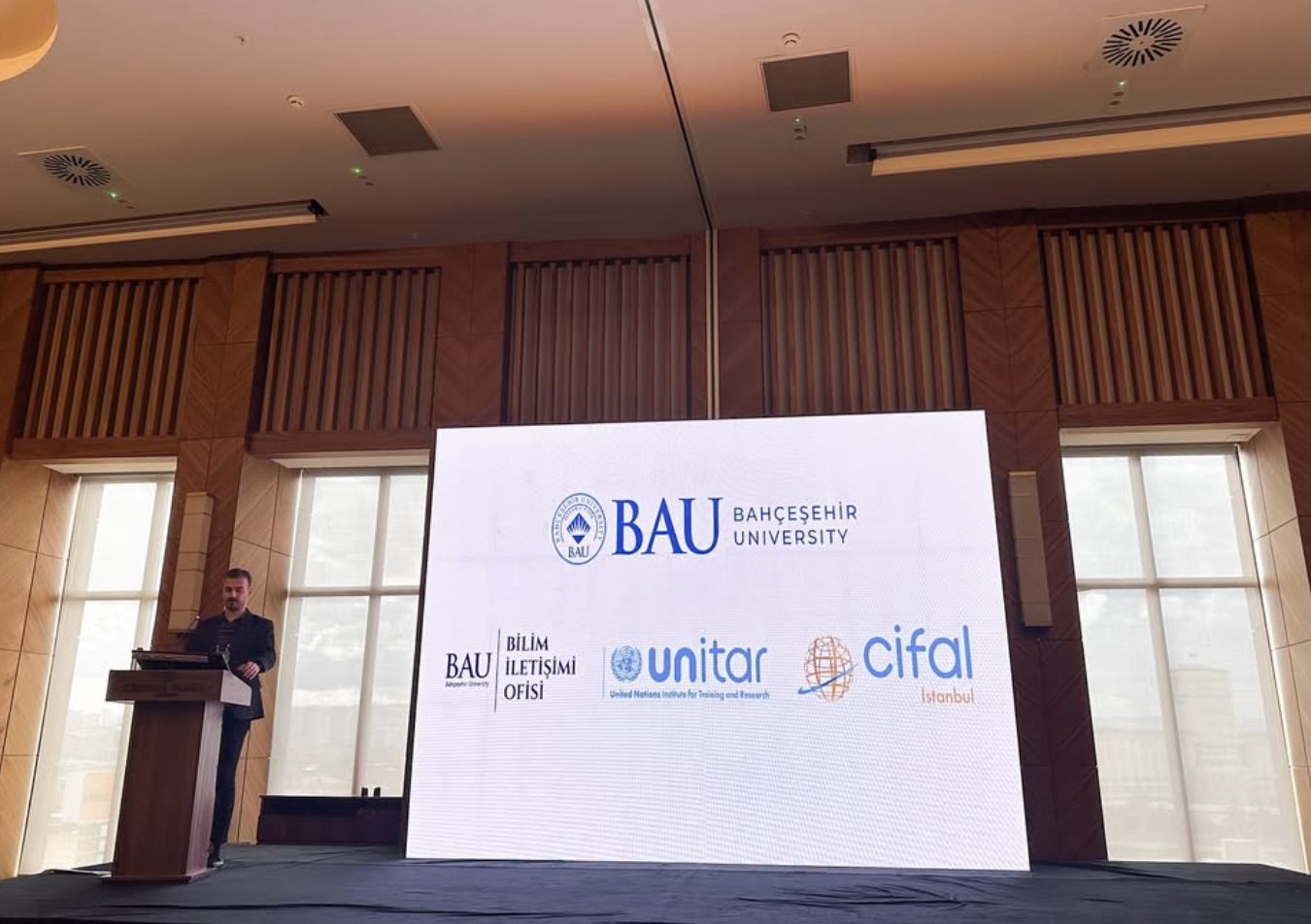
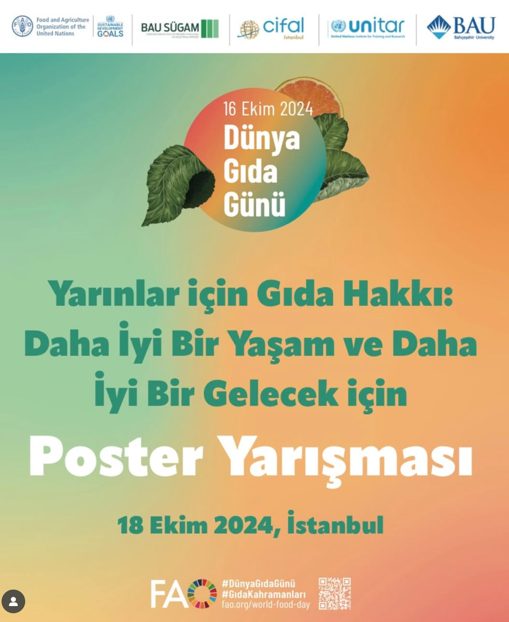
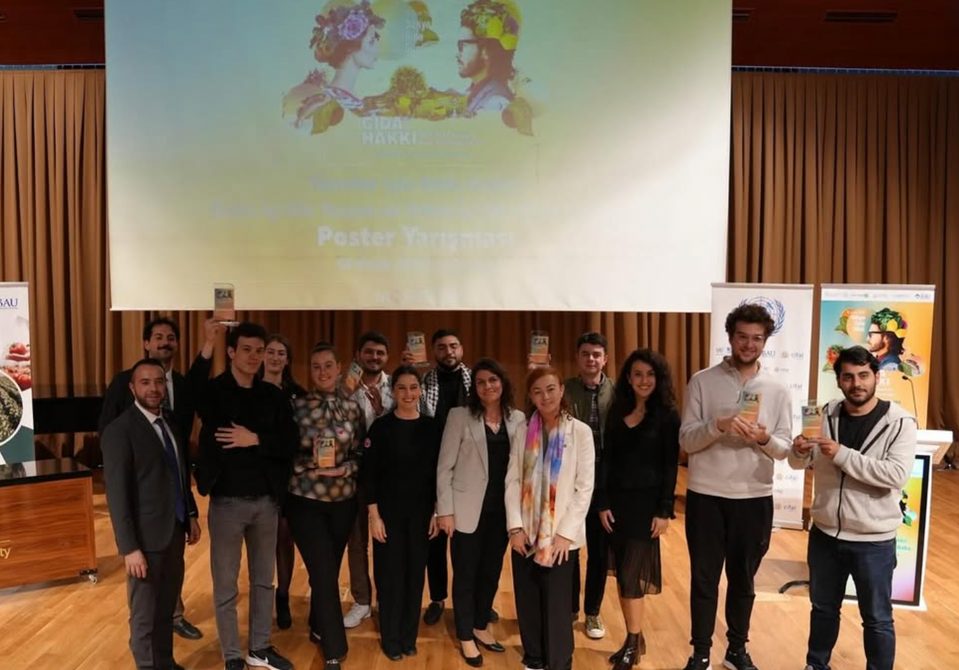
The images below showcase highlights from various events that all took place durşng the 2024-2025 academic year, in collaboration with FAO
2- Bahçeşehir University's Contribution to Climate Policy Dialogue and Sustainable Governance through the 21st Green Dialogue with NGOs
The image below presents the official poster of the 21st Green Dialogue Meeting, held in 2025, highlighting the educational programme, expert speakers, and key topics addressed in climate legislation, just transition, and environmental governance.
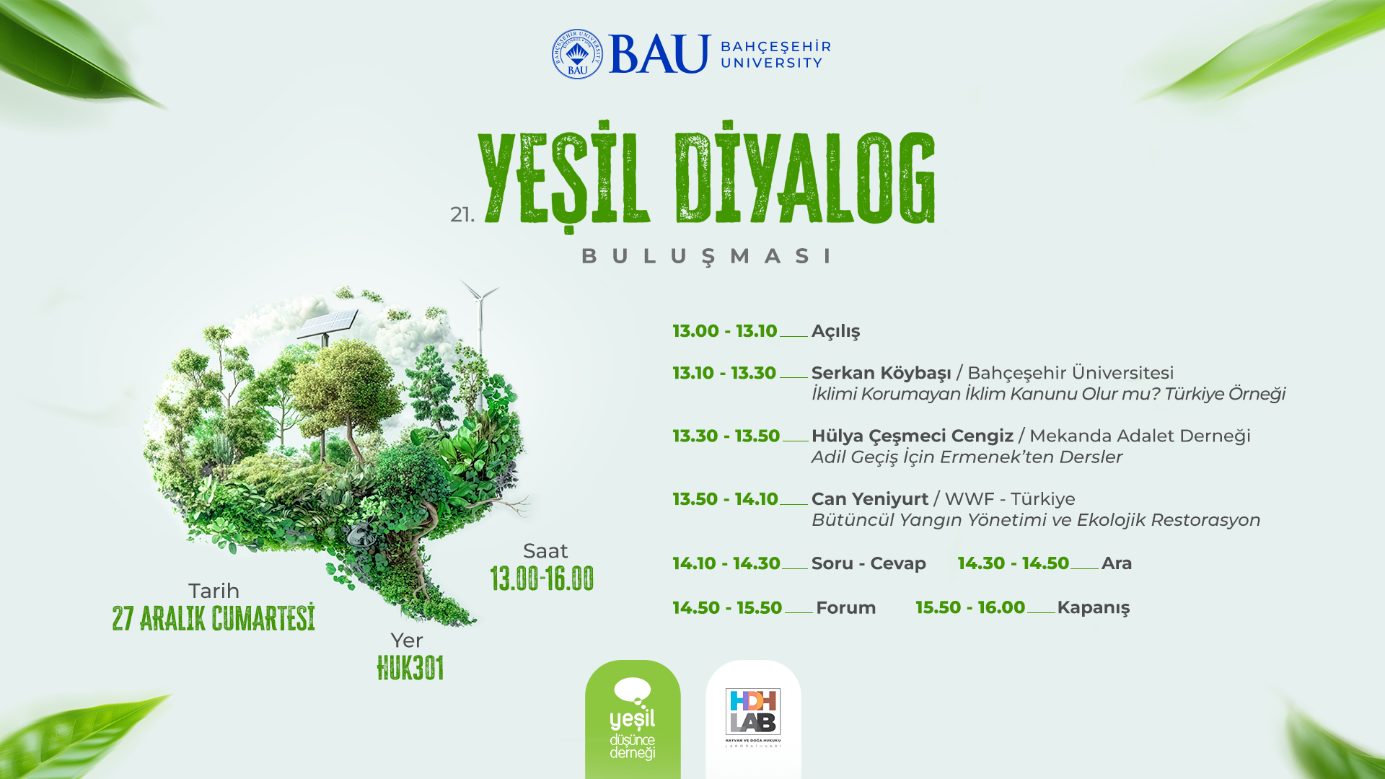
Bahçeşehir University (BAU) contributed to climate policy dialogue, environmental governance, and SDG-related policy discussions through the 21st Green Dialogue, held in 2025. The event brought together Bahçeşehir University (BAU), Green Dialogue Association (Yeşil Diyalog Derneği), and representatives of WWF-Türkiye and Mekanda Adalet Derneği (Centre for Spatial Justice). The event provided a multi-stakeholder platform for examining climate legislation, environmental governance, just transition, and ecological sustainability, facilitating policy-relevant dialogue between academia and civil society organizations actively engaged in environmental advocacy and sustainable development.
The dialogue featured Prof. Dr. Serkan Köybaşı from BAU, alongside representatives of WWF-Türkiye and Mekanda Adalet Derneği (Centre for Spatial Justice), two non-governmental organizations engaged in environmental sustainability, social justice, and policy advocacy.
Discussions addressed climate legislation, just transition, environmental justice, and ecological approaches to wildfire management, connecting environmental challenges with questions of institutional responsibility, regulatory priorities, and inclusive governance.
BAU's academic contribution supported the examination of climate-related legal and governance challenges, while the participation of civil society organizations brought practical experience and advocacy perspectives into the discussion. This exchange provided a platform for considering how environmental policies can address climate risks while taking account of social inequalities, local communities, and ecosystem protection.
Through this engagement, BAU facilitated policy-relevant dialogue between academia and NGOs, supporting the exchange of knowledge and perspectives that can inform climate policy priorities, environmental governance strategies, and approaches to implementing the SDGs.
The initiative contributes primarily to SDG 13 (Climate Action), SDG 16 (Peace, Justice and Strong Institutions), and SDG 17 (Partnerships for the Goals), while also supporting SDG 10 (Reduced Inequalities) and SDG 15 (Life on Land).
3- Bahçeşehir University's Climate Policy Dialogue with the Corporate Social Responsibility Association of Türkiye: NGO Engagement, Policy Development and Cross-Sectoral Cooperation
The image below portrays the official promotional poster of the event
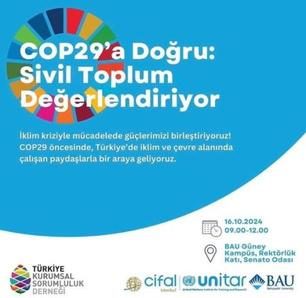
During the 2024–2025 academic year, ahead of the 29th United Nations Climate Change Conference (COP29), Bahçeşehir University (BAU) engaged with the Corporate Social Responsibility Association of Türkiye (Türkiye Kurumsal Sosyal Sorumluluk Derneği), a non-governmental organization (NGO), and representatives of civil society and environmental organizations in a multi-stakeholder dialogue focused on climate policy priorities, environmental governance, and sustainable development.
The meeting provided a platform for cross-sectoral dialogue and policy-oriented knowledge exchange, bringing together academic and civil society perspectives to assess challenges, identify priorities, and discuss strategies for more inclusive, transparent, and effective climate action ahead of COP29.
A central focus of the discussions was the role of NGOs and civil society organizations in shaping climate-related policies and sustainable development strategies. Participants examined how civic engagement, stakeholder consultation, and collective action can contribute to identifying environmental challenges, informing policy priorities, and strengthening accountability in climate-related decision-making.
Through its engagement with the Corporate Social Responsibility Association of Türkiye and other civil society stakeholders, BAU contributed to policy-oriented discussions concerning the development of inclusive climate strategies and participatory approaches to environmental governance. The dialogue emphasized the importance of incorporating diverse stakeholder perspectives into policy processes, particularly when addressing the social, institutional, and environmental dimensions of climate change.
The discussions also explored institutional transparency, public accountability, stakeholder participation, and the contribution of NGOs to monitoring environmental commitments and advocating for effective climate action. These exchanges connected civil society experience with academic perspectives on sustainable development, supporting shared understanding of policy challenges and potential approaches to addressing them.
By facilitating engagement between higher education and civil society, the initiative strengthened cross-sectoral knowledge exchange on SDG-related policy priorities. It demonstrated the role of universities in supporting dialogue with NGOs on the identification of sustainability challenges, the consideration of policy responses, and the development of more participatory approaches to environmental decision-making.
The meeting further highlighted the importance of multi-stakeholder cooperation in preparing for international climate negotiations, encouraging participants to consider how national and local priorities can be reflected in broader climate policy discussions and sustainable development strategies.
Through this engagement, Bahçeşehir University supported both NGO-related climate policy dialogue and cross-sectoral cooperation, reinforcing its commitment to participatory governance, environmental responsibility, and evidence-informed approaches to sustainable development.
The initiative contributed primarily to SDG 17 (Partnerships for the Goals) through cooperation and policy-oriented dialogue between academia, NGOs, and environmental civil society organizations. It also supported SDG 13 (Climate Action) through discussions on climate policy priorities and collective responses to environmental challenges, and SDG 16 (Peace, Justice and Strong Institutions) through its emphasis on participatory decision-making, institutional transparency, accountability, and inclusive governance.
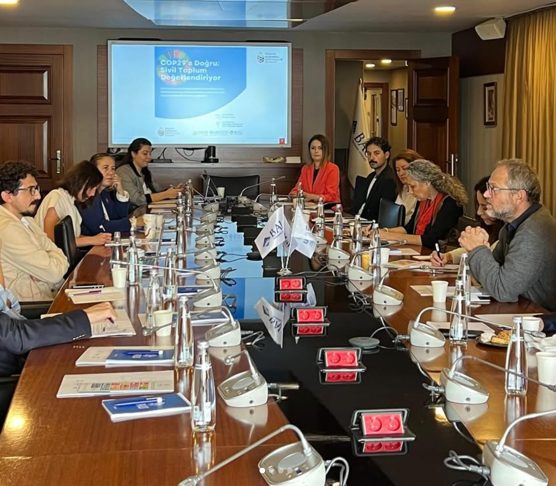
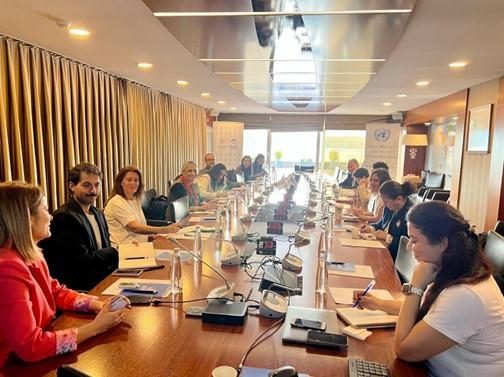
The images below show event pictures from the roundtable Evaluating Challenges, Solutions, and Policy Pathways for Climate Action in Turkey,’ featuring participants from academia, NGOs, and civil society organizations.
4- Bahçeşehir University's Consumer Law Symposium in Collaboration with Istanbul Arel University and the Confederation of Consumer Organizations (TÖK): Policy Education, Capacity Building and Cross-Sectoral Dialogue on Consumer Rights and Regulatory Governance
The image below presents the official programme of the 2nd Symposium on Current Issues in Consumer Law, held on 14 March 2025, documenting the collaboration among universities and consumer protection organizations, as well as the participation of public-sector representatives, legal professionals, and experts in consumer law and regulatory governance.
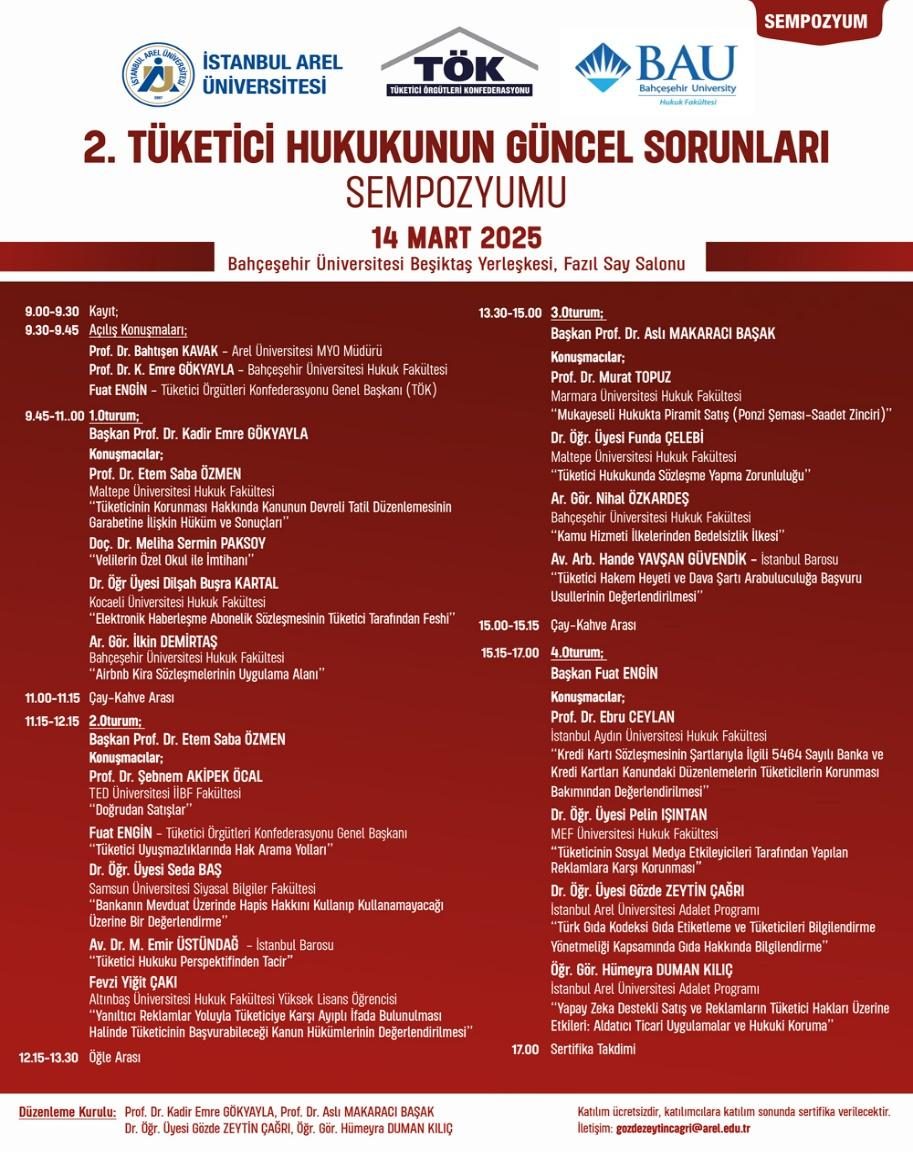
Bahçeşehir University (BAU) contributed to SDG-related policy dialogue, legal capacity building, and consumer protection policy development through the Second Symposium on Current Issues in Consumer Law, held on 14 March 2025.
Organized in cooperation with Istanbul Arel University and the Confederation of Consumer Organizations (Tüketici Örgütleri Konfederasyonu – TÖK), the symposium brought together academic legal experts, representatives of the Republic of Türkiye Ministry of Trade, legal professionals associated with the Istanbul Bar Association, and civil society stakeholders engaged in consumer rights advocacy.
The symposium served as a platform for policy-oriented legal education and professional knowledge exchange, enabling participants to examine contemporary consumer law challenges, regulatory developments, legal interpretation, and institutional approaches to consumer protection. In this respect, the initiative also reflected BAU's broader contribution to SDG 16 through strengthening the knowledge and professional capacity of stakeholders involved in legal and regulatory processes.
Beyond capacity building, BAU's collaboration with TÖK connected academic legal expertise with the policy priorities and practical experience of a consumer rights NGO. The participation of public authorities and legal professionals provided opportunities to discuss regulatory challenges and approaches relevant to improving consumer protection frameworks.
Through this combination of professional capacity development and multi-stakeholder policy dialogue, BAU supported the exchange of evidence-informed perspectives between academia, civil society, and public institutions, contributing to discussions relevant to consumer rights, regulatory governance, and equitable legal protection.
The initiative demonstrates how BAU integrates academic expertise, stakeholder education, and NGO engagement into policy-relevant cooperation, linking its contributions to institutional capacity building under SDG 16 with broader partnerships supporting SDG-related policy development.
The symposium primarily contributes to SDG 16 (Peace, Justice and Strong Institutions), SDG 12 (Responsible Consumption and Production), and SDG 17 (Partnerships for the Goals).
5- Bahçeşehir University's Contribution to the National Policy Forum on AI and Technology in Hazelnut Farming: Policy Capacity Building and Cross-Sectoral Dialogue for Sustainable Agriculture Ministry of Agriculture and Forestry, Giresun Governorship, Giresun University, and the Eastern Black Sea Development Agency (DOKA)
The official poster below presents the National Policy Forum on Artificial Intelligence and Technology in Hazelnut Farming held in Giresun, highlighting the involvement of Bahçeşehir University, government institutions, academic partners, and other stakeholders in policy-oriented capacity building and cross-sectoral dialogue on sustainable agriculture and digital transformation.
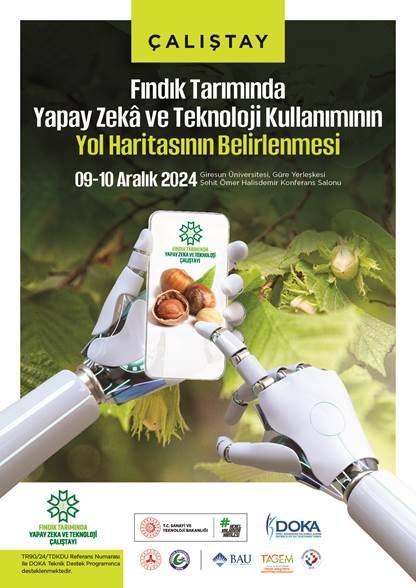
During the 2024–2025 academic year, Bahçeşehir University (BAU) participated in the National Policy Forum on Artificial Intelligence and Technology in Hazelnut Farming, held in Giresun under the coordination of the Ministry of Agriculture and Forestry of the Republic of Türkiye and the Giresun Governorship.
The forum brought together a broad network of stakeholders, including Bahçeşehir University, Giresun University, the Eastern Black Sea Development Agency (DOKA), government institutions, researchers, and private-sector representatives, establishing a platform for policy-oriented education, institutional capacity development, and cross-sectoral dialogue on the digital transformation of agriculture.
The initiative aimed to support the development of a national roadmap for integrating artificial intelligence (AI) and digital technologies into Türkiye's agricultural production systems, with particular emphasis on the hazelnut sector. Discussions addressed opportunities to improve agricultural productivity, strengthen climate resilience, encourage technological innovation, and support the long-term sustainability of rural economies.
Bahçeşehir University contributed its academic expertise in AI applications, sustainable food systems, and policy innovation, supporting knowledge exchange among public authorities, universities, development institutions, and industry stakeholders. Through its participation, BAU contributed to discussions on data-driven agricultural strategies, evidence-based policymaking, and the practical application of emerging technologies to agricultural development.
The forum provided opportunities for government officials, public-sector decision-makers, researchers, and industry representatives to exchange expertise on the opportunities and challenges associated with agricultural digitalization. This engagement supported policy-relevant learning and institutional capacity building, connecting scientific and technological knowledge with public policy priorities and implementation needs.
At the same time, the initiative facilitated cross-sectoral dialogue among national and local government institutions, higher education institutions, development agencies, and the private sector. By bringing together stakeholders with different responsibilities and areas of expertise, the forum encouraged coordinated approaches to agricultural innovation, sustainable production, rural development, and climate adaptation.
The participation of the Ministry of Agriculture and Forestry, Giresun Governorship, DOKA, Giresun University, BAU, and industry stakeholders demonstrated the importance of multi-stakeholder engagement in addressing complex sustainable development challenges. The forum connected national agricultural policy priorities with regional economic needs, academic research, and private-sector innovation.
Through its involvement, BAU contributed to both policy-oriented capacity development and SDG-focused cross-sectoral knowledge exchange, supporting collaborative approaches to integrating emerging technologies into sustainable agricultural systems.
The initiative contributed to SDG 2 (Zero Hunger) through sustainable and resilient agricultural production; SDG 1 (No Poverty) through its focus on rural livelihoods and agricultural development; SDG 9 (Industry, Innovation and Infrastructure) through AI applications and digital transformation; SDG 13 (Climate Action) through climate-smart agricultural approaches; and SDG 17 (Partnerships for the Goals) through cooperation among government institutions, universities, development agencies, and the private sector. It also supported SDG 16 (Peace, Justice and Strong Institutions) through evidence-based policy development, institutional knowledge exchange, and capacity building for sustainable agricultural governance.
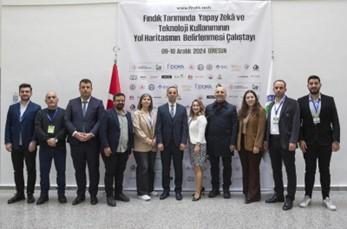
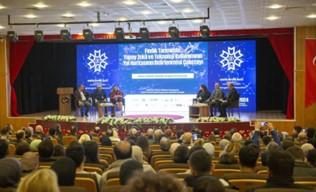
The photographs below document the National Policy Forum on Artificial Intelligence and Technology in Hazelnut Farming, illustrating the participation of government officials, academic experts, and industry representatives in cross-sectoral knowledge exchange, policy discussions, and collaborative approaches to sustainable agricultural development.
6- Special Session at COP29: Bahçeşehir University and United Nations Institute for Training and Research (UNITAR)- Advancing Climate Policy, Education, and Global Best Practices
The image below shows the promotional poster of the Special Session at COP29, co-organized by Bahcesehir University and the United Nations Institute for Training and Research (UNITAR).
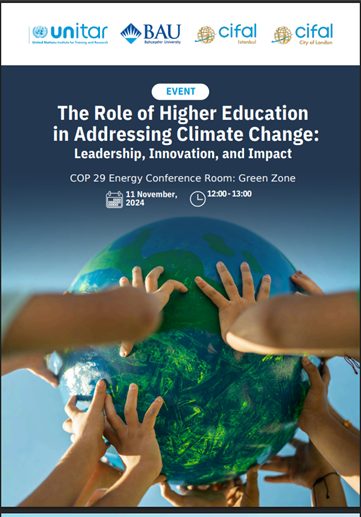
During 2024-2025 academic year, at the the United Nations Climate Change Conference in Baku, Azerbaijan, a landmark session titled “The Role of Higher Education in Addressing Climate Change: Leadership, Innovation, and Impact” was co-organized by UNITAR, CIFAL Istanbul, Bahçeşehir University (Bahcesehir University) and CIFAL City of London. Marking the first time a Turkish university hosted an independent session at COP, this event positioned Bahçeşehir University as a key contributor to global climate dialogue and higher education’s policy impact.
The session convened academic leaders, policymakers, and sustainability experts to explore how universities can shape climate solutions through research, education, and innovation.
Discussions focused on embedding climate literacy across curricula, promoting interdisciplinary collaboration, and developing science-based strategies for resilience and adaptation. Participants emphasized that universities play a pivotal role not only in knowledge generation, but also in influencing national and international climate policy through research-driven insights and stakeholder engagement.
In alignment with UNITAR’s global learning
objectives, the session highlighted best practices and
comparative approaches to integrating climate change education
into higher education, fostering capacity-building
initiatives for young leaders, educators, and
decision-makers.
Expected outcomes included the creation of cross-regional
networks between universities, NGOs, and government
institutions; the sharing of case
studies and innovative models; and the
development of policy frameworks to accelerate
sustainable transformation.
Representing Turkey’s academic leadership on the global
stage, Prof. Dr. Esra Hatipoğlu, Rector of Bahcesehir
(Bahçeşehir) University, and Prof. Dr. Çisil Sohodol,
Director of CIFAL Istanbul, shared the institution’s experience in
advancing sustainability-centered education and community
partnerships.
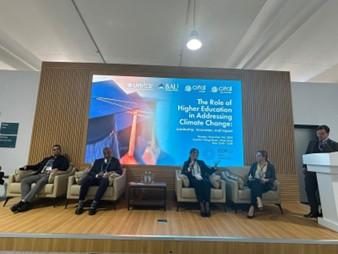
The session was moderated by Dr. Ebru Canan-Sokullu,
Associate Director at the CIFAL Global Network
(UNITAR), who underscored the importance
of university–organization cooperation in shaping
effective climate governance frameworks.
By integrating education, research, policy development, and
international best practice exchange, this
pioneering COP29 special
session exemplified Bahçeşehir University’s leadership
in sustainable transformation.
It reinforced the University’s commitment to SDG 13 (Climate
Action) through policy engagement, SDG
4 (Quality Education) by promoting climate literacy and
capacity-building, and SDG 17 (Partnerships for the
Goals) through international collaboration, best
practice exchange, and global climate resilience.
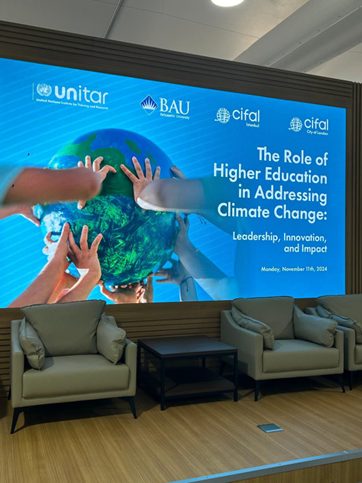
The images below show event photos from the Special Session at COP29 jointly organized by Bahcesehir University and UNITAR, featuring speakers and participants engaging in discussions on climate policy and education.
7- Bahçeşehir University's Active Engagement in the Impact Investing Advisory Board (EYDK): SDG Policy Development, Institutional Governance and Sustainable Finance
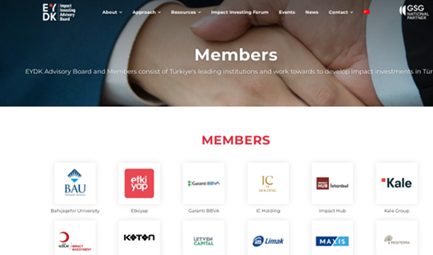
The image below shows a screenshot from the official website of the Impact Investing Advisory Board (EYDK), indicating Bahcesehir University’s membership and engagement in sustainable finance policy development.
The Impact Investing Advisory Board (EYDK) was established in April 2019 as a national multi-stakeholder platform and non-governmental organization (NGO) dedicated to advancing impact investment in Türkiye. EYDK brings together public institutions, private-sector organizations, investors, academic institutions, and civil society representatives to identify national priorities, develop strategic approaches, and formulate policy recommendations supporting sustainable economic, social, and environmental development.
Since its establishment, EYDK has contributed to the development of Türkiye's impact investment ecosystem through policy-oriented research, strategic recommendations, market development, stakeholder engagement, and advocacy activities. Its work focuses on strengthening the institutional and policy environment for investments that generate measurable social and environmental benefits alongside financial returns.
In March 2022, EYDK joined the Global Steering Group for Impact Investment (GSG), connecting Türkiye's impact investment ecosystem with an international network focused on sustainable finance, policy innovation, and impact-oriented investment strategies. This affiliation supports the exchange of international experience and the consideration of global good practices in national policy and strategy discussions.
Bahçeşehir University (BAU) is an active institutional member of EYDK, contributing its academic expertise and institutional perspectives to the organization's ongoing work on sustainable finance, impact investment, and SDG-related policy development.
Throughout 2025, BAU maintained its active engagement through participation in EYDK's regular member meetings, which provide an institutional platform for discussing developments in Türkiye's impact investment ecosystem, identifying emerging priorities, exchanging knowledge, and considering strategic and policy-related challenges. The meetings facilitate ongoing dialogue between universities, public-sector stakeholders, investors, businesses, and civil society organizations, connecting research-based knowledge with practical experience and policy-related needs.
A significant development in 2025 was Bahçeşehir University's representation on EYDK's Supervisory Board (Denetim Kurulu), further strengthening the university's institutional involvement in the organization.
A central dimension of EYDK's work is the integration of the Sustainable Development Goals into investment-related strategies and policy discussions. Within this framework, BAU's institutional participation supports knowledge exchange and evidence-informed discussions on impact investment policy, including the identification of market needs, consideration of institutional and regulatory challenges, development of shared strategic priorities, and promotion of approaches that connect financial decision-making with measurable social and environmental outcomes.
The collaboration is particularly relevant to SDG-related policy development in sustainable finance, inclusive economic growth, responsible investment, social innovation, and impact measurement.
By combining regular participation in policy-related member discussions with involvement in institutional governance, Bahçeşehir University reinforces its role as an academic stakeholder supporting the development of an inclusive, transparent, and evidence-informed impact investment environment in Türkiye.
The initiative contributes primarily to SDG 17 (Partnerships for the Goals) through sustained university–NGO engagement, multi-stakeholder policy dialogue, and institutional cooperation. It also supports SDG 8 (Decent Work and Economic Growth) through sustainable and inclusive economic development; SDG 9 (Industry, Innovation and Infrastructure) through impact-oriented innovation and investment; SDG 10 (Reduced Inequalities) through investment approaches addressing social and economic challenges; and SDG 16 (Peace, Justice and Strong Institutions) through institutional governance, transparency, accountability, and evidence-informed policy engagement.
8- Bahçeşehir University's Contribution to Gender Equality Policy Dialogue and Legal Protection through International Academic and NGO Engagement
The image below displays the official promotional poster of the event:
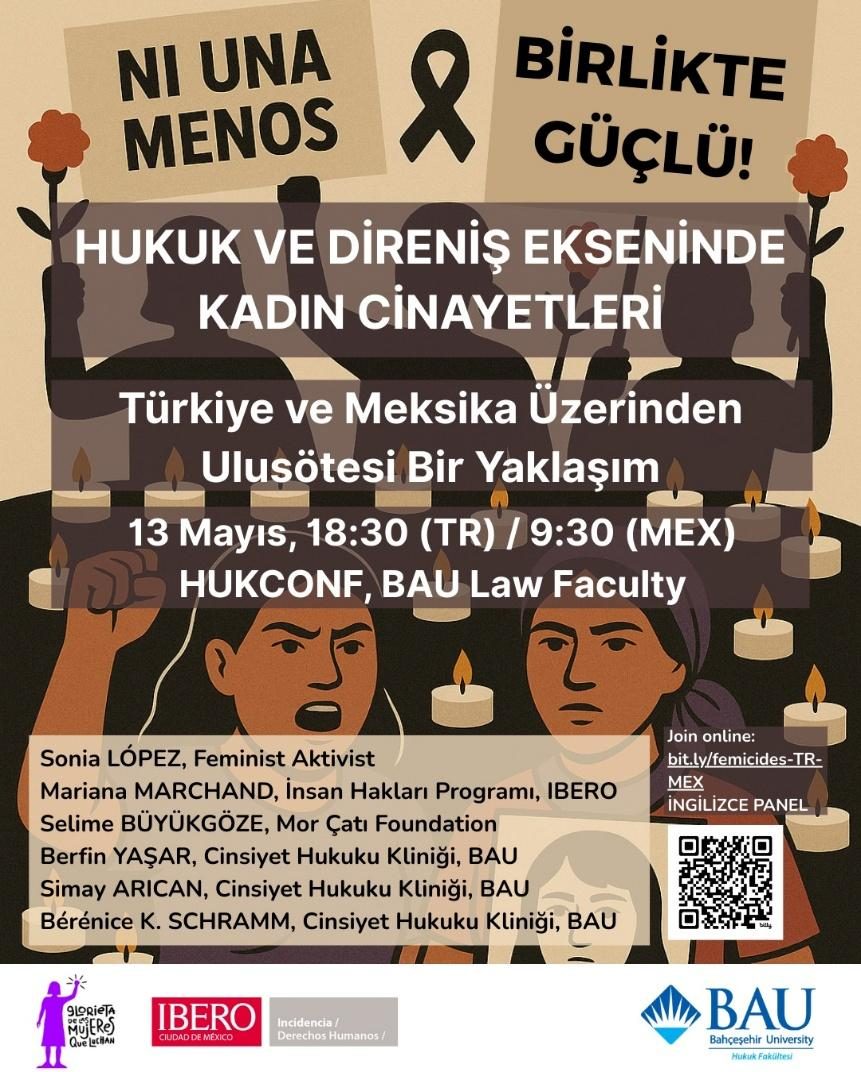
Bahçeşehir University (BAU) contributed to SDG-related policy dialogue on gender equality, women's rights, and legal protection through the international event “Femicide at the Intersection of Law and Resistance,” held on 13 May 2025. The initiative brought together academic expertise, international perspectives, and civil society experience to examine femicide as a critical challenge for human rights, justice, and public policy.
Hosted within BAU's Faculty of Law, the event engaged academic perspectives from IBERO University in Mexico and contributions from Mor Çatı Women's Shelter Foundation (Mor Çatı Kadın Sığınağı Vakfı), a Turkish non-governmental organization working to combat violence against women and strengthen women's access to protection and support mechanisms.
The dialogue examined femicide, legal protection frameworks, judicial responses, institutional accountability, and civil society resistance, drawing on experiences from Türkiye and Mexico. This comparative approach enabled participants to consider how legal systems, public institutions, and women's rights organizations respond to gender-based violence and the challenges associated with implementing effective protection measures.
BAU's academic contribution connected legal analysis with the practical knowledge and advocacy experience of Mor Çatı, creating opportunities for policy-relevant discussion on the effectiveness of existing legal protections, barriers to justice, and institutional responsibilities in preventing violence against women.
Beyond raising awareness, the event supported knowledge exchange relevant to gender equality policy development, particularly concerning legal safeguards, access to justice, implementation of protective legislation, and accountability mechanisms. The participation of an NGO directly engaged in supporting women affected by violence brought practical perspectives into discussions of legal and institutional responses.
The initiative also reflected BAU's broader contribution to SDG 16 through providing an academic environment for informed, inclusive, and constructive dialogue on sensitive legal and social issues. Within the context of SDG 17, the engagement extended this dialogue into international academic and civil society cooperation, connecting legal scholarship with policy challenges and the experience of organizations advocating for women's rights.
Through this collaboration, Bahçeşehir University contributed to evidence-informed discussion of legal and institutional approaches relevant to the development and implementation of gender equality policies, strengthening connections between academia, international partners, and civil society.
The event primarily supports SDG 5 (Gender Equality), particularly the prevention of violence against women; SDG 16 (Peace, Justice and Strong Institutions) through access to justice, legal protection, and institutional accountability; and SDG 17 (Partnerships for the Goals) through international academic and NGO engagement.
9- Advancing Policy Pathways for Sustainable Food and Land Systems: Bahçeşehir University and NGOs within the FABLE Consortium
The image below shows a screenshot from the official website of the FABLE Consortium, indicating Bahcesehir University’s membership and collaboration with NGOs in advancing policy pathways for sustainable food and land systems.
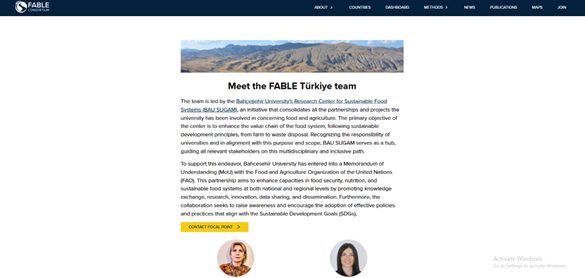
Bahçeşehir University (BAU) serves as the Turkish partner of the global FABLE Consortium (Food, Agriculture, Biodiversity, Land-Use, and Energy), an international network of research institutions and partner organizations working to develop nationally coherent and globally aligned pathways for achieving the United Nations Sustainable Development Goals (SDGs) and the objectives of the Paris Climate Agreement.
The FABLE Consortium provides a collaborative framework through which national research teams develop science-based, data-driven policy pathways for sustainable food systems, agriculture, biodiversity conservation, land use, and climate action. Its approach connects national development priorities with international sustainability commitments, supporting governments and other stakeholders in identifying integrated strategies for long-term environmental, economic, and social sustainability.
The FABLE Secretariat is jointly led by the Sustainable Development Solutions Network (SDSN), the International Institute for Applied Systems Analysis (IIASA), and the Alliance of Bioversity International and CIAT, bringing together international expertise in sustainable development, systems analysis, agricultural research, and environmental policy.
A central feature of the consortium is its bottom-up approach to policy development, through which country teams examine national conditions, identify sustainability challenges, and develop integrated pathways reflecting their countries' specific agricultural, environmental, and socioeconomic priorities. These national pathways are designed to remain consistent with global sustainability objectives while addressing local policy needs and implementation challenges.
In Türkiye, the FABLE initiative is led by the BAU Research Center for Sustainable Food Systems (BAU SUGAM), which brings together the University's research activities and institutional partnerships related to food systems, agriculture, biodiversity, land use, and sustainability policy.
Through this leadership role, BAU contributes academic expertise, research, data analysis, and modelling capabilities to the development of science-based policy pathways for Türkiye's food and land-use systems. This work supports the examination of long-term sustainability challenges and the identification of potential policy approaches addressing food security, agricultural productivity, biodiversity protection, responsible land use, and climate resilience.
The consortium's methodology emphasizes the importance of integrated policy analysis, recognizing that decisions concerning agriculture, food production, land management, biodiversity, and energy are interconnected. By considering these relationships, FABLE country teams contribute to the development of policy pathways that seek to balance environmental sustainability, food security, economic development, and climate commitments.
BAU's participation through BAU SUGAM connects university-based research directly with an international framework dedicated to informing national sustainability policies. The University's contribution supports the translation of scientific knowledge and analytical findings into policy-relevant insights that can inform the consideration of national strategies and long-term development priorities.
The FABLE Consortium also emphasizes engagement with national governments and relevant stakeholders, encouraging dialogue between researchers, public institutions, and other organizations involved in sustainable development. Through this approach, country teams seek to ensure that scientific findings and proposed sustainability pathways are relevant to national policy discussions and institutional decision-making.
Within this framework, BAU contributes to a collaborative policy development process that links national research and modelling with international sustainability objectives. Its involvement supports evidence-informed discussions on how Türkiye can pursue more sustainable agricultural production, strengthen food system resilience, protect biodiversity, and align land-use strategies with climate and development commitments.
The international structure of the consortium further enables knowledge exchange, methodological cooperation, and comparison of national sustainability pathways. By participating in this network, BAU contributes to the exchange of research-based perspectives and policy approaches between Türkiye and other participating countries.
The University's role in the FABLE Consortium demonstrates its engagement in SDG-related policy development beyond conventional academic research. Through BAU SUGAM, the institution participates in an international process designed to produce policy-relevant analysis, identify national sustainability priorities, and support the development of integrated strategies for sustainable food and land-use systems.
This engagement strengthens the connection between academic research, international scientific cooperation, and national policy development, reinforcing BAU's contribution to evidence-based approaches to sustainable development in Türkiye.
The initiative contributes primarily to SDG 2 (Zero Hunger) through sustainable food systems and food security; SDG 13 (Climate Action) through climate-aligned agricultural and land-use pathways; SDG 15 (Life on Land) through biodiversity conservation and sustainable land management; and SDG 17 (Partnerships for the Goals) through international scientific cooperation and policy-oriented knowledge exchange. It also supports SDG 12 (Responsible Consumption and Production) through integrated approaches to sustainable food production and resource use.
10- Bahçeşehir University's Strategic Partnership with the United Nations Institute for Training and Research (UNITAR): Advancing SDG Policy Development at National and Global Levels
The image below shows the signing of the Memorandum of Understanding (MoU) between Bahcesehir University and the United Nations Institute for Training and Research (UNITAR).
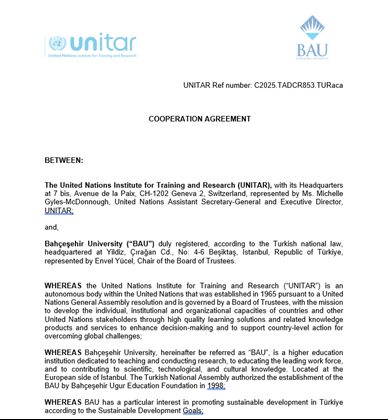
Bahçeşehir University (BAU) actively contributes to SDG-related policy development, sustainable governance, and international policy dialogue through CIFAL Istanbul, an international training centre operating within the University in partnership with the United Nations Institute for Training and Research (UNITAR). As a member of the UNITAR Global CIFAL Network, CIFAL Istanbul serves as BAU's institutional platform for connecting academic expertise, international cooperation, and multi-stakeholder engagement to support SDG policy formulation, strategic planning, and implementation at national, regional, and global levels.
Under the BAU–UNITAR Cooperation Agreement (2023–2025), the University integrates its academic expertise, research capabilities, institutional resources, and international partnerships into CIFAL Istanbul's programmes and initiatives. This cooperation supports policy-oriented research and knowledge exchange, expert consultations, multi-stakeholder dialogues, and capacity-building activities that contribute to identifying sustainable development priorities, addressing governance challenges, and developing evidence-informed approaches to SDG policy formulation and implementation. Through this institutional framework, BAU connects university-based knowledge with policymakers, public institutions, international organizations, civil society, and the private sector, supporting the integration of scientific evidence and international good practices into sustainable development policy processes.
In 2025, CIFAL Istanbul, operating within BAU, conducted 141 activities, including forums, expert workshops, conferences, seminars, training programmes, and multi-stakeholder dialogues. These initiatives addressed key sustainable development priorities, including climate action, sustainable governance, gender equality, social inclusion, economic development, digital transformation, artificial intelligence, and institutional leadership.
A central dimension of BAU's work through CIFAL Istanbul is supporting SDG policy development by bringing academic knowledge into dialogue with institutional needs and practical governance challenges. The University's activities facilitate discussions on emerging policy priorities, institutional and regulatory challenges, sustainable development strategies, and barriers to effective SDG implementation.
By engaging government officials, policymakers, international organizations, NGOs, academic experts, and private-sector representatives, BAU creates opportunities for cross-sectoral consultation and the exchange of perspectives relevant to policy formulation, strategic planning, and institutional decision-making. These interactions help stakeholders identify shared priorities, evaluate different approaches, and explore collaborative responses to sustainable development challenges.
BAU's academic resources, combined with UNITAR's international expertise and the Global CIFAL Network, strengthen the connection between scientific knowledge and public policy development. This institutional cooperation supports the translation of international SDG frameworks into context-specific strategies and encourages their integration into governance and institutional planning.
At the national level, BAU supports policy-oriented discussions addressing Türkiye's sustainable development priorities. At the regional and global levels, the University's engagement through CIFAL Istanbul facilitates international knowledge exchange, comparative learning, and cooperation on approaches to shared sustainability challenges.
The 141 activities conducted in 2025 demonstrate the scale and continuity of this institutional engagement, providing opportunities for policy dialogue, stakeholder consultation, institutional capacity development, and the exchange of evidence-informed strategies.
Through CIFAL Istanbul and its sustained partnership with UNITAR, Bahçeşehir University contributes not only to SDG education and capacity building but also to the identification of policy priorities, the development of sustainable governance strategies, and the integration of SDG objectives into national, regional, and international policy discussions.
This work contributes primarily to SDG 17 (Partnerships for the Goals) through international cooperation and multi-stakeholder engagement in policy development, and SDG 16 (Peace, Justice and Strong Institutions) through evidence-informed governance and institutional capacity building. It also supports SDGs 4, 5, 8, 9, 11, and 13 through education, gender equality, economic development, innovation, sustainable communities, and climate action.
11- BAU Rotary Peace Center – A Neutral Platform for Peacebuilding and Policy Development in the MENA Region
The image below shows a screenshot from the official Rotary International website indicating that Bahcesehir University hosts a Rotary Peace Center, serving as a neutral platform for peacebuilding and policy development in the MENA region.

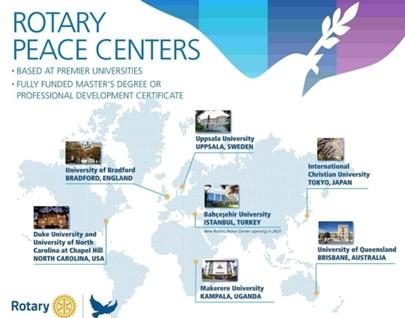
Bahçeşehir University (BAU) plays an active role in advancing peacebuilding, inclusive governance, international policy dialogue, and institutional capacity development through the BAU Otto and Fran Walter Rotary Peace Center, established at the University in partnership with Rotary International. The Centre's work is further supported by BAU's institutional partnership with the United Nations Institute for Training and Research (UNITAR) through CIFAL Istanbul. Serving the Middle East and North Africa (MENA) region, the Centre positions BAU as an international academic platform where policymakers, government representatives, civil society leaders, academics, international organizations, and peacebuilding professionals can engage in constructive dialogue on complex regional and global challenges.
The Centre reflects BAU's commitment to providing a safe, inclusive, and politically neutral environment for dialogue among individuals representing different countries, institutional backgrounds, political perspectives, and professional experiences. By encouraging open discussion, mutual understanding, and the exchange of diverse viewpoints, BAU facilitates engagement across political, cultural, and institutional boundaries, supporting collaborative approaches to conflict resolution, sustainable governance, and policy development.
Through its academic programmes, BAU combines capacity building, policy-oriented education, expert consultations, and practical field engagement. The Centre brings together Rotary Peace Fellows and professionals from across the MENA region, equipping participants with knowledge and practical skills in peacebuilding, conflict transformation, humanitarian diplomacy, migration, climate resilience, community development, and sustainable governance. Its academic coursework, workshops, seminars, and field-based projects strengthen participants' abilities to address complex challenges and contribute to informed institutional and policy responses.
A major milestone in 2025 was the Rotary Presidential Peace Conference, “Healing in a Divided World,” held in Istanbul on 20–22 February 2025. Organized under the leadership of Rotary International President Stephanie Urchick, with Bahcesehir University playing a prominent institutional and academic hosting role through the BAU Otto and Fran Walter Rotary Peace Center, the conference brought together more than 1,000 participants from over 80 countries, including international leaders, policymakers, peacebuilding practitioners, academic experts, NGO representatives, and stakeholders from diverse political and institutional backgrounds.
The conference provided an international platform for dialogue across differing perspectives, enabling participants to exchange experiences, examine shared challenges, and explore collaborative responses to issues affecting peace, governance, and sustainable development. Discussions addressed conflict prevention, social polarization, reconciliation, climate diplomacy, environmental challenges, and the role of institutions and communities in building sustainable peace.
BAU contributed directly to the conference's international academic and policy dialogue. BAU Rector Prof. Dr. Esra Hatipoğlu delivered a keynote address, while Prof. Dr. Esra Albayrakoğlu, Academic Director of the BAU Otto and Fran Walter Rotary Peace Center, contributed a session on Climate Diplomacy, connecting environmental challenges with international cooperation and peacebuilding strategies.
Beyond facilitating dialogue, the conference and the Centre's continuing activities support policy development and institutional capacity building by connecting academic research, policymaking perspectives, and practical experience. These exchanges create opportunities to identify emerging policy priorities, examine institutional and governance challenges, share evidence-informed approaches, and strengthen the capacity of participants to contribute to policy formulation and implementation within their respective organizations and communities.
The Centre also serves as a mechanism for international knowledge exchange and cross-sectoral cooperation, bringing together stakeholders who may hold different political positions or represent institutions with distinct priorities. Through this inclusive approach, BAU promotes constructive engagement, mutual learning, and collaborative problem-solving, reinforcing the importance of dialogue and institutional cooperation in addressing interconnected global challenges.
At the regional and global levels, BAU's participation in Rotary International's peacebuilding network, alongside its wider cooperation with UNITAR, strengthens its international engagement in sustainable development, peace education, and institutional capacity building. These partnerships support knowledge exchange among academic institutions, international organizations, governments, and NGOs and reinforce BAU's contribution to policy-oriented discussions on peace and sustainable governance.
Through the BAU Otto and Fran Walter Rotary Peace Center and its active participation in the 2025 Rotary Presidential Peace Conference, Bahçeşehir University contributes simultaneously to international policy dialogue, peacebuilding capacity development, inclusive stakeholder engagement, and evidence-informed approaches to sustainable governance. The initiative demonstrates BAU's role as a trusted academic convenor that connects individuals and institutions across different backgrounds, strengthens their capacity to address complex challenges, and supports cooperation on shared sustainable development priorities.
This engagement contributes directly to SDG 16 (Peace, Justice and Strong Institutions) through peacebuilding, inclusive dialogue, and institutional governance; SDG 17 (Partnerships for the Goals) through international cooperation and multi-stakeholder engagement; and SDG 4 (Quality Education) through professional education and capacity development. It also supports SDG 10 (Reduced Inequalities) through inclusive participation and dialogue across diverse backgrounds, and SDG 13 (Climate Action) through climate diplomacy and discussions connecting environmental challenges with peacebuilding and international cooperation.
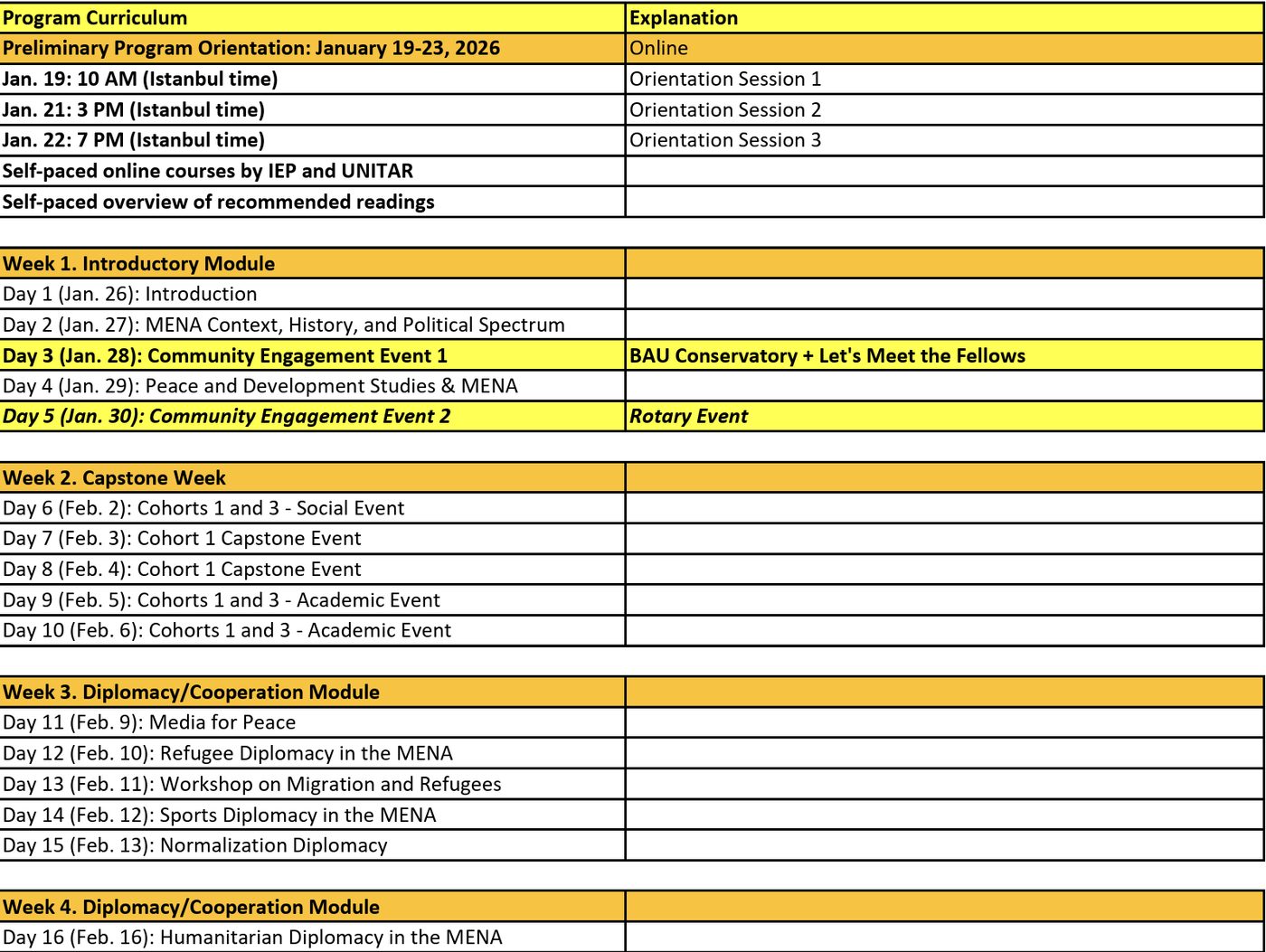
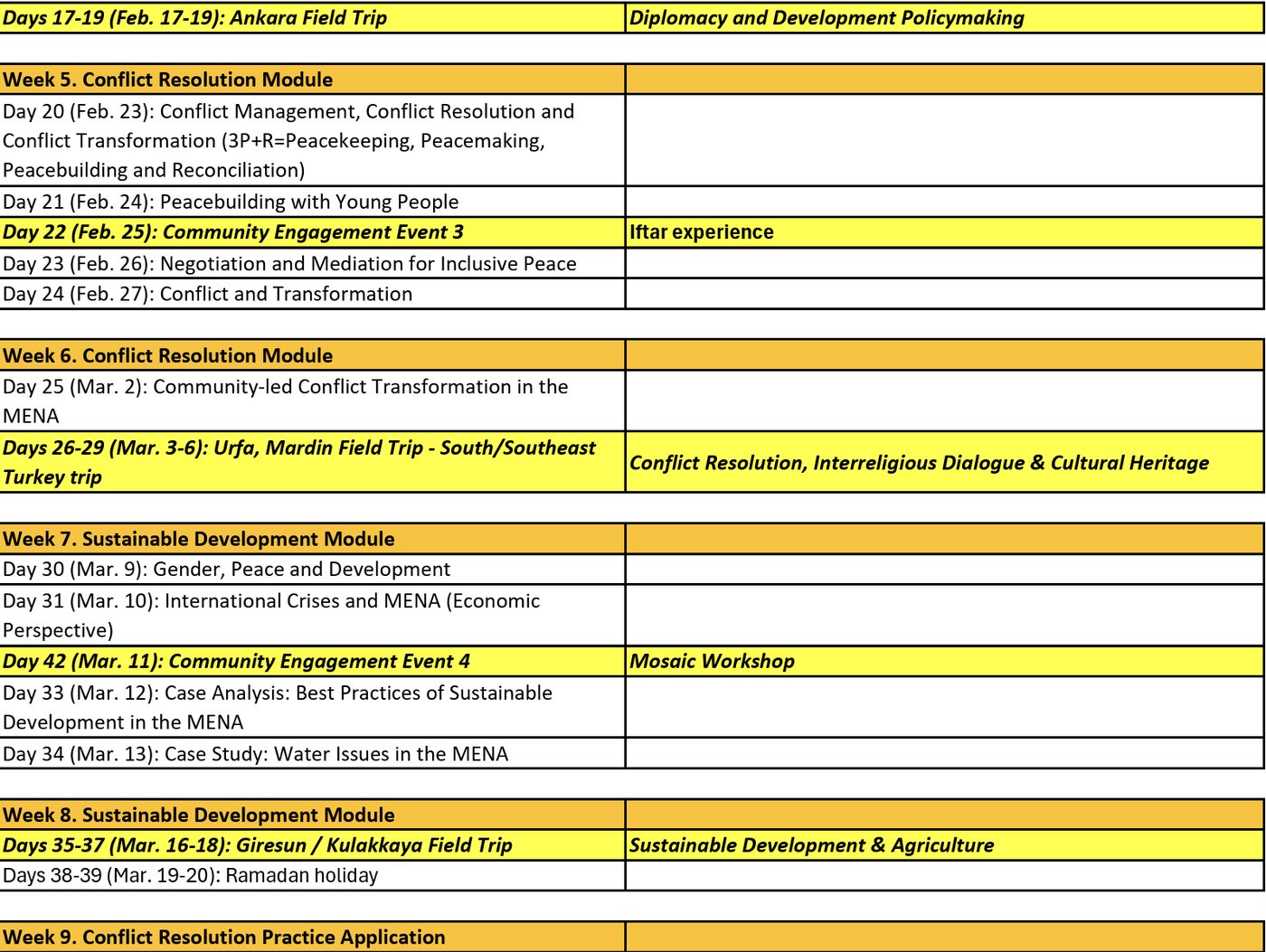
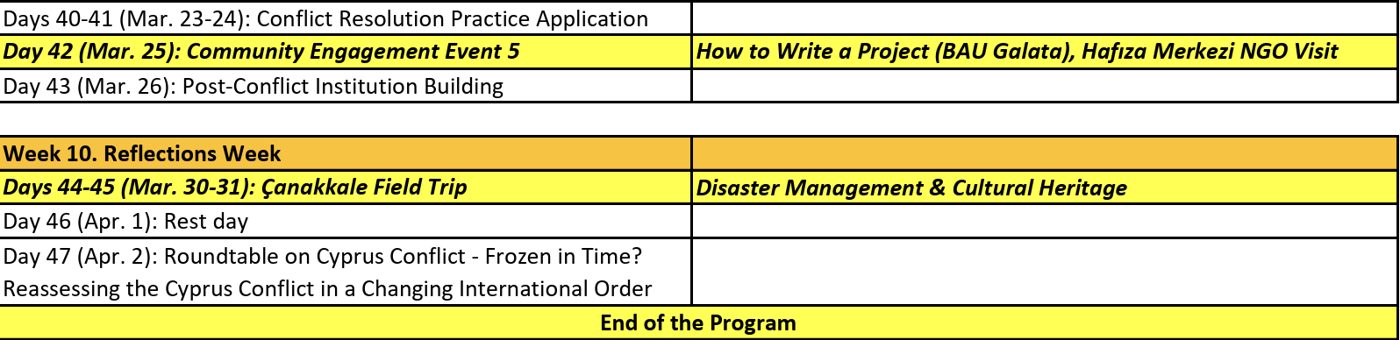
The images below represents the official 10-week curriculum, including modules which focused on displacement, refugee diplomacy, migration and refugees, humanitarian diplomacy, climate-related challenges, sustainable development, conflict resolution, and post-conflict institution building
12- Bahçeşehir University's Contribution to International SDG Policy Development through the Agroecology Coalition
The image below shows a screenshot from the official website of the Agroecology Coalition, indicating Bahcesehir University’s membership in the global initiative for transforming food systems.
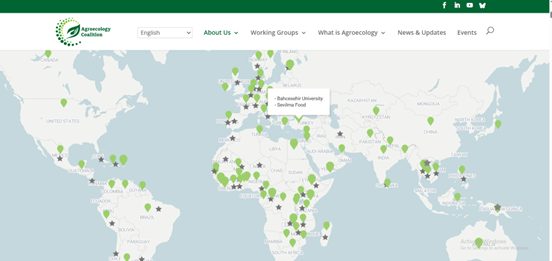
Bahçeşehir University (BAU) contributes to international SDG-related policy development, sustainable food systems governance, and evidence-informed agricultural strategies through its institutional membership in the Agroecology Coalition, a United Nations–supported global initiative established following the 2021 United Nations Food Systems Summit (UNFSS).
The Coalition brings together more than 300 members, including governments, universities, non-governmental organizations (NGOs), and international institutions, to advance the transition towards sustainable and resilient food systems. Its work is guided by the 13 Principles of Agroecology developed by the High-Level Panel of Experts for Food Security and Nutrition (HLPE-FSN) and the 10 Elements of Agroecology endorsed by the FAO Council in 2019.
As an official member, BAU participates in the Coalition's thematic working groups on Policies; Research, Innovation and Education; and Implementation. These platforms provide opportunities for the University to engage with international stakeholders in discussions concerning supportive policy frameworks, sustainable agricultural practices, research priorities, and strategies for integrating agroecology into national and regional development agendas.
BAU's engagement in the Policies Working Group is particularly relevant to SDG policy development, connecting academic knowledge and research perspectives with international efforts to strengthen enabling policy environments for agroecological transformation. Through its participation, the University supports policy-oriented knowledge exchange, evidence-informed approaches, and dialogue on regulatory and institutional conditions necessary for sustainable food systems.
The Coalition's multi-stakeholder structure also enables BAU to engage with governments, NGOs, international organizations, and research institutions on shared policy challenges, including food security, climate resilience, biodiversity protection, sustainable agricultural investment, and the implementation of agroecological practices.
Beyond policy dialogue, BAU's participation in the Research, Innovation and Education and Implementation working groups connects research-based knowledge with practical approaches to sustainable agriculture. This reinforces the relationship between policy development, institutional capacity building, scientific collaboration, and implementation, supporting the translation of sustainability objectives into actionable strategies.
Through this international engagement, Bahçeşehir University contributes to collaborative processes that inform SDG-related policy priorities and promote the exchange of international best practices, strengthening the role of higher education institutions in addressing interconnected food, climate, and biodiversity challenges.
The initiative primarily supports SDG 2 (Zero Hunger) through sustainable agriculture and food security; SDG 13 (Climate Action) through climate-resilient food systems; SDG 15 (Life on Land) through biodiversity protection and ecosystem restoration; and SDG 17 (Partnerships for the Goals) through international cooperation among academia, governments, NGOs, and multilateral organizations.
13- Bahçeşehir University's Strategic Partnership with Habitat Association: Advancing SDG Policy Dialogue, Inclusive Education and Sustainable Development
The photograph below documents the official signing ceremony of the cooperation protocol between Bahçeşehir University (BAU) and Habitat Association, attended by BAU Rector Prof. Dr. Esra Hatipoğlu and Habitat Association Executive Board President Bora Caldu.
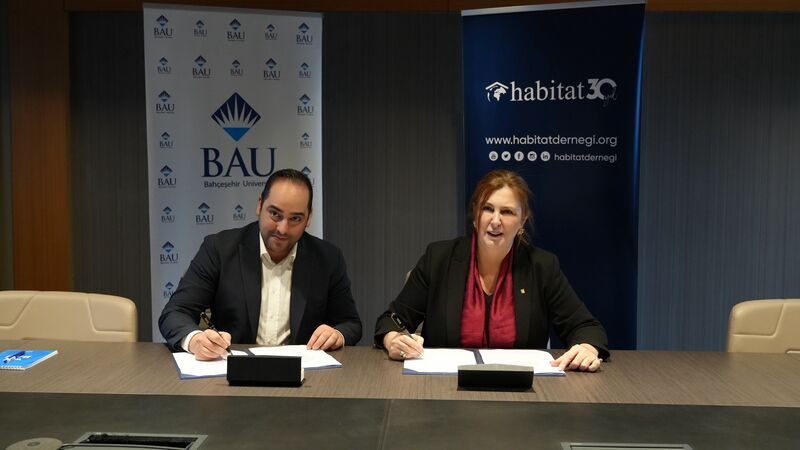
In 2025, Bahçeşehir University (BAU) strengthens its engagement in SDG-related policy dialogue, inclusive education, digital transformation, and sustainable development through an institutional cooperation protocol with Habitat Association, a leading Turkish non-governmental organization (NGO) working in capacity development, entrepreneurship, social inclusion, and public policy engagement.
Habitat Association contributes to public policy processes at local, national, and international levels, drawing on research, social impact assessments, multi-stakeholder partnerships, and advocacy initiatives. Its work addresses key sustainable development priorities, including digital inclusion, equal opportunities, youth participation, entrepreneurship, and sustainable economic development.
The BAU–Habitat Association Cooperation Protocol, signed by BAU Rector Prof. Dr. Esra Hatipoğlu and Habitat Association Executive Board President Bora Caldu, establishes a framework for expanding and implementing joint educational and capacity-building initiatives. The cooperation encompasses sustainability, digital transformation, and entrepreneurship programmes, the continuation of training activities through the Artificial Intelligence Classroom within BAU's Faculty of Educational Sciences, and scholarship cooperation at master's and doctoral levels.
Through this partnership, BAU connects its academic expertise, educational infrastructure, and research capabilities with an NGO actively engaged in public policy dialogue and sustainable development initiatives. The collaboration creates opportunities for knowledge exchange and the development of inclusive educational approaches addressing challenges relevant to SDG policy priorities, particularly digital inequalities, access to advanced technologies, sustainable entrepreneurship, and equitable educational opportunities.
By combining BAU's academic and institutional resources with Habitat Association's experience in community-based programmes, research, and engagement with public institutions, the partnership supports institutional capacity development, evidence-informed approaches, and cooperation between academia and civil society.
The initiative also provides a foundation for strengthening dialogue between academic knowledge and the practical challenges addressed by civil society organizations, contributing to broader discussions on inclusive digital transformation, sustainable development strategies, and equitable access to education and economic opportunities.
Through its cooperation with Habitat Association, Bahçeşehir University reinforces its role as an academic partner in NGO-led sustainable development initiatives, supporting SDG-oriented capacity building, cross-sectoral knowledge exchange, and policy-relevant collaboration.
The partnership primarily contributes to SDG 4 (Quality Education) through educational access and advanced learning opportunities; SDG 8 (Decent Work and Economic Growth) through entrepreneurship and skills development; SDG 9 (Industry, Innovation and Infrastructure) through artificial intelligence and digital transformation; SDG 10 (Reduced Inequalities) through inclusive participation; and SDG 17 (Partnerships for the Goals) through university–NGO cooperation.
14- Bahçeşehir University's Research Contributions to Governmental, Intergovernmental and Civil Society Policy Development
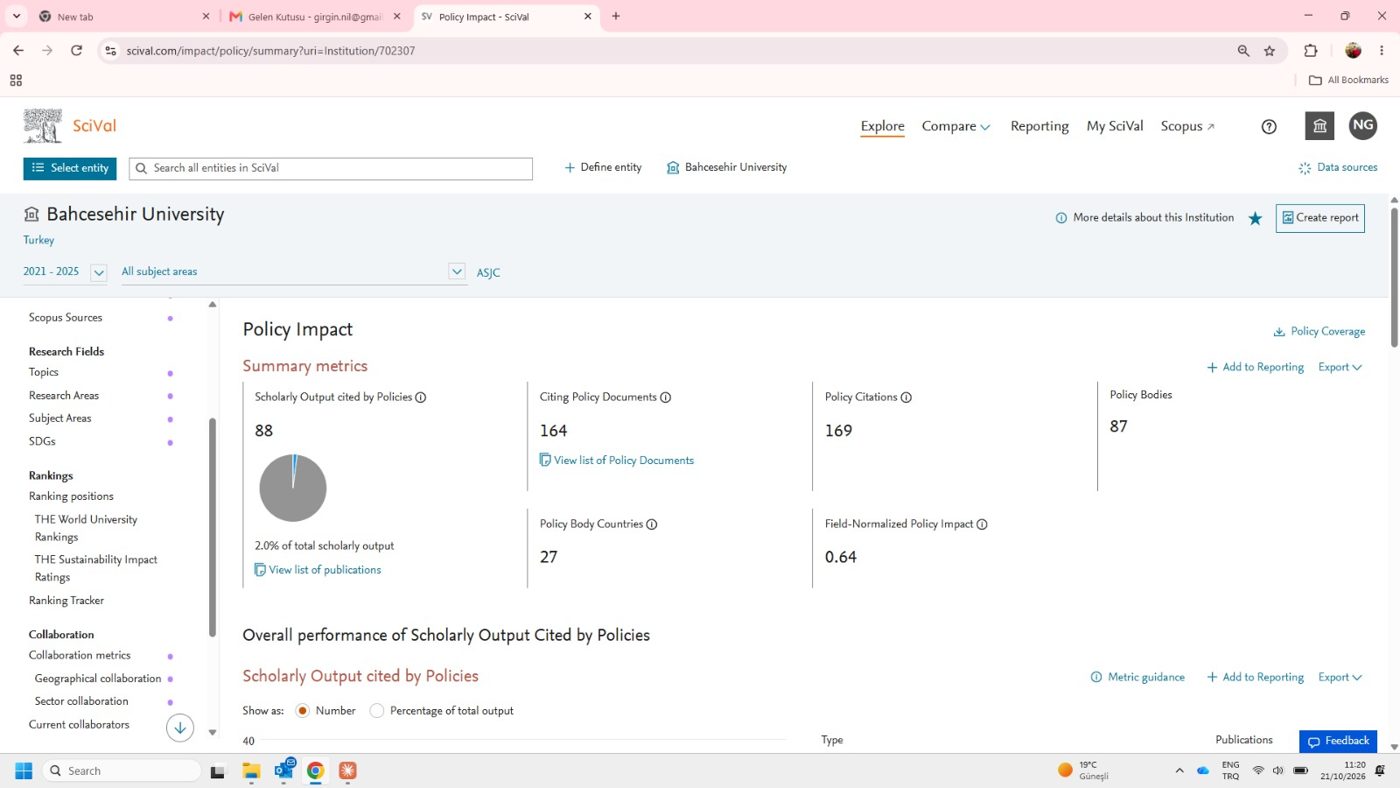
The screenshot below, taken from Bahçeşehir University's institutional profile on Elsevier's SciVal Policy Impact platform, presents the University's research contributions to policy-related documents. For the 2021–2025 publication period, it shows that 88 BAU scholarly publications were cited in 164 policy documents, generating 169 policy citations from 87 policy bodies across 27 countries.
Bahçeşehir University (BAU) contributes to evidence-informed policymaking by producing academic research that is referenced in policy documents issued by governmental institutions, intergovernmental organizations, and independent policy research bodies worldwide. This international research-to-policy reach demonstrates the relevance of the University's scholarly output beyond academia and its contribution to the knowledge base used in public policy analysis, institutional decision-making, and the development of responses to societal challenges.
Independent evidence of this contribution is provided by Elsevier's SciVal Policy Impact Analytics, drawing on data from the Overton policy document database. According to BAU's institutional profile, covering scholarly publications from 2021 to 2025, 88 BAU-affiliated academic publications have been cited in 164 policy documents, generating 169 policy citations from 87 policy bodies across 27 countries.
The policy documents referencing BAU research reflect a broad international and cross-sectoral institutional reach.
Governmental and Public Institutions
BAU-affiliated research has been referenced in documents issued by governmental and public institutions in different countries, including the Government of Japan, Government of Türkiye, French government ministries, and public institutions in the United Kingdom.
The dataset includes a document issued by the Government of Japan through its Ministry of Health, Labour and Welfare, as well as clinical guidance published by the United Kingdom's National Institute for Health and Care Excellence (NICE). These references illustrate the presence of BAU research within government-issued documentation and public-sector evidence resources.
Intergovernmental and International Organizations
BAU research is also referenced in documents published by major international organizations, including UNESCO, the World Bank, the Organisation for Economic Co-operation and Development (OECD), and institutions of the European Union.
The identified documents address areas such as higher education, artificial intelligence, digital transformation, climate change, human capital, and sustainable employment. Their inclusion demonstrates the international dissemination of BAU research within policy-oriented publications addressing development priorities relevant to the SDGs.
Independent Policy Research Institutions and Other Organizations
The SciVal dataset also identifies references to BAU research in documents produced by independent policy research institutions, think tanks, and other organizations contributing to public policy discussions.
This institutional diversity is particularly relevant to the University's commitment to supporting evidence-informed decision-making across sectors. It demonstrates that BAU's academic research is accessible and relevant not only to governmental institutions but also to organizations involved in policy research, analysis, and public dialogue.
Contribution to Sustainable Development and Evidence-Informed Governance
The policy documents referencing BAU research span several areas connected to sustainable development, including quality education, public health, technological innovation, climate action, social inclusion, and institutional development.
This research-to-policy reach supports the broader objectives of SDG 16 (Peace, Justice and Strong Institutions) by contributing scholarly evidence relevant to informed institutional and public decision-making, and SDG 17 (Partnerships for the Goals) by facilitating the international circulation and use of academic knowledge among governmental, intergovernmental, and policy-oriented institutions.
Together with BAU's direct policy engagement, institutional partnerships, and collaborative research initiatives, these independently documented references provide evidence of the University's contribution to connecting academic knowledge with policy-relevant challenges at national and international levels.











