





 EN
4.3.1 - Free Public Access to Educational Resources and Learning Opportunities
Bahçeşehir University (BAU) is committed to advancing quality education, lifelong learning, and equal access to educational opportunities by extending its educational resources and learning opportunities beyond its enrolled student community. In alignment with SDG 4: Quality Education, the University promotes free public access to educational resources for individuals who are not studying at the University, supporting inclusive learning opportunities for the wider community.
Through initiatives including Free Resources for Lifelong Learners, Free Courses Leading to Certificates, and Free Access to Library and Educational Resources, BAU provides opportunities for individuals of different ages, educational backgrounds, and professional experiences to access knowledge and develop new skills. These initiatives encompass free access to library resources, online educational materials, courses, lectures, and other learning opportunities, making educational resources available to individuals beyond the University's formally enrolled students.
By providing free access to educational resources and learning opportunities for the wider public, Bahçeşehir University supports continuous personal and professional development, encourages community engagement, and helps reduce financial and institutional barriers to education. This approach reflects the University's commitment to ensuring that access to knowledge and educational resources is not limited to those pursuing formal degree programmes.
The following sections present the University's initiatives, implementation practices, and supporting evidence demonstrating how free access to educational resources, library facilities, online courses, lectures, and certificate programmes is provided to individuals who are not studying at Bahçeşehir University. Together, these initiatives illustrate BAU's ongoing commitment to expanding lifelong learning opportunities, providing free educational and certification pathways, and making knowledge and learning resources accessible to the wider community.
1- BAU Open Learning
The image below shows the homepage of Open BAU, Bahcesehir University’s open education platform
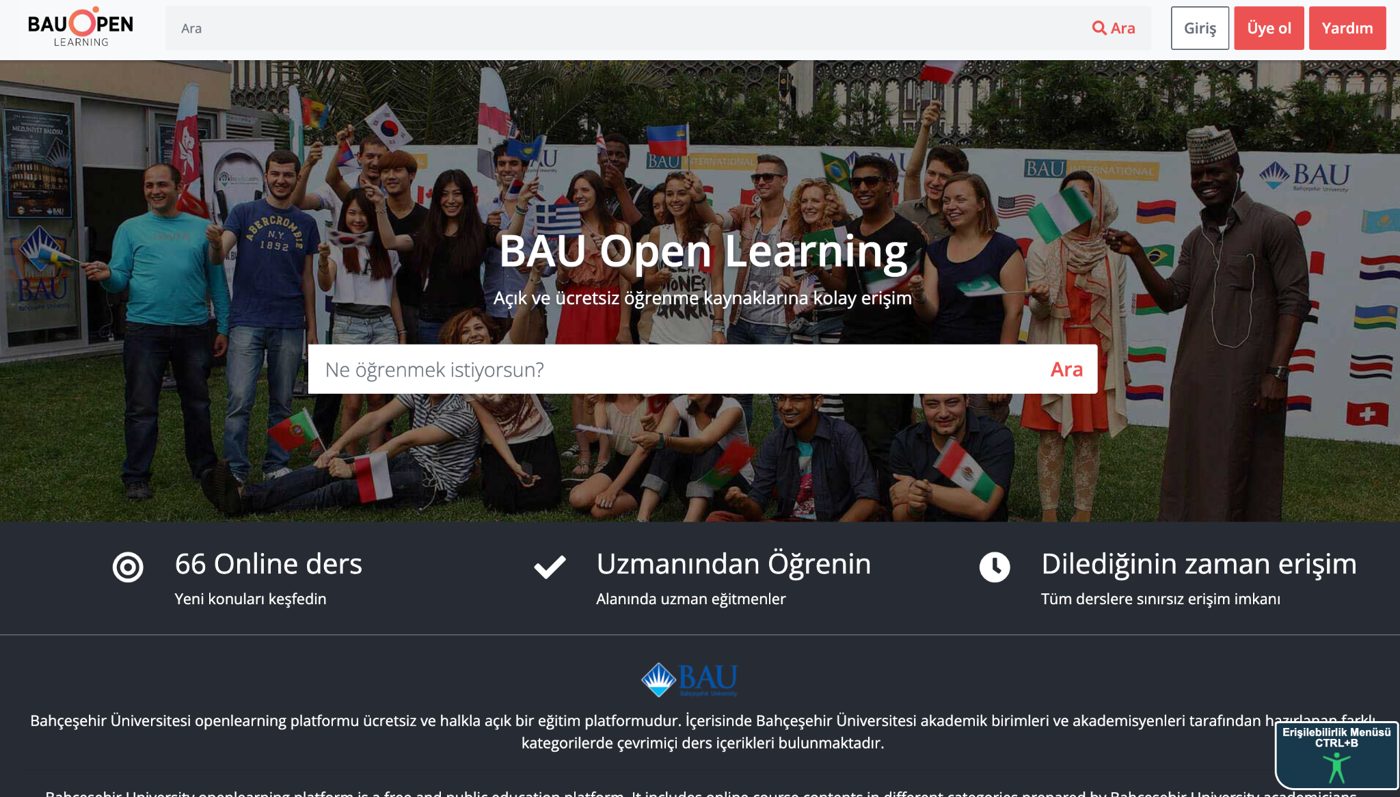
Bahcesehir University (BAU) Open Learning Platform is a free and publicly accessible educational initiative established to promote open and inclusive learning opportunities for all. The platform offers a wide range of online course materials across diverse disciplines, meticulously prepared and curated by Bahçeşehir University’s distinguished academic staff.
Designed to support both individual and professional development, the BAU Open Learning platform embodies the University’s commitment to lifelong learning, inclusive and equitable access to education, digital learning, and the democratization of knowledge. The platform is completely free of charge and open to everyone, regardless of age, educational background, professional status, nationality, or institutional affiliation. No university enrollment or tuition payment is required, ensuring that learning opportunities extend beyond the University’s students and academic community to the wider public, both nationally and internationally. By providing free and unrestricted access to high-quality educational resources , BAU Open Learning removes financial and geographical barriers to education, enabling individuals from diverse backgrounds to develop new skills, enhance their knowledge, and engage in self-paced lifelong learning.
During the 2024–2025 academic year, Open BAU recorded 4,297 registered users, while Google Analytics data indicated approximately 23,000 active users accessing the platform during the reporting period. These figures demonstrate the substantial public reach of BAU’s free and openly accessible learning resources, highlighting the University’s contribution to making lifelong learning opportunities available beyond its enrolled student population and institutional community.
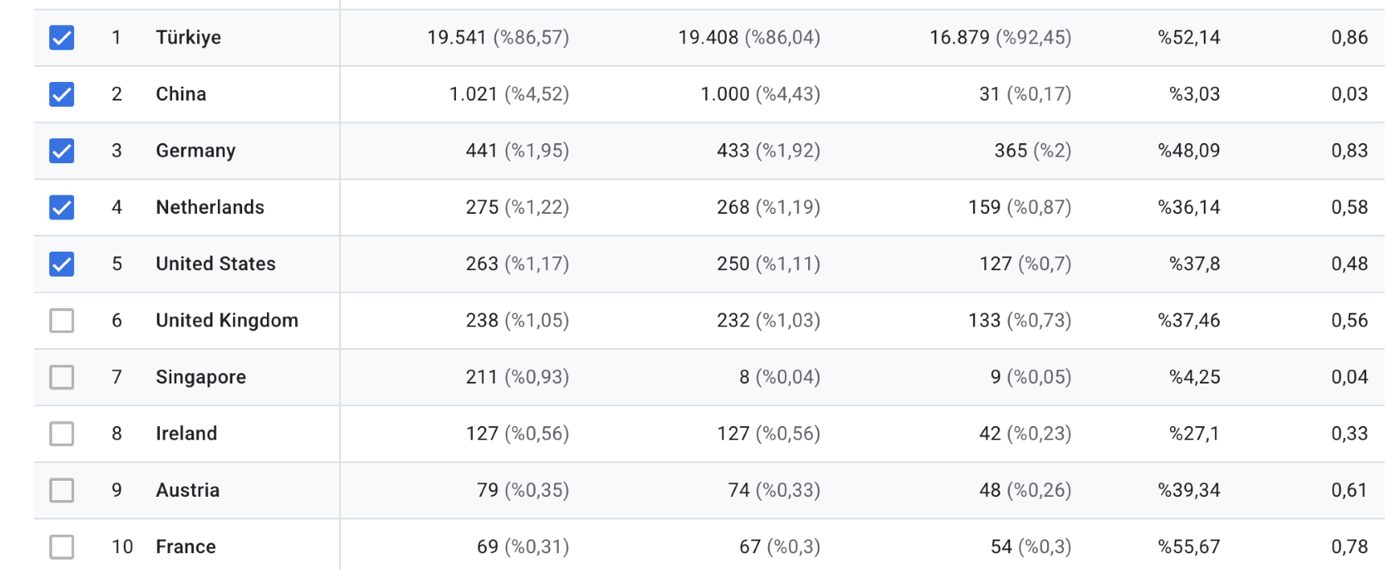
Open BAU’s reach also extended well beyond Türkiye, demonstrating the platform’s capacity to provide free access to educational resources across geographical and national boundaries. Google Analytics recorded 19,541 active users from Türkiye, alongside international audiences from China (1,021 users), Germany (441), the Netherlands (275), the United States (263), and the United Kingdom (238), among other countries. This geographical diversity illustrates how BAU’s open learning initiative enables individuals from different parts of the world to access educational content without tuition fees or university enrollment requirements, supporting the University’s commitment to inclusive education and lifelong learning.
The image below presents Google Analytics data illustrating the geographical distribution of Open BAU’s active users between September 1, 2024, and December 31, 2025. It provides a country-level breakdown of active users, new users, engaged sessions, and engagement rates, offering measurable evidence of the platform’s public accessibility, international reach, and engagement with freely available educational resources. The data includes users from Türkiye, China, Germany, the Netherlands, the United States, the United Kingdom, Singapore, Ireland, Austria, and France, further demonstrating the platform’s ability to reach audiences beyond the University’s immediate academic community.
OpenBAU Platform Overview
Bahçeşehir University recognizes equal opportunity, inclusivity, and accessibility in education as fundamental principles of its institutional commitment to lifelong learning. In line with these principles, the OpenBAU platform provides free and publicly accessible educational resources to individuals both within and beyond the University community, regardless of their educational background, institutional affiliation, or geographical location. Beyond removing financial barriers to learning, OpenBAU incorporates accessibility features designed to support the participation of individuals with diverse learning needs and abilities.
Accessibility and Inclusive Design
OpenBAU is designed to facilitate inclusive access to free educational resources across different devices and user environments, including for individuals with disabilities. The platform incorporates accessibility features aligned with internationally recognized World Wide Web Consortium (W3C) accessibility principles, including support for screen readers, keyboard navigation, and user-friendly content presentation.
An accessibility menu, located at the bottom right corner of the homepage, enables users to personalize their learning experience through features such as color contrast adjustments, text resizing, and alternative text support. These tools help reduce accessibility barriers, particularly for individuals with visual impairments, and support more equitable participation in digital learning opportunities.
Free Sign Language Education
As part of its commitment to inclusive education and broader public engagement, OpenBAU offers free sign language courses that are open to everyone, including individuals outside the University community. By making sign language education publicly accessible without financial barriers, the platform contributes to raising awareness of communication accessibility, strengthening inclusive communication skills, and promoting greater understanding of the needs of deaf and hard-of-hearing individuals.
Microsoft Teams Integration
OpenBAU also supports accessible learning experiences through integration with Microsoft Teams’ Immersive Reader functionality, which provides text-to-speech capabilities and customizable reading settings. Users can adjust font sizes, line spacing, and background colors according to their individual preferences and accessibility needs.
These features further strengthen OpenBAU’s role as an inclusive, free, and publicly accessible lifelong learning platform, reflecting Bahçeşehir University’s commitment to ensuring that educational opportunities are not limited by financial circumstances, institutional affiliation, geographical location, or individual accessibility needs.
2- Bahçeşehir University Library
Bahçeşehir University (BAU) Barbaros Library plays a central role in advancing the University's commitment to inclusive education, lifelong learning, and equitable access to knowledge. Beyond supporting the academic and research activities of BAU students, faculty, researchers, and administrative staff, the Library serves as a publicly accessible educational resource, extending learning and research opportunities to individuals outside the University community.
As part of its commitment to making knowledge accessible to all, BAU Barbaros Library is open to the general public, free of charge, without requiring enrollment or affiliation with Bahçeşehir University. Members of the public, students and academics from other universities, independent researchers, and other external visitors can access the Library by obtaining a free of charge daily entrance card. This arrangement enables individuals from diverse educational and professional backgrounds to benefit from the Library's available collections, study spaces, and learning resources without financial barriers or institutional membership requirements.
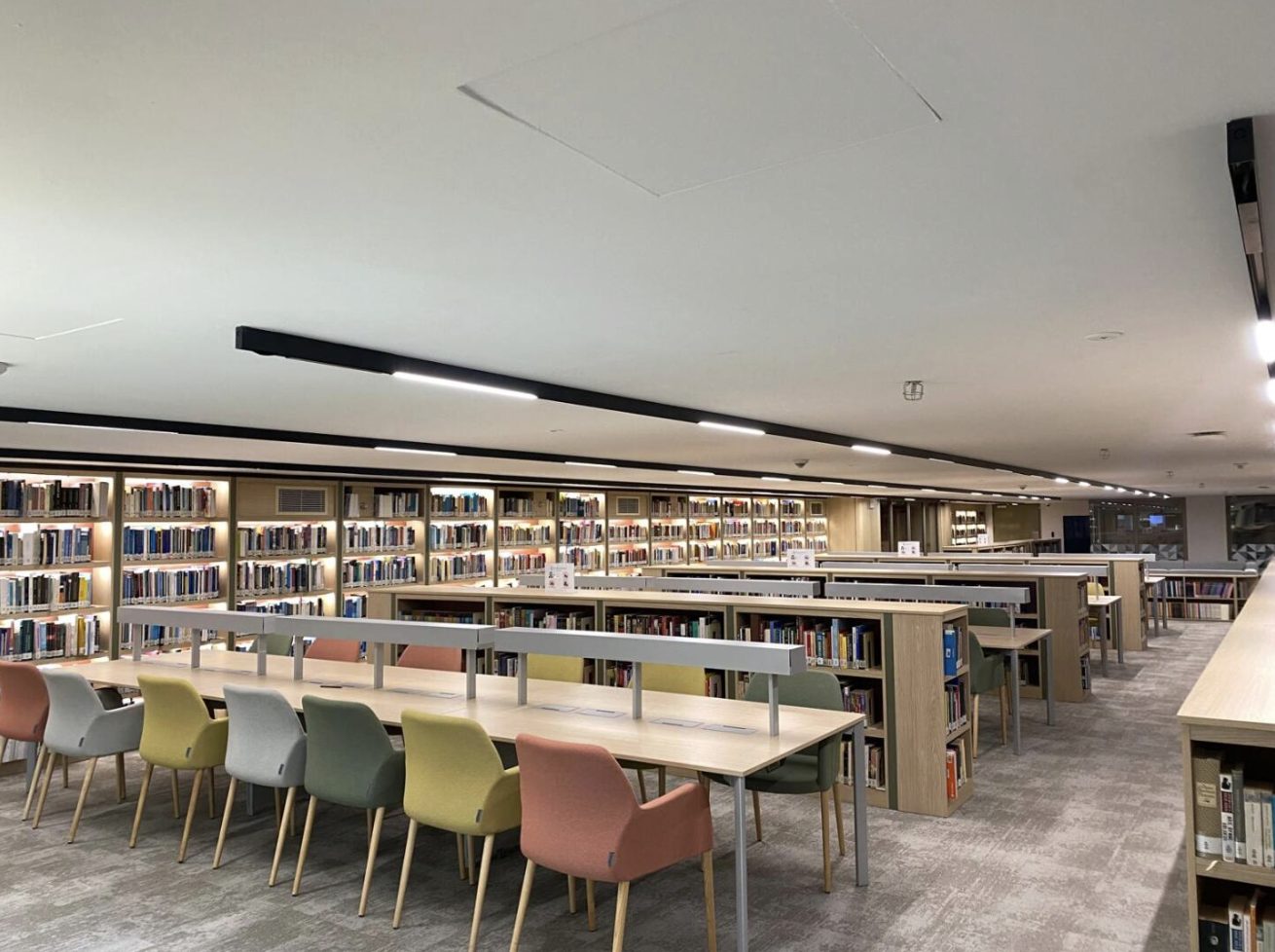
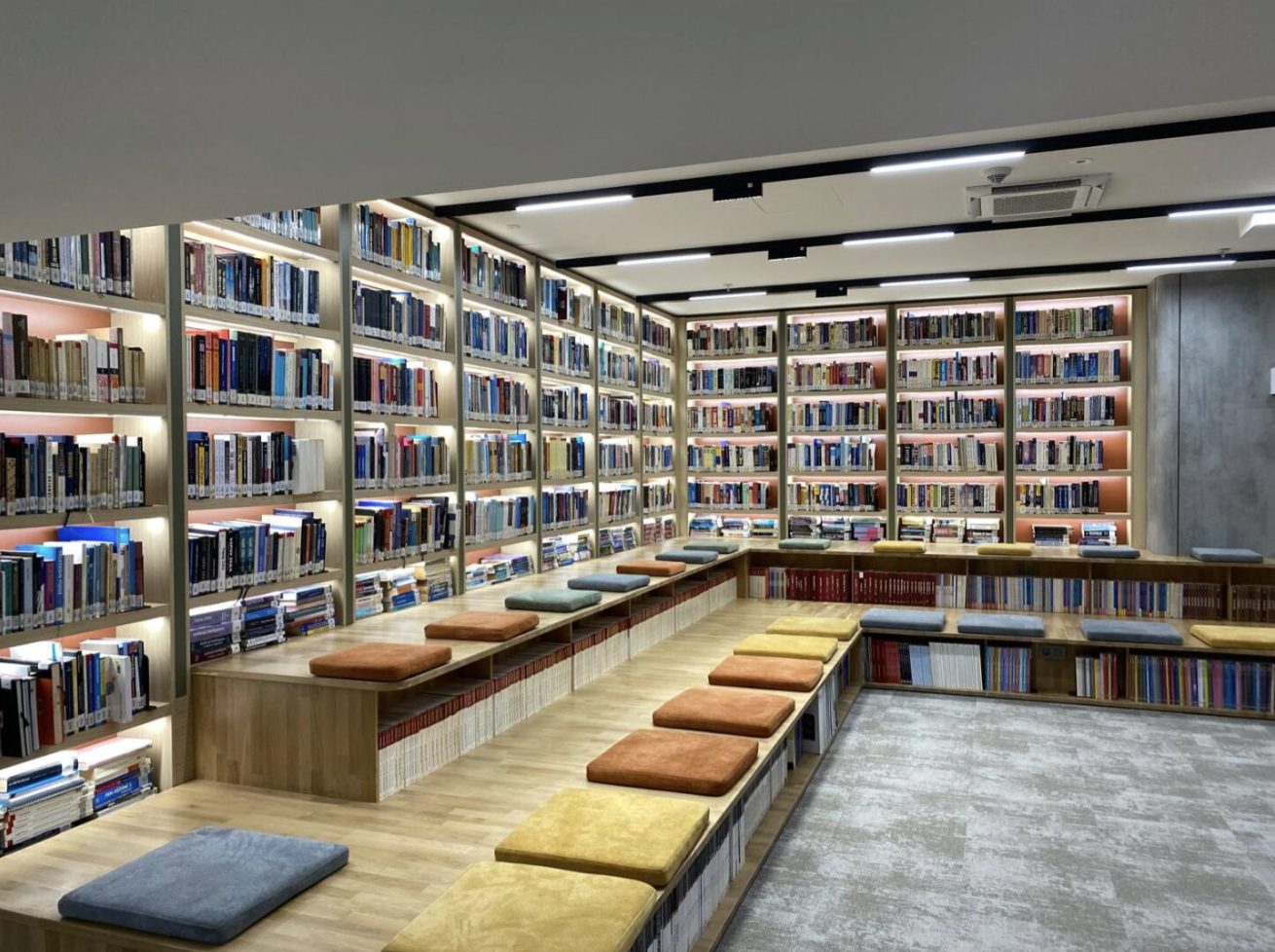
The opening of Barbaros Library's new building further strengthens the University's capacity to provide an inclusive and welcoming learning environment. With expanded study areas and facilities designed to accommodate different learning and research needs, the new building enhances opportunities for independent study, academic exploration, and collaborative learning. By making these facilities accessible to external visitors as well as the University community, BAU extends the benefits of its investment in educational infrastructure to the wider public.
In addition to its physical facilities, BAU Library provides publicly accessible open-access academic and educational resources through its official website, enabling individuals to explore available digital materials and information resources beyond the University's physical campus. These online resources complement the Library's on-site services and further support the University's commitment to removing barriers to knowledge and lifelong learning.
Bahçeşehir University also participates in the Free Interlibrary Loan System, supporting cooperation and resource sharing among academic institutions. Through this collaborative network, the University facilitates access to a wider range of academic and research materials, contributing to the exchange of knowledge and strengthening educational and research opportunities across participating institutions.
Together, these initiatives demonstrate Bahçeşehir University's commitment to providing free public access to educational resources, both physically and digitally, ensuring that opportunities for learning, independent research, and intellectual development extend beyond formal university enrollment.
The images below illustrate BAU Barbaros Library's facilities and publicly accessible learning spaces.
3- Bahçeşehir University Jean Monnet Chair on Feminist Epistemic Justice (FEJUST): Free Public Lectures and Open Educational Resources (2024–2025)
During the 2024–2025 academic year, Bahçeşehir University (BAU), through its Jean Monnet Chair on Feminist Epistemic Justice in the EU and Beyond (FEJUST), contributed to the University's commitment to providing free public access to educational resources and lifelong learning opportunities beyond formal university enrollment.
Under the theme "Gendering EU Politics," FEJUST organized a series of hybrid guest lectures and public seminars addressing gender equality, feminist perspectives, and policymaking within the European Union and beyond. Delivered by academics and practitioners, these educational activities were free of charge and open to the general public, including individuals who were not enrolled at or affiliated with Bahçeşehir University. Through Zoom and YouTube Live, participants could access academic discussions remotely, extending learning opportunities beyond the University's physical campus and reducing geographical and financial barriers to participation.
In addition to these public lectures and seminars, FEJUST made lecture notes and educational materials from its undergraduate courses, "Gender Politics in the EU" and "Gender in International Development," publicly available through its website. By sharing academic resources beyond the formal classroom, BAU enabled independent learners, researchers, students from other institutions, and interested members of the public to engage with university-level educational content without tuition fees or university enrollment requirements. The availability of these materials also supported continued self-directed learning beyond scheduled lectures and seminars.
Through these initiatives, FEJUST demonstrates how Bahçeşehir University extends its teaching and academic expertise to the wider community by providing free, publicly accessible lectures, seminars, and educational materials. This approach directly supports SDG 4 (Quality Education) by expanding opportunities for inclusive and lifelong learning, while also contributing to SDG 5 (Gender Equality) and SDG 10 (Reduced Inequalities) through the dissemination of educational resources addressing gender equality, social inclusion, and equitable participation.
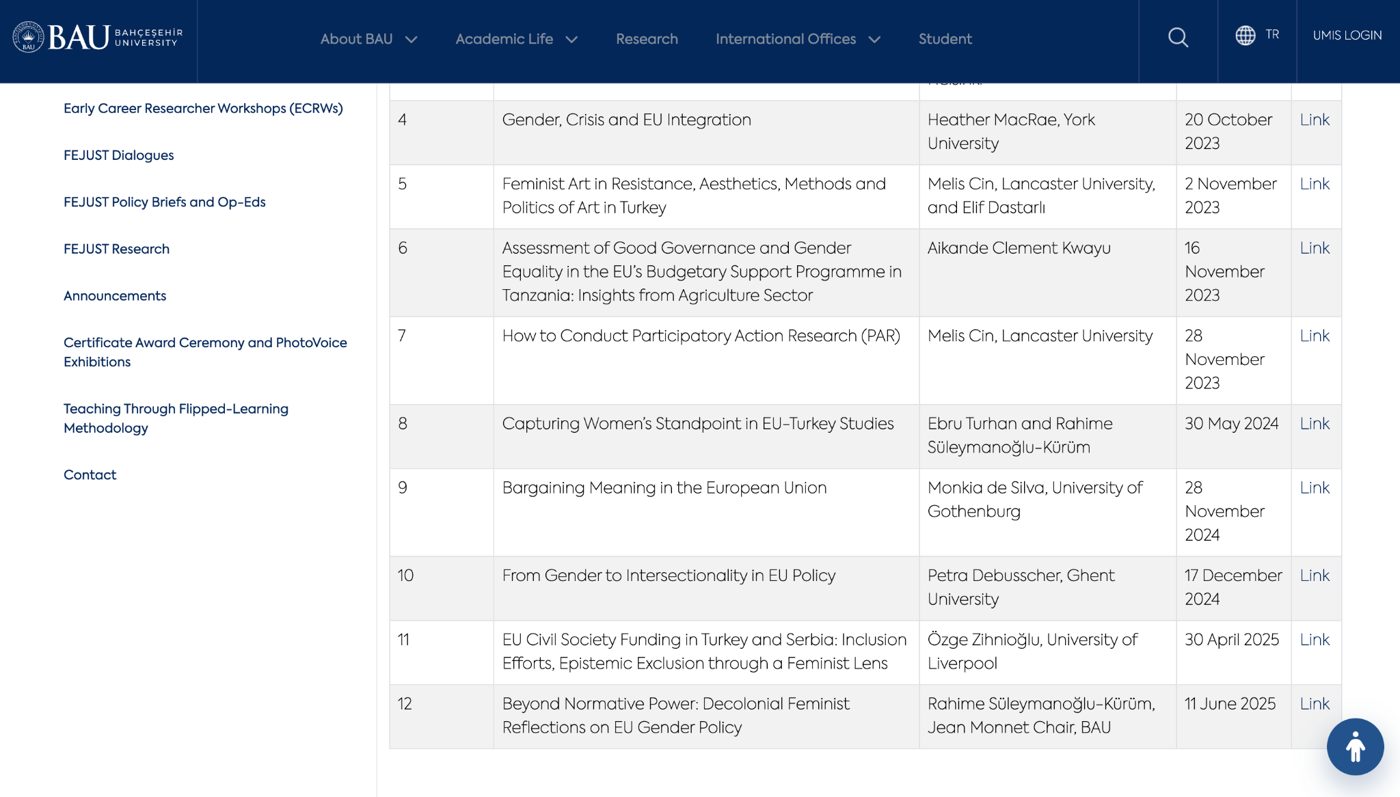
The image below presents the homepage of the Bahçeşehir University Jean Monnet Chair on Feminist Epistemic Justice (FEJUST), which provides public access to information about its educational activities and open learning resources.
4- Certification Programs
Bahcesehir University (BAU) offers a diverse selection of free short-term courses designed to provide participants with practical knowledge, new skills, and professional development opportunities. These programs are open to the public and lead to an official certificate of participation or specialization, supporting BAU’s mission to make lifelong learning and accessible education available to all.
Further information and examples of these programs are provided below.
4.1- Bahcesehir University Equal Opportunity in Technology Certification Program: Equal Opportunity in Technology: Advancing Women's Empowerment, Inclusive Education and International Partnerships through Free Technology Training
Bahçeşehir University (BAU), in partnership with the United Nations Institute for Training and Research (UNITAR), CIFAL Istanbul, and Yapı Kredi Bank, implements the Equal Opportunity in Technology Certification Program (Teknolojide Fırsat Eşitliği). UNITAR serves as a direct international institutional partner of the initiative, while CIFAL Istanbul, a UNITAR-affiliated training centre within the global CIFAL Network hosted by BAU, contributes to its international educational and capacity-building framework. Launched in 2023, this large-scale initiative aims to empower women through free and inclusive access to technology education, address gender disparities in technology-related fields, and extend university-level learning opportunities to individuals beyond formal higher education enrollment.
The programme responds to the persistent underrepresentation of women in technology, digital innovation, and other traditionally male-dominated fields, where unequal access to technical knowledge, professional networks, and development opportunities can limit women's educational and career prospects. By providing accessible technology training, the initiative seeks to strengthen women's digital competencies, encourage their participation in emerging technological sectors, and support greater gender equality in education and employment.
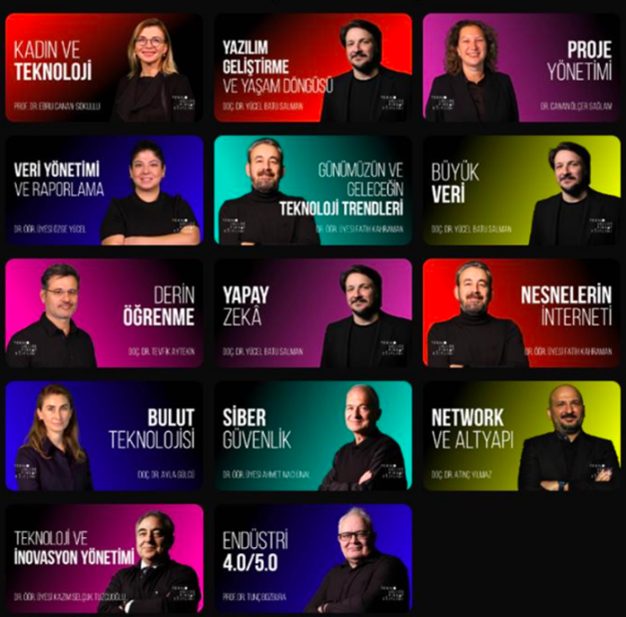
A central feature of the programme is its open and tuition-free educational model. All training is delivered by Bahçeşehir University's academic staff, extending the University's educational resources and academic expertise to the wider public. The curriculum covers six areas of digital transformation: Big Data, Artificial Intelligence, Cloud Technologies, Cybersecurity, the Internet of Things (IoT), and Industry 5.0. These modules provide participants with foundational technological knowledge and skills relevant to an increasingly digital economy, while promoting lifelong learning and professional development.
In 2025, the programme expanded its eligibility criteria to all women aged 15 and above, without an upper age limit or any requirement for university enrollment or affiliation. This inclusive approach enables women from different generations, educational backgrounds, employment situations, and socioeconomic circumstances to participate, including those who may otherwise face barriers to accessing technology education. By removing tuition fees and formal university admission requirements, BAU makes academic learning opportunities available to women beyond its own student community.
In 2025, the programme further expanded its international reach by opening participation to women in Azerbaijan, creating opportunities for cross-border educational engagement and the exchange of technological knowledge across national boundaries. This development strengthened the initiative's international dimension and demonstrated how cooperation among higher education, the private sector, and international education networks can support wider access to learning.
The programme also incorporates a dedicated inclusion measure for communities affected by the Kahramanmaraş-centered earthquakes. Individuals of any gender residing in the “Hope Cities” established by Koç Holding are eligible to participate free of charge. This provision extends educational outreach to disaster-affected communities and reflects BAU's commitment to reducing inequalities in access to learning opportunities among populations facing additional social and economic challenges.
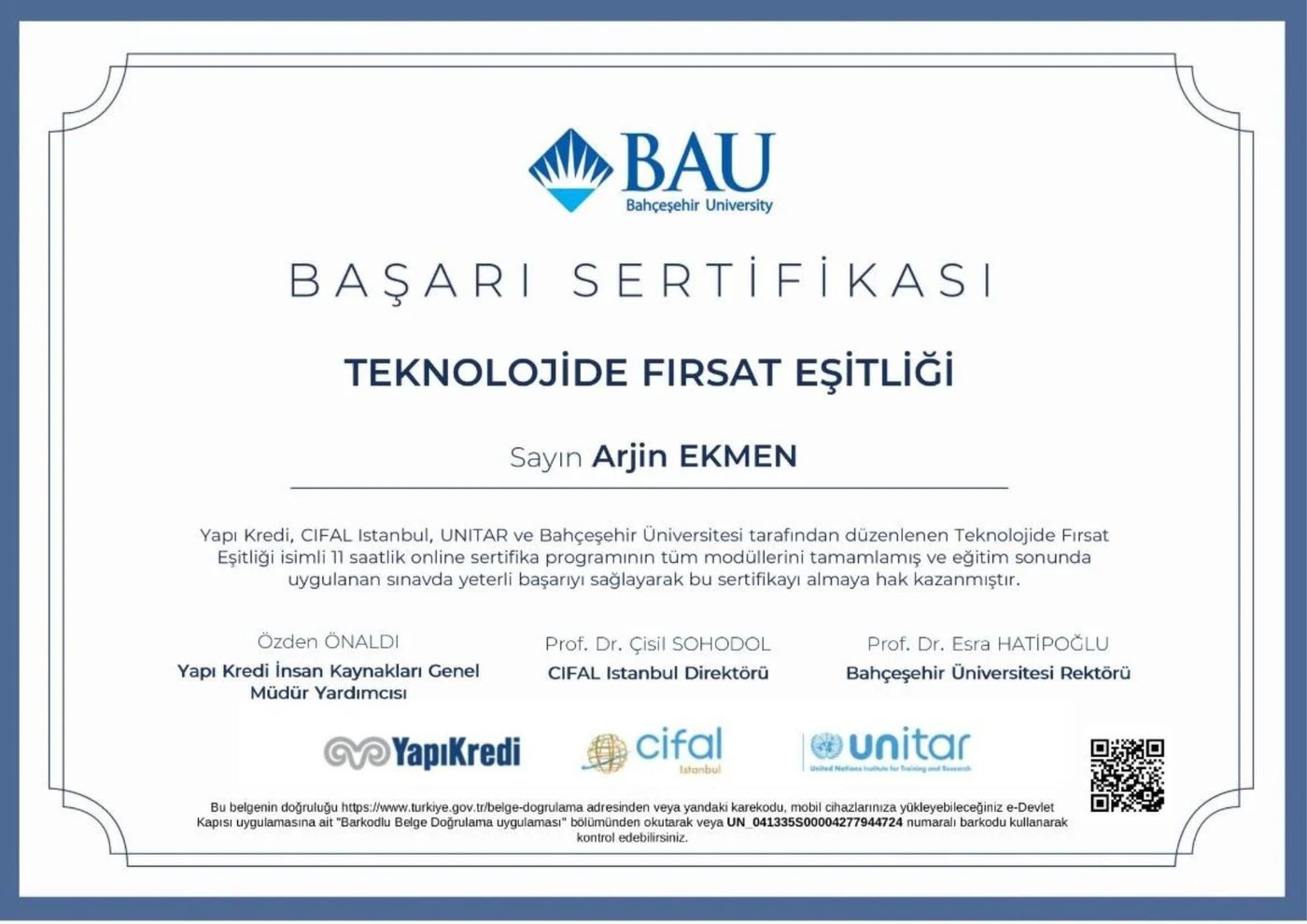
Participants who successfully complete the training and achieve a minimum score of 70 in the final assessment are eligible to receive an e-Government-verifiable Certificate of Achievement through the programme's certification framework involving BAU and UNITAR. Participants who complete at least 75% of the coursework may receive a Certificate of Participation. These certification opportunities recognize acquired competencies and support participants in demonstrating their learning achievements for personal and professional development.
The initiative represents a significant example of cross-sectoral cooperation and international partnership for sustainable development, bringing together Bahçeşehir University as a higher education institution, UNITAR as a United Nations organization and direct international programme partner, Yapı Kredi Bank as a private-sector partner, and CIFAL Istanbul as a UNITAR-affiliated training centre hosted by BAU. This institutional partnership connects academic expertise, international capacity-building resources, and corporate engagement to expand access to technology education and promote gender equality. The programme's expansion to Azerbaijan in 2025 further strengthens its international outreach and cross-border educational cooperation, demonstrating how partnerships across sectors and national boundaries can contribute to shared Sustainable Development Goals.
Since its launch in 2023, the programme has achieved substantial measurable impact. By the end of 2025, a total of 34,563 women had successfully completed the training and received certificates. With activities planned to continue through 2027, the initiative demonstrates a sustained commitment to expanding women's access to technology education and strengthening digital inclusion over time.
Through the Equal Opportunity in Technology Certification Program, BAU demonstrates how universities can extend educational opportunities beyond campus boundaries, address women's underrepresentation in technology, reduce barriers to lifelong learning, and contribute to international cooperation for sustainable development.
The programme contributes directly to several interconnected Sustainable Development Goals:
SDG 4 – Quality Education: By providing free, open-access technology education to individuals outside formal university enrollment, expanding educational outreach, and supporting lifelong learning and professional skills development.
SDG 5 – Gender Equality: By addressing women's underrepresentation in technology-related and traditionally male-dominated fields, strengthening digital competencies, and promoting more equitable opportunities for participation in technological innovation and employment.
SDG 10 – Reduced Inequalities: By removing financial and institutional barriers to education, extending participation across age groups and socioeconomic backgrounds, and providing additional access for disaster-affected communities.
SDG 17 – Partnerships for the Goals: By establishing a direct international partnership with UNITAR and strengthening cooperation among academia, the private sector, and the CIFAL Global Network, supporting cross-sectoral engagement, international educational outreach, and cross-border participation through the programme's expansion to Azerbaijan.
SDG 8 – Decent Work and Economic Growth: By developing digital and technological competencies that can support employability, professional development, and participation in the evolving labour market.
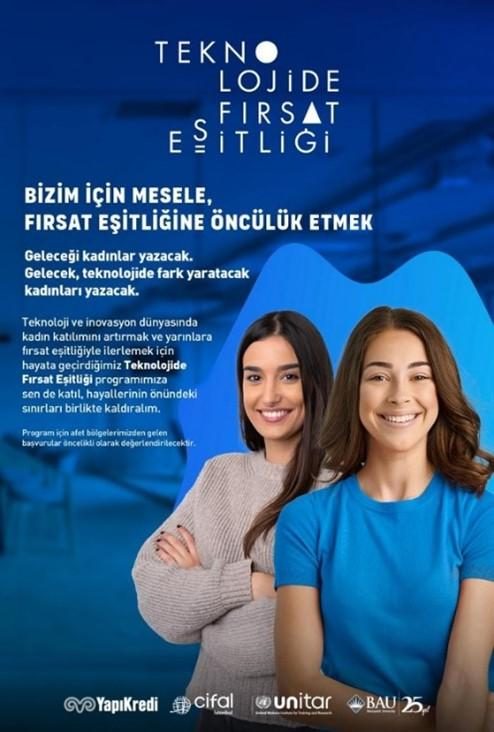
The images below present the official promotional poster and training curriculum of the Equal Opportunity in Technology Certification Program, illustrating the program's educational content, training modules, and free participation opportunities.
The image below represents the official Certificate of Achievement of the Equal Opportunity in Technology Certification Program, obtained through the e-Government system upon completion:
4.2- BAU Bridge Certificate Programs
The Bahcesehir University (BAU) Bridge Certificate Programs are free of charge and open to all interested participants, reflecting Bahçeşehir University’s commitment to inclusive education and its contribution to Sustainable Development Goal 4 (Quality Education) and Goal 10 (Reduced Inequalities).
By providing free, accessible, high-quality learning experiences, the programs support both students and external participants in developing essential competencies for academic, professional, and personal growth, while also promoting equal opportunities in education.
The 2024-2025 term featured six distinct certificate programs, each designed and delivered in collaboration with BAU’s departments, research centers, and partner institutions. These programs combine academic rigor with applied learning to equip participants with future-oriented competencies.
2024-2025 BAU Bridge Programs:
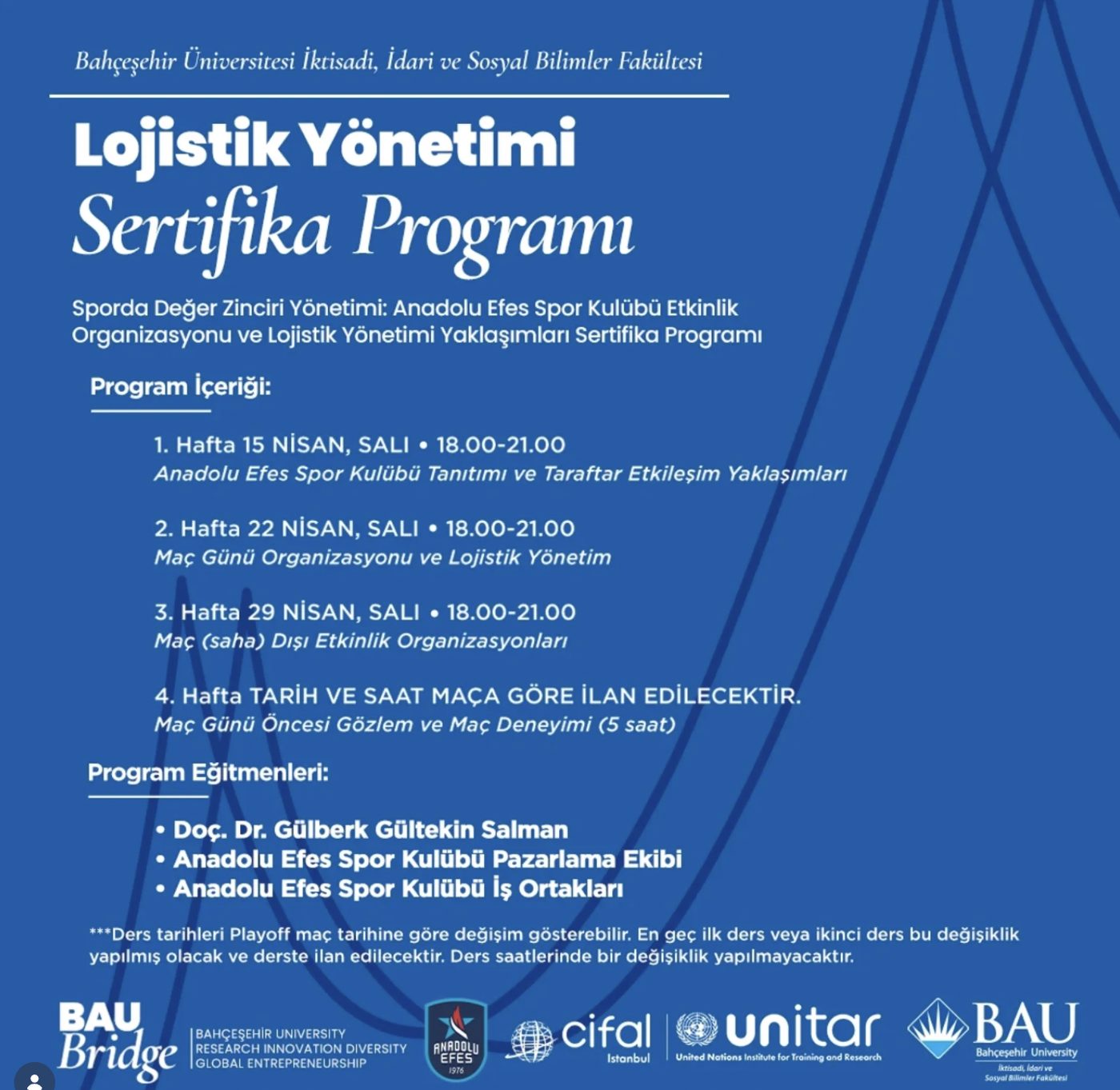
1- BAU Bridge: Value Chain Management in Sports: Certificate Program on Event Organization and Logistics Management Approaches of Anadolu Efes Sports Club
This BAU Bridge Certificate Program, held at Bahçeşehir University in April 2025, provided participants with practical and vocational knowledge on sports event organization, logistics, fan engagement, sponsorship, and related value-chain processes. By offering accessible higher-education-based training that develops sector-specific knowledge and professional skills, Bahçeşehir University demonstrates its commitment to lifelong learning and enhanced employability.
The program also supports SDG 8 (Decent Work and Economic Growth) by strengthening workforce capabilities and introducing participants to employment opportunities and sustainable growth within the sports industry.
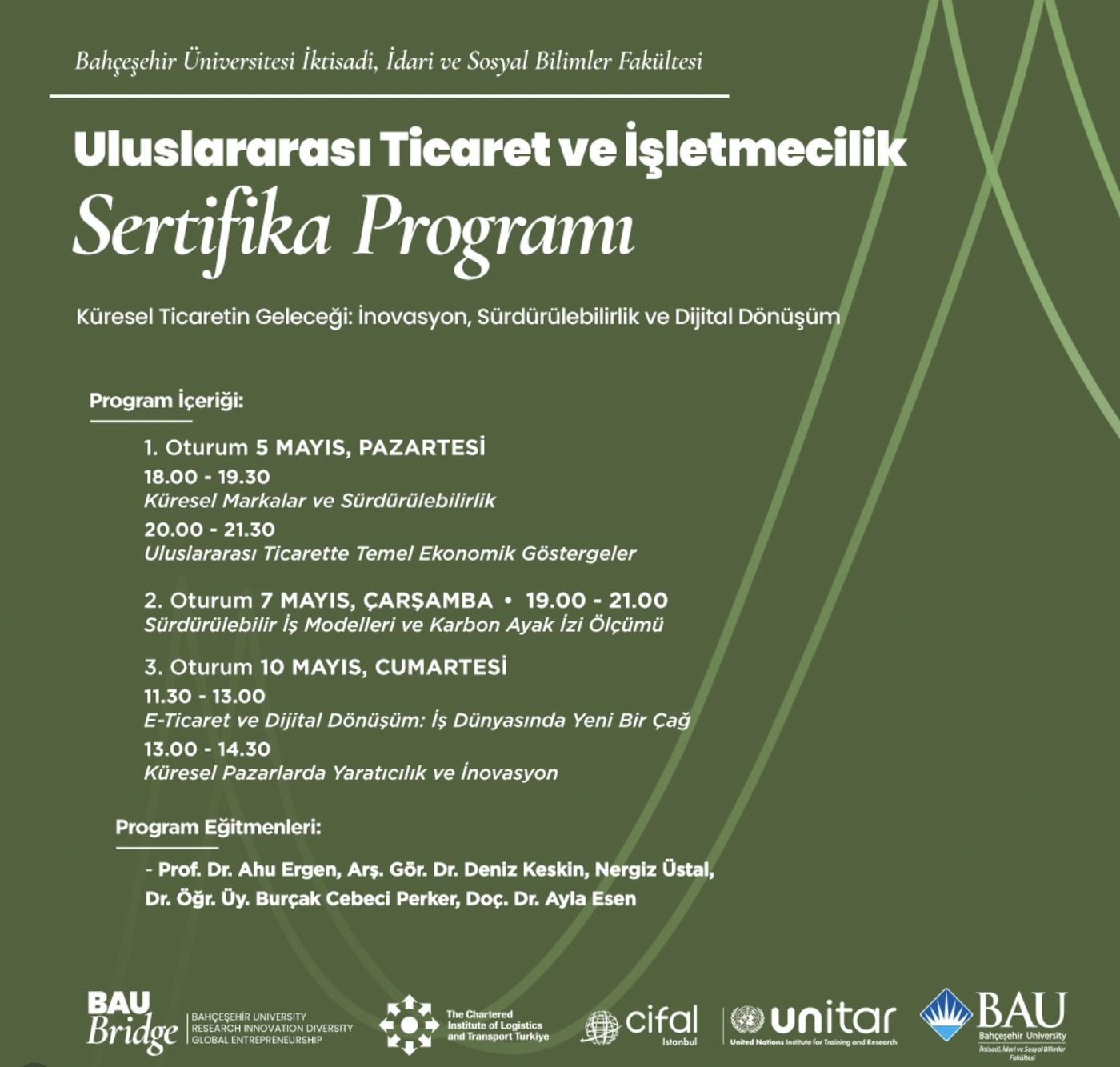
2- BAU Bridge: The Future of Global Trade: Innovation, Sustainability and Digital Transformation
The three-day training program at Bahçeşehir University introduced students and employees to international trade, sustainability, digital transformation, and innovation, while developing their understanding of emerging skills and business practices. By providing accessible learning opportunities that strengthen participants’ knowledge, digital competencies, and capacity to respond to evolving professional demands, Bahçeşehir University reinforces its commitment to lifelong and future-oriented learning.
The program also contributes to SDG 8 (Decent Work and Economic Growth), SDG 10 (Reduced Inequalities), and SDG 12 (Responsible Consumption and Production) through its focus on employability, inclusive participation in global markets, and sustainable business practices.
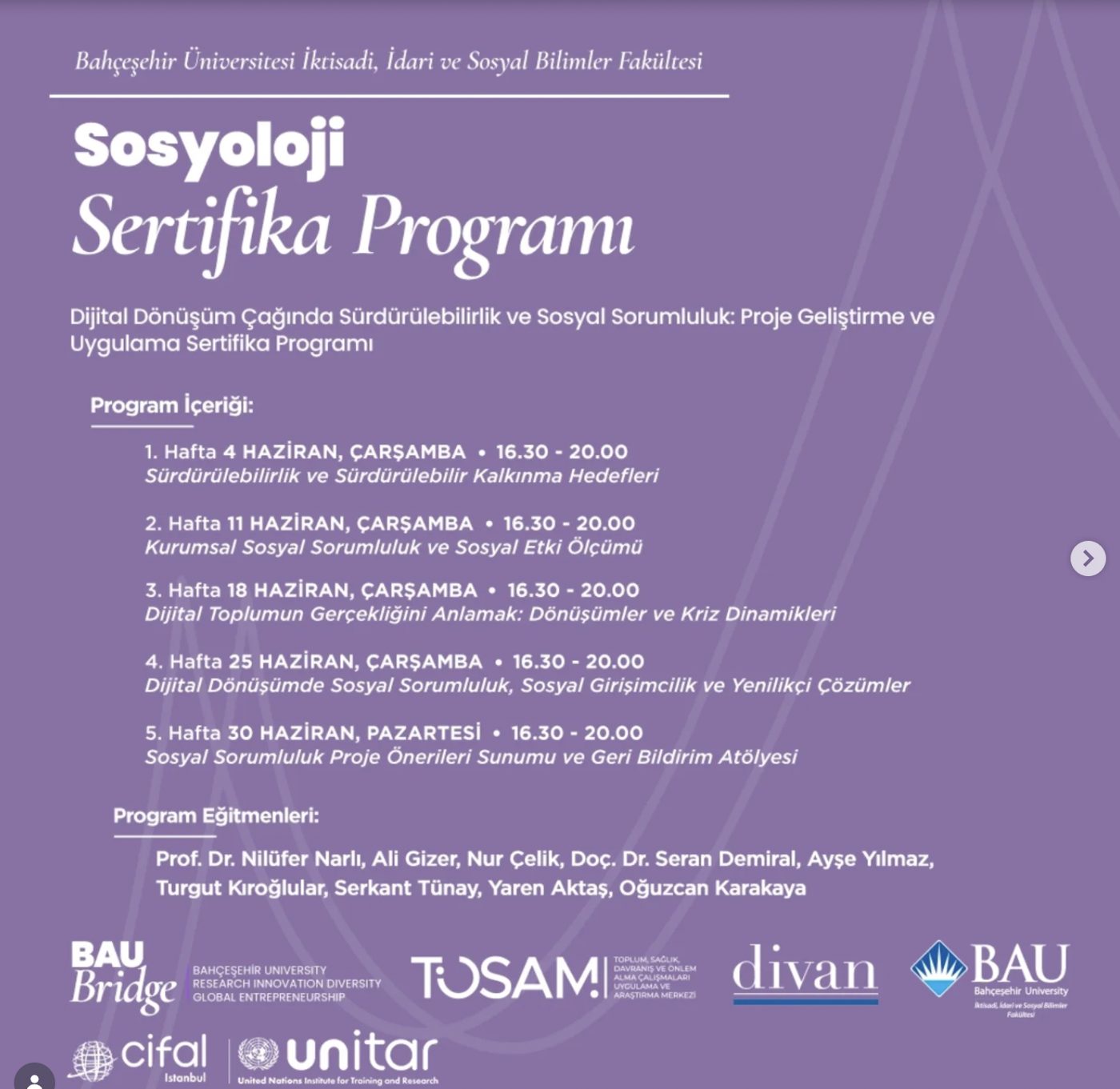
3- BAU Bridge: Sustainability and Social Responsibility in the Digital Transformation Era: Project Development and Implementation Training Program
The five-week online certificate program organized by Bahçeşehir University provided participants with an interdisciplinary learning experience on sustainability, corporate social responsibility, digital transformation, social impact measurement, and project development. Bringing together academic expertise and sectoral perspectives, the program supported participants in understanding how digitalization reshapes social, economic, and environmental challenges, while equipping them with practical tools to design SDG-aligned social responsibility projects. Through thematic sessions and a final project presentation and feedback workshop, the program contributed to SDG 4 by expanding access to applied, lifelong learning opportunities beyond formal degree programs.
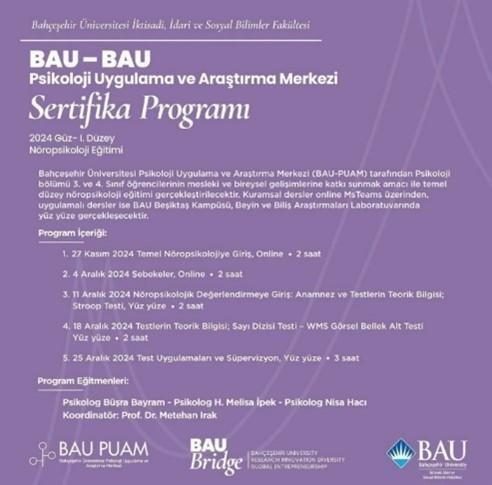
4- BAU Bridge: Neuropsychology Training Program
The five-session training program at Bahçeşehir University introduced all participants to the foundations of neuropsychology and neuropsychological assessment. Combining online theoretical instruction with face-to-face laboratory practice, test applications, and supervision, the program strengthened participants’ knowledge of assessment processes and their ability to apply evidence-based methods in professional settings. Through this practice-oriented learning opportunity, Bahçeşehir University supports SDG 4 (Quality Education) by connecting academic knowledge with practical experience and developing students’ specialized professional competencies.
The program also contributes to SDG 3 (Good Health and Well-being) and SDG 8 (Decent Work and Economic Growth) by strengthening knowledge relevant to psychological assessment, supporting the development of qualified future professionals, and improving students’ readiness for careers in psychology and related fields.
Each program provides a certificate upon successful completion and serves as a platform for both students and external participants to develop skills relevant to today’s rapidly changing social and economic landscape.
By bridging academia, industry, and society, the BAU Bridge Certificate Programs reflect Bahçeşehir University’s commitment to lifelong learning, innovation, and equal opportunity in education.
The images below present the official promotional posters, training curricula, and a sample certificate of completion from the Bahçeşehir University (BAU) Bridge Certificate Programs, illustrating the educational content, program structure, and certification opportunities offered through these free and publicly accessible lifelong learning initiatives.
4.3- Bahcesehir University Innovation Focus Open Training and Certification Program 2024-2025
The images below show the official posters for the BAU “Innovation Focus Open Training Program,” featuring the speakers and schedule.
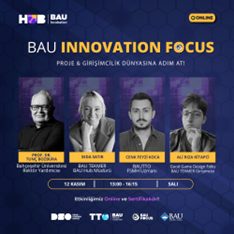
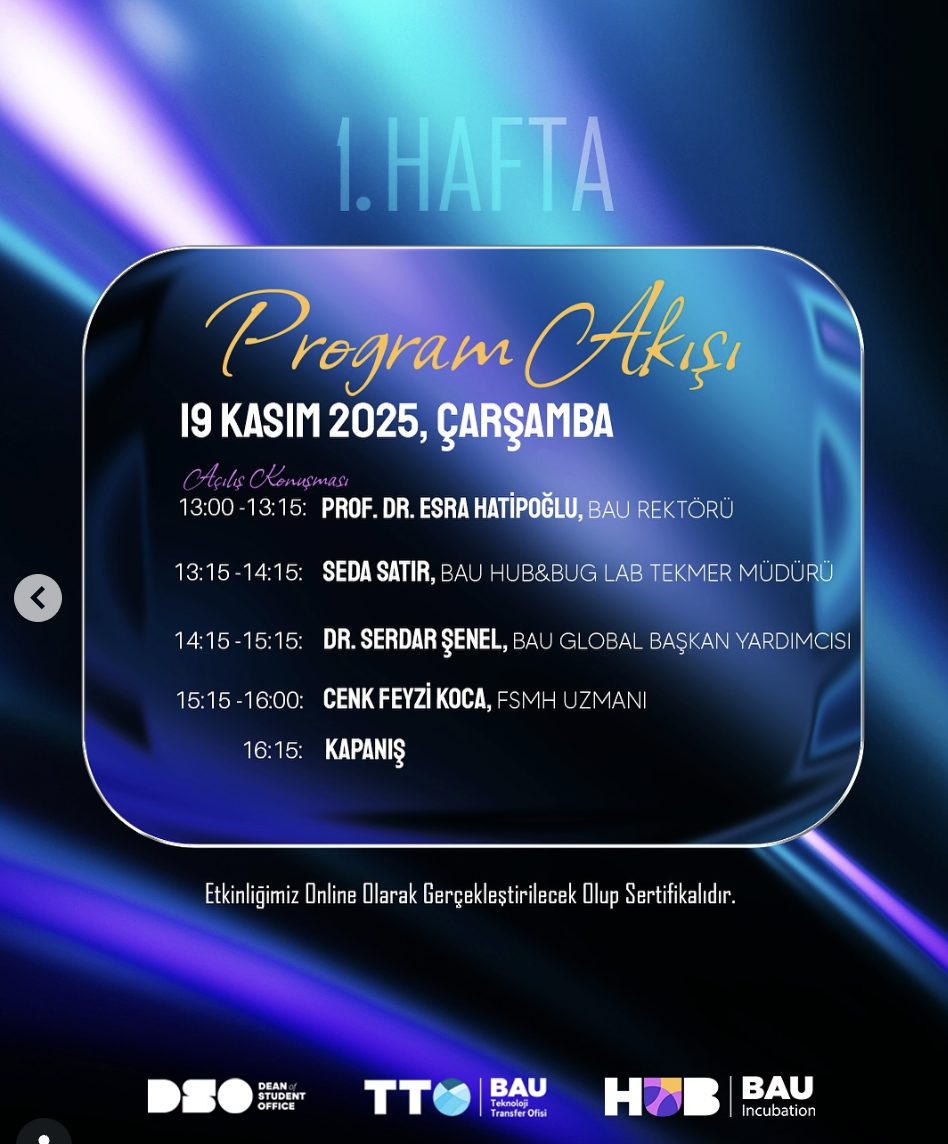
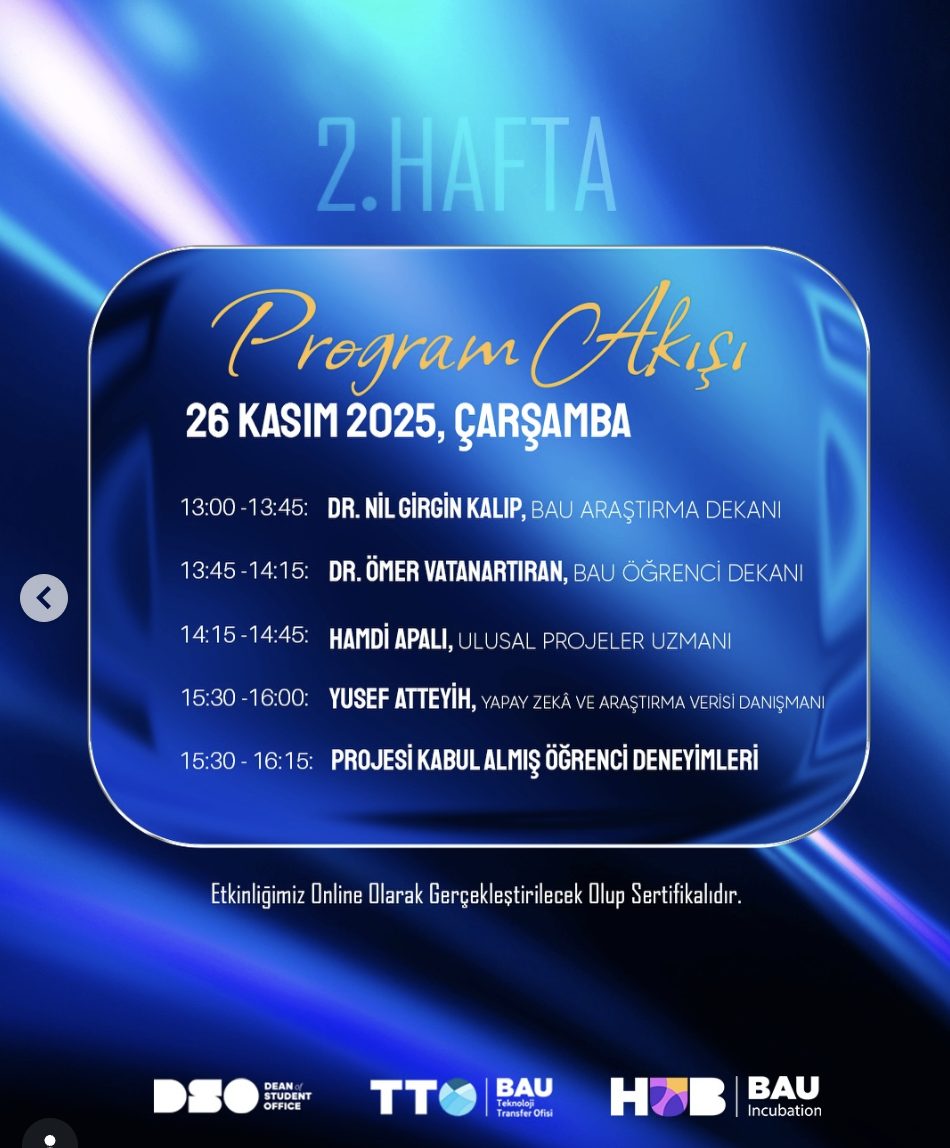
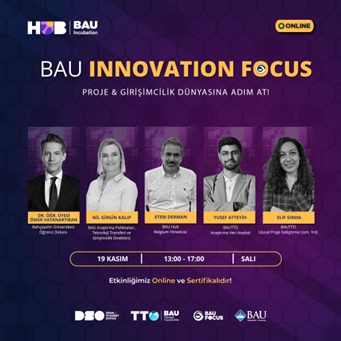
During the 2024–2025 academic year, Bahçeşehir University (BAU) organized the 7th and 8th editions of the Innovation Focus Program through the BAU Hub Incubation Center, in collaboration with the BAU Technology Transfer Office (TTO). Offered as a completely free and open-access educational program, the initiative provided entrepreneurship and innovation training opportunities to students, young professionals, aspiring entrepreneurs, and individuals beyond the University's enrolled student community.
The program aimed to develop participants' knowledge and practical skills in entrepreneurship, innovation, idea development, project preparation, and business modeling. Through interactive training sessions, participants explored how to identify and validate innovative ideas, prepare effective project proposals, develop entrepreneurial business models, and access funding opportunities, incentives, and patent registration processes. The program also incorporated experience-sharing sessions featuring entrepreneurs and BAU alumni, connecting theoretical knowledge with practical insights into the entrepreneurial ecosystem.
The 7th and 8th editions, held during the reporting period, provided participants with free access to educational content, expert knowledge, and practical entrepreneurship training. Participants who successfully completed the program also received certificates, recognizing their participation in the training activities and the skills developed throughout the program.
By making entrepreneurship education and certificate opportunities freely accessible to the wider community, Bahçeşehir University contributed to SDG 4: Quality Education, particularly Target 4.3, which promotes equal access to affordable and quality technical, vocational, and tertiary education, and Target 4.4, which focuses on developing relevant skills for employment, decent jobs, and entrepreneurship. The initiative reflects BAU's commitment to lifelong learning, inclusive access to educational resources, and the development of entrepreneurial skills beyond formal degree programmes.
4.4- Bahcesehir University Diplomat School: Policy Education, Capacity Building and Neutral Dialogue on Global Challenges, Including Climate and Energy Diplomacy
The image below shows the official poster and content of BAU Diplomat School.
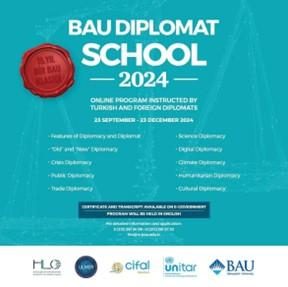
During the 2024–2025 academic year, Bahçeşehir University (BAU), through its International Leadership Practice and Research Center (ULMER) and the Government Leadership School, continued to deliver the free access BAU Diplomat School, a long-standing educational initiative designed to strengthen the knowledge, professional competencies, and policymaking capacities of policymakers, diplomats, public officials, senior administrators, and professionals engaged in international relations and public governance.
Celebrating its 15th year, the Diplomat School serves two complementary institutional purposes: providing structured education, professional upskilling, and capacity building for policymakers and public officials, while also offering a neutral, inclusive, and academically guided platform where individuals representing different political perspectives, ideologies, institutional affiliations, and professional backgrounds can engage in open and constructive dialogue.
Over the years, the programme has brought together ministers, ambassadors, members of parliament, senior bureaucrats, policy advisors, academics, and public-sector professionals, creating opportunities for individuals with different political identities and approaches to public policy to exchange knowledge, challenge assumptions, and examine complex national and international issues within a shared academic environment.
A defining feature of the BAU Diplomat School is its commitment to political neutrality and intellectual openness. Rather than promoting a particular political position or institutional agenda, the programme provides a non-partisan academic setting in which participants with differing and sometimes conflicting viewpoints can discuss sensitive, complex, and contested policy issues. The University facilitates respectful disagreement, constructive debate, and the exchange of diverse perspectives, supporting an environment in which participants can express their views and engage with opposing arguments without political or ideological exclusion.
This approach is particularly important when addressing subjects such as international conflicts, diplomatic crises, humanitarian challenges, climate and energy policy, and changing geopolitical relationships, where perspectives may differ significantly. By bringing different political stakeholders into the same educational and discussion environment, BAU supports informed dialogue across political and institutional boundaries and contributes to mutual understanding on issues of public significance.
For the 2024–2025 academic year, the Diplomat School delivered its 14-week online programme, with weekly sessions held on Mondays from 08:30 to 11:30. The structured curriculum provided sustained opportunities for professional learning, knowledge exchange, and discussion of contemporary diplomatic challenges.
The updated curriculum covered climate and energy diplomacy, humanitarian and cultural diplomacy, the characteristics and responsibilities of diplomats, traditional and contemporary diplomacy, crisis diplomacy, public and commercial diplomacy, and science and digital diplomacy.
Through these specialized modules, the programme strengthened participants' understanding of international policy frameworks, diplomatic negotiation, crisis management, climate governance, cross-border cooperation, and emerging technological challenges. It supported the development of analytical, diplomatic, and decision-making competencies relevant to effective policy formulation and implementation.
Importantly, the programme's educational and dialogue functions reinforce one another. Participants not only gain knowledge and professional competencies but also encounter alternative interpretations of complex policy challenges, engage with differing political perspectives, and develop the ability to approach disagreement through evidence-based and respectful discussion. This combination of professional education and open dialogue strengthens the University's contribution to both institutional capacity development and inclusive democratic discourse.
Through the BAU Diplomat School, the University therefore contributes to two interconnected dimensions of effective governance: strengthening the capabilities of policymakers and public officials, and maintaining a neutral academic space where political stakeholders with different perspectives can come together to discuss challenging issues openly and constructively.
Participants who attend at least 75% of the sessions and successfully complete the final assessment receive a Certificate of Achievement, while those fulfilling the attendance requirement are eligible for a Certificate of Participation. This structured certification model provides formal recognition of learning achievements and encourages continuous personal and professional development.
The initiative contributes primarily to SDG 16 (Peace, Justice and Strong Institutions) by advancing policymaker education, institutional capacity building, political dialogue, and inclusive governance. It also supports SDG 17 (Partnerships for the Goals) through diplomatic cooperation and cross-sector knowledge exchange, and SDG 4 (Quality Education) through structured professional education and lifelong learning.
4.5- Bahçeşehir University Politics School 2025 Certificate Programme (2025)
The images below illustrate the promotional posters of the Politics School Certificate Programme, showcasing various guest speakers from different sessions.
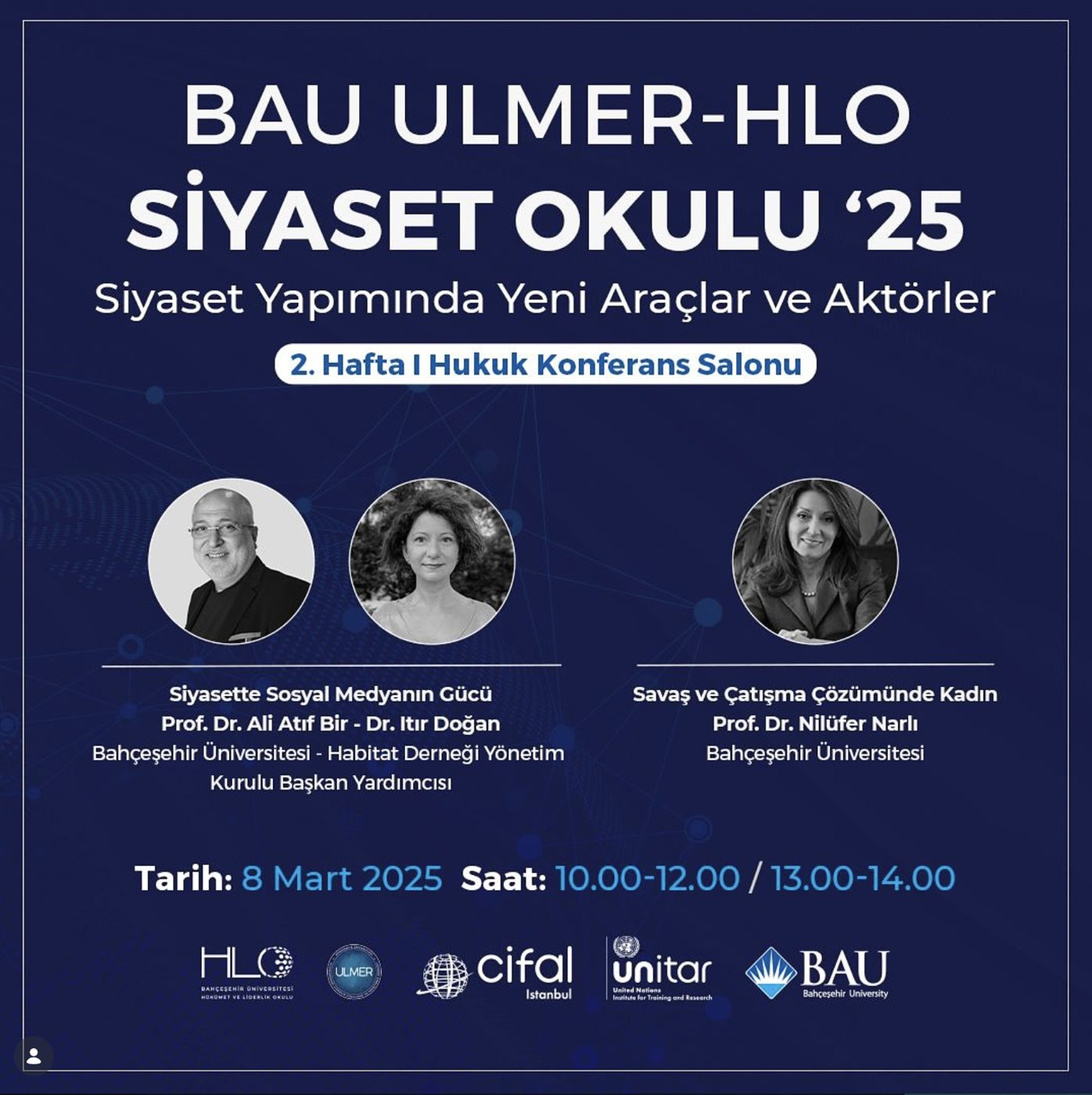
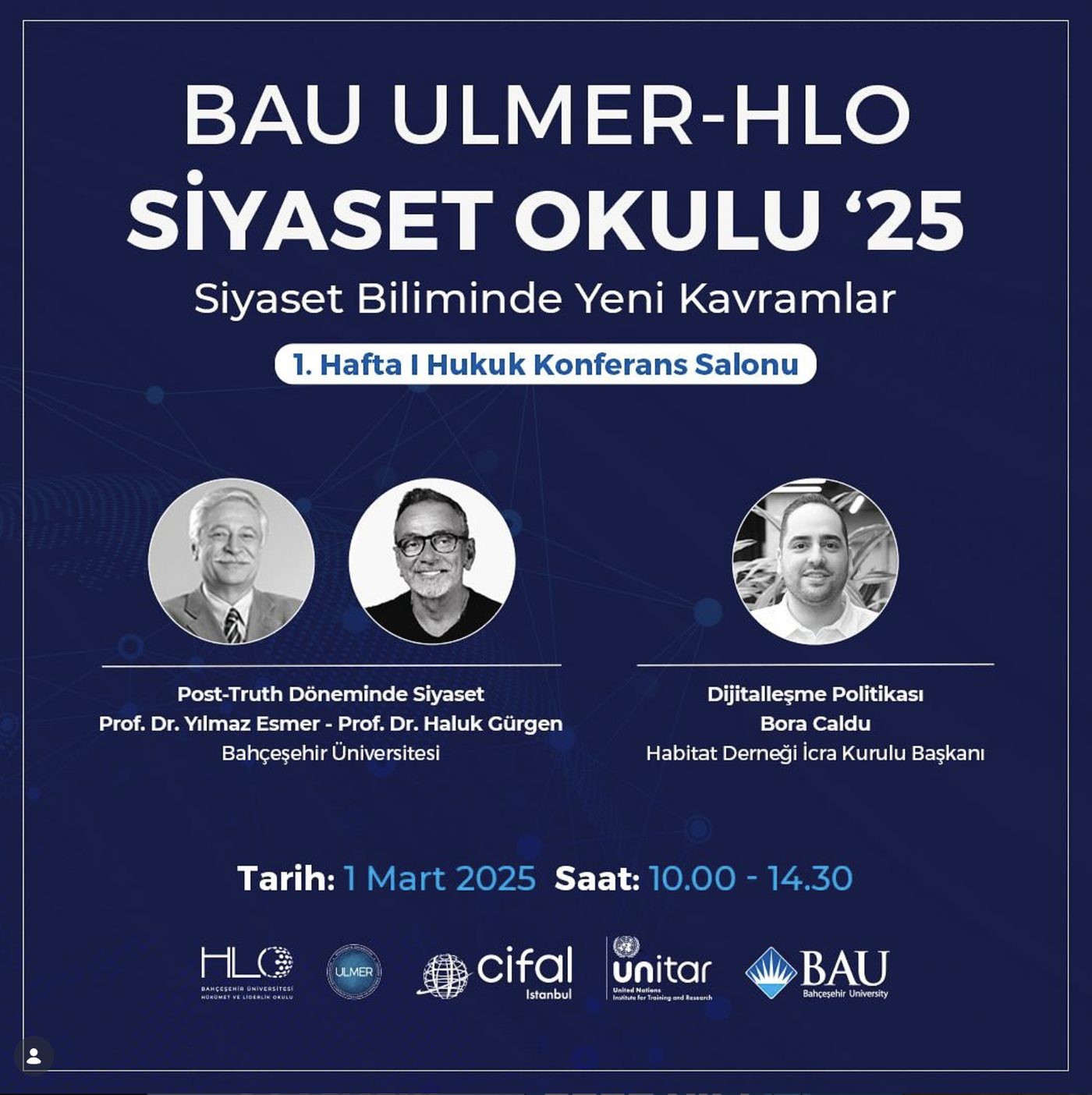
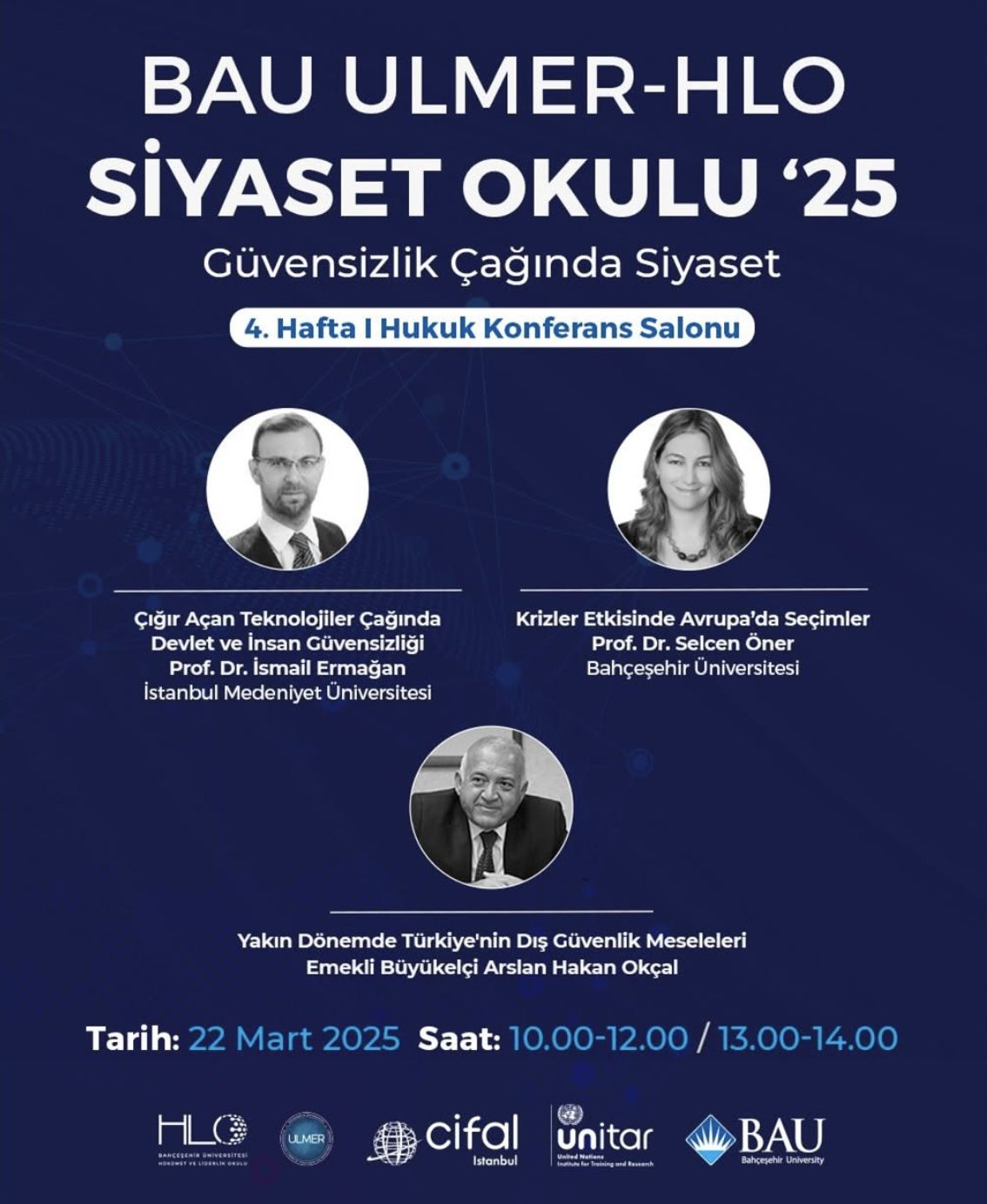
Bahçeşehir University continued its longstanding commitment to civic education and lifelong learning through the Politics School 25 (Siyaset Okulu 25) Certificate Programme, organized annually by the University's International Leadership Research and Application Center (ULMER) Government Leadership School. Established as a pioneering educational initiative in Türkiye, the programme brings together distinguished political figures, academics, diplomats, economists, business leaders, and public intellectuals to share their knowledge and experiences with participants. Over the years, Politics School has hosted presidents, prime ministers, ministers, ambassadors, members of parliament, and influential experts, providing a platform for examining political institutions, governance, leadership, and contemporary social challenges. The 2025 edition commenced on 1 March 2025 at Bahçeşehir University's South Campus, Faculty of Law, continuing the programme's tradition of connecting academic knowledge with practical insights from individuals experienced in public administration and decision-making.
A defining feature of Politics School is its inclusive and publicly accessible educational model. The programme is open to individuals of all ages, educational backgrounds, and professional experiences, without restricting participation to Bahçeşehir University students or members of the academic community. Full scholarships are also awarded to selected participants, helping reduce financial barriers and enabling wider participation in the programme. Anyone interested in politics, governance, public affairs, or leadership can apply through the programme's registration process, making it an important opportunity for lifelong learning and civic education beyond formal degree programmes. Conducted in Turkish during March and April, the programme consists of weekly Saturday sessions covering different aspects of political history, contemporary governance, and leadership. Each session includes an interactive question-and-answer component, allowing participants to engage directly with experienced speakers, raise questions, and develop a deeper understanding of political and societal issues.
The programme adopts an interdisciplinary and practice-oriented educational approach, combining theoretical knowledge with firsthand perspectives from individuals who have participated in political, diplomatic, economic, and administrative decision-making. Rather than examining Türkiye's political history and contemporary developments solely through academic frameworks, Politics School encourages participants to understand the causes, consequences, and broader implications of major political events and institutional decisions. This educational model aims to strengthen political literacy, critical thinking, analytical reasoning, and informed civic participation while encouraging participants to evaluate public affairs through objective information and evidence-based discussion. Participants who meet the 80% attendance requirement and successfully complete the final assessment are eligible to receive a certificate. Since Politics School 22, programme certificates have also been verifiable through Türkiye's e-Government system, providing formal recognition of participants' educational achievements.
The initiative makes a significant contribution to SDG 4: Quality Education by expanding access to continuing education, promoting lifelong learning, and providing structured educational opportunities for individuals beyond the university's enrolled student population. Its open-registration model enables people from diverse age groups and educational backgrounds to engage with academic expertise and practical knowledge on governance and public affairs. By connecting experienced public figures and scholars with the wider community, Bahçeşehir University supports the dissemination of knowledge, the development of critical thinking skills, and the accessibility of non-degree educational opportunities. The programme demonstrates how universities can contribute to society by making specialized educational content available to a broad public audience and encouraging continuous intellectual and personal development.











