





 TR
Why Mathematics?
Mathematics emerged as a science of quantity devoted to determining magnitudes that cannot be measured directly with any physical instrument. Although it initially had two main branches, arithmetic (the study of discrete quantities) and geometry (the study of continuous quantities), this definition of mathematics was abandoned over the course of history, and new branches of mathematics with no evident relationship to the measurement of magnitudes were developed. Today, mathematics is understood as a science through which necessary conclusions are reached.
The main reason for a mathematician's existence is to solve problems. The thrill of suddenly learning an old secret or discovering a new truth carries a spark of enlightenment, an almost unbelievably advanced perspective, excitement and restlessness. A large part of every meaningful life, and a significant part of the professional lives of technicians, engineers, scientists and others, consists of solving mathematical problems. Mathematical problems have a very extensive literature that is still growing and flourishing.
The strongest motivation for doing mathematics is pride, a sense of triumph and the satisfaction of solving a difficult problem. The research needed to solve mathematical problems may require long, uninterrupted work. So how can we do mathematics?
To answer this question, we need to know what mathematics consists of. Mathematics is inconceivable without definitions, symbols, formulas, theorems, proofs and methods. These are respected words in most mathematicians' vocabulary, and they constitute mathematical rigor, the first components of mathematics, which allows mathematics to be written while avoiding logical errors. This, in turn, requires that nothing be left implicit, given the responsibility of verifying proofs, and that all assumptions be stated correctly.
Strong intuition is an important component of mathematics. It requires a deep understanding of mathematical concepts and treating mathematical structures as living objects. Intuition is the reflection of deep insights that can lead to new discoveries. For mathematicians, intuitive thinking often means using words and figures rather than symbols.
If your intuitions are correct, turning them into detailed proofs should be easy. Here is an example:
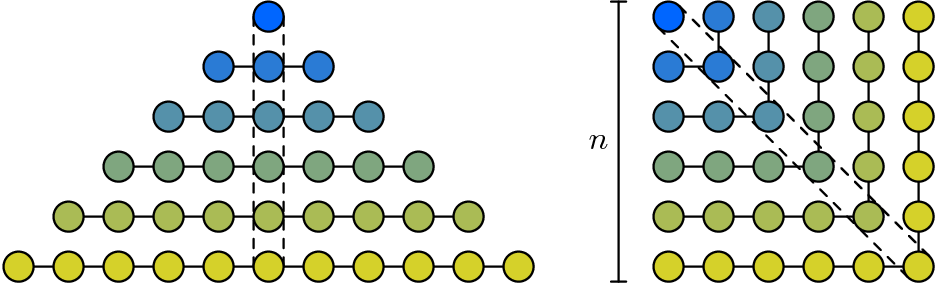
Figure: Sum of the first n odd natural numbers
Now, an ambitious mathematician will pick up a pen and turn the picture above into a chain of equations that gives a rigorous proof of the statement that it is n2 (1)
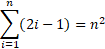
or will prefer to close their eyes, lean back in their chair and see these equations in their mind.
Who Should Choose the Department of Mathematics?
Those who can think analytically
- Those with reasoning and design skills
- Curious
- Observant
- Patient
- Determined
- Committed to continuous self-improvement
- Open to new ideas
'(1) AoPS Online: https://artofproblemsolving.com/wiki/index.php/Proofs_without_words#note_1











