





 TR
A Sigmund Weinberg Docu-Commentary
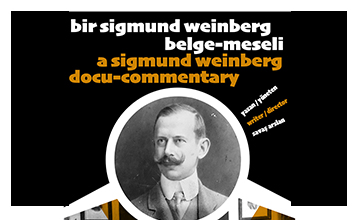
Professor Savaş Arslan, faculty member of the Department of Cinema and Television, has made a documentary tracing Sigmund Weinberg, considered one of the pioneers of Turkish film history. Shedding light on social life in early 20th-century Istanbul, the film traces the technological innovations of the period, from the camera to the gramophone and from cinema to the automobile, the opening of Istanbul's first movie theater in 1908, and the traces of Weinberg's family, scattered across five continents.
A Sigmund Weinberg Docu-Commentarypresents comprehensive research on Sigmund Weinberg, the official photographer and filmmaker of both Sultan Abdülhamid II and Sultan Mehmed V Reşad, in a period of great change a hundred years ago. In addition to interviews with film historians such as Burçak Evren and Giovanni Scognamillo, the film also takes a witty look at the differences and connections between Karagöz and Weinberg, and between shadow play and motion pictures.
Who is Sigmund Weinberg?
Sigmund Weinberg was born in 1868 in the Galicia region of Romania. He came to Istanbul in 1889 and went into trade, selling equipment and accessories for phonographs, gramophones and photography. He became the representative of the Pathé company in Türkiye. In 1908, he opened the Pathé Cinema in Tepebaşı, considered the first movie theater in Türkiye. In 1915, he was appointed head of the Central Army Cinema Office (MOSD), established by order of Enver Pasha, then Minister of War and Deputy Commander-in-Chief. Together with his assistant Fuat Uzkınay, he shot many documentaries and newsreels.
With Uzkınay, he tried to adapt for the screen the playLeblebici Horhor, staged by the Arşak Benliyan Company. The film was left unfinished because one of the lead actors died. After this attempt, the pair tried to film another play by the Benliyan Company,Himmet Ağa's Marriage. While the film was being shot, the actors were called up for military service, so filming was interrupted. After the war, Uzkınay completed the film on his own. When war broke out between the Ottoman State and Romania on 27 August 1916, Weinberg was removed from his post at MOSD because he was a Romanian national. Although there were rumors that Weinberg was deported after this date, they were never proven.











