


 TR
Deputy Director Dr. Mert NOMER and Board Member Dr. Ecem ÇOBAN BİLİCİ Took Part in IVRJ 2026
The 3rd IVR Japan International Conference (IVRJ 2026), one of the global gatherings in legal philosophy and sociology, was held this year with the theme "The Transformation of Law and Technological Challenges". Organized by the Japan section of the International Association for the Philosophy of Law and Social Philosophy (IVR), the event brought together legal scholars from around the world and opened issues such as artificial intelligence, algorithmic governance and the legal status of the individual in the digital age to discussion on a multidisciplinary platform. In this year's conference programme, the papers presented by Bahçeşehir University YETİ Deputy Director Dr. Mert Nomer and Board Member Dr. Ecem ÇOBAN BİLİCİ, which question the democratic and ethical foundations of digitalization, attracted the interest of participants.

In his paper titled "From Autonomy to Automation: The Crisis of the Legal Subject in Digital Democracy", Mert Nomer argued that the Cambridge Analytica scandal marked a turning point in public understanding of how data-driven technologies can erode democratic processes. He pointed out that at the center of the scandal was not only the unlawful collection of personal data but also the use of algorithmic profiling and micro-targeting to manipulate voter behavior. He emphasized that this effectively restructured the relationship between individuals, information and democratic decision-making. The paper he presented argues that these practices reveal a crisis of relational democracy.
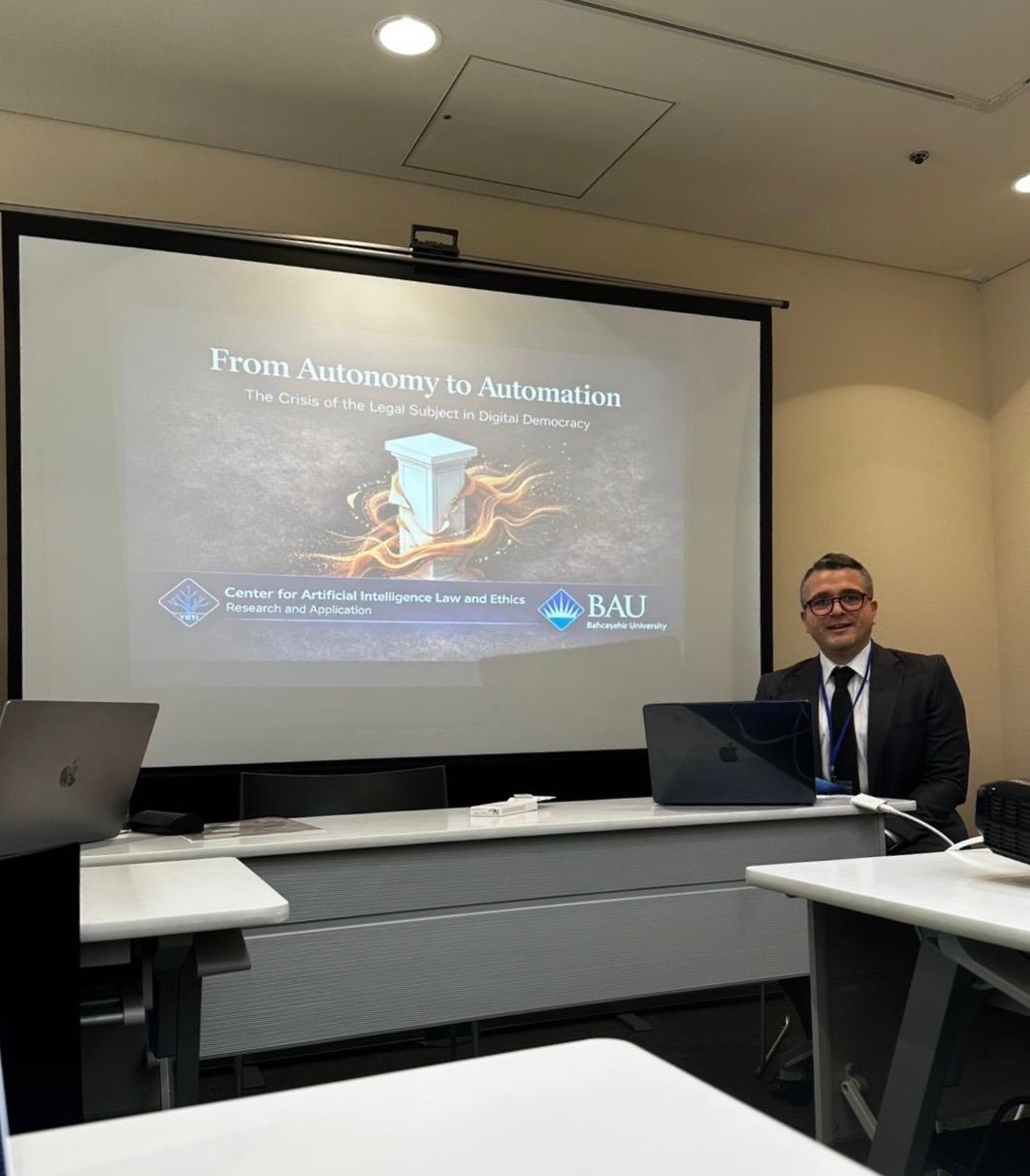
He also explains that this crisis is not merely technological or regulatory in nature, but directly concerns the transformation of the legal subject. According to Nomer, much of liberal democratic theory and modern jurisprudence rests on the assumption of an autonomous individual capable of reasoned judgment who participates in public debate. However, in digital environments shaped by opaque AI systems, algorithmic recommendation engines and behaviorally targeted content, the autonomy of this subject is systematically weakened. As citizens become subjects of algorithmic governance, their relationships with the state, with each other and with the legal system are fractured through invisible infrastructures of influence and surveillance. The paper presented by Nomer re-examines the normative role of law in sustaining the relational conditions of democracy. It focuses in particular on the following three interrelated questions:
- What becomes of democratic legitimacy when public discourse is fragmented by algorithmic targeting?
- How should law respond to environments in which consent is manufactured and influence is automated?
- Can legal frameworks protect autonomy and trust in digitally mediated relationships?
Ultimately, the paper advocates a relational understanding of democratic legality, one that centers not only on rights and rules but also on the ethical and epistemic integrity of human relationships established through technology. As democracy increasingly takes place in online spaces governed by corporate algorithms, it argues that the task of law must be rethought: not only to regulate after harms have occurred, but to protect the preconditions of mutual recognition, deliberation and will on which democratic life depends. In her paper titled "After-Truth Democracy: Rebuilding Democratic Legitimacy in the Age of Artificial Intelligence", Ecem ÇOBAN BİLİCİ discusses how, in the age of artificial intelligence, democracy faces a profound challenge to its ethical and epistemic foundations. She states that as algorithmic systems reshape the ways societies determine truth and AI-generated content increasingly pervades public discourse, democracy faces not only a disinformation crisis but a fundamental shaking of the conditions that make collective self-government possible. She argues that this "after-truth" condition requires not the repair of democratic deliberation but the rebuilding of its foundations.
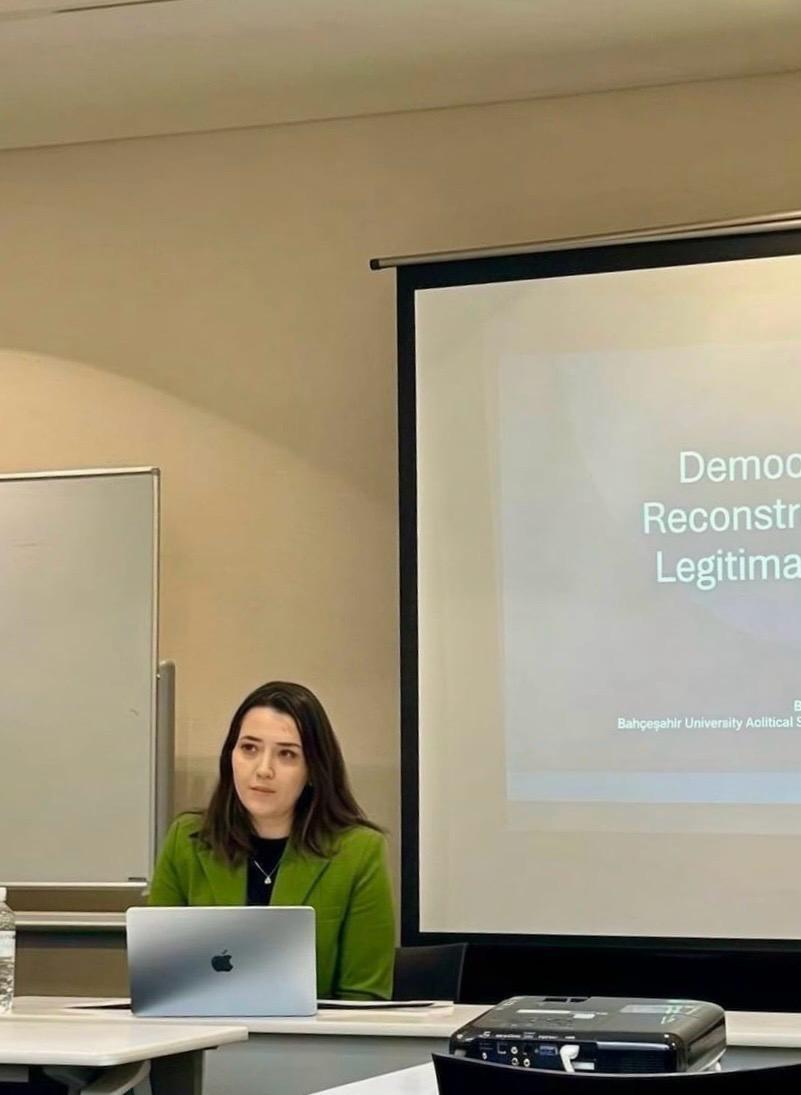
As stated in the paper, the epistemic-ontological rupture brought about by artificial intelligence not only unsettles the ways citizens know; it also causes a collapse in what they are prepared to accept as "real". Current AI ethics frameworks, largely focused on bias and transparency, have been insufficient to address this deep destabilization. Such frameworks assume epistemic stability as an unquestionable foundation, whereas AI systems are eroding precisely this ground.
The paper seeks to show how "data silence" functions as a mechanism of epistemic exclusion. Data silence arises when computational systems accept only quantifiable and processable information as valid and render other ways of knowing, such as experiential, contextual and embodied understanding, invisible. This mechanism produces epistemic inequality by legitimizing data-driven knowledge while marginalizing human judgment. More seriously, however, it ultimately leads to ontological instability as citizens lose their footing on a shared ground of reality.
The aim of the paper presented at the conference is to show that the crisis democracy faces is not only technical or institutional but constitutive. Artificial intelligence is transforming how reality is formed, how knowledge is verified and how responsibility is distributed. The task of this rebuilt ethics is to resist algorithmic tendencies that suspend human judgment in favor of automated certainty. Ultimately, she states that without reaffirming the value of human interpretation, democracy cannot survive in the age of intelligent systems.