

 TR
TR
Academic Expert Panels
PLURIEX will host two high-level Academic Expert Panels each year, bringing together interdisciplinary perspectives on the EU and its evolving relationship with Turkey. These panels provide a platform for dialogue between scholars, policymakers, and EU practitioners, reflecting PLURIEX’s commitment to epistemic pluriversality and inclusive knowledge production.
Panels will be organized at major national and international conferences as well as at Bahçeşehir University. Researchers who wish to contribute to or collaborate with PLURIEX Expert Panels are warmly invited to get in touch.
Expanding the Boundaries of EU Studies
As part of its mission to broaden and diversify EU studies, PLURIEX will organize two Academic Expert Panels each year at leading national and international academic platforms, as well as at Bahçeşehir University. These panels will bring together scholars, policymakers, EU practitioners, and experts from multiple disciplines—ranging from political science and law to economics, sociology, digital governance, engineering, and environmental studies.
Rooted in PLURIEX’s commitment to epistemic pluriversality, the panels aim to challenge Eurocentric and single-discipline narratives by integrating perspectives from non-Western, post-Western, and constructivist traditions in International Relations and European Studies. Through these discussions, the panels will foster a more inclusive, critical, and globally relevant understanding of EU policymaking and EU–Turkey relations.
Each year, at least one panel will be held at a major international conference (such as ECPR, IPSA, CES, or EUSA), and one at a national academic forum in Turkey. These events will also serve as networking spaces, enabling collaboration with other Jean Monnet Modules, Chairs, and Centres of Excellence, and strengthening long-term academic and policy partnerships.
PLURIEX welcomes scholars and practitioners who wish to participate, contribute ideas, or collaborate in future Academic Expert Panels. Those interested are encouraged to contact us to explore engagement and co-creation opportunities.
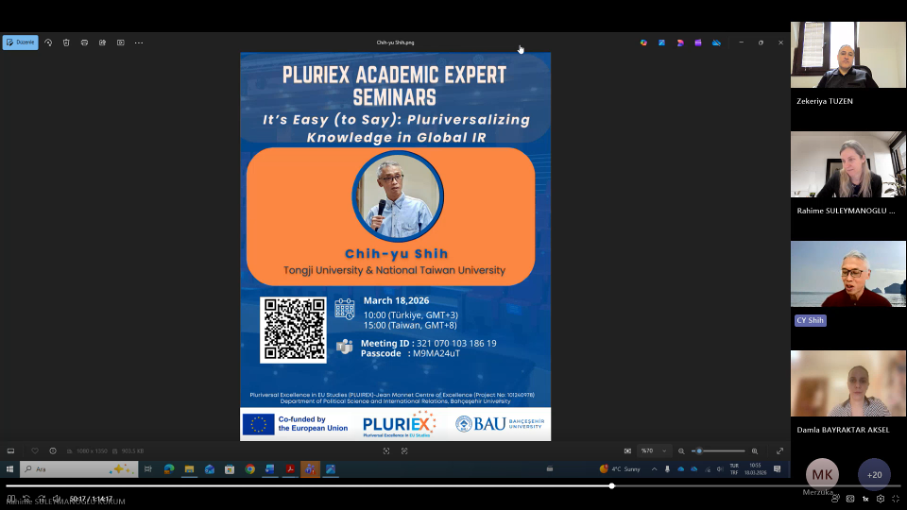
It’s Easy (to Say): Pluriversalizing Knowledge in Global IR
Moderator: Assoc. Prof. Rahime Süleymanoğlu-Kürüm
Host: PLURIEX – Jean Monnet Centre of Excellence on Epistemic Pluriversality, Department of Political Science and International Relations, Bahçeşehir University
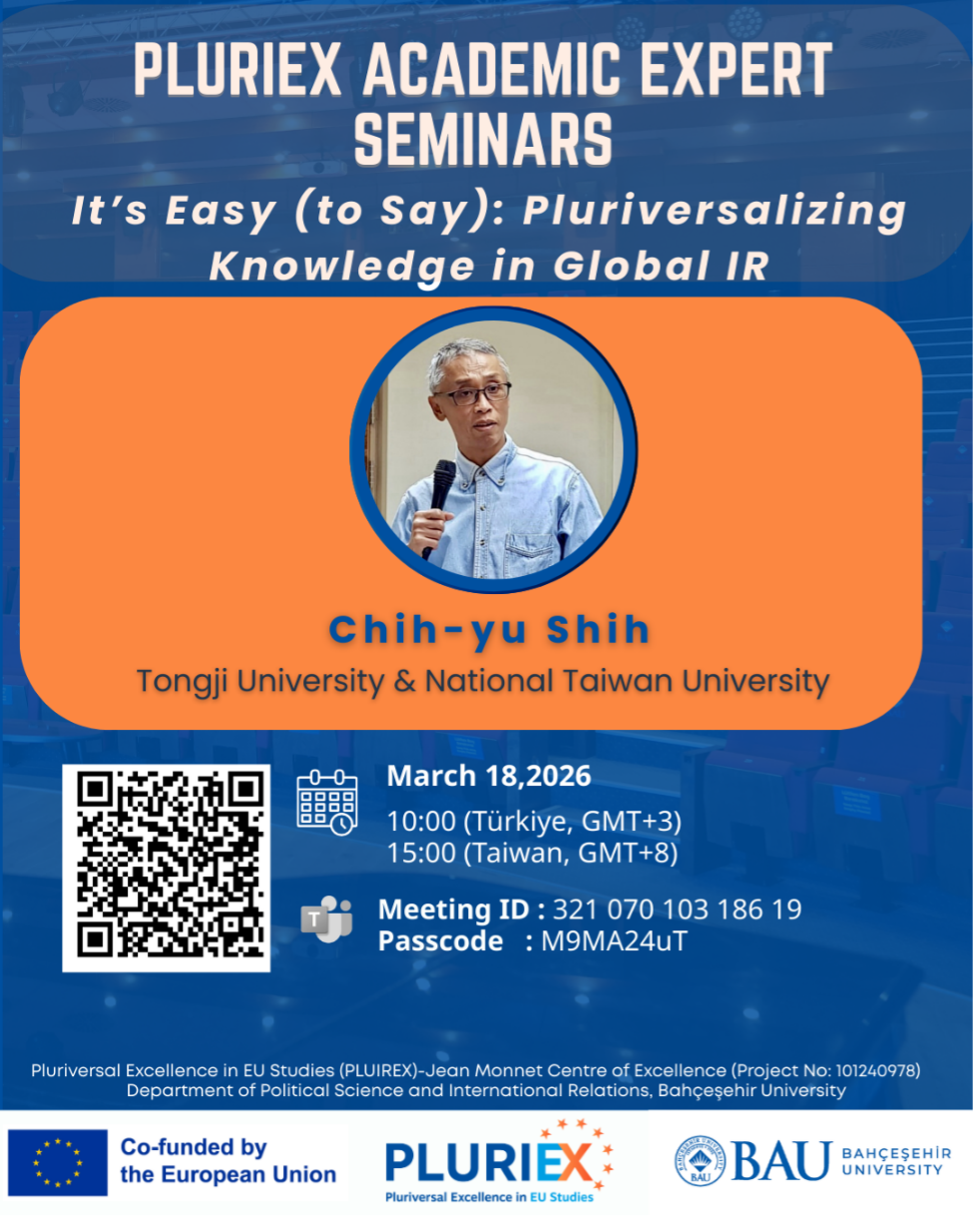
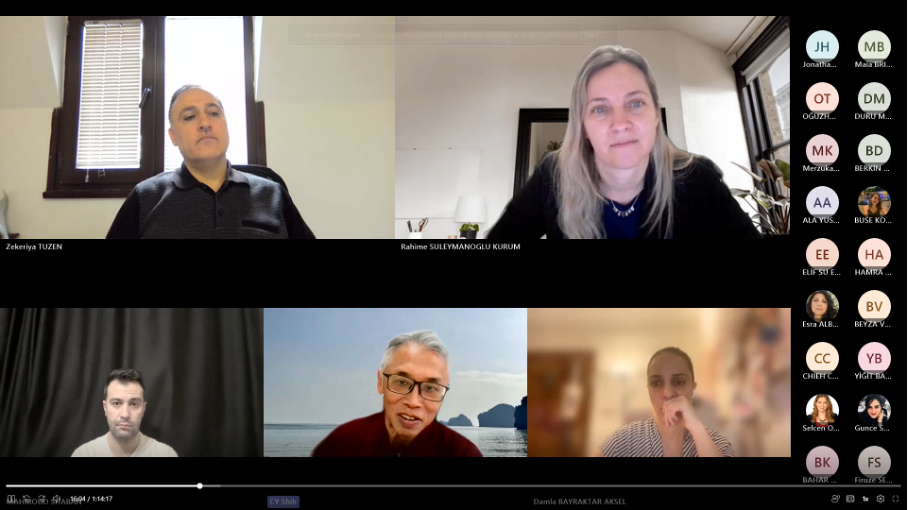
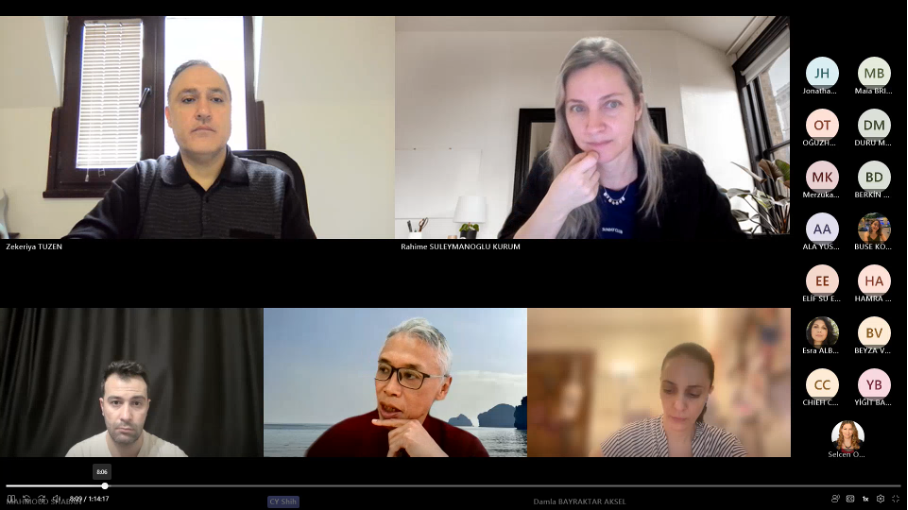
The PLURIEX Academic Expert Seminar Series continued with its first event, welcoming Chih-yu Shih (Tongji University & National Taiwan University) for a seminar titled “It’s Easy (to Say): Pluriversalizing Knowledge in Global IR.”
In his talk, Shih invited participants to reconsider how pluriversality is understood within International Relations. Rather than approaching it as a normative project or an alternative framework to replace dominant theories, he presented pluriversality as an already existing condition of global life—one characterised by multiple, overlapping, and coexisting worlds.
Positioning his argument in relation to Global IR, non-Western IR, and postcolonial approaches, Shih argued that these perspectives often remain entangled in the very hierarchies they seek to challenge, as they continue to define themselves in relation to “the West.” In contrast, pluriversality shifts the focus away from opposition and toward the coexistence and interaction of diverse epistemologies and lifeworlds on their own terms.
He developed this perspective through three key formulations: the relation of relations, the world of worlds, and the order of orders. These concepts emphasise that identities, social worlds, and political orders are not singular or fixed, but fluid, contingent, and constantly negotiated.
Importantly, Shih stressed that pluriversality is not inherently emancipatory or harmonious. It does not resolve hierarchies or inequalities, but rather makes visible how different worlds coexist—sometimes in tension, sometimes in overlap, and often through everyday practices shaped by historical and relational contexts.
The seminar also explored the implications of these ideas for research and knowledge production in International Relations. Shih highlighted the importance of moving beyond state-centric approaches and instead attending to transnational, relational, and practice-based forms of analysis.
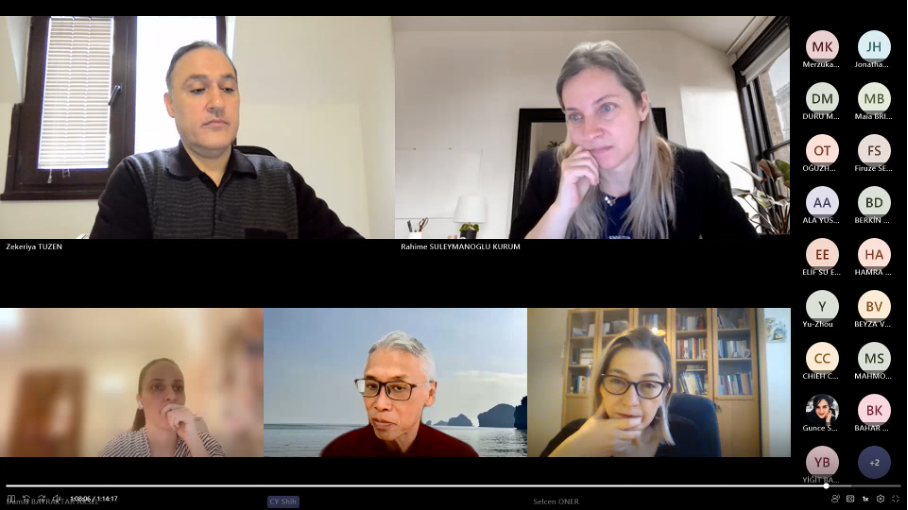
The Q&A session further deepened these reflections by engaging with key conceptual and practical questions related to postcolonial and transnational approaches, methodological limitations, and how plurality can be engaged without reducing it into a new universal framework.
The seminar concluded with a broader reflection on pluriversality as both an analytical and practical orientation. In line with PLURIEX’s wider objectives, the discussion highlighted how knowledge production in EU and global studies might be rethought to better accommodate multiplicity and relationality.
This event also contributed to PLURIEX’s broader intellectual agenda and served as preparation for the residential writing retreat to be held in Kazdağları between 7-11 April 2026.
The seminar attracted an engaged audience of approximately 30 participants, including undergraduate and postgraduate students as well as academics.
Pluriversality and Cosmopraxis
Moderator: Assoc. Prof. Rahime Süleymanoğlu-Kürüm
Host: PLURIEX – Jean Monnet Centre of Excellence on Epistemic Pluriversality, Department of Political Science and International Relations, Bahçeşehir University
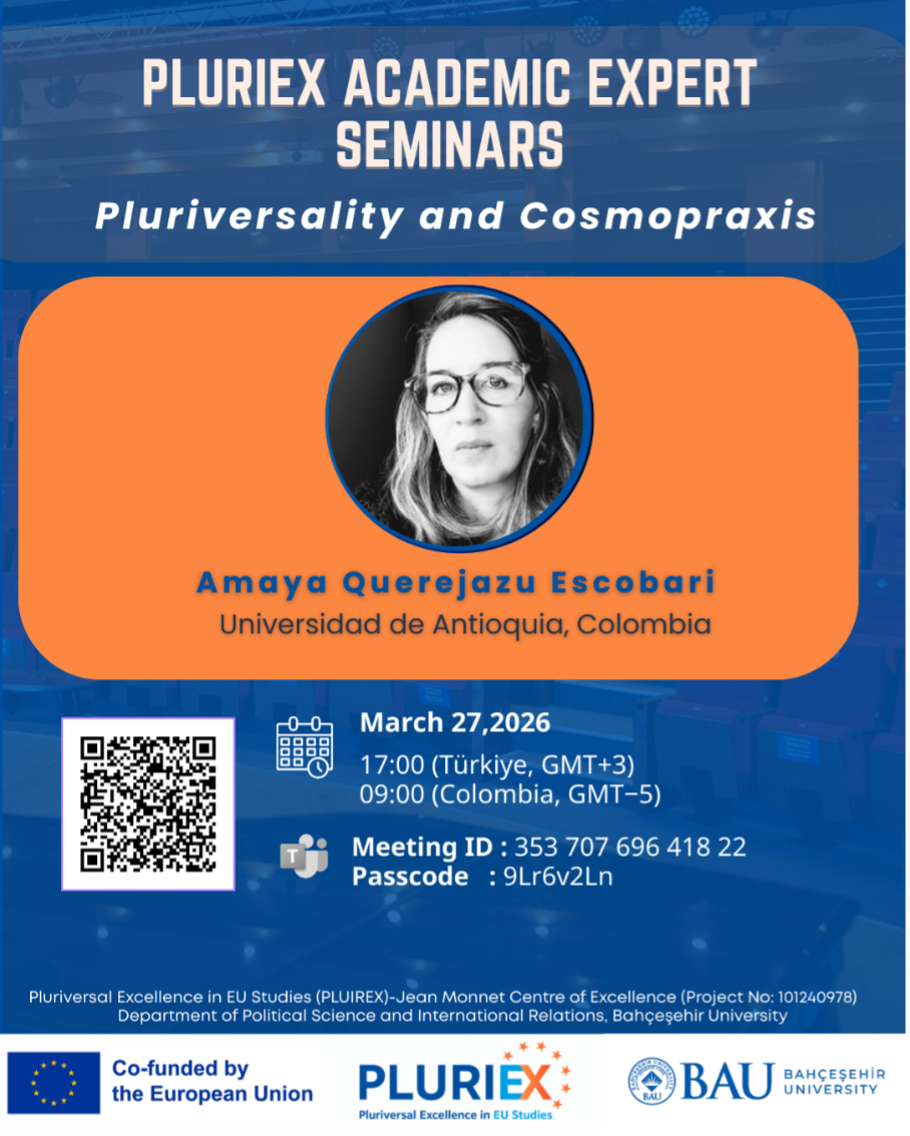
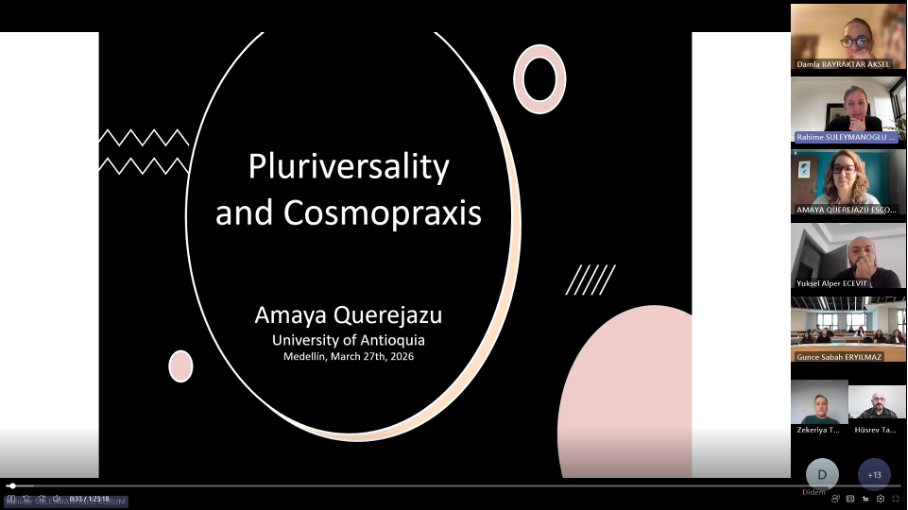
The PLURIEX Academic Expert Seminar Series continued with its second event, welcoming Amaya Querejazu Escobari (Universidad de Antioquia) for a seminar titled “Pluriversality and Cosmopraxis.”
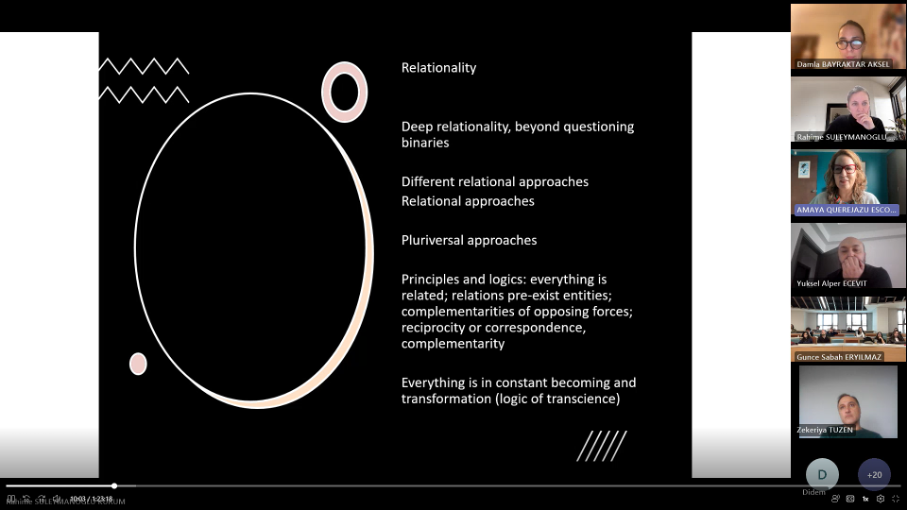
In her talk, Querejazu invited participants to reconsider one of the most deeply embedded assumptions of International Relations: the idea that we inhabit a single, coherent world that can be understood through universal concepts. Instead, she proposed taking seriously the existence of a pluriverse—a reality composed of multiple, coexisting worlds, each grounded in distinct ways of being, knowing, and relating.
Drawing on her fieldwork in Latin America, she illustrated the practical implications of this argument through the example of water governance projects in Indigenous communities. While international organisations conceptualised water as a resource to be managed and distributed, Indigenous communities understood it as a living being embedded in relational networks. The so-called “failure” of these projects, she argued, reflects not merely technical shortcomings, but a deeper ontological mismatch—one that reveals the limits of dominant IR frameworks in engaging with fundamentally different worlds.
Building on this, Querejazu presented pluriversality not as a theoretical proposition, but as an already existing condition—one that has been obscured by the universalising tendencies of Western epistemologies. Rather than accommodating difference within a single overarching framework, pluriversality calls for recognising the coexistence of multiple ontologies, each of which must be engaged on its own terms.
A central contribution of the talk was the concept of cosmopraxis, introduced as a way of engaging with the pluriverse through everyday practices. Challenging conventional separations between knowing, being, and doing, cosmopraxis foregrounds the ways in which realities are continuously enacted through practice. Activities often considered mundane—such as cooking, remembering, crafting, or storytelling—were reframed as forms of world-making, through which different realities are sustained and negotiated.
Importantly, Querejazu emphasised that such practices are not limited to specific cultural or social groups, but are part of how all beings—human and non-human—relate to the world. In this sense, cosmopraxis offers a way of engaging plural realities without fixing them into rigid categories or romanticising them.
The seminar also explored the implications of these ideas for research and teaching. Adopting a pluriversal approach, Querejazu suggested, requires moving beyond fixed answers and remaining open to uncertainty, contradiction, and complexity. Rather than seeking to resolve tensions, scholars are invited to work within them—recognising that multiplicity and in-betweenness are constitutive of social and political life. In pedagogical terms, this entails creating space for students to bring their own experiences and forms of knowledge into the classroom, enabling more relational and situated forms of learning.
The Q&A session further deepened these reflections by engaging with key methodological and practical questions. Participants explored how pluriversal approaches might be reconciled with quantitative methods, how they can inform policy-making in areas such as migration governance, and how to avoid romanticising marginalised practices. Across these discussions, a recurring theme was the importance of sustaining dialogue across difference—what Querejazu framed as a form of ongoing diplomatic engagement, rather than a search for definitive resolution.
The seminar concluded with a broader reflection on pluriversality as both an intellectual and practical commitment. In line with PLURIEX’s wider objectives, the discussion underscored the importance of not only engaging with pluriversality at a conceptual level, but also experimenting with how it can be enacted within EU Studies—particularly through collaborative research, writing practices, and alternative modes of knowledge production.
This event also contributed to PLURIEX’s broader intellectual preparation for its upcoming residential writing retreat and related collaborative activities. Bringing together participants working across different strands of the project, the seminar created a shared space to engage directly with leading scholarship on pluriversality and cosmopraxis. In doing so, it supported ongoing efforts to explore how these approaches can be meaningfully translated into EU Studies, across diverse research agendas and outputs, including but not limited to the development of a forthcoming special issue.
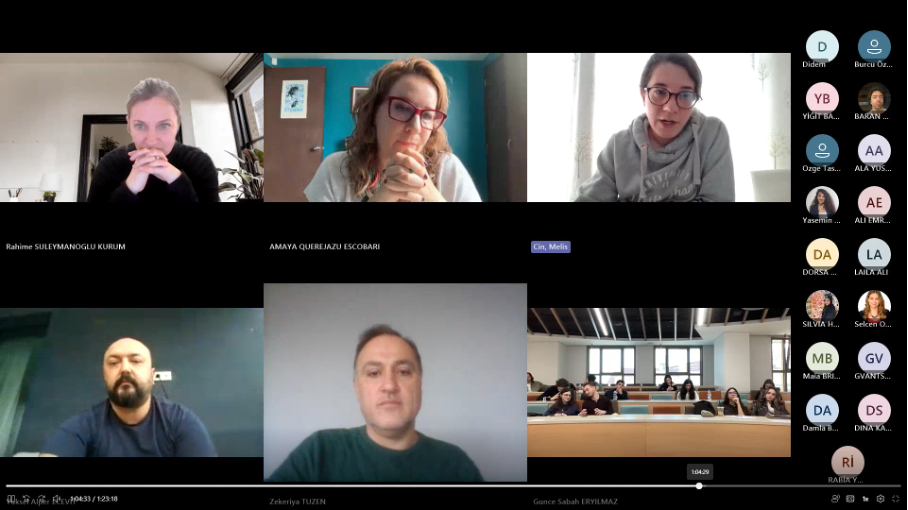
The seminar attracted a diverse and engaged audience of over 50 participants. In addition to individual online attendance, the event was broadcast live in a classroom setting, creating a shared collective viewing experience. Participants included undergraduate and postgraduate students, civil society actors, and academics from across Türkiye as well as the United Kingdom, reflecting the wide intellectual and institutional reach of the PLURIEX network.