





 TR
Earthquake Disaster Risk Reduction Workshop and Research Program Held
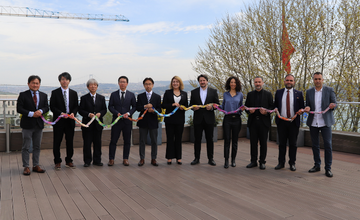
A Japanese delegation of scientists and experts who experienced the 1995 Kobe earthquake, which caused severe losses and went down in world history for the first collapse of a skyscraper, came to Türkiye to carry out inspections in the Kahramanmaraş-centered earthquake zone. Following their inspections, the delegation took part in the Earthquake Disaster Risk Reduction Workshop and Research Program hosted by Bahçeşehir University and attended by President Prof. Dr. Şirin Karadeniz.
Mr. Yukio Tanaka, Head of the Building Inspection and Zoning Department of Kobe Municipality; Mr. Masayoshi Nose, Director of the Kobe Municipality Crisis Management Center; Prof. Tosu Shigeki, Prof. Yanagisawa Kazuhiko and Prof. Tagawa Hiroyuki, faculty members of Mukogawa Women's University; and Prof. Dr. Murat Dündar, Dean of the BAU Faculty of Architecture, examined buildings in heavily damaged settlements in the earthquake zone, particularly in Hatay, and carried out work to identify technical problems.
The thousand-crane origami, which became a symbol in Japanese history through Sadako Sasaki, who was two years old when an atomic bomb fell near her home in Hiroshima and who died of leukemia caused by radiation at the age of 12, and who folded the cranes as a wish to recover during her treatment, will be delivered to earthquake survivors in Türkiye with the wish that it brings healing and that their wounds heal as soon as possible.
"WE WILL ESTABLISH A DISASTER-RESILIENT CITIES RESEARCH AND APPLICATION CENTER"
Emphasizing that the scale of the disaster in Türkiye resonated around the world, Prof. Dr. Murat Dündar said: "The scale of the disaster our country has experienced has made an impact all over the world. In this context, Mukogawa University in Japan, with which our university has long collaborated, and various public institutions there contacted us immediately after the earthquake about the path we should follow. As Bahçeşehir University, since we regard spreading disaster awareness to every level of society as a social responsibility, we decided to establish a dedicated mechanism. We invited our partners and experts in Japan here to accompany us and provide consultancy during the establishment phase of the center, so that they could examine the reasons that increased the scale of the disaster."
"MORE THAN 100 BILLION DOLLARS OF FINANCING IS NEEDED FOR THE REGION'S DEVELOPMENT"
Prof. Dr. Dündar added: "Even though two months have passed, the situation is saddening. Above all, the visits made there mean a great deal; everywhere we go, hope emerges for people regarding the continuation of the process. When we visited the disaster areas, we realized that the reconstruction of the region poses a major challenge. One of the main reasons we invited our colleagues from Japan is to act jointly in the process of revitalizing the region. We need to create international public awareness, form partnerships with countries that have expertise, experience and financing in this field, and with their institutions and organizations, and redesign the future of the cities in the earthquake zone. As for the financial situation, it is fair to say that various projections have been drawn up for the entire region. As far as we can follow, it is very often stated that more than 100 billion dollars of financing must be found for the development of the region."
"IT IS NOT POSSIBLE TO PREVENT EARTHQUAKES, BUT WE MUST BE PREPARED"
Speaking about his experiences in the earthquake zone, Prof. Yanagisawa Kazuhiko said: "In our research, we focused on the structural problems of buildings with our academics from the university. I had the opportunity to meet with the Mayors of Çukurova and Kahramanmaraş, which also allowed me to make assessments from a local government perspective. As you know, Japan also experienced major earthquakes in Kobe and Eastern Japan. Here, too, I was able to feel closely the destructive effect and magnitude of nature. It is not possible to prevent earthquakes, but we must be prepared."
"I CANNOT EVEN ESTIMATE HOW LONG THE REGION'S RECOVERY WILL TAKE"
Noting that the recovery of the region after the Kobe earthquake took more than 20 years, Mr. Yukio Tanaka shared the following on what can be done in Türkiye after the earthquake:
"When I toured the earthquake zone, I felt the impact of the destruction in a striking way. Another important point that caught my attention was that those in local government in the earthquake zone were anxiously wondering what they would do next. After the Kobe earthquake, the region's recovery took 20 years, and some parts of the region have still not fully recovered. Since the earthquake here covered an area large enough to affect many cities, I cannot even estimate how long the region's recovery will take. In this process, the central government and local governments need to cooperate. In addition, universities, academics and public employees should act together. I heard that Bahçeşehir University will establish a crisis management structure. I can say that such initiatives are very important. We, as Kobe, have come here to be able to cooperate in the areas municipalities need."
A SURPRISE: SADAKO'S THOUSAND-CRANE WISH
After the roundtable meeting where the program was held, the Japanese delegation presented to Bahçeşehir University officials the thousand-crane origami they had brought with them, made by Mukogawa University students. The story of the thousand-crane origami, made by Sadako Sasaki, a Japanese girl who lived through the Second World War, and which became a symbol in Japanese history, touched the hearts of all who heard it. Sadako Sasaki was born in Hiroshima in 1943. When she was two years old, an atomic bomb fell near her home by the Misasa Bridge. She suffered no visible injuries in the event. However, while fleeing with her mother, she was caught in the nuclear fallout. The long-term effects of radiation appeared when she was 11. In November 1954, swellings began to develop on Sadako's neck and behind her ears. She was later diagnosed with leukemia. On 21 February 1955, Sadako was admitted to the Hiroshima Red Cross Hospital. While receiving treatment in hospital, Sadako folded small pieces of paper, such as medicine wrappers, into cranes in the hope that she would recover if she made a thousand paper cranes. As her condition steadily worsened, when her family urged her to eat something at her bedside, she asked for tea with rice and said "delicious," then thanked her family; these were her last words, and she died on the morning of 25 October 1955, at only 12 years old. The thousand-crane origami Sadako made is still one of Japan's most important symbols of wishes today. The Children's Peace Monument, where Sadako's statue stands, is located today in Hiroshima Peace Park.
Moved to tears on hearing the story, Bahçeşehir University officials announced that the thousand origami cranes they received will be delivered to earthquake survivors with the same wishes, that they bring healing and that their wounds heal as soon as possible.











