





 TR
Prof. Dr. Serdar Durdağı Receives the 2023 Turkish Academy of Sciences (TÜBA) International Academy Award!
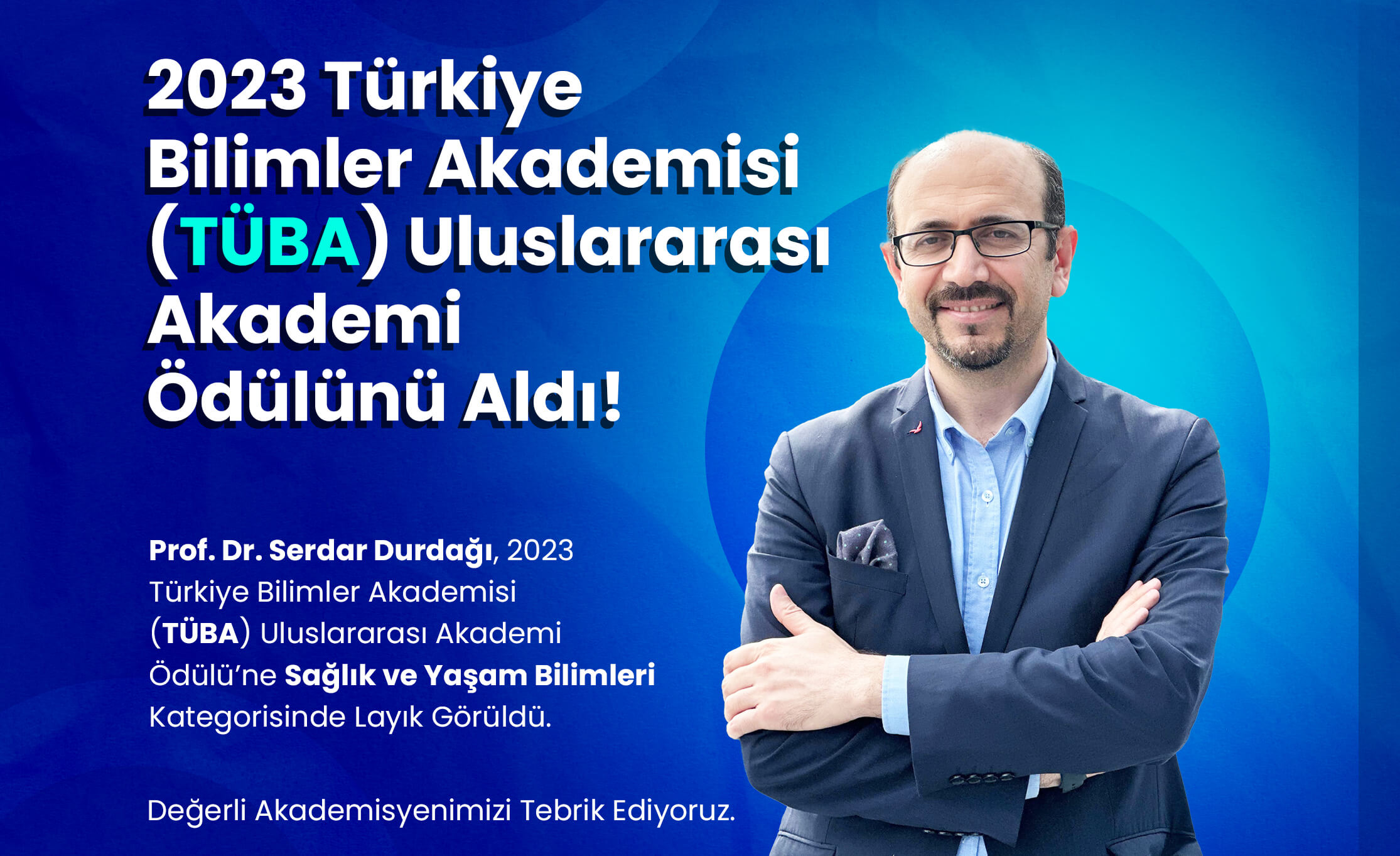
The TÜBA International Academy Awards, conducted under the auspices of the Presidency of the Republic of Türkiye, have found their recipients. Prof. Dr. Caner Süsal, Prof. Dr. Serdar Durdağı and Prof. Dr. Derviş Karaboğa will receive their awards from President Recep Tayyip Erdoğan at the TÜBA-TÜBİTAK Science Awards Ceremony to be held at the Presidential Complex.
The 2023 "TÜBA International Academy Awards," established within TÜBA's mission to encourage and recognize scientists and open to all scientists worldwide, were granted to a total of three scientists in two categories: Health and Life Sciences, and Science and Engineering.
President Şeker stated that the high number of applications for the 2023 "TÜBA International Academy Awards" was gratifying for science, and reiterated that since 2015, candidates for the award program have been nominated by TÜBA members, university rectorates in Türkiye, academies of sciences affiliated with TÜBA, inter-academy organizations and other invited scientific institutions. He congratulated the scientists who, as every year, were announced following a long and rigorous evaluation process and will be presented with the Academy Award Medal for their original, pioneering and groundbreaking research. TÜBA President Prof. Dr. Muzaffer Şeker also recalled that since the establishment of the award program, one of the awards has been given on a rotating basis among the three categories to scientists who are citizens of the Republic of Türkiye or whose work is related to Türkiye, and emphasized that in 2023 this award went to Prof. Dr. Caner Süsal and Prof. Dr. Serdar Durdağı in the Health and Life Sciences category.
Following the opinions of national and international referees and the evaluations of the field committees, the TÜBA Academy Council granted the TÜBA International Academy Awards as follows:
In the Health and Life Sciences category, the 2023 TÜBA Academy Award was granted to Koç University Faculty of Medicine faculty memberProf. Dr. Caner Süsalfor his contributions to organ transplantation through his work on the transplantation of highly sensitized patients, the role of non-HLA immunity and the CD30 molecule in the alloimmune response, the induction of tolerance to kidney allografts, the identification of markers reflecting the balance between the effector and regulatory components of the alloimmune response, and the preparation of international guidelines. In the same category, the 2023 TÜBA Academy Award was also granted to the Dean of the Faculty of Pharmacy at Bahçeşehir University, Prof. Dr. Serdar Durdağı, for his contributions to academia and the pharmaceutical industry through the development of new codes for creating ligand-based models with machine learning approaches, the virtual screening of ultra-large molecular databases with these models, the design of new drug molecules, and the hERG1 3D potassium ion channel models known in the literature by his name (Durdagi/Noskov hERG1 K Models).
In the Science and Engineering category, the 2023 TÜBA Academy Award was granted to Erciyes University Faculty of Engineering, Department of Computer Engineering faculty member and Director of the Artificial Intelligence CenterProf. Dr. Derviş Karaboğafor his significant contributions to science and technological development by developing an optimization algorithm used in artificial intelligence applications in the engineering sciences, known in particular as the "Artificial Bee Colony algorithm," and for his original contributions in energy efficiency and health by applying his work in artificial intelligence to these fields.
The TÜBA International Academy Awards consist of an Academy Medal and approximately 30,000 US dollars and are given to scientists distinguished by their "original, pioneering and groundbreaking" work in their fields.
Prof. Dr. Caner Süsalwas born in Konya in 1961. He graduated from Heidelberg University in Germany in 1986, became a professor at the same university in 2005 and received the title of academic director in 2012. Prof. Süsal, who worked at the same university until 2021, has received numerous scientific awards and was selected as a New Key Opinion Leader by The Transplantation Society in 2009. He served as president of the German Society for Immunogenetics between 2010 and 2012 and for many years held positions on the boards of national and international transplantation societies, including Eurotransplant. In 2021, he became head of TIREX, the Transplant Immunology Research Center of Excellence at Koç University supported by the Council of Europe. Prof. Dr. Caner Süsal continues to teach at both Koç University and Heidelberg University.
Prof. Dr. Serdar Durdağıwas born in 1978. He graduated from the Department of Chemistry at Hacettepe University in 2001. He completed his PhD at Freie Universität Berlin as a Marie Curie fellow under the European Union's 6th Framework Program, and his dissertation was awarded the highest distinction, "summa cum laude." He became a professor in 2018. Prof. Durdağı has numerous articles published in international peer-reviewed journals, conference papers and books, and has taken part in many national and international projects. His research focuses on computational and medicinal chemistry applications of biological systems. To this end, in addition to molecular modeling applications, Dr. Durdağı writes and develops programming codes for various biological problems, and his hERG1 3D potassium ion channel models, known in the literature by his name (Durdagi/Noskov hERG1 K Models), are widely used in academia and the pharmaceutical industry. Prof. Dr. Serdar Durdağı currently serves as Dean of the Faculty of Pharmacy at Bahçeşehir University.
Prof. Dr. Derviş Karaboğareceived his bachelor's degree in Electrical and Electronics Engineering from Erciyes University in 1983 and began his academic career as a research assistant in the same year. He earned his PhD in Systems Engineering from the University of Wales College of Cardiff in 1994. He has conducted research in fields such as computer science, algorithms, artificial intelligence and the Artificial Bee Colony (ABC) algorithm. Prof. Karaboğa, who has publications in peer-reviewed journals, symposium papers, articles and two patents, currently serves as Director of the Artificial Intelligence Center at Erciyes University.











