





 TR
University-Industry Collaboration Is a Necessity in a Changing World
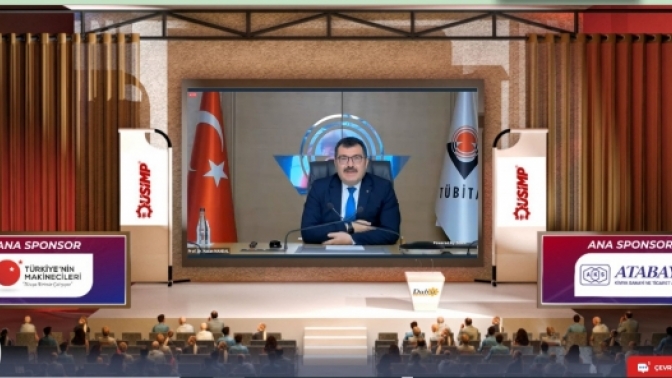
TÜBİTAK President Prof. Dr. Hasan Mandal delivered the opening speech at the National Patent Fair and University-Industry Collaboration National Congress organized by the University-Industry Collaboration Centers Platform (ÜSİMP).
In his opening speech at the Congress, Prof. Dr. Mandal emphasized the great importance of sharing technologies developed through virtual environments with entrepreneurs and gave a presentation titled "University-Industry Collaboration in a Changing World: Developing Together and Achieving Together."
"University-industry collaboration is of great importance in finding structural solutions to problems"
Emphasizing that university-industry collaboration has become a necessity in a changing world, Prof. Dr. Mandal stated that the problems of today and the future can be solved through this collaboration. Referring to the Global Risks Report 2021 published by the World Economic Forum, Mandal said: "As this report also shows, pandemics, climate change and environmental problems will remain on our agenda over the next 10 years. While tackling these problems, we are also encountering new problem areas. For example, although we partially overcame the difficulties of the pandemic period through digitalization, we became more exposed to cybersecurity threats. University-industry collaboration is of great importance in finding structural solutions to such problems."
"We can reach constructive solutions to problems with the contribution of the social sciences and humanities"
TÜBİTAK President Mandal pointed out that, for Türkiye to tackle such problems better in the period ahead, a two-way interaction must be established between institutions that produce and use knowledge. Emphasizing that it is therefore essential for different disciplines to collaborate, Prof. Dr. Mandal said: "Work is being carried out in fields such as Health Sciences and Engineering to find solutions to many problems. However, we can reach constructive solutions in these fields with the contribution of the social sciences and humanities as well. While combating climate change, it is also necessary to raise public awareness and assess its social impacts. For this reason, all studies should also include a Social Sciences perspective."
Mandal stated that, within the scope of Co-Development Models, they support collaboration through High Technology Platforms aimed at creating impact in the fields of Domestic Medicines/Domestic Vaccines, Solar Energy Technologies, Nanotechnology, Advanced Materials Technologies, RF Technologies, 3D Printers, Regenerative/Personalized Medicine and Medical Device Technologies.
Also referring to the TÜBİTAK University-Industry Collaboration Program (1505), Prof. Dr. Mandal emphasized that the program aims to turn university-industry collaboration into tangible outputs by transforming accumulated knowledge into products and processes. Stating that through the Industrial PhD Program they aim to train the qualified human resources needed by our industry, Mandal added that the program encourages employment not only during but also after doctoral studies.
"We act with a more innovative, human-centered approach based on sustainability"
Underlining that all work to be carried out within this collaboration should have a systematic perspective and a perspective of working and developing together, Prof. Dr. Mandal said: "When we speak of an interdisciplinary approach, we should consider not only closely related disciplines but also very different fields together. We need to think more broadly. As TÜBİTAK, we act with this perspective and carry out our activities accordingly. We act with a more innovative, human-centered approach based on sustainability."
"We are continuing the 'Green Growth Technology Roadmap' work with our Ministry of Industry and Technology"
Stating that combating climate change and environmental problems will become even more important for all institutions in the period ahead, Mandal said: "As TÜBİTAK, we have placed these issues at the top of our agenda for many years. We will continue to strengthen our work in this direction so that our country can reach its 2053 net-zero emissions target. About one-third of our 1001 projects supported in 2021 are related to the European Green Deal. Climate change and environment-focused projects also have a large share in the other support we provide." Mandal also announced that they are continuing their "Green Growth Technology Roadmap" work with the Ministry of Industry and Technology to contribute to Türkiye's sustainable development policies and strategies.
Emphasizing that the agreements enabling Türkiye's official participation in the Horizon Europe Program run by the European Union (EU) were signed last month, Prof. Dr. Mandal announced that the 96 billion euro budget allocated to the Horizon Europe program will support many projects on climate change and environmental problems.











